What full-stack marketing services does Asfand offer?
Inputs in, results out!
Asfand Yar Junejo is a full-stack marketer for international brands. He offers 58 services in eight pillars: SEO, AI visibility, content, social media, email marketing, paid media, web design and development, and measurement. Each service is written below as a formula, so you can see what goes in and what you get back. Every pillar has a short animated explainer and a sample, and the whole journey from first brief to monthly run is laid out as a scroll story.
Each publish gets a kit: a LinkedIn carousel, an animated reel, Pinterest pins, a Web Story and captions with tracked links. The same facts feed a newsletter or a flow, and a small, capped paid test.
You get: scheduled, quality-checked posts in your brand, with facts taken only from the article.
Directional The order is a typical path. The first diagnosis decides the real order, and any step can be bought alone
2. How do SEO services find and fix what blocks search?
They diagnose why a site is not found or trusted, then fix crawl, index, entity and market problems in order of impact: audits, semantic and international SEO, release gates for generated pages, ecommerce listings, migrations and link risk.
Explainer, 19 seconds, no sound: a baseline first, then crawl, index, entities and a ranked 90-day plan.Read the video as text
Fix what blocks search first. A baseline first, then the audit: Search Console and GA4 verified, crawl access, rendering and speed, canonicals and index bloat, schema graph and topical gaps, then a ranked plan with review dates. SEO is one pillar with six services: SEO audit, semantic SEO, international SEO, programmatic QA, ecommerce listings and migration QA. No bought links. No guaranteed rankings. Start with a diagnosis.
Formula
Returns
=SEO_AUDIT(site, competitors)
A 17-phase technical and semantic audit covering crawl, rendering, indexing and speed, benchmarked against competitors you name
=SEMANTIC_SEO(topic, entities)
A topical map and an entity-based content architecture
=SEARCH_INTENT(queries)
Intent analysis that sets what the editorial sprint writes next
=ENTITY_HOME(brand)
A canonical “who is” page, a schema graph and matching public profiles
=INTERNATIONAL_SEO(markets)
Market priorities, hreflang and canonical clusters, and localized intent review for each language or region
=PROGRAMMATIC_QA(dataset)
Six release gates for generated pages: purpose, data, technical delivery, semantic review, localization and a controlled pilot. See the programmatic SEO framework
=LISTING_AUDIT(product)
A product listing audit that checks displayed facts against verified sources, classifies each gap and keeps retail results apart from AI answer observations. See the Alexa for Shopping audit
=MIGRATION_QA(old, new)
Redirect maps, raw and rendered parity checks, tracking continuity and a rollback plan for a move or relaunch
=LINK_RISK(domain)
A review of links, mentions and entity consistency off the site, with evidence for any disavow decision. No bought links
=LOCAL_SEO(locations)
Business profile, citations, location pages and review handling for each place you serve, with the data kept consistent
=ECOMMERCE_SEO(store)
Category, product and filter architecture, product schema that matches the page, and crawl control for faceted URLs
A 90-day ship plan with confidence labels and review dates
Show all 17 phases
Baseline and measurement
1. Telemetry and baseline verification. Audits the Search Console and GA4 setup, domain and protocol property splits, referral exclusions and conversion events, so every later change is measured against a baseline that can be trusted.
2. Competitor and SERP benchmarking. Maps the site against named competitors across query clusters and records where AI Overviews, local packs, product grids or forums have taken clicks from classic organic results.
Discovery, crawl and rendering
3. Crawl access and AI bot governance. Reviews robots.txt, firewall and CDN bot rules, XML sitemaps and llms.txt, to confirm that search crawlers and AI retrieval bots can fetch priority URLs. A first check you can run yourself: the robots.txt checker for AI crawlers.
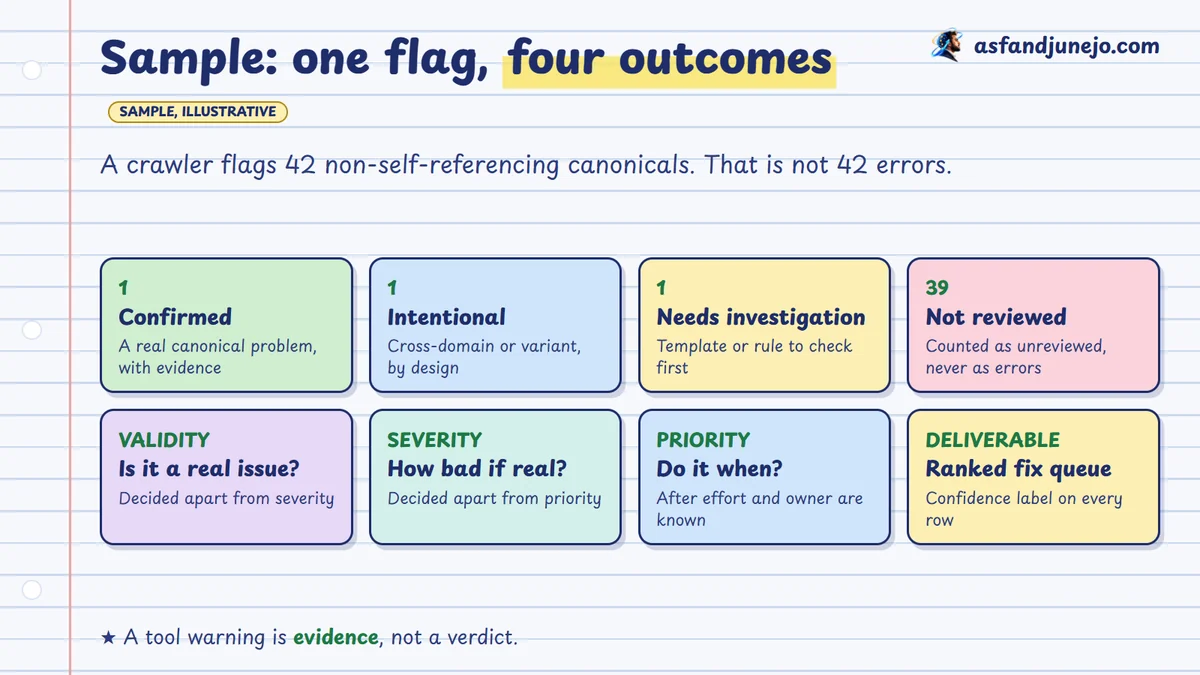
4. Indexation hygiene and canonical drift. Analyzes Search Console coverage states (crawled but not indexed, duplicate canonicals, parameter bloat, soft 404s) to stop crawl budget being wasted.
5. Rendering parity and DOM snapshot. Compares the raw server HTML with the rendered DOM that headless crawlers capture, to catch hydration failures, truncated attributes and missing text.
6. Template speed and Core Web Vitals. Evaluates LCP, INP and CLS for each page template (home, category, service, article) rather than relying on one homepage score.
7. URL taxonomy, click depth and internal links. Audits folder structure, orphan pages, pagination and anchor text, so commercial and cornerstone pages sit within three clicks of the root.
Entities and semantic architecture
8. Entity home and disambiguation. Checks that the brand, founders and core products each have one canonical “who is” page, and that external bios repeat the same facts.
9. Connected JSON-LD graph validation. Goes past syntax checks to confirm that Organization, Person, Service, Product and FAQPage nodes connect through persistent @id values and match the visible copy. The schema markup generator and checker covers the structural part.
10. Topical map and entity gaps. Compares the site's subtopic coverage with the pages Google and AI assistants cite most, to find missing concepts.
11. Query cannibalization. Uses Search Console query-to-page data to find URLs competing for the same query and splitting impressions.
Search intent and AI retrieval
12. Search intent and format alignment. Checks whether each target page matches the dominant intent of its query: definition, comparison, diagnosis or purchase.
13. Answer-first structure and chunk extractability. Reviews heading phrasing, opening sentences and comparison tables, to judge how cleanly retrieval systems can lift and cite a passage.
14. Content decay and consolidation. Finds outdated articles, zero-impression URLs and overlapping posts that should be merged, redirected or refreshed.
Trust, conversion and the decision plan
15. Off-page corroboration. Audits third-party mentions, directories, review platforms and backlinks for entity consistency and link risk.
16. Commercial path and conversion friction. Traces the journey from organic entry pages to a lead or checkout and flags buried calls to action, broken forms and missing proof.
17. Decision matrix and 90-day plan. Consolidates every finding into one prioritized sheet, each tagged with a confidence label, expected impact, effort and a review date.
3. How do you get found and cited in AI answers?
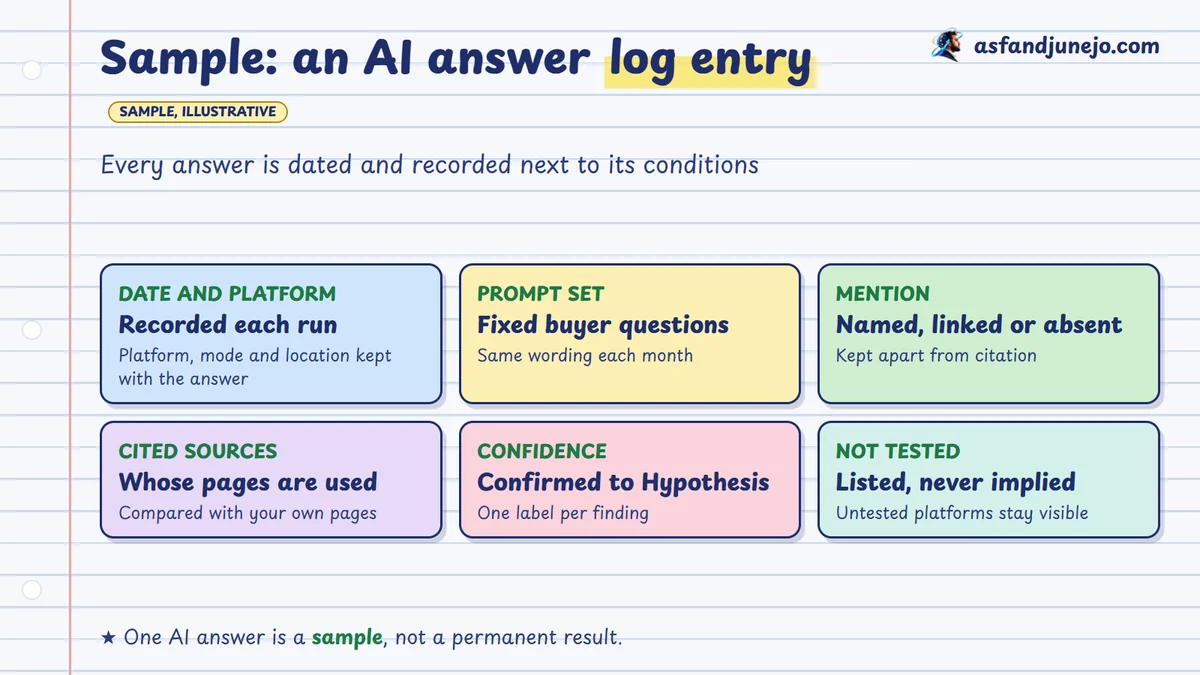
By making facts clear, consistent and reachable, then measuring what AI platforms actually say, with each answer dated and each claim labeled. No service promises a mention or a citation.
Explainer, 19 seconds, no sound: an illustrative AI answer, the sources it uses, and five ways to work on it.Read the video as text
Be the answer AI can verify. What do AI answers say about your category? An illustrative answer cites sources that state their facts clearly and agree with each other. Every answer is dated, with platform and location recorded. Five ways to work on it: an AI visibility audit in Lite or Standard size, monthly answer tracking, crawler access review, an entity home, and claim checks before AI-assisted content ships. Anything not tested is listed as not tested. No guaranteed mentions or citations.
Formula
Returns
=AI_VISIBILITY(brand)
AEO and GEO work that makes a brand extractable, citable and consistent in AI answers
=AI_AUDIT(brand, questions)
A fixed-scope audit in two sizes: buyer questions run across AI platforms, cited sources compared with your pages, and a ranked action list. See Lite and Standard
=AI_TRACKER(prompts)
A fixed prompt set run on a schedule, with every answer dated and mentions, links and citations kept apart
=AI_ACCESS(site)
A review of robots.txt, firewall and CDN bot rules, sitemaps and llms.txt, so the right crawlers can fetch the right pages
=CLAIM_CHECK(content)
Verification of AI-assisted content and recommendations: claims, sources, currency and who approved them
4. How do content services turn evidence into pages people trust?
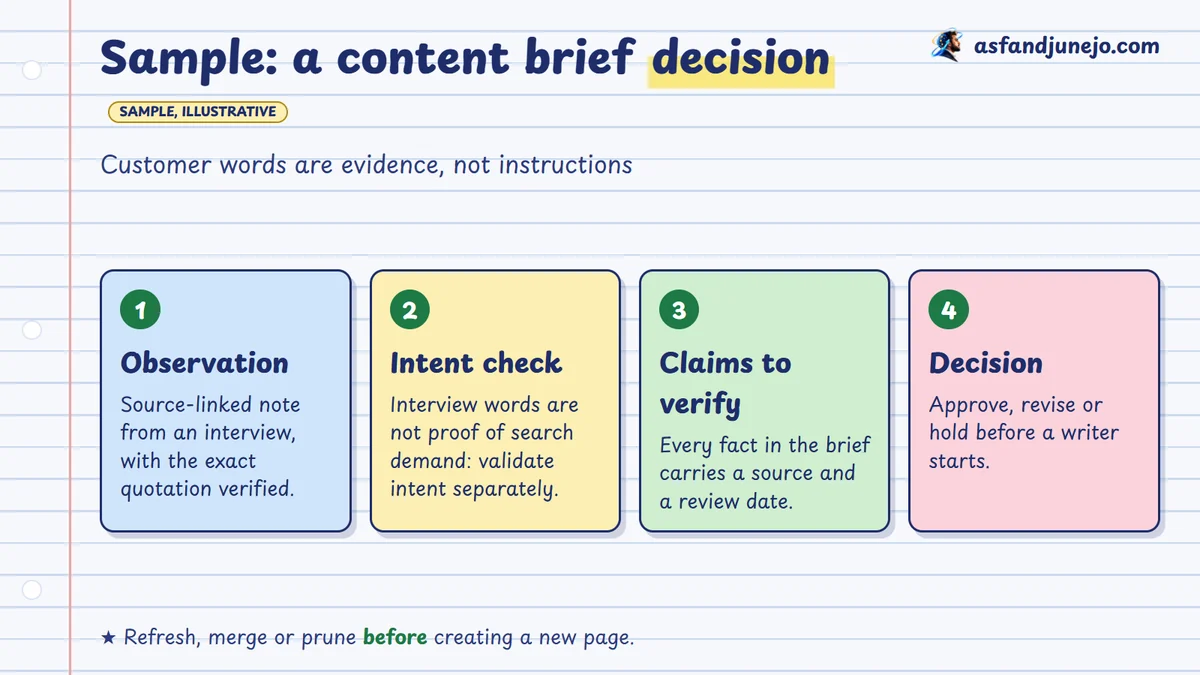
They start from real buyer words and verified facts, not from keywords alone: interviews become briefs, briefs become answer-first pages, and kits, workbooks and a newsletter give each topic a second life.
Explainer, 19 seconds, no sound: the answer goes on top, and each page follows the path from interview to verified draft.Read the video as text
Content that answers first. Put the answer on top: the first sentence answers the question, each heading is one question, and evidence and a date sit beside each claim. The path from interview to published page runs through real buyer words, source-linked evidence, a brief with validated intent, an answer-first draft and claim verification. Also: gated kits, workbooks and a monthly brief. Publish fewer, better pages. Refresh, merge or prune before creating.
Formula
Returns
=CONTENT_SYSTEM(topics, evidence)
A repeatable path from customer interviews to approved briefs and verified drafts. See interviews to content brief
=ANSWER_REWRITE(pages)
Answer-first rewrites, refreshes, merges and prunes, with a before and after for each page. See answer-first content
=LEAD_MAGNET(topic)
Workbooks, PDFs and Word templates in your brand, with an email gate and a download that works
=NEWSLETTER(audience)
A newsletter setup and a monthly brief, with claims labeled by how well they are supported
=RESEARCH_POST(topic)
Evidence-labeled articles and a claim-checked weekly brief that senior readers can trust
Sample, illustrative: customer words are evidence, not instructions. Read the blog for the finished method posts.
5. How does social media extend one article across every channel?
Each publish gets a kit made in your brand: a carousel, an animated reel, Pinterest pins, a Web Story and captions with tracked links. The kit points back to the page that answers the question, so social supports search instead of competing with it.
Explainer, 19 seconds, no sound: one article becomes a carousel, a reel, pins, a Web Story and posts.Read the video as text
One article, every channel. A social kit for each publish: a LinkedIn carousel PDF, an animated reel, a tall Pinterest pin, an Instagram carousel and caption, an AMP Web Story, and a post and thread for X and Threads. The work includes facts only from the article, captions per platform with tracked links, scheduling and quality checks, and social-to-search reporting that counts clicks, not vanity. Distribute what you already know. Social supports search and trust.
Formula
Returns
=SOCIAL_KIT(article)
A 10-slide carousel, captions for each platform and tracked links, with every fact taken from the article
=REEL(topic)
A short animated explainer video with original music, sized for vertical feeds or for a wide page
=PINTEREST(content)
Tall pins, a framework pin and an AMP Web Story, with boards, keywords and a posting schedule
=SOCIAL_SCHEDULE(calendar)
Posts scheduled across LinkedIn, X, Facebook, Instagram, Threads and Pinterest, then checked in each platform's own queue
=SOCIAL_TO_SEARCH(reports)
A report on which posts led to branded search, visits and enquiries, with the limits of attribution stated
=SOCIAL_STRATEGY(audience)
Channel choice, content pillars and a posting rhythm for one brand, written down with the evidence behind each choice
=SOCIAL_PROFILES(brand)
Profile and page setup for LinkedIn, Facebook, Instagram, Pinterest and X so names, bios and links agree with your entity home
Real outputs from this site's own articles: carousel slides, a Pinterest pin and a reel frame.
6. How does email marketing build a list that answers back?
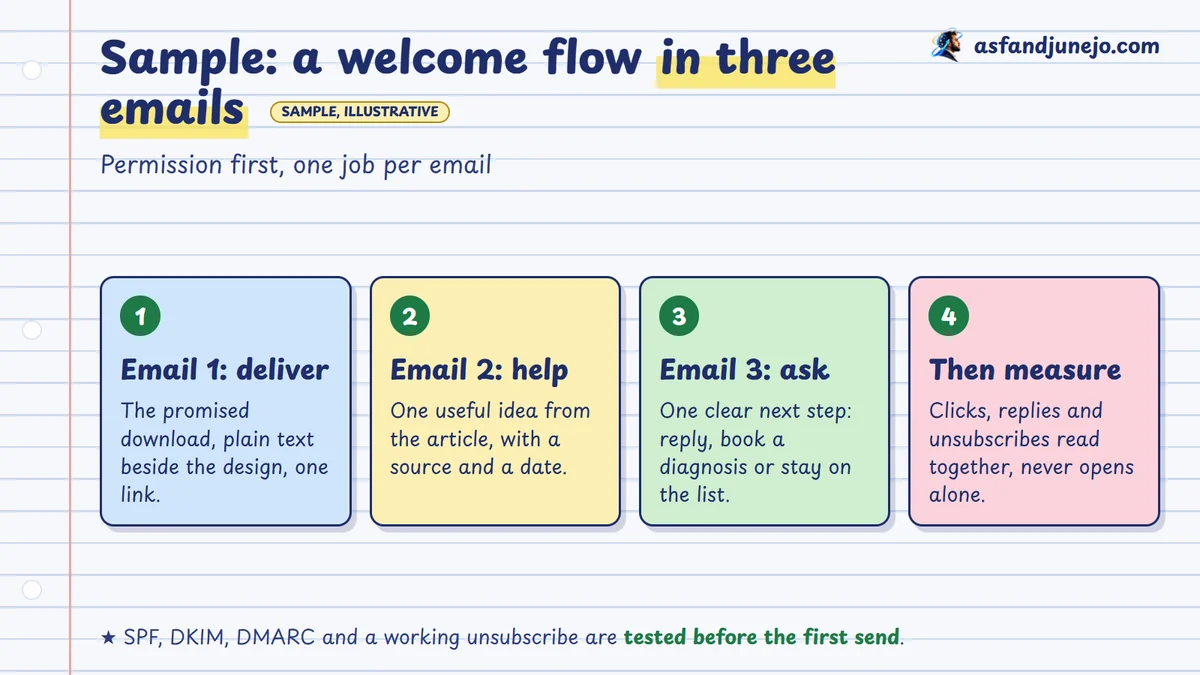
With permission first: a clear promise at sign-up, a short welcome flow, a monthly newsletter that is claim-checked, and sender authentication tested before the first send. Replies, clicks and leads are read together, never opens alone.
Explainer, 19 seconds, no sound: six building blocks of one email program and the deliverability checks behind them.Read the video as text
Email that earns the next open. One program with six building blocks: a welcome flow of the first three emails, a monthly claim-checked newsletter, lead nurture from kit to conversation, win-back for quiet subscribers, automation with triggers and segments, and a report on clicks, replies and leads. Deliverability is part of the work: SPF, DKIM and DMARC, list hygiene with consent recorded, plain-text and mobile checks before each send, and an unsubscribe that is tested. Permission-based only. No bought lists. No guaranteed open rates.
Formula
Returns
=EMAIL_STRATEGY(audience)
Segments, a sending rhythm, a content plan and the goal of each email, written down before anything is built
=EMAIL_FLOWS(triggers)
Welcome, nurture, onboarding and win-back flows, with the trigger, the delay and the stop condition for each
=EMAIL_CAMPAIGNS(offer)
Newsletters and one-off sends: copy, layout, plain-text version, test sends and a scheduled, checked release
=DELIVERABILITY(domain)
SPF, DKIM and DMARC set up and tested, list hygiene, bounce and complaint review, and a plan for a sender with a poor reputation
=LIST_BUILDING(forms)
Sign-up forms, gated downloads and consent wording that record where and when each subscriber agreed. See the newsletter as a working example
=EMAIL_REPORT(program)
Clicks, replies, unsubscribes and leads by flow and send, with the limits of open-rate data stated
Sample, illustrative: one job per email, and sender checks before the first send.
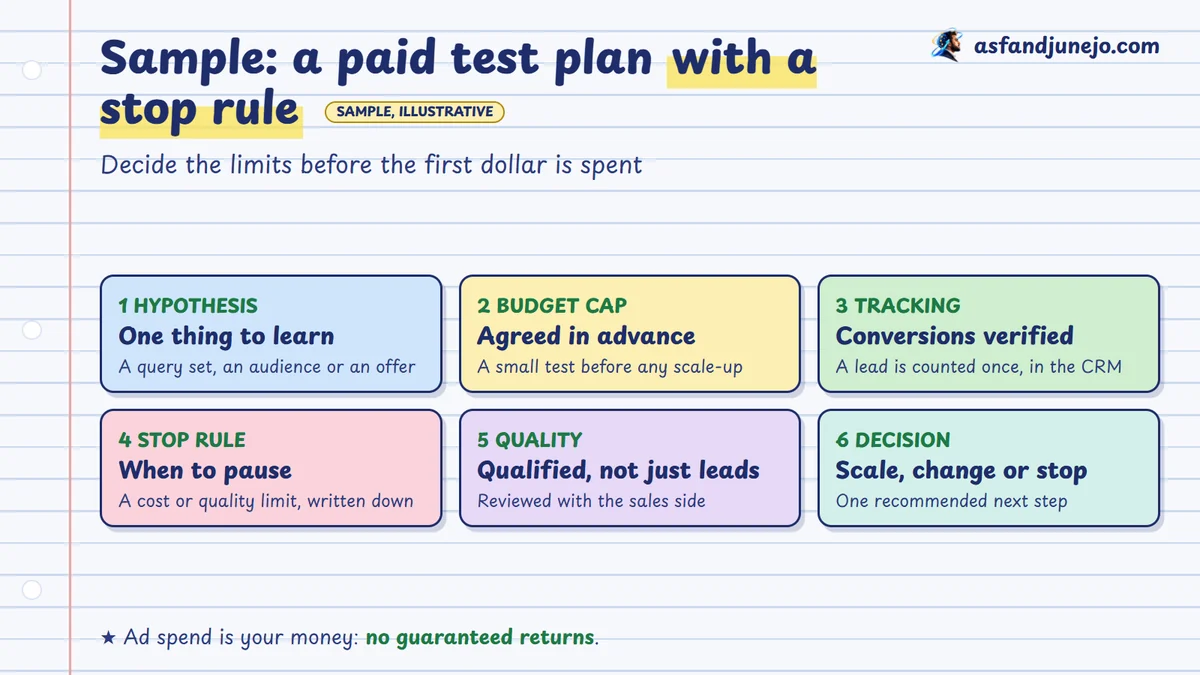
As small, capped tests with a stop rule agreed before launch. Paid search and paid social run beside organic work, conversions are verified first, and the report ends in one decision: scale, change or stop.
Explainer, 19 seconds, no sound: spend, leads and quality side by side, and where the paid work happens.Read the video as text
Paid media with a stop rule. Spend, leads and quality are shown side by side, with wasted spend flagged weekly and a pause rule agreed before launch. Where paid work happens: Google and Bing Ads for search and shopping, Meta and LinkedIn Ads for audience and creative tests, retargeting with a frequency cap, landing page tests that change one thing at a time, verified conversion tracking, and budget reports that lead to a decision. Test small, then scale. Ad spend is your money: no guaranteed returns.
Formula
Returns
=PPC_SEARCH(google, bing)
Search campaigns built from verified intent, with negative keywords, ad copy tests and a budget cap
=PAID_SOCIAL(meta, linkedin)
Audience and creative tests on Meta and LinkedIn, with frequency limits and a quality check on the leads
=SHOPPING_ADS(feed)
Product feed fixes and shopping campaigns, with the listing facts checked against the page
=RETARGETING(audiences)
Retargeting with consent respected, a frequency cap and an exclusion list for people who already enquired
=AD_CREATIVE(tests)
Ad copy, images and short videos made in your brand, tested one change at a time
=PAID_REPORT(spend)
Spend, leads and lead quality by campaign, with attribution limits stated and one recommended decision
Sample, illustrative: limits are decided before the first dollar is spent.
8. How do web design and development services turn visits into leads?
By designing, building and testing the site that has to do the work: a clear offer, a fast WordPress or store build, integrations that reach your CRM, and checks on the deployed URL. Care plans keep it secure after launch.
Explainer, 19 seconds, no sound: test the deployed page, then design to development in one stack.Read the video as text
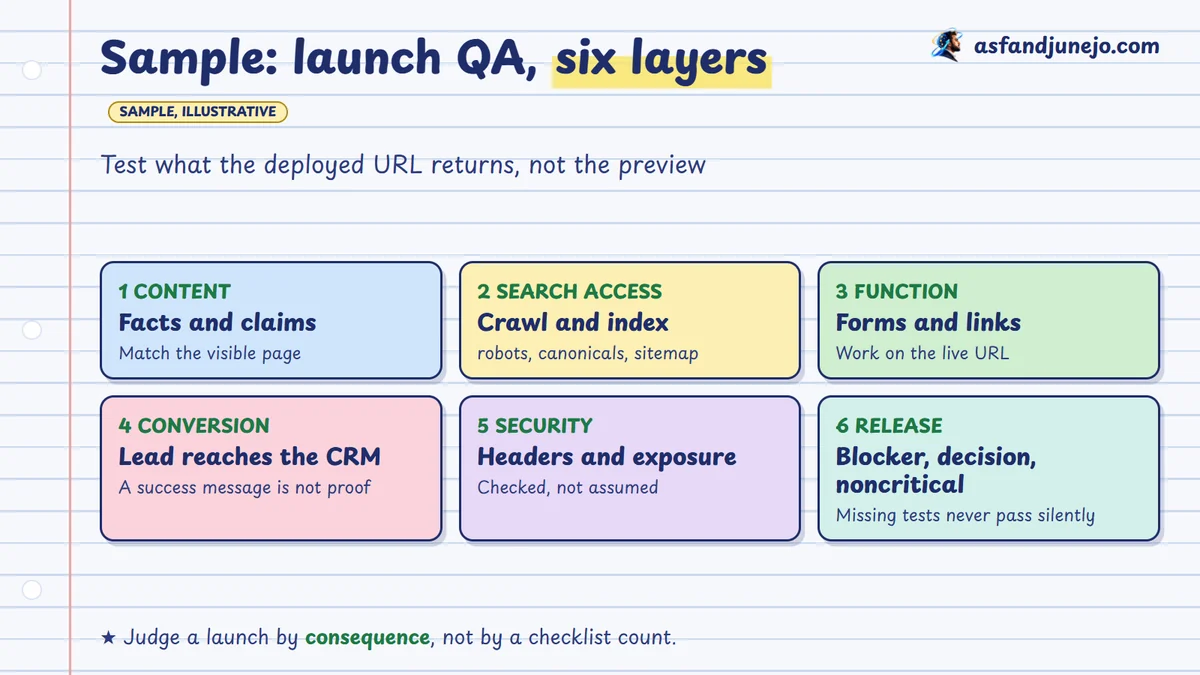
Websites that convert and ship. Test the deployed page, not the preview: a clear offer above the fold, proof and answers, and a form that reaches the CRM. Search access, function, conversion and security are checked. Design to development in one stack: design and UX with wireframes to templates, WordPress and WooCommerce, Shopify and custom builds, speed and security per template, integrations with CRM, email and payments, and care plans with updates, backups and fixes. Ship it, then measure it. Launch QA runs on the deployed URL.
Formula
Returns
=WEB_DESIGN(brief)
Wireframes, page templates and a design system in your brand, with content and calls to action planned before any build
=WORDPRESS(site)
Theme and plugin work, speed per template, schema and tracking set up so they match the visible page
=STORE_BUILD(catalog)
WooCommerce or Shopify store setup: product templates, checkout, tax and shipping rules, and product schema that matches the page
=CUSTOM_BUILD(spec)
Small custom features and web apps written to a written spec: forms, calculators, dashboards and members areas, tested before release
=INTEGRATIONS(systems)
CRM, email platform, payment and booking connections, with a test that a lead or order arrives once and is not lost
=SPEED_SECURITY(site)
Core Web Vitals per template, caching, image and script weight, security headers, login hardening and a recovery plan
=LANDING_PAGE(offer)
A landing page with one offer, proof and one next step, plus tests that change one thing at a time
=CRO(pages, tests)
Conversion research on forms, calls to action and page flow, then tests judged by qualified leads rather than clicks
=FREE_TOOL(problem)
A calculator, checker or validator that runs in the browser and earns trust. See the free SEO tools
=ACCESSIBILITY(site)
Automated scans and manual checks, with fixes ranked by who is blocked
=LAUNCH_QA(url)
Six layers tested on the deployed URL: content, search access, function, conversion, security and release. See the launch checklist
=WEB_CARE(site)
A monthly care plan: updates, backups, uptime and form tests, a security review and a short written log of what changed
Sample, illustrative: a launch is judged by consequence, not by how many boxes are ticked.
9. How do measurement services decide what happens next?
They keep signals apart and turn them into one decision per week. Dashboards, attribution, alerts and tracking setup replace manual exports, and every figure shows what it can and cannot prove.
Explainer, 19 seconds, no sound: separate signals, alerts, and six layers that never become one score.Read the video as text
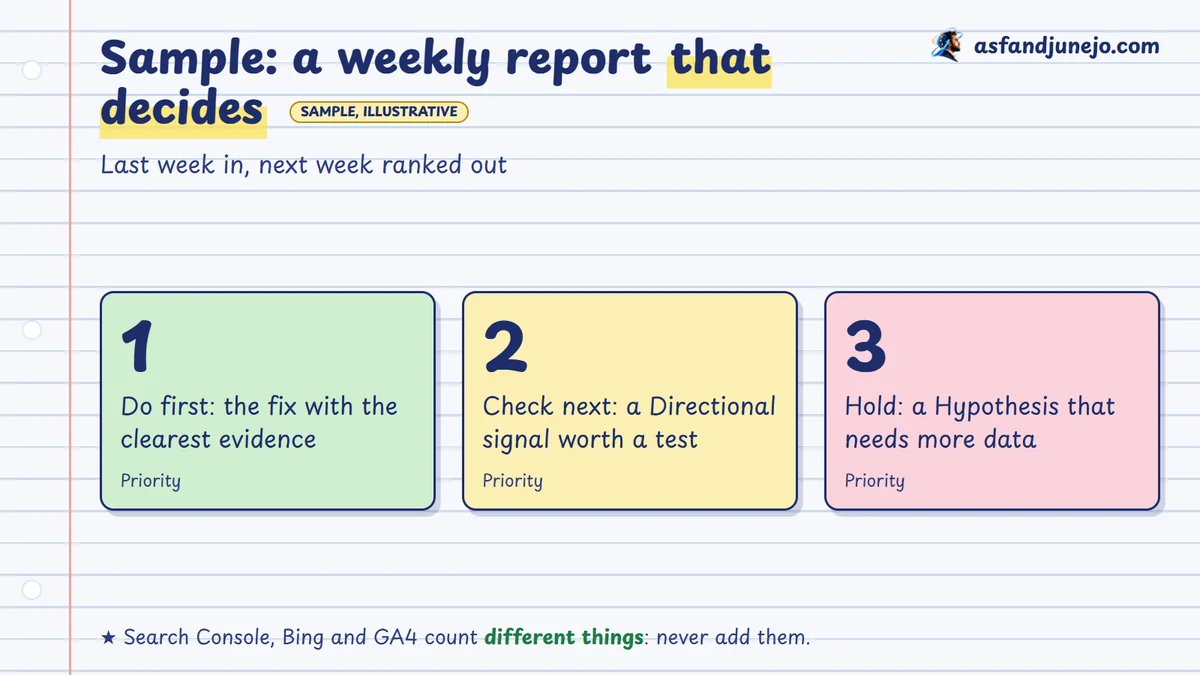
Reports that decide the week. Separate signals, one decision: Search Console clicks, Bing citations and GA4 sessions sit side by side and are never added together. Alerts flag an indexing drop within hours, and a zero is not always a measured zero. Six layers, never one score: readiness, visibility, citation, referral, qualification and revenue each keep their own evidence and limit. Measure it, then decide. Attribution is not incrementality.
Formula
Returns
=ATTRIBUTION(keyword, content)
Which pieces of content actually bring commercial traffic
=DASHBOARD(GA4, GSC)
API-fed dashboards that replace manual exports
=AUTOMATE(diagnostics)
Agents and alerts that flag indexing drops within hours
=TRACKING_SETUP(events)
GA4 events, consent and CRM hand-off set up and tested, so a lead is counted once and a blank is never read as a zero
=CRM_SETUP(pipeline)
Pipeline stages, lead sources and hand-off rules in your CRM, so marketing and sales read the same numbers
=WEEKLY_REPORT(data)
Last week's performance turned into next week's priorities
Sample, illustrative: a weekly report ends in ranked decisions, not a wall of charts. See the missing data playbook.
10. How can you engage him?
In four formats, from a single diagnosis to a monthly run, and any service can be bought alone.
Format
Best when
Typical services
Diagnose
You need to know what is wrong before spending on fixes. For AI answers, see the two fixed-scope AI visibility audit options
A baseline, a confidence label on every claim and a clear next decision.
The numbers as they were before any change
Each finding labeled Confirmed, Strongly supported, Directional or Hypothesis
Competing explanations kept visible, not smoothed over
One recommended decision, with the alternatives considered
A date to review whether it worked
13. What is never offered?
Anything that trades long-term trust for a short-term number.
Guaranteed rankings or guaranteed AI citations
Bought links or private blog networks
Mass-produced pages written to a keyword count
Structured data describing things the page doesn't show
Fake reviews, invented statistics or untraceable claims
Reports built around vanity metrics
Directional Long-form video production, PR placement and influencer buying are not offered directly
14. How does a first project start?
With a short written description of the problem, followed by a diagnosis that records the baseline before anything is changed.
Send the problem: the site, what changed and when (how to brief it)
Diagnose: find the likely cause and rank the fixes
Record the baseline: the numbers before any change
Decide: one recommended next step, with alternatives
15. Where does the work happen?
Remotely. Asfand is based in Hyderabad, Pakistan, and delivers these services to international brands and teams.
Deliverables are documents, dashboards, videos, kits and shipped changes, so nothing depends on being in the same place. His sourced background is on the profile page and in the credentials register.
16. What do people ask before they hire a full-stack marketer?
What does full-stack mean here?
One person who covers eight pillars: SEO, AI visibility, content, social media, email marketing, paid media, web design and development, and measurement. The pillars share one baseline and one set of confidence labels, so decisions in one do not contradict another.
Which services can I see the output of before I buy?
Most of them. This site is the working sample: the method articles, the free tools, the carousels, reels and pins, the gated workbooks and the newsletter are all made by Asfand. A full AI visibility audit example shows a diagnosis end to end.
Do you guarantee rankings, AI citations or leads?
No. Nobody outside a search engine or AI platform can guarantee them. Each deliverable states what was tested, what was not, and how confident the finding is.
Can I buy one service on its own?
Yes. The journey is a typical order, not a requirement. A single audit, a reel, a landing page or a monthly report can each be a first project.
Which markets and languages do you work in?
International brands and teams, remotely. Deliverables are written in English. International SEO work covers multilingual and multi-region sites, with localized claims reviewed by someone qualified for each market.
How are fees set?
By scope. After a short written brief, the fee is confirmed by email with the agreed scope before any work starts. The AI visibility audit is fixed scope in two sizes.
Do these services replace an agency?
For one brand at a time they cover SEO, content, organic social kits, email, capped paid tests, and website design and development. Long-form video production, PR placement and influencer buying are not offered directly.
Do you design and build websites, or only advise?
Both. Design, WordPress and store builds, integrations, speed and security work, and monthly care are services in their own right. Every build ends with launch QA on the deployed URL.
Do you run paid ads?
Yes, as small capped tests on Google, Bing, Meta and LinkedIn with a stop rule agreed before launch. The ad spend is paid to the platform by you, and no return is guaranteed.
How do you handle email marketing and consent?
Permission first. Every subscriber is recorded with where and when they agreed, lists are never bought, and sender authentication and the unsubscribe link are tested before the first send.
How do I start?
Send a short written description of the problem through the contact page: the site, what changed and when, and what decision is waiting.
5. How does social media extend one article across every channel?
Each publish gets a kit made in your brand: a carousel, an animated reel, Pinterest pins, a Web Story and captions with tracked links. The kit points back to the page that answers the question, so social supports search instead of competing with it.
Read the video as text
One article, every channel. A social kit for each publish: a LinkedIn carousel PDF, an animated reel, a tall Pinterest pin, an Instagram carousel and caption, an AMP Web Story, and a post and thread for X and Threads. The work includes facts only from the article, captions per platform with tracked links, scheduling and quality checks, and social-to-search reporting that counts clicks, not vanity. Distribute what you already know. Social supports search and trust.
=SOCIAL_KIT(article)=REEL(topic)=PINTEREST(content)=SOCIAL_SCHEDULE(calendar)=SOCIAL_TO_SEARCH(reports)=SOCIAL_STRATEGY(audience)=SOCIAL_PROFILES(brand)