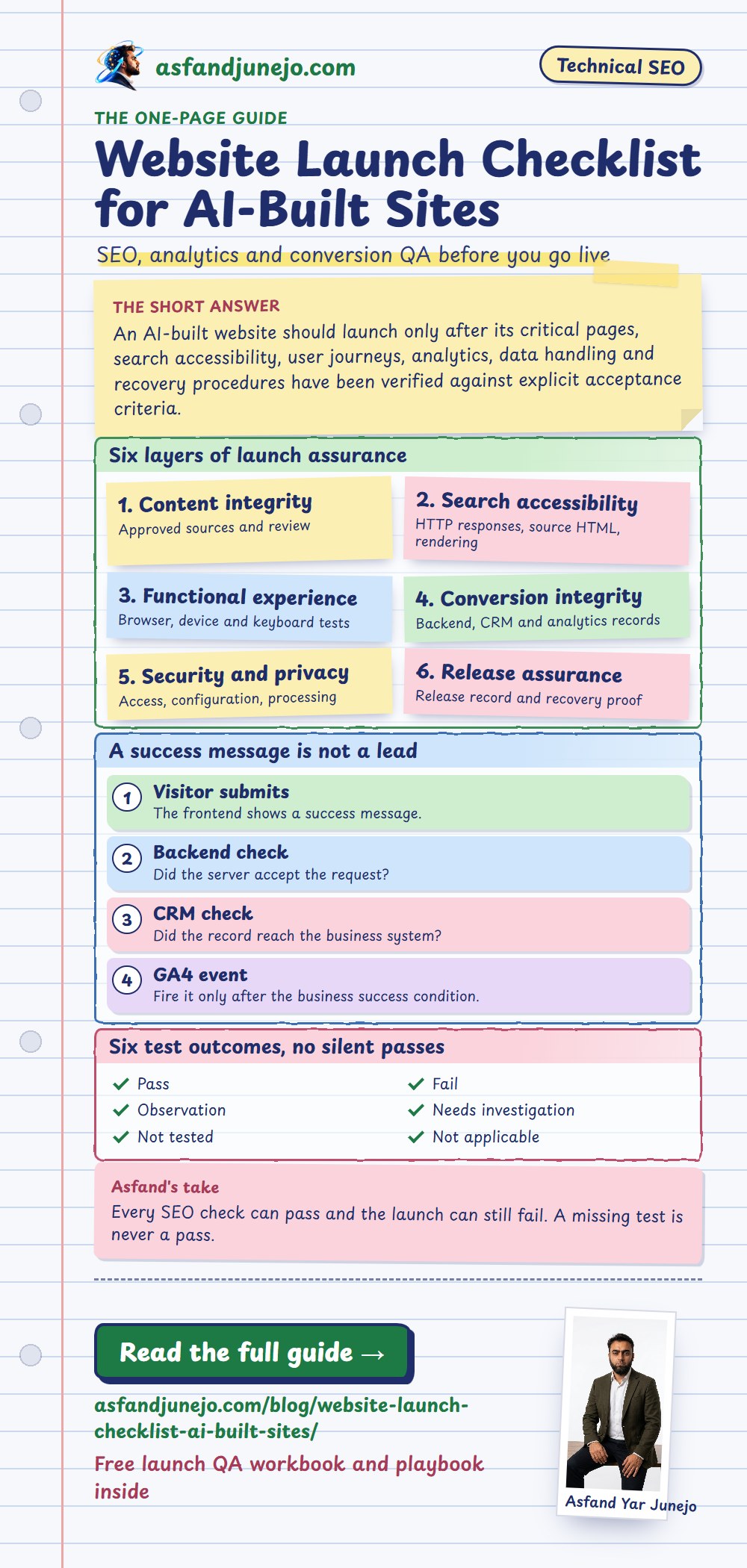
A website built with AI should be launched only after its critical pages, search accessibility, user journeys, analytics configuration, data handling, and recovery procedures have been verified against explicit acceptance criteria. A website that looks complete is not necessarily ready for real users. Its content may be difficult for some crawlers to access, its forms may fail to preserve inquiries, and its analytics may report conversions that never reach the business.
Published · Sources checked · By Asfand Yar Junejo, publisher asfandjunejo.com
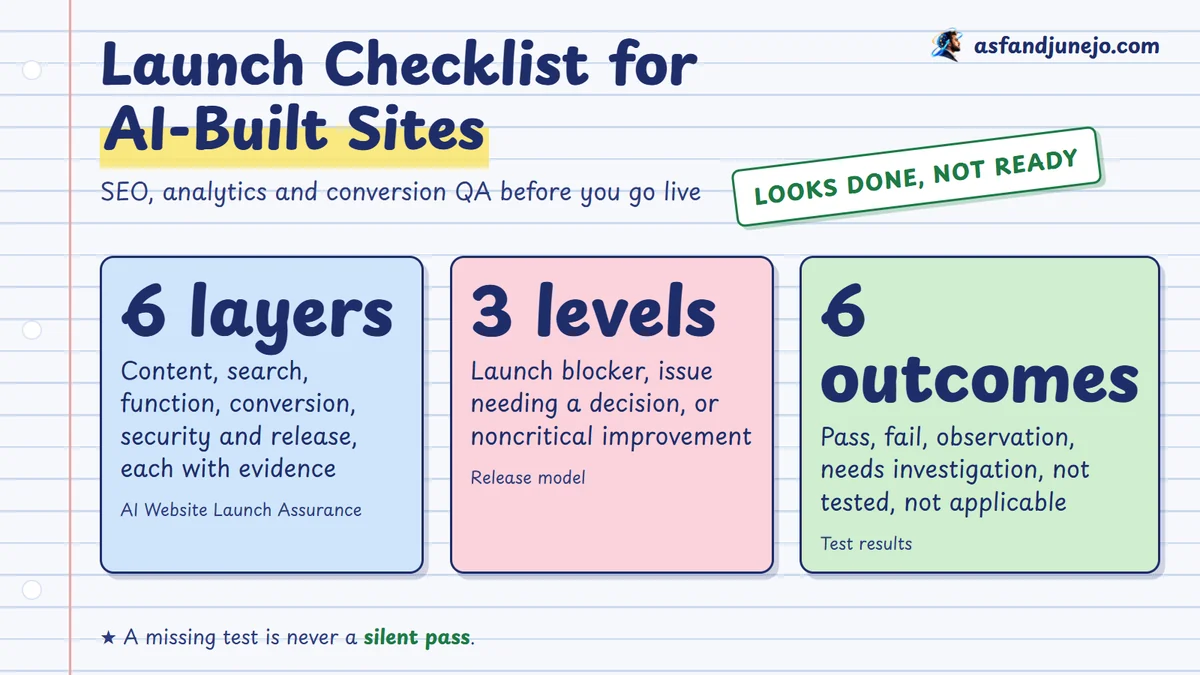
The distinction between visual completion and operational readiness has become increasingly important as AI-assisted development tools make it easier to create and deploy websites with relatively little manual coding.
Platforms and development environments such as Lovable, Bolt, Replit, v0, Cursor, and Emergent can assist with generating layouts, application logic, integrations, and deployment configurations. Yet the speed of implementation does not establish that every requirement has been tested.
A generated website may contain attractive service pages, working navigation, and a professional contact form, yet still have problems with backend processing, search visibility, consent configuration, or recovery procedures.
These failures are not exclusive to AI-assisted development. Conventional websites can suffer from the same problems. The relevant issue is whether the development and publication process includes sufficient independent verification.
Google’s guidance on generative AI content emphasizes accuracy, usefulness, and human review. It does not establish a separate ranking disadvantage merely because AI was used to produce content or assist with development.
This guide introduces the AI Website Launch Assurance framework, a six-layer approach to evaluating content integrity, search accessibility, functional usability, conversion processing, security and privacy, and release readiness.
It combines Google’s official technical documentation with real-world examples and a clearly labeled fictional B2B website used to demonstrate end-to-end launch testing.
The objective is not simply to complete a longer checklist. It is to establish what the website must accomplish, which evidence demonstrates that those requirements have been met, and which unresolved failures should prevent publication.
The assurance workbook and the QA playbook with release approval are free for Search Signals subscribers.
What are the key takeaways?
Launch an AI-built website only after search access, forms, analytics, security and recovery have each been tested against written acceptance criteria, and treat a missing test as a failure to verify, never a pass.
- A successful deployment does not establish that a website is production-ready.
- AI-generated content should be reviewed for accuracy, originality, attribution, and compliance with applicable Google Search policies.
- Search accessibility requires verification of HTTP responses, rendering, internal links, canonicalization, and indexing directives.
- A form confirmation message does not prove that the backend processed a request or that the intended business system received it.
- GA4 events should represent clearly defined actions and should not count failed submissions as successful leads.
- Automated accessibility and security checks are useful but cannot independently verify every important requirement.
- A launch decision should distinguish critical failures, accepted limitations, and noncritical improvements.
- Post-launch monitoring should measure operational changes without assuming that every alert represents a confirmed incident.
What is a website launch checklist for AI-built sites?
A website launch checklist for AI-built sites is a structured process for determining whether an AI-assisted website meets its technical, functional, measurement, security, and business requirements before public release. It defines what must be tested, the expected behavior, the evidence needed to establish success, and the conditions that require correction or further investigation.
The emphasis is on verification rather than task completion.
A website owner may confirm that Google Analytics has been installed, but that does not establish that conversions are measured correctly.
A developer may demonstrate that a contact form displays a confirmation message, but that does not establish that the backend accepted the submission.
An SEO specialist may confirm that an XML sitemap exists, but that does not establish that every listed page is accessible, appropriate for indexing, or currently indexed by Google.
These conditions must be evaluated independently.
Website completion versus launch readiness
Website completion generally describes whether the intended design, content, and functionality have been implemented.
Launch readiness describes whether the implementation has been adequately tested under the conditions that real users, browsers, business systems, and search engines will encounter.
A website can satisfy its visual requirements while failing its primary business objective.
For example, a consulting website may present a professional service page and a visible inquiry form, yet fail to preserve submitted leads.
From a design perspective, the website appears finished. From a commercial perspective, it remains incomplete.
The launch checklist should expose that difference before real visitors depend on the website.
Do AI-built websites follow different Google SEO rules?
No.
Google’s minimum technical requirements for index eligibility concern whether Googlebot can access the page, whether it receives a successful HTTP response, and whether the page contains indexable content.
Meeting those requirements does not guarantee indexing or rankings.
Source: Google Search Central: Technical Requirements (opens in a new tab).
The requirements apply regardless of whether the website was programmed manually or created using an AI-assisted development environment.
The practical difference is that generated implementation details should not be assumed correct merely because the application appears complete.
A website built through prompts still requires testing of its code, content, integrations, and production behavior.
Why do AI-built websites need independent launch QA?
AI-built websites require independent launch QA because a working preview, successful deployment, or generated implementation does not establish that every requirement has been satisfied. The actual application must be evaluated based on observable behavior, including error handling, data handling, search accessibility, and business-system integrations.
The main risk is treating successful intermediate steps as proof of outcomes.
A page rendering correctly does not prove that all routes return appropriate responses.
A valid-looking form does not prove that the application processes submissions.
A successful API response does not always establish that a downstream CRM record has been created.
A configured analytics event does not prove that the intended business conversion occurred.
The verification process should follow the website’s actual dependencies.
The difference between preview and production
Development previews and public deployments can use different configurations.
Differences may involve API endpoints, environment variables, credentials, database connections, caching behavior, security settings, or analytics destinations.
A form that works with demonstration data may fail when connected to its production service.
An application that works inside an authenticated development environment may expose different behavior when accessed publicly.
Consequently, testing should include the actual production configuration and relevant user journeys.
A prelaunch preview is useful, but it should not be treated as a substitute for testing the deployed application.
A recurring example: The fictional consulting website
To demonstrate the workflow, consider a fictional B2B consulting company that has developed its website using an AI-assisted environment.
The website includes a homepage, a service page, a contact form, a backend processing service, CRM integration, and GA4 tracking.
Its primary business objective is to generate inquiries for consultations.
The critical user journey is:
Visitor → Service page → Contact form → Backend → CRM → Analytics → Business follow-up
The fictional website appears complete, but the launch team has not yet confirmed that every step functions correctly.
This example is instructional. It is not presented as a real customer website or an independently executed application test.
The AI Website Launch Assurance framework
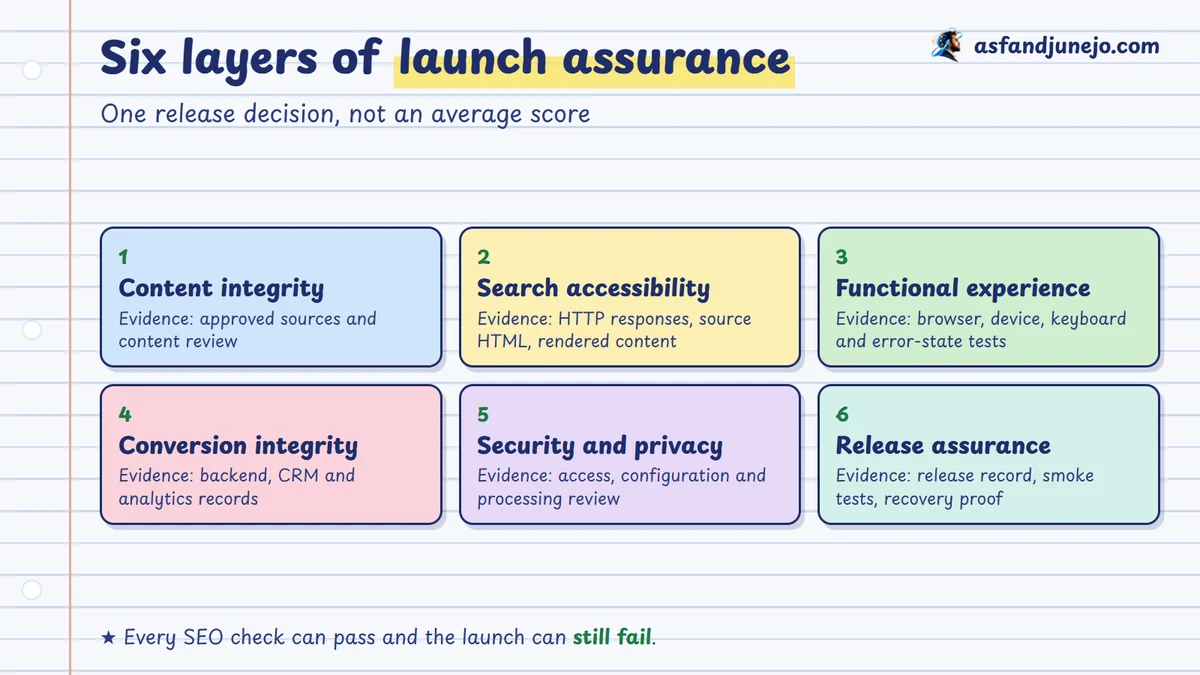
The AI Website Launch Assurance framework organizes prelaunch testing into six connected areas: content integrity, search accessibility, functional experience, conversion integrity, security and privacy, and release assurance.
Each area requires defined expectations, observable evidence, a review decision, and an accountable owner.
The framework is a proposed operational method, not an official Google or industry certification.
| Assurance layer | Main objective | Required evidence |
|---|---|---|
| Content integrity | Verify published information | Approved source records and content review |
| Search accessibility | Verify access and search signals | HTTP responses, source HTML, rendered content |
| Functional experience | Verify critical user tasks | Browser, device, keyboard, and error-state tests |
| Conversion integrity | Verify business outcomes | Backend, CRM, and analytics records |
| Security and privacy | Verify appropriate protections | Access, configuration, and processing review |
| Release assurance | Verify deployment and recovery | Release record, smoke tests, and recovery evidence |
These layers should contribute to a single release decision rather than be reduced to an arbitrary average score.
A website may pass every planned SEO check and still fail release approval because its primary lead-generation workflow is broken.
Similarly, a functional website may require additional security review before it can safely process private customer information.
Hypothesis A proposed operating model from this article, not an official Google or industry certification
How should tests be classified?
Every important check should have a documented outcome.
Pass means the expected behavior was demonstrated.
Fail means the acceptance criterion was not met.
Observation means a relevant condition was identified without establishing a defect.
Needs investigation means the available evidence is insufficient or conflicting.
Not tested means the required test was not performed.
Not applicable means the requirement does not apply to the defined website scope, with an explanation of why it does not.
A missing test should never be silently interpreted as a pass.
The purpose of these classifications is to preserve uncertainty rather than conceal it behind a completed checklist.
How do you verify AI-generated website content and claims?
AI-generated website content should be reviewed against reliable source information before publication. Material claims about services, experience, credentials, customers, statistics, product capabilities, and business outcomes should be verified rather than accepted because the generated language sounds credible.
A website can function correctly while publishing inaccurate or misleading information.
An AI-generated service page may describe capabilities that the business does not offer.
A generated About page may contain unsupported professional qualifications.
A testimonial section may include fictional customers or statements that real people never provided.
These are substantive content-quality problems, not merely stylistic imperfections.
Google’s current guidance for generative AI content emphasizes manual fact-checking, accurate metadata, trustworthy information, and compliance with its broader Search policies.
Verify claims according to their evidentiary requirements
A statement identifying a company’s actual service can generally be checked against approved business information.
A statement claiming hundreds of completed projects requires records supporting the reported count.
A performance claim describing revenue increases requires a defined measurement period, underlying data, and an appropriate method for calculating the result.
These claims do not have equal verification requirements.
The stronger the implied factual or commercial consequence, the stronger the supporting evidence should be.
Testimonials and social proof
A testimonial should correspond to a genuine and appropriately represented customer experience.
If an AI-generated template contains placeholder testimonials, those statements should be removed or replaced with authentic, authorized material before publication.
For U.S. businesses, the Federal Trade Commission’s rule concerning consumer reviews and testimonials is also relevant where the practices fall within its scope.
The launch review should distinguish fictional design examples from statements that visitors may reasonably understand as genuine endorsements.
Image provenance and accessibility
Images should be reviewed for permitted use, factual representation, and accessibility.
A generated photograph should not be presented as a real employee, customer, business location, or project unless the representation is accurate.
Alternative text should communicate the image’s relevant meaning or function.
W3C guidance distinguishes informative images, functional images, complex visual information, and decorative elements.
An empty alt text value may be appropriate for decorative images, whereas meaningful content requires suitable alternatives.
Source: W3C: Images Tutorial (opens in a new tab).
The goal is accurate communication, not inserting keywords into every image description.
What about AI-generated legal pages?
Automatically generated privacy policies, terms, or disclaimers should not be accepted as legally accurate merely because they contain familiar language.
They must reflect the website’s actual information processing, services, business relationships, and applicable obligations.
The appropriate review depends on the nature of the website and relevant jurisdictions.
For high-stakes or regulated activities, specialist legal review may be necessary.
How do Google’s spam policies apply to AI-built websites?
Google’s spam policies apply to AI-built websites in the same way they apply to other websites. AI-assisted production is not automatically a violation. The relevant concerns include manipulative scaled content, deceptive functionality, doorway pages, misleading representations, hacked content, and other practices that attempt to manipulate search systems or users.
This distinction is particularly important following Google’s September 2026 spam update.
What did the September 2026 spam update actually confirm?
Google’s Search Status Dashboard records that the September 2026 spam update began on September 24 and completed on October 8.
The update applied globally across languages.
Google did not publish a builder-specific list of affected websites or establish that using AI-generated code was itself a reason for a ranking decline.
Source: Google Search Status Dashboard: September 2026 Spam Update (opens in a new tab).
An AI-built website experiencing lower visibility during that period should therefore not automatically conclude that the update penalized it.
A defensible investigation would compare relevant search data, technical changes, content quality, and the site’s actual adherence to Google’s published policies.
For a detailed discussion of the update’s confirmed facts and diagnostic limitations, see Google’s September 2026 Spam Update: What Changed and How to Investigate.
Scaled content abuse
Google defines scaled content abuse around producing large amounts of content primarily to manipulate rankings rather than help users.
The method of production is not decisive by itself.
Large numbers of pages generated manually, automatically, or with AI can create concerns when they provide little original value and primarily target search variations.
For example, generating hundreds of nearly identical location pages that merely change city names without meaningful local information may deserve review.
However, multiple pages are not inherently spam when they serve distinct user needs and provide substantive information.
The relevant question is whether the content exists primarily to help its intended audience or to manipulate search visibility.
Doorway pages
A website builder may make it easy to create many pages targeting similar search phrases.
Google’s doorway-abuse policy concerns pages created primarily to rank for similar queries and to funnel users toward another destination without providing sufficient independent value.
A launch review should therefore examine whether each important page has a meaningful purpose.
Separate service, industry, or location pages may be appropriate when they address genuinely different requirements.
They should not be generated merely to increase the number of search entry points.
Misleading functionality
Google’s spam policies also address misleading functionality.
However, this policy should be interpreted accurately.
Google describes intentionally deceptive websites that promise functionality but fail to deliver it, often redirecting users to another objective.
An accidental form-processing defect is not automatically evidence of an intentional violation of the spam policy.
It remains a serious launch-quality problem because it can mislead visitors about the outcome of their interaction.
The distinction between an operational defect and deceptive intent should be preserved.
User-generated and share-only pages
Google updated its user-generated spam prevention guidance on October 26, 2026, including advice for platforms that publish generated or shareable pages.
The guidance distinguishes content intended for public search discovery from pages created primarily for direct sharing, collaboration, or utility.
For AI-assisted applications that generate public-facing pages, this raises an important launch question:
Should every generated URL be discoverable through search engines?
Not necessarily.
A private workspace, a temporarily generated result, an internal collaboration page, or a share-only tool output may not belong in the search index.
The appropriate approach depends on intended exposure.
Google discusses using indexing controls for content not intended for Search, but indexing restrictions are not a substitute for authentication or the protection of sensitive information.
Source: Google Search Central: Prevent User-Generated Spam (opens in a new tab).
Spam-policy acceptance criteria
A high-quality launch review should confirm that the site does not depend on fabricated claims, mass-produced low-value pages, intentionally deceptive functionality, or misleading structured data.
It should also distinguish legitimate public pages from private or share-only information.
Google’s Spam Policies for Web Search (opens in a new tab) provide the authoritative definitions.
A content audit aligned with those policies should improve the site’s value to readers rather than introduce cosmetic changes intended to imitate ranking signals.
How do you test SEO, rendering, and indexability?
SEO launch QA should verify that important public URLs return appropriate HTTP responses, expose meaningful content, contain accurate metadata, provide useful internal links, and communicate consistent crawling and indexing signals.
For JavaScript-based websites, the initial HTML and rendered page should be evaluated separately where the implementation makes that distinction important.
Google supports JavaScript rendering, but crawling, rendering, and indexing remain different stages.
Source: Google Search Central: JavaScript SEO Basics (opens in a new tab).
Test the deployed URLs directly
A website should not pass SEO QA solely because navigation works after the application has loaded.
Important public routes should be tested through direct requests.
The reviewer should examine the homepage, principal service pages, contact page, and representative content routes.
Invalid routes should also be tested.
A nonexistent URL should not return a misleading successful response merely because a client-side application shell loads.
For certain single-page applications, this can create soft 404 behavior.
The response should reflect the intended state of the resource.
Compare source HTML with rendered content
The initial server response may contain different information from the page after JavaScript execution.
This is not automatically a defect.
However, the difference can matter for crawlers or other systems that do not process the page in the same way as a modern browser.
The reviewer should compare the availability of important headings, explanatory content, internal links, metadata, and applicable structured data.
If significant content is missing from the initial response, determine whether the rendering architecture and relevant crawlers can access it appropriately.
Do not automatically conclude that Google cannot index the page merely because JavaScript is involved.
Canonicalization and indexing directives
Canonical annotations communicate preferred representative URLs.
A non-self-referencing canonical is not necessarily an error, since duplicate or substantially similar pages may legitimately consolidate under another URL.
Google considers multiple canonicalization signals rather than treating one declaration as an absolute command.
Similarly, robots.txt and noindex serve different purposes.
Blocking a crawler through robots.txt may prevent it from accessing and processing a noindex instruction.
Private information should be protected through appropriate access controls rather than depending solely on search-indexing directives.
Sitemaps and structured data
An XML sitemap can support URL discovery but does not guarantee indexing.
The launch review should confirm that the sitemap contains appropriate public URLs and excludes unintended preview or temporary routes.
Structured data should accurately describe the visible page.
Google does not guarantee rich results simply because markup passes a technical validation test.
The same principle applies to AI search.
Google’s generative AI guidance emphasizes foundational SEO and useful original information, not mandatory llms.txt files or special AI-only markup.
For deeper technical verification, the site’s AI Visibility Audit Example demonstrates the importance of reporting passed checks, observed gaps, and untested conditions separately.
Real website case study: Koomba’s AI-built website rebuild
A documented example of the distinction between visual completion and crawler accessibility comes from Koomba, a mental performance and nutrition coaching business.
According to a case study published by its website-development provider, Suede Web Systems, on October 21, 2026, Koomba previously used a website built with the AI-assisted platform Emergent.
The provider reported that the original website rendered its primary content in the browser and returned little meaningful page content to non-rendering crawlers.
The case study describes a nine-page rebuilding project.
The reported technical problem
Suede stated that the original site’s important marketing content was not present in the initial HTML response in the manner needed for its intended crawler-accessibility goals.
The provider reported that the issue was demonstrated with JavaScript disabled.
The important distinction is that the website could appear functional to visitors, while its initial HTML provided substantially less useful information to systems that did not execute the required JavaScript.
This is a technical observation about the reported implementation, not proof that every AI website builder has the same limitation.
What the provider changed
The case study reports that Koomba’s nine pages were rebuilt using pre-rendered HTML and a Next.js implementation, with the replacement launched on July 28, 2026.
The described work included page-level metadata, navigation and search signals, and a more accessible HTML output.
Suede also reports subsequent improvements in AI visibility and inbound inquiries.
Those performance improvements are vendor-reported results. They should not be treated as independently verified causal effects of the rebuild without examining the underlying datasets, query samples, attribution methods, and concurrent changes.
Source: Suede Web Systems: Koomba Website Case Study (opens in a new tab).
Directional Results reported by the rebuild provider in its own case study (checked November 1, 2026); not independently verified
Independent public website overview
Koomba’s current public website is accessible at koomba.co (opens in a new tab).
Its publicly retrievable pages describe mental performance coaching, sports nutrition, organizational partnerships, and its process for connecting athletes with coaches.
The current site, therefore, provides a real website that readers can inspect.
However, public page retrieval alone does not reproduce Suede’s historical before-and-after crawl measurements or verify the reported changes in AI visibility or inbound inquiries.
Why this case matters
The transferable lesson is not that every AI-built website should be rebuilt in Next.js.
It is that launch verification should examine what the deployed website actually returns and whether its rendering strategy supports the site’s intended audience and discovery requirements.
Different platforms and versions may produce different outputs.
For example, Lovable reported moving newly created projects to a server-side-rendered architecture beginning May 13, 2026, while providing prerendering support for existing applications.
That documented platform change demonstrates why launch advice should be version-aware rather than describing every AI website builder as permanently client-side rendered.
The appropriate test is the actual page response, not an assumption based on the builder’s name.
How do you test mobile usability and accessibility?
Mobile and accessibility QA should establish that visitors can complete important tasks across the supported devices, browsers, and interaction methods.
A responsive layout is not necessarily a usable layout.
A website can fit within a mobile viewport while its navigation is difficult to operate, its form labels are unclear, or important buttons are obscured.
Likewise, an automated accessibility scan can identify detectable problems without establishing that every user journey is accessible.
Test the task, not only the page
On the fictional consulting website, the central task is to submit a consultation inquiry.
The reviewer should verify that the visitor can navigate to the form, understand its fields, identify errors, correct invalid information, and complete the interaction using the supported input methods.
Keyboard navigation deserves particular attention.
W3C’s WCAG 2.2 guidance includes requirements concerning keyboard accessibility, visible focus, error identification, reflow, and target size.
The applicable requirements should be evaluated according to the interface and relevant conformance obligations.
Source: W3C: WCAG 2.2 Quick Reference (opens in a new tab).
Manual testing remains necessary
Automated tools can detect missing labels, certain contrast problems, and other machine-checkable conditions.
However, they cannot independently determine whether an instruction is understandable or whether a complex interaction makes sense to the intended user.
A useful test should therefore include manual keyboard operation and controlled error scenarios.
For the fictional contact form, the reviewer should confirm that required inputs are accessible, the focus remains visible, error messages clearly identify problems, and the user can correct mistakes without unnecessarily losing information.
A passing accessibility scan should not be presented as evidence that all accessibility requirements have been satisfied.
How do you test forms and backend processing?
Form QA should establish that the website validates input appropriately, sends the request to the intended processing system, handles errors correctly, and records an accepted submission according to the application’s defined business requirements.
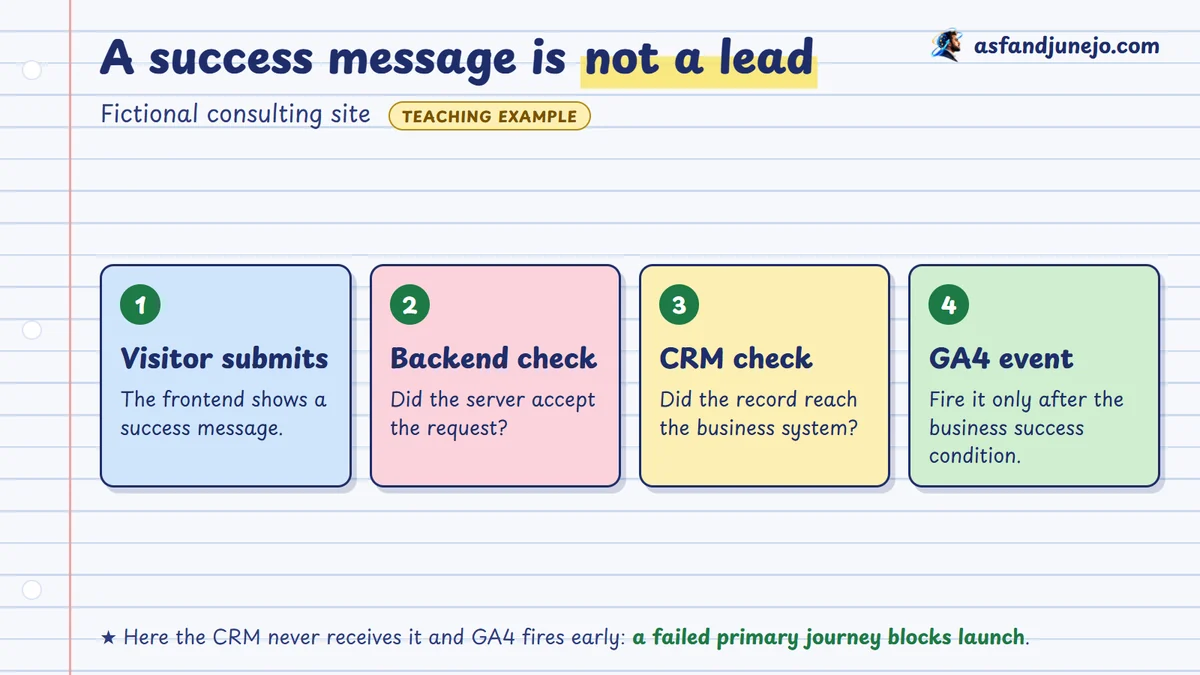
The frontend and backend may produce different outcomes.
A visitor may see a confirmation message when the backend rejects the request.
An API may acknowledge a request without completing downstream CRM processing.
An integration may temporarily fail even though the original information was accepted into a reliable processing queue.
These situations require different interpretations.
Define successful submission before testing
A successful submission should include explicit technical and business definitions.
In a simple system, success may mean that the backend has validated the information and stored a durable lead record.
In an asynchronous system, success may mean that the request has entered a reliable processing queue, while delivery to the CRM occurs afterward.
Neither architecture is automatically correct for every application.
The important requirement is that the user-facing confirmation accurately reflects what has happened.
Test successful and unsuccessful states
For the fictional consulting website, valid test information should reach the processing system and follow the expected business workflow.
Invalid input should generate understandable feedback without being recorded as a successful inquiry.
A controlled backend failure should not produce a misleading confirmation.
A CRM outage should follow the application’s documented failure or retry behavior.
These tests should be conducted in an authorized environment with appropriate protections. Testing should not unnecessarily create real customer records or expose sensitive information.
Use a stable test reference
A useful QA record connects the frontend interaction, backend processing, and the destination system’s result through an appropriate internal identifier.
That reference allows the reviewer to trace a single submission without exposing personal information in public screenshots.
The result should remain unresolved until the expected processing state has been verified.
The purpose is to establish that the website can perform its intended business function, not merely that its interface responds to clicks.
How do you verify GA4 and conversion tracking?
GA4 conversion QA should establish that events represent the intended actions, trigger under the correct conditions, and avoid unintended duplication.
Installing Google Analytics does not prove that conversion measurement is accurate.
The event definition must match the business outcome.
A click is not automatically a lead
Google Analytics recommends generate_lead for defined lead-generation actions and provides separate recommended events for later qualification and sales stages.
For a consulting website, a button click may indicate interest, whereas a successfully submitted inquiry represents a different event.
A qualified lead is another stage in the business process.
The implementation should preserve those distinctions.
Why the fictional website initially fails
In the constructed example, the contact form triggers generate_lead when the visitor clicks Submit.
However, the backend subsequently rejects the request.
No valid lead reaches the CRM.
The analytics system may still record a lead because the event was attached to the wrong trigger.
The problem is not necessarily that GA4 malfunctioned. It recorded the event the website instructed it to record.
The measurement implementation failed to represent the intended business outcome.
Verify the event against the business system
The launch team should perform controlled submissions and compare the resulting application state, backend processing record, CRM result, and analytics event.
Google Analytics DebugView can help inspect event activity during testing.
However, DebugView does not independently prove that a transaction succeeded, and privacy settings or denied consent may prevent certain events from appearing.
The reviewer should also check for duplicate events and determine whether legitimate repeated actions are being distinguished from accidental double counting.
Separate lead generation from qualification
A successfully accepted consultation inquiry is not automatically a qualified sales opportunity.
The business may subsequently review the project requirements, budget, company fit, or other relevant criteria.
Those later decisions should not be inferred from the original submission event.
For additional guidance on connecting search and analytics systems while preserving data and permission boundaries, see Connect Claude to GA4 and Search Console: A Read-Only SEO Workflow.
The same principle applies here: access to data and the presence of events do not establish the correctness of every interpretation.
How do you verify security, privacy, and consent?
Security and privacy launch checks should reflect the application’s actual functionality, information sensitivity, exposure, and applicable requirements.
A public marketing website and an authenticated application storing confidential customer information may require substantially different assessments.
HTTPS, security headers, and basic vulnerability scans are useful controls, but none independently establishes complete application security.
Establish the data flow
Before approving the website, identify what information is collected, where it is transmitted, which systems retain it, and who can access it.
For the fictional consulting website, submitted contact details may be routed through the backend to a CRM and a notification service.
Analytics systems may process separate information about visits and interactions.
The privacy review should establish whether these activities match the actual disclosures, permissions, and applicable obligations.
Consent must affect actual tracking behavior
Where consent is required for particular technologies, the website must implement the corresponding behavior.
Google’s Consent Mode distinguishes basic and advanced implementations.
Basic mode blocks Google tags until a relevant consent interaction occurs. Advanced mode can load tags before consent and transmit limited cookieless signals under denied states.
These approaches do not have identical technical behavior or necessarily satisfy every legal requirement in every jurisdiction.
The QA process should test the initial consent state, granted and denied choices, and, where relevant, later preference changes.
A consent banner should not be treated as sufficient evidence of correct processing.
Apply appropriate application security controls
OWASP Top 10:2025 identifies major web application risks, including broken access control, security misconfiguration, software supply chain failures, injection, and authentication failures.
The applicable testing depth should follow the application’s risk profile.
For a public marketing site, the review may focus on secrets handling, form processing, backend validation, external dependencies, and production configuration.
An authenticated application containing private records may require deeper authorization testing, session management review, data isolation checks, and a specialist security assessment.
Real-world evidence: Lovable’s April 2026 incident
On April 22, 2026, Lovable published an account of an access-control incident affecting certain public projects.
According to the company’s disclosure, a backend regression introduced in February 2026 allowed authenticated Lovable users with relevant project links to access public project chat histories and source code under circumstances that should no longer have permitted such access.
Lovable stated that private projects and Lovable Cloud were not affected.
The company reported fixing the problem and changing its handling of public-project visibility.
It also described failures in the vulnerability-report escalation process, in which reports were not appropriately escalated.
Source: Lovable: Our Response to the April 2026 Incident (opens in a new tab).
This is a real, publicly documented platform incident.
It does not establish that every Lovable application was vulnerable or that all AI-built websites have the same security problem.
Its principal lesson is that project visibility and published website accessibility are separate controls.
A public website may be intended for visitors, while its source code, editor conversations, internal configuration, or confidential records should have different access rules.
That distinction should be part of launch QA.
Confirmed Lovable's own disclosure of April 22, 2026 describes a February 2026 backend regression affecting public projects only; private projects and Lovable Cloud were not affected (checked November 1, 2026)
Security acceptance
The security and privacy layer should pass only when relevant controls have been evaluated against the website’s actual requirements.
Any unresolved exposure affecting sensitive information or critical access controls should receive appropriate specialist investigation and risk treatment.
An automated scan should not be used to certify an application as completely secure.
How do you test Core Web Vitals and performance?
Performance launch QA should evaluate representative pages under relevant conditions, identify significant usability problems, and establish a baseline for later observation.
Google’s Core Web Vitals currently include Largest Contentful Paint, Interaction to Next Paint, and Cumulative Layout Shift.
The recommended good thresholds are:
- LCP: 2.5 seconds or less.
- INP: 200 milliseconds or less.
- CLS: 0.1 or less.
Google recommends evaluating these at the 75th percentile of relevant page loads, separately for mobile and desktop.
Laboratory testing versus field data
A newly launched website may not have sufficient real-user measurements for a meaningful field-data assessment.
The absence of field data should not be classified as a pass.
Prelaunch testing can use laboratory diagnostics and representative device checks, while field measurements can be reviewed after sufficient eligible user activity becomes available.
The reviewer should distinguish these measurement types.
Test important page templates
The homepage may contain large images or animations.
A service page may have extensive content and supporting graphics.
A contact page may depend on third-party form scripts.
These pages can have different performance characteristics.
Testing only the homepage may overlook problems affecting the primary conversion journey.
For the fictional consulting website, responsiveness during form completion may be more commercially important than a minor delay in loading decorative content.
Performance should therefore be evaluated in relation to the user task, not solely through an aggregate Lighthouse score.
How do you test deployment, backups, and rollback?
Deployment readiness requires verification of the production configuration, essential dependencies, and the ability to recover from a serious release failure.
A successful build does not prove that the application can operate correctly after deployment.
The production system may depend on DNS records, TLS configuration, environment variables, database connections, external APIs, email services, and caching behavior.
These dependencies should be checked against the actual release configuration.
Verify production destinations
For the fictional consulting website, the launch team should confirm that the contact form uses the intended production endpoint, that accepted inquiries reach the correct CRM environment, and that analytics events are sent to the appropriate property.
Test data should not accidentally contaminate real business reporting.
Likewise, production inquiries should not disappear into a development database or testing account.
Backups and recovery
A backup file does not establish that the website can be restored successfully.
The recovery plan should identify which components must be restored and how their compatibility will be verified.
This becomes particularly important for database-backed applications.
Reverting application code may not reverse database changes or restore data affected by a migration.
A rollback process should therefore be tested in an appropriate environment rather than assumed to work.
The release record should identify the approved version, relevant dependencies, the recovery owner, and the conditions that would justify a rollback.
A documented but untested recovery procedure should remain classified accordingly.
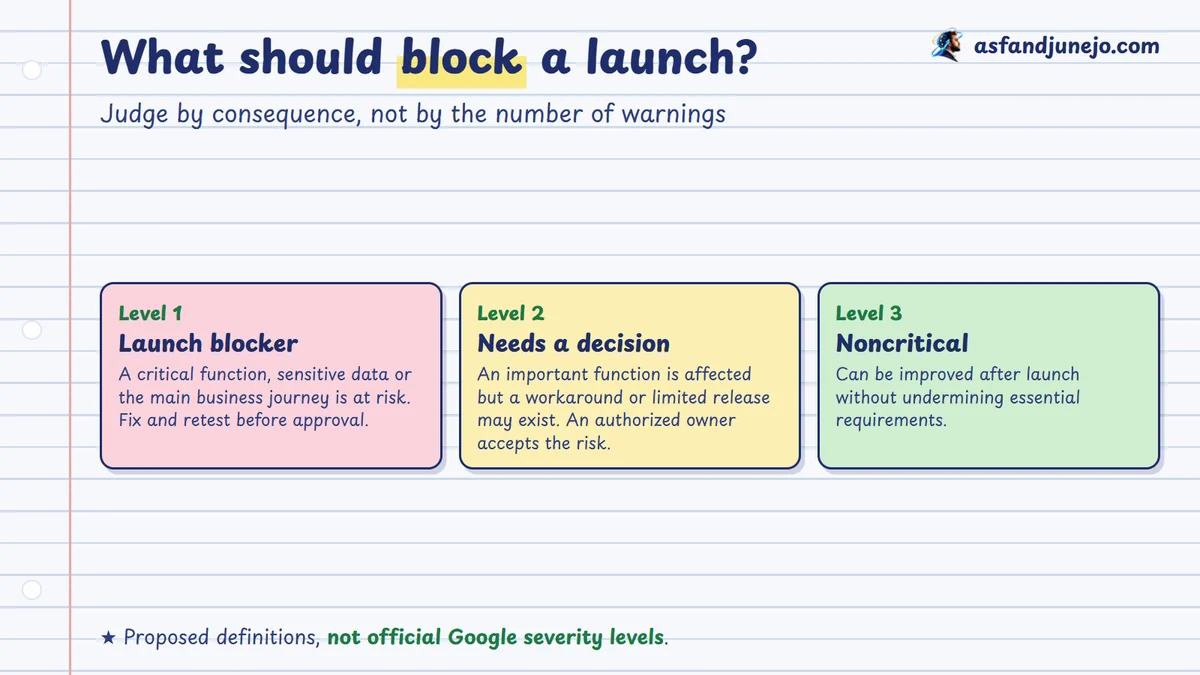
What should prevent an AI-built website from launching?
An AI-built website should not launch when an unresolved problem creates unacceptable risk to its critical functionality, sensitive information, essential transactions, or defined business objective.
The decision should follow the consequences of the problem rather than the number of automated warnings.
A minor visual inconsistency may be acceptable temporarily.
A broken consultation form may be unacceptable for a website whose principal purpose is generating inquiries.
An exposed private database may require an immediate no-go decision regardless of how many other checks have passed.
The three-level release model
P0: Launch blocker
A critical issue prevents an essential function or creates unacceptable security, data, or business risk.
The issue must be corrected and the relevant acceptance test completed before approval.
P1: Material issue requiring a decision
The issue affects an important function, but an appropriate workaround or controlled release limitation may exist.
An authorized owner must evaluate and accept the risk where permitted.
P2: Noncritical improvement
The issue can be addressed after launch without undermining essential requirements or applicable obligations.
These categories are proposed operational definitions rather than official Google severity levels.
The fictional website’s release decision
The fictional consulting website initially fails its primary conversion requirements.
The frontend displays a success message, but accepted information does not reliably reach the CRM.
The GA4 event also fires before the business success condition has been established.
These are connected problems.
The website cannot reliably receive consultation inquiries, and its measurement system may overstate the number of successful conversions.
Under the proposed framework, the failed primary business journey is a P0 launch blocker.
The launch should remain on hold until the processing flow and analytics conditions are corrected.
What would justify approval?
The corrected implementation should demonstrate that valid test submissions are accepted according to the defined technical requirement, reach the intended processing or CRM destination, and generate the appropriate analytics event.
Invalid or rejected submissions should not be counted as successful leads.
The team should also confirm that the relevant privacy, security, accessibility, and recovery requirements have passed.
Only then can the original no-go decision be reconsidered.
The correction outcomes described here are expected results in a fictional demonstration, not measured results from a real application.
What should be monitored after launch?
Post-launch monitoring should track key technical conditions, user journeys, conversion processes, and relevant search signals against a documented baseline.
Monitoring should distinguish detecting an unexpected condition from confirming its cause and implementing a correction.
For a lead-generation website, critical monitoring may include form-processing availability, CRM delivery failures, significant analytics anomalies, and important public-page responses.
Search monitoring may include robots changes, canonical declarations, indexing information, and relevant organic search performance.
Search monitoring after publication
Google Search Console can help website owners examine indexing and search performance after publication.
However, newly published pages may take time to be discovered and processed.
The absence of immediate impressions does not independently establish a technical error.
The appropriate response is to verify the website’s public accessibility, indexing signals, internal links, and available Search Console evidence.
A sitemap remains a discovery aid rather than an indexing guarantee.
Monitor the business journey
A homepage returning HTTP 200 does not establish that the consultation form is functioning.
The website may still be available while its CRM integration fails.
Monitoring should therefore reflect the actual dependencies of the business process.
Where synthetic submissions are used, they should operate through an authorized method that avoids creating unmanaged customer data or triggering inappropriate notifications.
Separate detection from response
A monitoring system may check availability every few minutes without a qualified analyst continuously available.
The monitoring specification should clearly distinguish the responsibilities for collection frequency, alert acknowledgment, investigation, escalation, and remediation.
A detected anomaly is not necessarily a confirmed incident.
Similarly, an incident should not be marked as resolved merely because a notification was delivered.
When should the site be reassessed?
A migration, major redesign, new application feature, change to the form-processing system, or substantial rendering change may require renewed QA.
The scope should follow what changed.
A new contact form may require targeted conversion and analytics testing.
A new rendering architecture may require broader SEO verification.
A domain migration may require checks for redirects, canonicals, sitemaps, and indexing.
The objective is to investigate the affected assumptions rather than rerun every possible test without considering relevance.
For an example of ongoing website changes and documented technical corrections, see Asfand Junejo’s Website Experiment Log.
That log concerns the author’s own website. It is not presented as evidence that the website was created using a particular AI website builder.
Final website launch acceptance checklist
The final launch decision should answer six questions.
Content: Is the published information accurate, authorized, and complete enough for its intended audience?
Search: Can intended public pages be accessed and interpreted appropriately, with consistent technical signals?
Functionality: Can visitors complete critical tasks across the relevant environments and interaction methods?
Conversion: Do accepted business actions reach their intended destinations and produce accurate measurement?
Security: Are relevant information, permissions, and processing activities protected appropriately?
Release: Are production configuration, recovery responsibilities, and unresolved risks understood and approved?
Each critical requirement should have an identifiable test, actual observation, evidence reference, and responsible reviewer.
The final approval should distinguish passed, failed, unresolved, and untested conditions.
A high checklist completion rate is not sufficient if a single unresolved failure undermines the website’s central purpose.
Not tested is not passed.
A launch should be approved only when the relevant critical requirements have been verified, and the appropriate decision-maker has evaluated any remaining risks.
Where can you get the AI website launch QA kit?
Join Search Signals with your email and three files unlock on this page straight away: the AI Website Launch QA Kit (ZIP), the launch assurance workbook (Excel) and the printable QA playbook with release approval (PDF).
The workbook has eleven tabs: start here, launch register, SEO and rendering, forms and CRM, GA4 and consent, security and privacy, release and rollback, decision and sign-off, post-launch monitor, a synthetic demo and sources. The ZIP also holds the editable Word version of the playbook.
- AI Website Launch QA Kit (ZIP)Workbook, editable playbook, printable PDF, read-me and checksums
- Launch Assurance WorkbookExcel workbook, 11 tabs
- QA Playbook and release approvalPDF, 5 pages
Directional Launch-readiness templates with a fictional sample site, not legal, security or compliance advice and not a guarantee of any outcome
Frequently asked questions
Can a website created entirely with AI be launched professionally?
Yes. The use of AI does not prevent a website from meeting professional technical, accessibility, security, or search requirements. Readiness depends on the quality of the implementation and the evidence supporting its operation.
Does Google penalize AI-built websites?
Google does not classify AI-assisted website creation as an automatic spam policy violation. Its policies address manipulative practices, deceptive behavior, and content that fails to provide meaningful value. The website’s actual content and behavior matter.
Can Google index JavaScript-generated content?
Yes. Google can render JavaScript and use rendered content during indexing. However, resource access, rendering failures, routing behavior, and content availability can still create problems that require investigation.
Does every AI-built website need server-side rendering?
No. The appropriate rendering strategy depends on the application’s purpose, technical architecture, and discovery requirements. Server-side rendering or prerendering may offer advantages for particular pages and crawlers, but a universal requirement would be misleading.
Is an XML sitemap enough to get indexed?
No. A sitemap can help discovery but does not guarantee crawling, indexing, or ranking.
Does Google require llms.txt for AI search visibility?
No. Google does not require llms.txt or any other AI-specific text files to participate in its generative search features.
How do you verify a contact form?
Test the actual processing path using authorized data. Confirm the frontend interaction, the backend acceptance condition, and the intended business destination rather than relying solely on a confirmation message.
When should GA4 generate_lead fire?
It should represent the agreed lead-generation success condition. For a form workflow, it should not be triggered solely by a button click when the submission can fail afterward.
Can automated accessibility testing replace manual review?
No. Automated testing can identify many detectable problems, but meaningful task-based evaluation and some accessibility requirements require human judgment.
What should block a website launch?
Unresolved failures involving critical business functions, unacceptable security or data risks, and other requirements designated as launch blockers should prevent approval.
How often should a website be monitored after launch?
Monitoring frequency depends on the importance of the signal, the website’s rate of change, available data, and actual response capabilities. Critical operational checks may require more frequent monitoring than aggregated search performance trends.
Website readiness must be demonstrated.
AI-assisted development has changed how quickly websites can be assembled, but it has not eliminated the responsibilities involved in publishing a functioning business website.
A generated interface can appear complete while its underlying application, search accessibility, measurement system, or recovery process remains unverified.
The appropriate response is neither to reject AI-assisted development nor to assume that every generated website is defective.
It is to establish a repeatable process to test the requirements the website is expected to meet.
The real-world examples reinforce this principle from different directions.
Koomba’s documented rebuild illustrates why page appearance and crawler-accessible content should not be treated as equivalent.
Lovable’s disclosed incident demonstrates why access to published websites and internal project visibility require different controls.
The fictional consulting website illustrates a separate commercial failure: a visually successful form interaction that does not produce a reliable business outcome.
Together, these examples show why launch quality cannot be inferred from one passing layer.
The AI Website Launch Assurance framework organizes the necessary verification around content integrity, search accessibility, functionality, conversion processing, security, and release readiness.
Its purpose is not to certify every website through a universal score.
It is to make the launch decision accountable to observable evidence.
A website is not launch-ready because it looks finished. It is launch-ready when its critical technical and business requirements have been verified, its unresolved risks are understood, and an authorized owner approves the release.
Apply the framework
Begin with the website’s most important user journey.
Identify the systems that must function for that journey to succeed.
Define the expected behavior, assign the required tests, and preserve evidence of the results.
Extend the same approach to search accessibility, content accuracy, privacy, security, performance, and recovery.
For organizations requiring deeper technical SEO or AI visibility assessment, explore SEO and AI Visibility Services to discuss a separately scoped investigation.
Research methodology and limitations
Research review date: October 31, 2026.
This article combines official technical documentation, a proposed launch assurance framework, publicly documented real-world cases, and a fictional instructional scenario.
The six-layer AI Website Launch Assurance framework is an editorial operating model. It has not been established through a controlled study that demonstrates specific improvements in conversion rates, search performance, security outcomes, or business growth.
The fictional consulting website and its form, backend, CRM, and analytics failures were constructed to demonstrate the verification process. No live customer application was tested to produce those observations.
The Koomba case relies primarily on the published account of the development provider that performed the reported rebuild. The current public website was separately located and reviewed at the page-content level, but the historical crawl evidence and reported commercial improvements were not independently reproduced.
The Lovable incident is based on the platform’s published disclosure and is presented within the scope described by that disclosure.
Google’s September 2026 spam update dates and global scope were confirmed through the official Search Status Dashboard. No claim is made that a particular AI website builder or website category was penalized by that update.
The technical guidance reflects publicly available documentation reviewed as of the stated date. Platform configurations, Google Search documentation, analytics interfaces, and security requirements may change.
Primary technical and policy sources
- Google Search Essentials (opens in a new tab)
- Google Search Spam Policies (opens in a new tab)
- Google’s Guidance on Generative AI Content (opens in a new tab)
- Google Search Technical Requirements (opens in a new tab)
- Google JavaScript SEO Basics (opens in a new tab)
- Google AI Search Optimization Guidance (opens in a new tab)
- Google Analytics Recommended Events (opens in a new tab)
- Google Consent Mode Documentation (opens in a new tab)
- W3C WCAG 2.2 (opens in a new tab)
- OWASP Top 10:2025 (opens in a new tab)
- Google Core Web Vitals (opens in a new tab)