Google's September 2026 spam update began on September 24 at 9:15 a.m. Pacific Time, finished on October 8 after about 13 days and 16 hours, and applied worldwide across all languages. Google has not said which detection systems changed, which websites were affected or whether any particular ranking decline was caused by this rollout.[1] A traffic drop that overlaps the dates is a clue to investigate, not proof of a spam-policy violation.
Published · Last reviewed · By Asfand Yar Junejo, publisher asfandjunejo.com
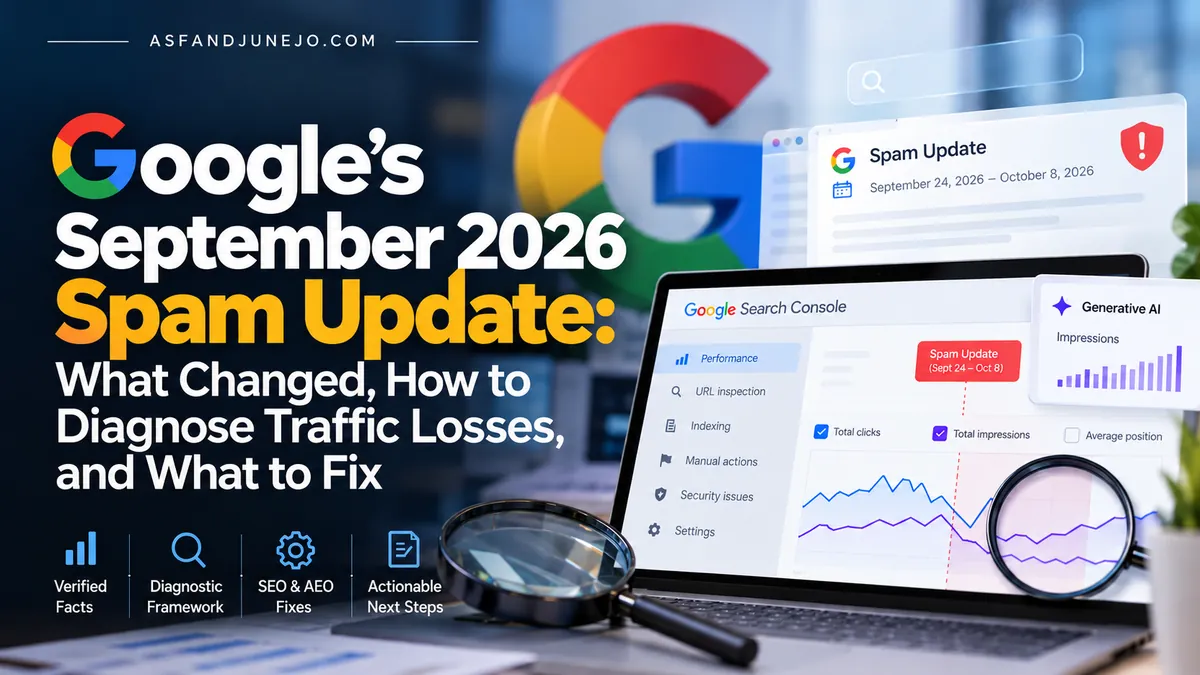
For site owners with reduced visibility, that distinction decides the right response. The evidence-led approach is to identify what changed, verify that the change is persistent, investigate alternative causes, and correct documented policy, technical or content weaknesses instead of applying speculative fixes. The update also arrives alongside separate Generative AI performance reporting in Search Console and a Search generative AI inclusion control. They make AI-search exposure easier to investigate, but they do not prove that the spam update targeted AI Overviews or AI Mode.[5][6][7]
What are the key takeaways?
Google confirmed the dates and global scope; everything about causes, targets and individual sites remains undisclosed, so diagnose with your own Search Console evidence.
- Confirmed: the global, all-language rollout ran from September 24 to October 8, 2026.[1]
- Not confirmed: Google did not publicly identify a new spam-policy category, a specific classifier or a particular content-production technique as the target.
- Diagnostic rule: use Search Console page- and query-level evidence before assigning a cause to a traffic decline.
- Remediation rule: fix confirmed eligibility, policy, editorial or user-value problems; avoid mass deletion, blanket disavows and indiscriminate rewriting.
- Measurement rule: analyze traditional Web performance and Generative AI impressions separately, without double counting or unsupported AI-conversion attribution.[7]
- Timing: the October 9 to 23 post-rollout comparison period is incomplete as of October 12; early movement is not a settled recovery outcome.
What did Google confirm about the September 2026 spam update?
Google's Search Status Dashboard confirms the dates, the ranking-update classification and the worldwide, all-language scope, and nothing more.[1]
The incident began September 24, 2026 at 9:15 a.m. Pacific Time and ended October 8 at 1:00 a.m. Pacific Time, roughly 13 days and 16 hours. The dashboard does not identify which spam-detection subsystems changed or disclose site-specific outcomes. Google's general documentation says spam updates improve its automated systems for identifying search spam and names SpamBrain as an example of spam-prevention technology. That is not proof of a specific change to SpamBrain during this incident.[2]
| Statement | Status | Evidence-based interpretation |
|---|---|---|
| The update started September 24 and finished October 8 | Confirmed | Official US/Pacific timestamps establish the event window.[1] |
| Rollout applied globally and to all languages | Confirmed | Google's incident notice states both.[1] |
| It lasted about 13 days and 16 hours | Confirmed | Computed from the official timestamps. |
| Google introduced a new spam-policy category | Not established | The incident record announces no new category. |
| AI-written pages were specifically targeted | Not established | A page's production method alone is not a diagnosis.[3][9] |
| Links or a particular backlink tactic caused losses | Not established | The incident was not publicly identified as a dedicated link-spam update. |
| A site's traffic loss during the rollout proves causation | Unsupported | Demand, technical changes, SERP features and other ranking activity remain competing explanations.[4] |
Why does the update matter, and what does it not establish?
It fixes an official event window for before, during and after analysis; it does not show greater severity, a broader targeting rule or an AI-content crackdown.
The September rollout was longer than several earlier 2026 spam updates, but a longer deployment period is not evidence of greater severity. The meaningful operational fact is that the window is now fixed, which allows consistent comparisons.
Large-scale publishing, programmatic SEO, automated content production, generative AI and third-party publishing arrangements deserve careful examination where they are actually used. Google's existing policies apply to manipulative practices regardless of the technology used to create a page. These industry conditions explain why an audit is useful; they do not reveal Google's unpublished September mechanisms.[3][9]
Did the spam update actually affect your website?
Possibly, but a decline between September 24 and October 8 is timing evidence, not attribution; the case strengthens only when the loss is persistent, starts near the window, hits coherent page or query groups and matches a documented weakness.
Even then, label the update a possible contributor rather than a proven cause.
How do you diagnose the shape of the loss?
Start with the distribution of the decline, not one sitewide percentage. A single directory may signal a template or topical problem, while a sitewide decline may point to a technical, market or ranking-system issue. A country-specific decline differs from an across-market one, and stable impressions with falling clicks differ from simultaneous impression and click losses.
| Observed performance pattern | Possible explanations | What to check first |
|---|---|---|
| Web clicks and impressions decline sitewide | Technical changes, demand shifts, ranking movement, policy risk | Page Indexing, deployments, query mix, manual actions, Trends |
| Only generated or near-duplicate directories decline | Repetitive intent coverage, weak differentiation, template faults, possible scaled-content issues | Representative pages, uniqueness, intent, publishing process |
| Impressions stable but CTR drops | SERP presentation, competition, titles and snippets, intent shifts | Query CTR, title changes, devices, SERP features |
| One template or section loses visibility | Shared technical configuration or intent-quality issue | Matched audit of affected versus unaffected templates |
| Web performance stable but AI impressions decline | AI feature exposure, site inclusion settings, device and country mix, reporting | Generative AI report, AI inclusion control, page dimensions |
| GA4 sessions down while Search Console clicks stable | Attribution, tags, consent, timezones, landing-page measurement | GA4 configuration and consistent-period comparison |
| Third-party rank tracker moves but Search Console does not | Tracker sampling, localization, devices, query selection | First-party Search Console trends and tracker settings |
Hypothesis These are hypotheses, not observations from a measured case study. Test them with first-party exports, technical checks and published policy definitions.
What is the six-gate framework for diagnosing a search visibility decline?
It is an editorial operating method, not a Google-defined test: six decision gates that link the observation, the competing explanations, change approval and independent verification.
| Decision gate | Key test | What the evidence permits |
|---|---|---|
| 1. Validate the signal | Are comparisons complete, like-for-like and corroborated by first-party metrics? | Repair data quality or keep monitoring before asserting a sustained decline. |
| 2. Locate the loss | Which URL populations, query families, intents, countries and devices changed? | Build a bounded hypothesis for the affected group, not the whole site by default. |
| 3. Check technical and administrative findings | Are indexability, canonicals, redirects, rendering, security or manual actions affected? | Repair verified defects immediately, without waiting for the full post-update period. |
| 4. Evaluate content, demand and policy alternatives | Is there a documented weakness, and what evidence contradicts that explanation? | Separate a verified finding from a hypothesis about Google's undisclosed systems. |
| 5. Approve a proportionate intervention | Are scope, owner, expected benefit, risks and rollback criteria documented? | Authorize narrow, defensible changes; avoid broad rewrites based only on timing. |
| 6. Evaluate four outcomes | Was the change deployed, processed, followed by Search movement and reflected in business results? | Report milestones separately; a temporal improvement does not prove causal recovery. |
Gate 1: how do you verify the dataset before the website?
Use Search Console clicks and impressions as the primary first-party Search measures. Check the property, country, device and search-type filters, extraction method, reporting timezone, date completeness and known query-export limits. Search Console clicks and GA4 organic sessions are not the same metric. Classify each comparison as Ready for interpretation, Preliminary, Not comparable or Unavailable, and never declare a final recovery from an incomplete post-rollout window.[4][7]
Gate 2: how do you identify the affected search populations?
Compare page groups, directories, templates, query families, intent, country, device, and branded versus nonbranded demand. A drop in branded demand may reflect reduced awareness or seasonal behavior, while a template-only decrease may call for a narrower template audit. Position and CTR shifts need query-mix and SERP context before interpretation.
Gate 3: which technical and security findings should you inspect?
Review crawl access, response codes, rendered text, robots instructions, noindex, Google-selected canonicals, redirects, internal linking and recent deployments. Check URL Inspection, Page Indexing, Manual Actions and Security Issues. A confirmed technical or security defect should be repaired even if the October 9 to 23 comparison is incomplete. Algorithmic ranking changes and manual actions are not interchangeable.[4]
Gate 4: how do you challenge each content or policy hypothesis?
Audit affected page groups against published spam policies, user-task differentiation, factual accuracy, authorship, original information and publishing practices. Record the evidence for and against, and test demand or market movement as an alternative. A group of many weak location pages may justify a content review, but it does not prove that Google's classifier acted on those pages.[3]
Gate 5: how do you approve controlled remediation?
For every substantial change, record the observation, explanation, supporting and contradicting evidence, source URLs, affected population, expected user benefit, owner, risk guardrail and rollback condition. Correct false claims and verified security or technical defects promptly. When the hypothesis is uncertain, prefer a bounded, reviewable intervention over mass deletion or a full-site content overhaul.
Gate 6: how do you verify the right kind of progress?
Evaluate deployment (is the fix live?), processing (have crawling, canonical and indexing signals reflected it?), Search outcome (do comparable metrics improve?) and business outcome (did qualified leads or other KPIs improve?) as distinct milestones. An upward line after an edit is an observation, not proof that the edit reversed a particular Google mechanism.
How do you diagnose a location-page decline without assuming a penalty?
Compare page groups first, then review what the affected pages actually contain; only the pages with a documented problem justify a change.
The example is a fully fictional local-service website with 24 city pages, eight main service guides and six other commercial pages. The figures are synthetic teaching values, not observations from a real site, and the post-rollout numbers are hypothetical future values relative to this article's October 12 publication date.
| Fictional page group | Baseline clicks (Sep 9 to 23) | Rollout clicks (Sep 24 to Oct 8) | Hypothetical post clicks (Oct 9 to 23) | Appropriate first action |
|---|---|---|---|---|
| 24 city-service pages | 1,800 | 1,050 | 600 | Investigate locality accuracy, repetitive task coverage and query overlap. |
| 8 primary service guides | 1,600 | 1,620 | 1,640 | Preserve useful guides; do not impose an unproven sitewide diagnosis. |
| 6 other commercial pages | 800 | 800 | 800 | Keep as comparison context; these pages serve different query populations. |
Suppose the page review finds that 18 city pages differ mainly by city name, while six contain distinct local project evidence, and several pages imply offices the business does not operate. The evidence supports correcting the inaccurate locality claims and reviewing redundant page purpose. It does not support claiming that the spam update penalized all local landing pages. Redirect or consolidate only where a shared user task truly warrants it, and track original URLs with their canonical destinations as a single reporting population.
A later gain would be reported as improvement observed, attribution uncertain until comparable measurement, processing checks, other changes and business outcomes had been reviewed. That wording keeps the educational example apart from a real recovery claim.
Hypothesis Fictional example for teaching; not a measured case study
Which Google spam policies should you investigate?
Start from the published policy definitions that match what your site actually does, not from theories about the September rollout.[3]
What is scaled content abuse?
Producing many pages primarily to manipulate rankings rather than help users. The method used, whether human, automated, generative AI or mixed, is not decisive on its own. Pages that merely substitute city names, product attributes or synonyms without added user value warrant investigation; pages with genuinely distinct needs, evidence, availability or outcomes may be legitimate.[3][9]
What is doorway abuse?
Pages created primarily to rank for similar queries and funnel people toward another destination. Ask whether each location, service or category URL completes a meaningful separate task or exists mainly as another keyword-shaped entry point.[3]
What counts as scraping and unoriginal content?
Lightly transforming material from other sites, or assembling derivative summaries without substantive added value, can raise concerns. Attribute sources accurately, but remember that attribution alone does not supply original reporting, testing, methodology or editorial interpretation.[3][8]
How should you treat link spam?
Manipulative link schemes need evidence-led investigation. A September traffic decline alone is not a reason for sitewide link removal or bulk disavow. Google's documentation cautions that credit neutralized during certain link-spam actions may not be restored merely by cleaning up links, and this incident was not identified as a dedicated link-spam update.[2][3]
What is site reputation abuse?
Third-party material is not automatically abusive. The concern is content hosted mainly to exploit a site's established ranking signals rather than to serve its own audience. Document editorial oversight, sponsorship or partner relationships and the purpose of contributed content.[3]
What about cloaking, hidden content and security issues?
Review deceptive content or links, cloaking, expired-domain abuse, hacked pages and other relevant practices when site evidence points that way, using the policy definitions rather than unsupported theories.[3]
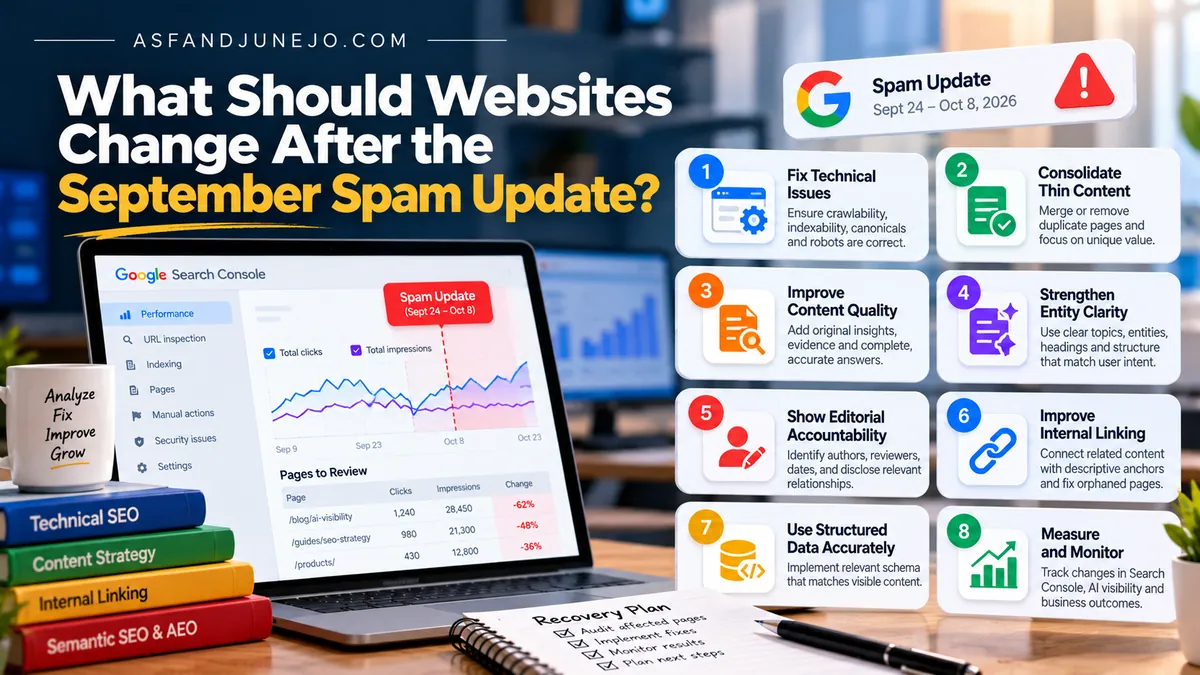
What should websites change after the September spam update?
Not an unconditional SEO overhaul: change only the pages or systems where the investigation finds a specific problem and a defensible user benefit.
1. Repair indexing and accessibility first
For URLs with sustained impression losses, verify the intended canonical, indexability, robots directives, response codes, internal link destinations, rendering and access to primary content. Confirm whether Search generative AI participation settings also permit AI visibility. Eligibility is necessary for possible appearance but never guarantees indexing, ranking or citation.[5][6]
2. Consolidate thin or redundant intent coverage
Cluster affected URLs by task, entity, search intent and template. When pages exist only to target slight variants of the same need, merge their useful material into a canonical resource, redirect retired URLs where justified and repair internal links. Keep separate pages when they serve different tasks or offer independent firsthand evidence.[3][5]
3. Improve semantic clarity and entity relationships
Use descriptive titles and H1 headings, define ambiguous terms, and identify organizations, products, versions, places, scope, dates and conditions, then explain how those entities relate. Do not add entities as decorative keywords: each reference should improve comprehension, precision or verifiability. The entity home page is the clearest example of this on a whole site.
4. Provide direct answers with necessary context
State a useful answer near the beginning, then add the process, evidence, exceptions and next step, as answer-first content does. Do not dismantle complete explanations into hundreds of fragments or build unnecessary FAQs for every query variation. Directness serves readers; it is not a guaranteed ranking or AI-citation signal.[5]
5. Add original research, examples and evidence
Strengthen commodity content with documented tests, original measurements, transparent methods, expert observations, decision criteria or verified examples. Explain the sample and date, what was excluded and what the evidence cannot support. Distinctive, inspectable value matters more than another generic rewrite of existing sources.[5][8]
6. Make editorial responsibility visible
Identify the author, publisher, relevant reviewer, credentials where appropriate and meaningful review dates. Disclose material third-party, sponsored or affiliate relationships. Do not fabricate expertise or use generic author bios as a cosmetic fix.[3][8]
7. Improve internal paths and use accurate structured data
Link from relevant resources to the right canonical answer with meaningful anchor text, fix orphaned pages and avoid redirect chains. Add accurate, eligible structured data only when it matches visible page content. Google does not require special schema.org markup or an AI-specific text file for AI Overviews or AI Mode, and structured data is not an AI-citation switch.[5][10]
8. Measure outcomes and document changes
Track Web visibility, Generative AI impressions, GA4 landing-page outcomes and business KPIs as separate datasets, and record interventions so later observations can be judged against deployment dates and confounding events. Do not call general organic conversions AI-sourced without a valid attribution method; the distinction is the subject of ranking vs retrieval vs citation.[7]
How does the September update relate to AI Overviews and AI Mode?
It should not be described as an update specifically targeting AI Overviews or AI Mode: Google's broader Search policies apply, but the dashboard discloses no AI-feature-specific target.[1][3]
Google explains that its generative AI Search features build on its foundational ranking and quality systems, using retrieval-augmented generation and related-query approaches such as query fan-out to assemble answers from relevant sources. The practical implication is accessible, useful, non-commodity information and sound SEO fundamentals, not a parallel set of guaranteed AEO or GEO tricks.[5]
How do you verify the Search generative AI inclusion control?
As of August 31, 2026, Google says its Search generative AI control was available worldwide. For an eligible property, open Search Console, then Settings, then Search generative AI. The control covers inclusion in supported generative AI features including AI Overviews, AI Mode and generative AI features in Discover. A site may be excluded, or inherit an exclusion from a parent property, and inclusion never promises appearances.[6]
How do you use the Generative AI performance report correctly?
The dedicated report gives impressions for AI Overviews and AI Mode, by page, country, device, date and text-based or multimodal Web search type. It is not a full AI-only funnel of clicks, sessions and conversions. AI-feature impressions are also reflected in broader Web performance, so do not add the two datasets as if they were independent totals.[7]
A missing report is not necessarily a measured zero: the property may lack enough generative-AI impressions or be excluded from eligible features. The interface may also show unavailable values as ~ or -, which can export as numeric zeros. Keep Measured value, Observed zero, Unavailable, Report absent and Not extracted as separate states, and disclose it if the original availability cannot be reconstructed. The report does not document query-level or separate AI Overviews versus AI Mode breakdowns.[7]
Chart totals and page-level table sums can differ because of aggregation conventions, the newest dates can be preliminary, and Search Labs experimental data is excluded. Document the dimension, search type, export date and filters, and whether values are preliminary, missing or recorded as zero.[7]
Which comparison windows should you use after the update?
Use three 15-calendar-day periods in Search Console's Pacific-time convention: baseline September 9 to 23, rollout September 24 to October 8, post-rollout October 9 to 23.
The baseline replaces the original 14-date September 10 to 23 suggestion. These periods suit event analysis; they are not a controlled causal experiment.
| Period | US/Pacific dates | Interpretation |
|---|---|---|
| Baseline | September 9 to 23, 2026 | Fifteen calendar dates before the update began |
| Rollout | September 24 to October 8, 2026 | Fifteen calendar dates touched by the rollout |
| Post-rollout | October 9 to 23, 2026 | Fifteen calendar dates after completion; not yet complete as of October 12 |
The rollout began and ended partway through calendar dates, and equal 15-day periods do not share the same weekday mix. Add weekday-aligned 14- or 28-day comparisons and seasonal or year-over-year context where it matters, and report no final post-rollout finding until the full period is available and the data has settled.[1][4]
How do you calculate comparisons without distorting the data?
Absolute change is the later value minus the earlier value. Percentage change is that difference divided by the earlier value, and a zero denominator returns N/A. CTR is total clicks divided by total impressions, not an average of daily CTRs. Use Search Console's period-level average position where possible; when recomputing from rows, weight position by impressions. A lower position number is generally better but is not a stable exact rank.
Do not mix Search Console clicks with GA4 sessions, or silently combine Pacific-time search dates with GA4 property-timezone dates. Row limits, canonical URL assignment, filters, preliminary measurements and aggregation methods can all change conclusions.[4][7]
How do you prioritize SEO recovery work?
Rank actions by observed impact, strength of evidence, expected user benefit, confidence that the fix addresses the cause, and effort or risk; technical failures and well-evidenced policy conflicts outrank speculative rewrites.
Group related fixes, record deployment dates and avoid changing many unrelated variables at once.

| Decision factor | Priority question | Practical rule |
|---|---|---|
| Impact | Which pages, templates and outcomes are materially affected? | Concentrate on sustained, business-relevant losses. |
| Evidence | Is the issue directly observable or policy-supported? | Prefer verified failures and replicable findings. |
| User benefit | Will the fix make the page more useful or accessible? | Avoid cosmetic edits justified only by ranking speculation. |
| Remedy confidence | Does the action address the documented weakness? | Set testable expectations, not recovery guarantees. |
| Effort and risk | What else could the change break? | Stage risky changes; log owners, dates and dependencies. |
What is the five-question intervention approval check?
Before approving a high-impact fix, ask: what did we observe? What evidence supports and contradicts the hypothesis? What specific change is authorized? Which metric must not deteriorate? Under what condition would we reverse the change? Keeping separate, linked records for the diagnosis, the intervention and the evaluation stops one uncertain ranking observation turning into many untraceable website edits.
Which four recovery milestones should you report separately?
| Milestone | Evidence of completion | What it does not prove |
|---|---|---|
| Deployment | Correct code or content live at the intended URLs | That Google has processed the change |
| Processing | Verified crawling, rendered content, canonical and index signals where relevant | That rankings have improved |
| Search outcome | Comparable clicks, impressions or AI exposure stabilize or improve | That the change caused those movements |
| Business outcome | Leads, sales or other agreed KPIs improve | That AI search can be individually attributed without valid tracking |
Where can you get the free recovery toolkit and guide?
Join Search Signals with your email and two files unlock on this page straight away: the Evidence-Led SEO Recovery Toolkit (Excel) and the Search Visibility Recovery Guide (Word).
The workbook holds the Recovery_Tasks scoring sheet, Hypothesis_Register, Intervention_Log, Recovery_Checkpoints and URL_Population_Map beside an executive Dashboard, and it contains no fabricated website performance data. The fictional case in this post appears only in the article and the guide.
- Evidence-Led SEO Recovery Toolkit v2Excel workbook, 14 sheets, about 1.8 MB
- Search Visibility Recovery GuideWord document: six gates, worked example, reporting and acceptance checklist, about 175 KB
How long does recovery from a spam update take?
Google gives no uniform timeframe; its spam-update documentation says automated systems may need months to learn that a site complies with spam policies after improvements.[2]
That statement does not prove a particular website was affected or guarantee reinstatement of previous visibility. Expectations depend on the real cause: an accidental technical exclusion differs from an established manipulative content system, a market demand contraction or credit lost from artificial links. Judge improvement against the diagnosed issue and meaningful business measures, not a fixed calendar promise.
What mistakes should you avoid after a spam update?
The costly ones are treating timing as proof, deleting or disavowing at scale without evidence, and mixing datasets that measure different things.
- Treating rollout timing as proof of an update-related penalty.
- Labeling every AI-assisted article as scaled-content abuse.
- Running mass disavow campaigns or deleting whole directories without evidence.
- Combining AI impressions and ordinary Web impressions into one total.
- Confusing Search Console clicks, GA4 organic sessions and business conversions.
- Treating schema markup, answer fragments or keyword repetition as guaranteed AI visibility solutions.
- Making broad, unrelated site changes before a stable baseline exists.
- Presenting a few days of October post-rollout performance as a settled recovery verdict.
What should website owners monitor next?
From October 12 onward, keep checking affected pages and queries for sustained changes, and wait for the full October 9 to 23 window before drawing a mature conclusion.
Review Page Indexing, Manual Actions, technical deployments, geographic and device differences, search demand and the Search generative AI inclusion setting when applicable. Keep ordinary Web trends and dedicated Generative AI impressions separate, and compare both with clearly labeled GA4 business outcomes.
Around October 15 a preliminary post-rollout view may be useful. Google's advice to wait at least a full week is written for core updates, so applying a similar interval here is an analytical precaution, not a formal spam-update rule. Run the complete comparison only after the period ends and Search Console data is no longer preliminary.[2][4]
If a policy violation is evidenced, address the underlying publishing practice. If none emerges, keep testing competing explanations rather than blaming an unknown classifier.
Frequently asked questions
Did Google penalize AI-generated content in the September 2026 spam update?
Google did not announce AI-generated content as a specific target. Its scaled-content-abuse policy concerns producing many pages primarily to manipulate rankings, regardless of the creation method, and an AI-assisted page is not by itself proof of a policy violation.[3][9]
Can AI Overviews impressions fall while ordinary search visibility is stable?
Yes. AI exposure and traditional Web performance are related but different measurements, and changes in feature exposure, page inclusion, country and device mix, eligible pages, query activity or reporting can make them diverge. Check the Generative AI report and the site's inclusion control.[6][7]
Should websites remove backlinks because of the September update?
No broad backlink cleanup is warranted solely because traffic moved during the rollout. Investigate actual evidence of manipulative links and understand Google's applicable guidance before acting.[2][3]
Does structured data guarantee AI citations?
No. Google requires no AI-specific schema.org markup for AI Overviews or AI Mode, and valid structured data may support ordinary eligible Search features but cannot guarantee citation, ranking or appearance.[5][10]
When is the post-update comparison reliable?
Only after the October 9 to 23 window has ended and preliminary data has settled; it was still incomplete on October 12. Monitor sooner, and add longer seasonal and weekday-aligned context where appropriate.[4][7]
Final analysis: diagnose the evidence, not the update's reputation
The September 2026 spam update gives you a verified event window, not a universal explanation for ranking losses.[1]
Google confirmed the dates and global scope but did not identify a new policy category, targeted tactic, classifier or site-level cause. The most defensible response is to verify first-party measurements, isolate affected page and query groups, rule out technical and market explanations, compare site practices with Google's actual spam policies, and make changes that are both evidence-supported and useful to readers. Semantic clarity, distinctive analysis, visible editorial accountability, accurate structured data and accessible technical foundations support sustainable Search participation without implying a secret recovery shortcut.
Google's generative AI inclusion controls and impressions reporting add observability, not a guarantee of AI traffic or a replacement for business measurement. A recovery program is defined by the quality of its diagnosis, not by how many optimization tasks are done right after an announcement. The update is a reason to check the integrity and usefulness of your search presence, not a reason to invent explanations for every traffic movement.
Sources and research methodology
Every factual claim above traces to Google's own documentation, listed below; the tables are analytical frameworks, not measured results from a particular website.
This analysis separates officially confirmed events, diagnostic hypotheses and unverified claims. As of the review date, October 12, 2026, the October 9 to 23 post-rollout window is incomplete.
- Google Search Status Dashboard. September 2026 spam update. status.search.google.com (opens in a new tab)
- Google Search Central. Google Search spam updates and your site. developers.google.com (opens in a new tab)
- Google Search Central. Spam policies for Google Web Search. developers.google.com (opens in a new tab)
- Google Search Central. Debugging drops in Google Search traffic. developers.google.com (opens in a new tab)
- Google Search Central. Optimizing your website for generative AI features on Google Search. developers.google.com (opens in a new tab)
- Google Search Console Help. Search generative AI control. support.google.com (opens in a new tab)
- Google Search Console Help. Generative AI performance report (Search). support.google.com (opens in a new tab)
- Google Search Central. Creating helpful, reliable, people-first content. developers.google.com (opens in a new tab)
- Google Search Central. Google Search's guidance on using generative AI content on your website. developers.google.com (opens in a new tab)
- Google Search Central. Introduction to structured data. developers.google.com (opens in a new tab)
Confirmed Dates and scope: Google Search Status Dashboard. Hypothesis The diagnostic tables and the six-gate method are editorial frameworks.