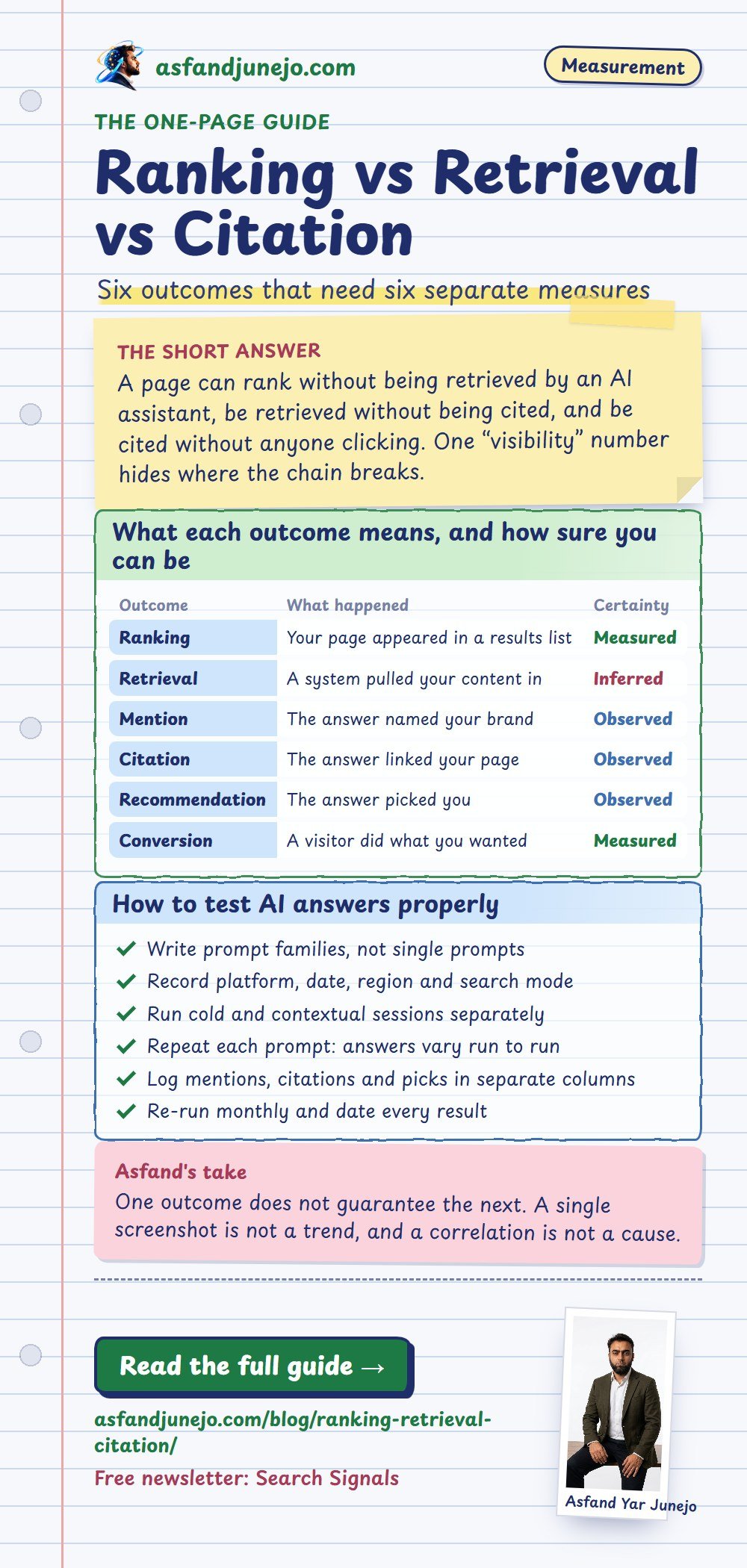
Ranking, retrieval, mention, citation, recommendation and conversion are six different outcomes, and one does not guarantee the next. A page can rank without being retrieved by an AI assistant, be retrieved without being cited, and be cited without anyone clicking. Measuring them as one “visibility” number hides where the chain actually breaks.
Published · Last reviewed · By Asfand Yar Junejo, publisher asfandjunejo.com
What does each outcome mean?
Each one describes a different moment between a question being asked and a customer acting on the answer.
| Outcome | What happened |
|---|---|
| Ranking | Your page appeared at a position in a list of results |
| Retrieval | A system pulled your content into what it used to build an answer |
| Mention | The answer named your brand |
| Citation | The answer linked your page as a source |
| Recommendation | The answer suggested you as the choice |
| Conversion | Someone arrived and did what you wanted them to do |
Which outcomes can actually be measured?
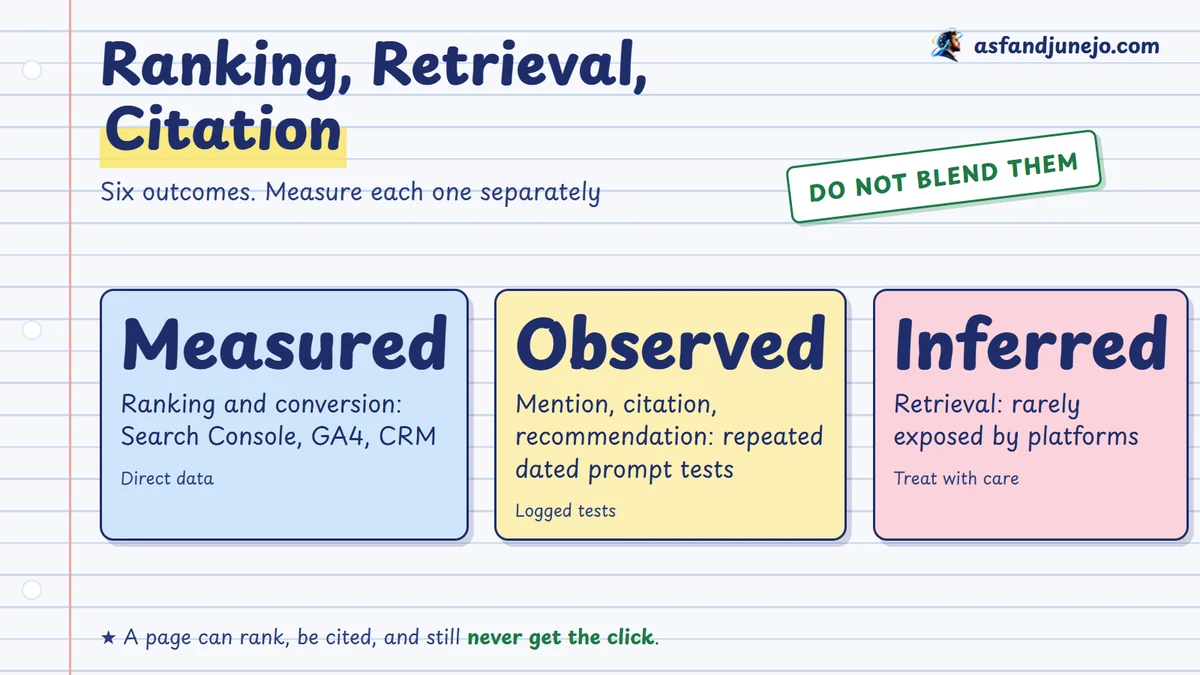
Rankings and conversions can be measured directly; mentions and citations can be observed by testing; retrieval mostly has to be inferred.
| Outcome | How | Certainty |
|---|---|---|
| Ranking | Search Console, rank trackers | Measured |
| Retrieval | Rarely exposed by platforms | Inferred |
| Mention / citation | Repeated, logged prompt tests | Observed |
| Recommendation | Decision-stage prompt tests | Observed |
| Referral | Analytics referrer data, partly | Partly measured |
| Conversion | GA4 or CRM events | Measured |
How do you test AI answers properly?
Treat every prompt test as an experiment: fix the conditions, repeat it, log everything and compare like with like.
- Write prompt families, not single prompts: informational, comparison and decision-stage questions
- Record the conditions: platform, model if shown, date, region, signed in or not, search mode
- Separate cold and contextual tests: a fresh chat behaves differently from a long conversation
- Repeat each prompt several times, because answers vary run to run
- Log mentions, citations and recommendations as separate columns
- Re-run monthly and date every result, since platforms change without notice
How do you log all six outcomes in one prompt test?
Test each query twice, in a cold session and in a contextual follow-up, and record the six outcomes in separate columns instead of one combined score.
A cold session means a clean browser profile, logged out, with no earlier conversation. This is the blank logging template; it contains no results.
| Column | What to record |
|---|---|
| Prompt and session | The exact wording, copied, and whether the session was cold or a contextual follow-up |
| 1. Ranking | Search Console average position for the target URL |
| 2. Retrieval | Whether the page was fetched or a passage from it was used |
| 3. Mention | Whether the brand is named in the answer text |
| 4. Citation | Whether the answer links to the domain |
| 5. Recommendation | Whether the brand is positioned first or presented as the pick |
| 6. Conversion | The click or inquiry, traced to its source |
A downloadable Prompt Tracker for this is on the measurement method page, with the columns to record each run.
How do you separate AI citations from search clicks in GA4 and Search Console?
Use two tracks: referral sessions in GA4 for the visits an assistant sends, and branded-query trends in Search Console for the citations that send no click.
- AI referral sessions (GA4). Filter session source with a pattern for the assistants you track, for example
chatgpt\.com|perplexity\.ai|claude\.ai|gemini\.google\.com|copilot\.microsoft\.com. Compare conversion rate and engaged time with organic search rather than assuming either is higher. Referrer names change, so review the list regularly. - Zero-click citations (Search Console plus the prompt log). A citation without a click often shows up as more exact-brand and “brand + service” queries. Compare weekly branded impressions against the dated prompt-log entries.
Before you trust either track, know why GA4 sessions and Search Console clicks never match; this guide to connecting Claude to both safely explains the differences and how to reconcile them.
Directional Branded-query growth is consistent with, but does not prove, an AI citation as the cause
What are the common measurement mistakes?
Treating one screenshot as a trend, and treating a correlation as a cause.
- Reporting a single AI answer as proof of visibility
- Adding mentions and citations together into one score
- Crediting a change for a rise that also happened to competitors
- Comparing results taken on different platforms or dates
- Hiding tests that came back negative or inconclusive
The GEO Visibility Index in the Lab applies this routine to citation tracking.
Why does one "AI visibility" score hide the real problem?
Because each outcome has a different cause and a different fix, and a blended score cannot tell you which link in the chain failed.
Imagine a brand that is not named in an AI answer. The cause could be that the page is not crawlable, that it is crawlable but never ranks for the question, that it ranks but its passage does not answer the question cleanly, or that the passage is used but the brand name never appears in it. Those are four different jobs for four different people: a developer, an SEO, an editor and a brand manager. A single "visibility: 12%" figure points at none of them.
Separating the outcomes turns a vague complaint ("AI does not mention us") into a diagnosis ("we rank, we are cited, but the answer recommends a competitor"). That is a much shorter route to a fix, and it also stops you taking credit for a good number that has nothing to do with your work.
Confirmed Google says generative AI search is still search, so ordinary crawl, index and quality practices apply to the first links in the chain. Directional How the later links behave differs by platform and changes without notice.
What does each link in the chain depend on?
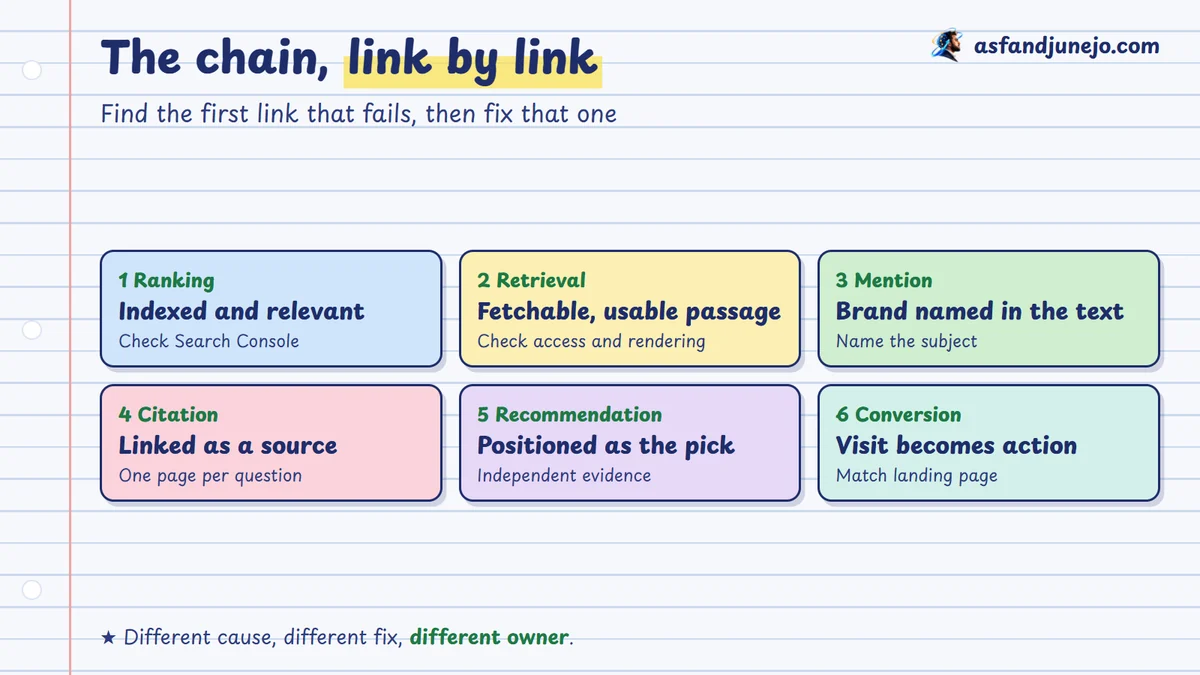
Ranking depends on classic search signals, retrieval on how an assistant picks and reads sources, mention and citation on what the passage says, recommendation on how the answer is framed, and conversion on the page the visitor lands on.
| Outcome | Mainly depends on | First thing to check when it is missing |
|---|---|---|
| Ranking | Crawlability, indexing, relevance, quality and links | Is the URL indexed, and for which queries does Search Console show it? |
| Retrieval | Whether a system can fetch the page and finds a passage worth using | Is the page blocked by robots.txt or login, slow, or rendered only by script? |
| Mention | The brand name sitting next to the answer in the source text | Does the passage name the brand, or only say "we"? |
| Citation | A page the assistant treats as a source for that claim | Is there a page that answers this exact question, with a stable URL? |
| Recommendation | Comparative evidence, reviews, and how the question is framed | Do independent sources support the claim that you are the right choice? |
| Conversion | Landing page clarity, offer fit and trust | Does the landing page answer the question the visitor arrived with? |
What is the difference between a mention, a citation and a recommendation?
A mention names your brand, a citation links to your page as a source, and a recommendation positions you as the choice; an answer can contain any one without the others.
- Mention without citation: the assistant knows your name from training data or other sites but does not link to you. You gain awareness, not a visit.
- Citation without mention: your page is listed as a source, but the answer text never says your name. You may get a click without brand recall.
- Mention with a negative frame: the answer names you as an example of what to avoid. Counting it as a win would be a reporting error, so record the sentiment in its own column.
- Recommendation: the answer presents you as the pick for a decision-stage question such as "which provider should I choose for..."; this is the outcome closest to revenue and the hardest to earn.
This is why the log template in this post keeps three separate columns. When a client asks for "citations", ask which of the three they mean, because the work and the evidence differ for each.
Why do AI answers change between runs, and how should you handle it?
Generated answers are not fixed documents: wording, sources and brand lists can vary between runs, accounts, locations and dates, so one result is an anecdote and only repeated, dated tests show a pattern.
Treat a prompt like a survey question. Ask it several times under the same conditions, record how often each outcome appears, and report that as a rate with its date range rather than as a yes or no. When the rate moves, check whether the platform, model or search mode changed before you credit your own work.
- Fix the conditions you control: same wording, same session type, same region, same search mode
- Run each prompt more than once and keep every run, including the ones that do not mention you
- Report a rate and a range ("appeared in 3 of 5 runs, 1 to 8 November"), never a single screenshot
- Note platform changes in the log so a jump or drop can be explained
- Include competitors in the same prompts so you can tell a market-wide shift from a change that only affects you
Directional Run-to-run variation is widely observed by practitioners; this post gives no universal number of runs because none has been established.
How do you design prompt families that match the buying journey?
Write prompts for each stage of the decision, because informational, comparison and decision-stage questions pull different sources and test different outcomes.
| Stage | Example prompt pattern | Outcome it mainly tests |
|---|---|---|
| Learn | "What is [topic] and how does it work?" | Retrieval and citation of explanatory pages |
| Compare | "[Option A] vs [Option B] for [use case]" | Mention, plus which sources frame the comparison |
| Shortlist | "Best [service] providers for [audience]" | Mention and recommendation |
| Decide | "Is [brand] a good choice for [need]?" | Recommendation and sentiment |
| Act | "How do I contact or buy from [brand]?" | Referral and conversion path |
Keep five to ten prompts per stage that real customers use, taken from sales calls, support tickets and Search Console queries, not invented from your own vocabulary. If you are building briefs from customer language, turning customer interviews into an AI-assisted content brief shows how.
How do you read the results and decide what to fix first?
Find the first link in the chain that fails, fix that, and only then move to the next, because improving a later link does little while an earlier one is broken.
| Pattern in the log | Likely meaning | First fix to try |
|---|---|---|
| No ranking for the target query | Indexing, relevance or quality gap | Check indexing and the page's match to the query in Search Console |
| Ranks, but never cited | The passage does not answer the question cleanly | Rewrite the section answer-first with the subject named |
| Cited, but brand not named | The source text never ties the answer to your name | Name the brand in the answer sentence and on the entity page |
| Named, but not recommended | Weak independent corroboration or unclear fit | Add evidence, case detail and third-party references; state who it is for |
| Cited, but few visits convert | Landing page does not match the answer's promise | Align the landing page headline and first paragraph with the cited claim |
| Name is wrong or mixed with another entity | Entity signals are inconsistent | Build a single entity home page and align profiles |
Hypothesis The "likely meaning" column is a diagnostic starting point from practice, not a documented rule; verify each against your own data before acting.
How should you report the six outcomes to a client or a manager?
Report each outcome separately with its method and certainty label, show the trend against the prior period, and end with the single next action for the weakest link.
- One row per outcome, each tagged measured, observed or inferred
- Date range and sample size next to every prompt-based number
- Competitors in the same table, so context is visible
- Negative and inconclusive results kept in; hiding them makes the next report untrustworthy
- One recommended action, tied to the first failing link
For the reporting mechanics in GA4 and Search Console, see AI visibility tracking: citations, referrals and qualified leads and automated weekly SEO reporting. Google also describes a Generative AI performance report in Search Console in its optimization guide, which is the first-party source to check before trusting a third-party number.
Frequently asked questions
Can a page rank without being cited by an AI assistant?
Yes. Ranking, retrieval, mention, citation, recommendation and conversion are six different outcomes. A page can rank without being retrieved, be retrieved without being cited, and be cited without anyone clicking.
Which of the six outcomes can be measured directly?
Rankings and conversions can be measured directly (Search Console, rank trackers, GA4 or CRM events). Mentions and citations can be observed by repeated, logged prompt tests. Retrieval is rarely exposed by platforms, so it is mostly inferred.
What is the difference between an AI mention and an AI citation?
A mention means the answer names your brand in its text. A citation means the answer links to your page as a source. Either can happen without the other, so log them in separate columns.
How many times should an AI prompt be tested?
Several times, because answers vary from run to run; the post gives no fixed number. Record the platform, date, region, signed-in state and search mode, and re-run monthly with dated results.
How do you find AI referral traffic in GA4?
Filter session source with a pattern for the assistants you track, for example chatgpt\.com|perplexity\.ai|claude\.ai|gemini\.google\.com|copilot\.microsoft\.com, and review the list regularly because referrer names change. Compare conversion rate and engaged time with organic search rather than assuming either is higher.
Does a rise in branded searches prove an AI citation?
No. Growth in exact-brand queries is consistent with an AI citation but does not prove it as the cause. Compare weekly branded impressions against dated prompt-log entries and treat the result as directional.
What should you fix first when AI answers do not mention your brand?
Fix the first failing link in the chain. Check indexing and ranking first, then whether the page answers the question in a quotable passage, then whether the passage names the brand, and only then work on recommendation signals such as independent corroboration.
Is there a Google report for AI feature traffic?
Google's optimization guide points to the Generative AI performance report in Search Console for how people find content through generative AI features, and warns that third-party tools cannot access Google's internal metrics, so check their advice against official guidance.
Sources
- Google Search Central, Guide to optimizing for generative AI features on Google Search (opens in a new tab).
- Google Search Central, Creating helpful, reliable, people-first content (opens in a new tab).
- Measurement method on this site, How runs are recorded, and the downloadable Prompt Tracker (opens in a new tab).