AI in SEO should automate repeatable analysis and production, support evidence-based recommendations, and execute only authorized changes. Strategic decisions, factual verification, risk acceptance, and accountability must remain under the governance of clearly defined human responsibilities and technical controls.
Published · Last reviewed · By Asfand Yar Junejo, publisher asfandjunejo.com

The most effective approach is to evaluate every AI-assisted SEO task against five factors: business impact, reversibility, data sensitivity, evidence reliability, and operational scale. Those factors determine how much verification, supervision, and execution control the task requires.
This distinction matters because generating a recommendation is not the same as establishing its correctness.
An AI assistant can analyze thousands of Google Search Console records, identify overlapping search queries, recommend content consolidation, or generate technical SEO changes. However, the accuracy of its interpretation depends on the underlying evidence, while the suitability of its recommendations depends on the website’s architecture, audience needs, and business objectives.
An incorrect interpretation may waste analytical effort. An incorrect recommendation implemented across thousands of URLs may create considerably greater consequences.
As AI evolves from a research assistant into an operational agent, SEO teams need more than effective prompts and editorial review.
They need a system for determining what AI can do, which conclusions can be trusted, and what must happen before a recommendation becomes a production change.
To address this, I propose three connected decision models:
- SEO AI Delegation Ladder: Defines whether AI is exploring, drafting, recommending, or executing.
- Five-Dimensional Risk Model: Determines the safeguards required for a particular task.
- Six-Stage SEO AI Governance Framework: Establishes how work moves from classification and evidence verification to authorized execution and measurable outcomes.
Together, these models provide a practical approach to adopting AI without outsourcing SEO judgment.
Why Does AI in SEO Need Decision Governance?
The main risk of AI-assisted SEO is allowing an automated system to make or influence consequential decisions without sufficient evidence, appropriate permissions, or clear accountability.

AI can accelerate the production of information, but producing information and making a justified decision are separate activities.
Consider an SEO specialist investigating a decline in organic traffic.
An AI assistant reviews Search Console data and suggests that several landing pages have lost visibility due to insufficient content depth.
The explanation sounds plausible.
However, the data may show only that clicks or impressions declined. It does not automatically establish why the decline occurred.
Possible explanations include changes in search demand, altered query composition, technical accessibility issues, indexing changes, competitor activity, or changes in search-result presentation.
Rewriting the pages may be appropriate in some circumstances, but the available evidence must support that decision.
Google Search Console also has reporting limitations. Some queries are anonymized, and performance data can be aggregated differently depending on the selected dimensions. An exported dataset must therefore be interpreted within the boundaries of what it actually reports.[1]
The distinction is fundamental:
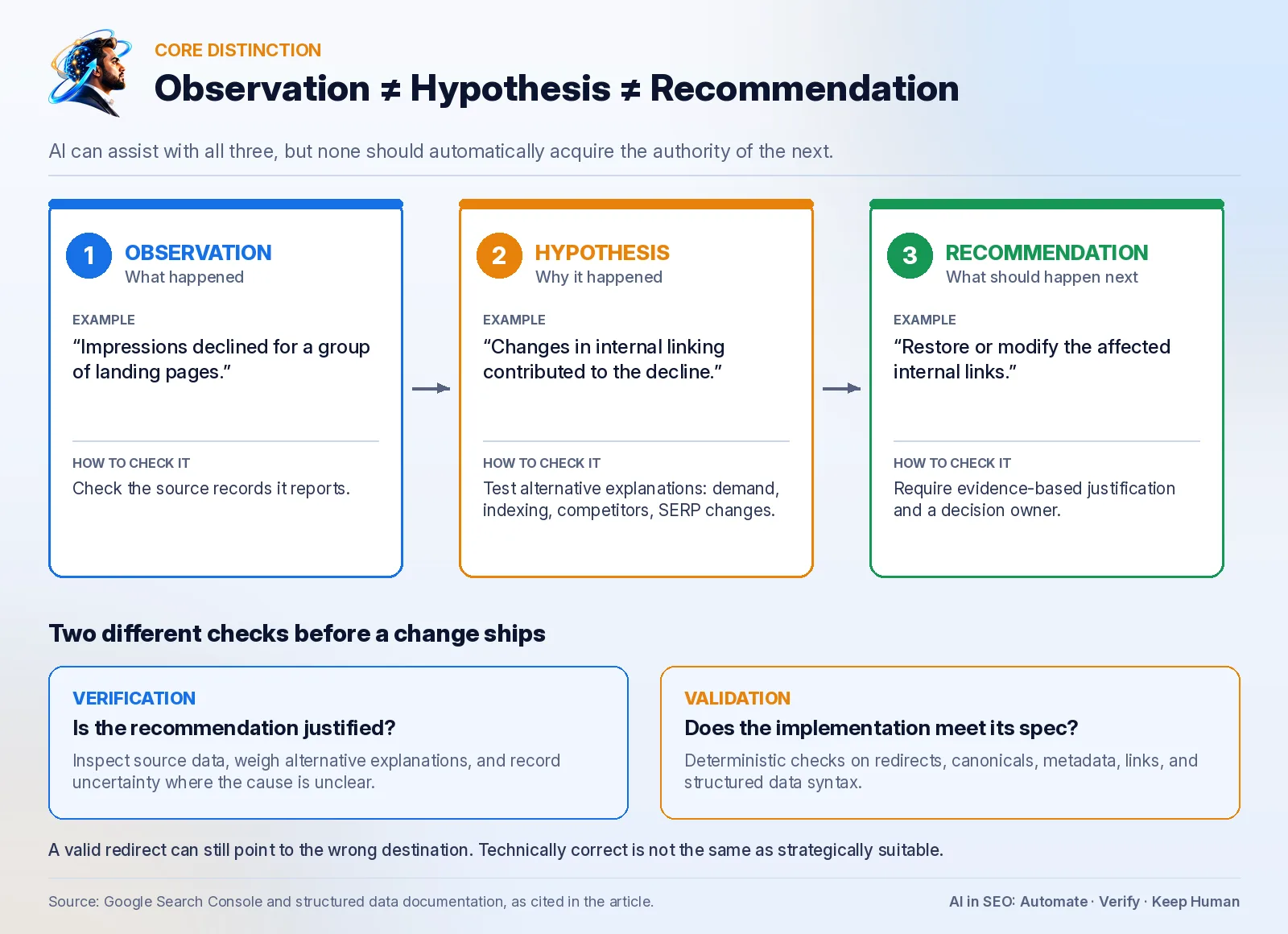
An observation describes what happened. A hypothesis proposes why it happened. A recommendation proposes what should happen next.
AI can assist with all three, but none should automatically acquire the authority of the next.
The three failures that undermine AI SEO performance
In the October 2026 Majestic SEO panel, Are You Using AI the WRONG Way in SEO?, four practitioners discussed the risks of replacing expert thinking with generated answers. Rejoice Ojiaku, Giulia Panozzo, Eli Schwartz, and Sante Achille also challenged the habit of prioritizing production volume over useful outcomes.
Ojiaku emphasized the danger of accepting confident AI outputs without adequate analysis. Panozzo questioned approaches that treat AI usage itself as an indicator of productivity. The broader discussion reinforced the need to evaluate AI according to the quality of the work it supports.[2]
These concerns translate into three operational failures.
Unverified diagnosis: AI generates explanations that appear convincing but are insufficiently supported by the available evidence. The appropriate control is independent verification, including source inspection and alternative hypotheses.
Interchangeable content: AI increases publication volume without adding meaningful information. The appropriate control is an editorial process that evaluates page purpose, factual accuracy, and distinct user value.
Misleading productivity: Organizations measure prompts, generated articles, or automated tasks without accounting for verification costs, errors, or business outcomes. The appropriate control is measurement against a comparable manual baseline.
The problem is not necessarily that AI produces imperfect outputs.
Human specialists also make mistakes.
The organizational risk arises when errors pass through the workflow undetected, unchallenged, or inadequately controlled.
An effective system must therefore distinguish between defects identified during preparation and defects that reach production.
This creates a more useful standard for automation. The question is not whether AI can perform a task without ever making an error. It is whether the complete workflow can produce acceptable outcomes at a defensible cost and level of risk.
What Should AI Automate in SEO? The SEO AI Delegation Ladder
AI can support four levels of SEO activity: Explore, Draft, Recommend, and Execute. Each level requires a different degree of evidence, authorization, and human involvement.
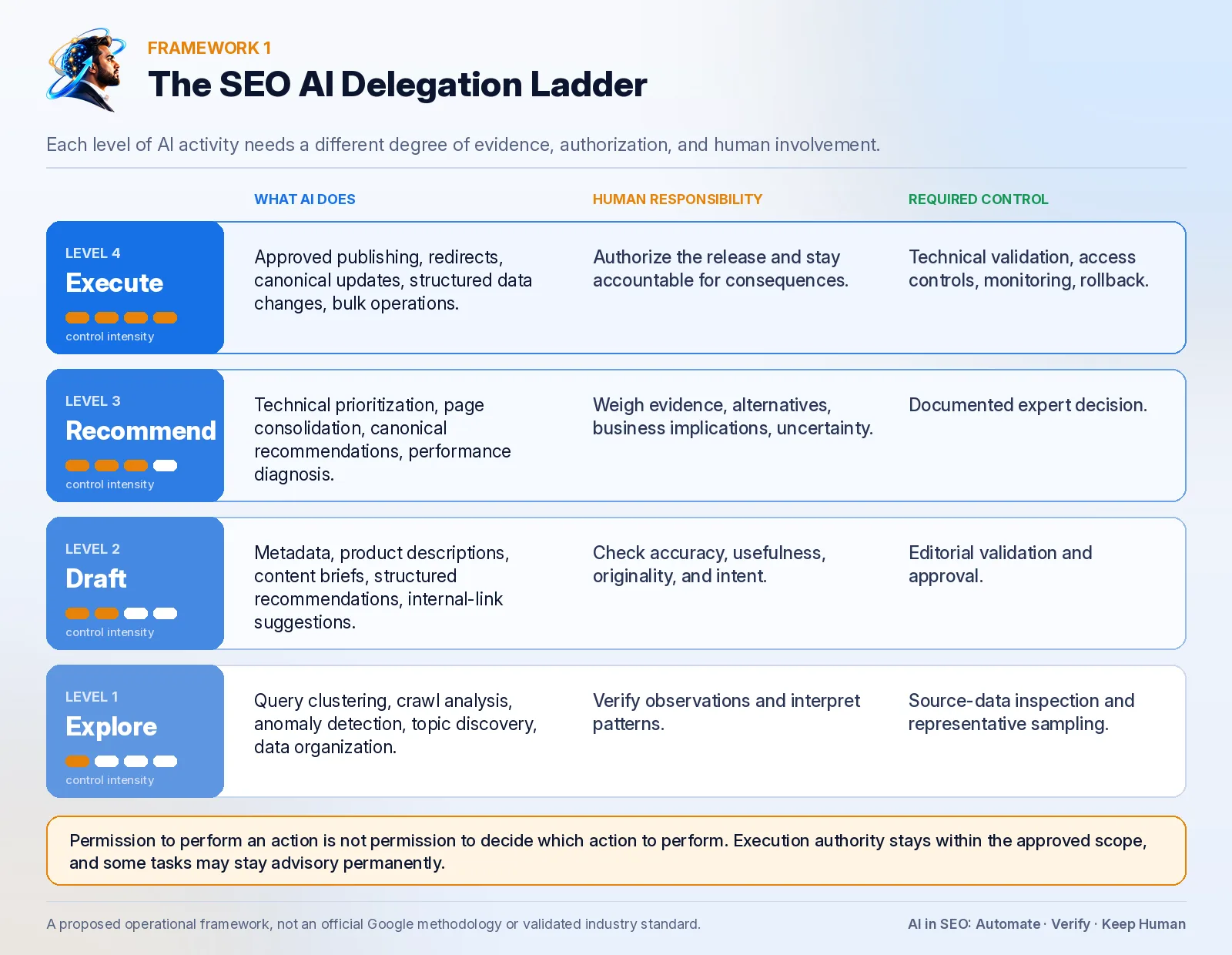
The SEO AI Delegation Ladder is a proposed operational framework for assigning responsibilities. It is not an official Google methodology or an independently validated industry standard.
| Delegation level | Appropriate AI activities | Human responsibility | Required control |
|---|---|---|---|
| 1. Explore | Query clustering, crawl analysis, anomaly detection, topic discovery, and data organization. | Verify observations and interpret patterns. | Source-data inspection and representative sampling. |
| 2. Draft | Metadata, product descriptions, content briefs, structured recommendations, and internal-link suggestions. | Check accuracy, usefulness, originality, and intent. | Editorial validation and approval. |
| 3. Recommend | Technical prioritization, page consolidation, canonical recommendations, and performance diagnosis. | Evaluate evidence, alternatives, business implications, and uncertainty. | Documented expert decision. |
| 4. Execute | Approved publishing, redirects, canonical updates, structured data changes, and bulk operations. | Authorize the release and remain accountable for its consequences. | Technical validation, access controls, monitoring, and rollback procedures. |
Level 1: Explore
At the exploratory level, AI helps identify information that deserves further investigation.
For example, it may group queries by apparent search intent, identify unusual performance changes, or flag pages with overlapping organic visibility.
These outputs are analytical candidates rather than established conclusions.
Two pages receiving impressions for similar queries do not necessarily compete harmfully with one another. They may address different audiences, stages of the buying journey, or commercial requirements.
The specialist must establish whether a meaningful problem exists before recommending a change.
Level 2: Draft
Drafting allows AI to transform approved source information into preliminary content or implementation materials.
An e-commerce company might generate product descriptions using verified dimensions, materials, applications, and technical specifications.
The system should preserve product-specific differences and identify missing information rather than inventing plausible attributes.
Human review determines whether the resulting content is accurate, relevant, and sufficiently useful to publish.
Level 3: Recommend
At the recommendation level, AI proposes actions that may influence website architecture, content strategy, or development priorities.
For example, an AI assistant may suggest consolidating two pages because they share several ranking queries.
Before accepting that recommendation, the specialist must determine whether the pages serve the same search intent, attract distinct audiences, or support separate commercial objectives.
The recommendation requires an evidence-based justification.
Confidence in the model’s wording does not substitute for that evidence.
Level 4: Execute
Execution allows AI to perform specifically authorized actions through connected systems.
Examples include publishing approved metadata, implementing verified redirect mappings, or updating structured data in accordance with a documented specification.
The distinction at this level is between permission to perform an action and permission to decide which action to perform.
An agent authorized to implement a defined set of canonical updates should not independently expand the task into a broader website-restructuring project.
Execution authority must remain limited to the approved scope.
The ladder does not imply that every organization should progress toward complete autonomy.
Some SEO activities may remain permanently advisory because their consequences require contextual judgment that cannot be adequately reduced to predetermined rules.
How Should SEO Teams Classify AI Automation Risk?
SEO automation risk should be classified using business impact, reversibility, data sensitivity, evidence reliability, and operational scale. The combined assessment determines whether the workflow requires lightweight review, stronger approval, or restricted execution.
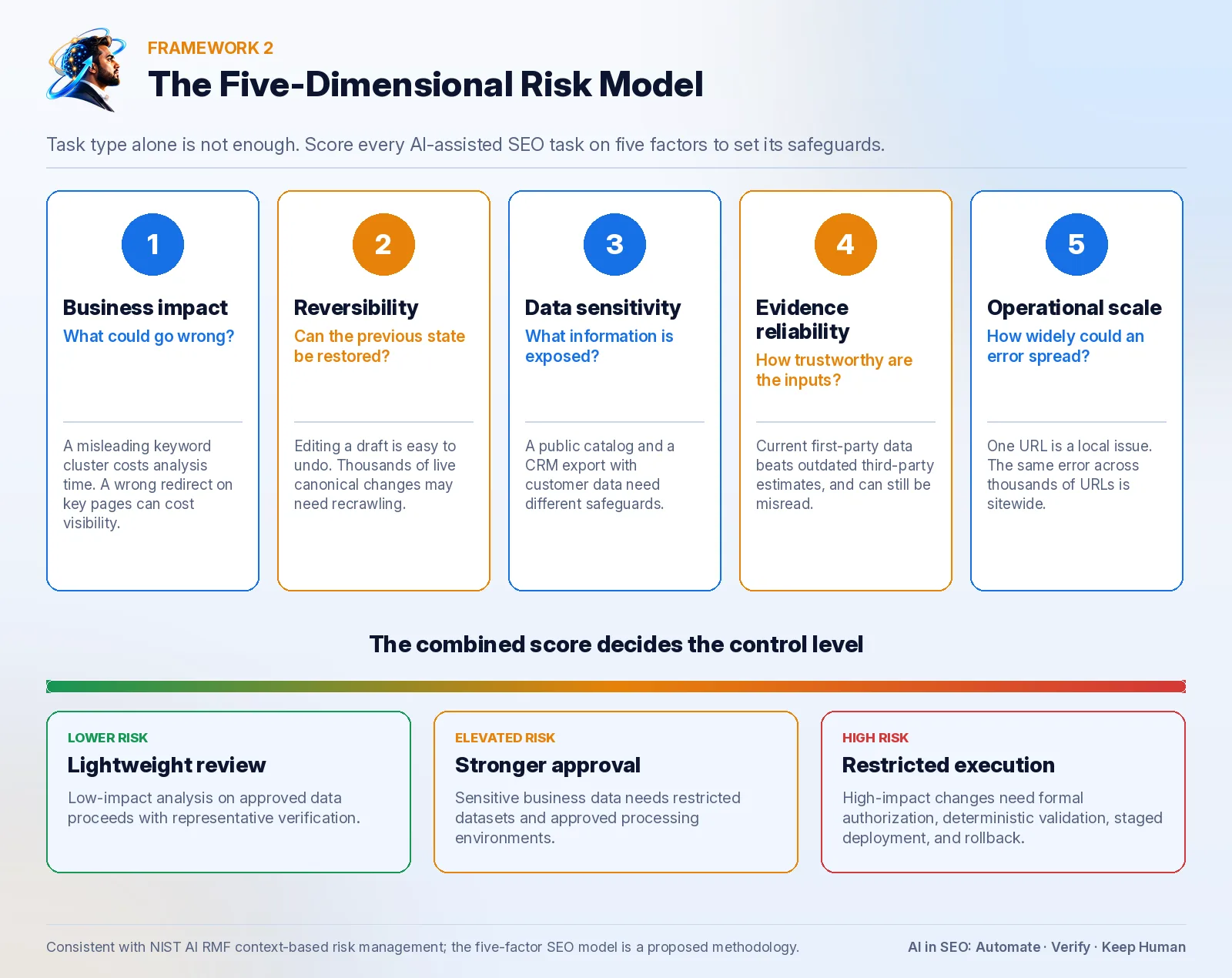
Task type alone is insufficient.
Generating a single meta description and generating descriptions for an entire e-commerce catalog are both drafting activities, but their operational consequences differ.
Likewise, analyzing a small public keyword dataset and analyzing confidential customer information may both be exploratory activities, yet present substantially different data-governance requirements.
Business impact: What could go wrong?
Business impact measures the potential consequences of an incorrect output or action.
A misleading keyword cluster may require additional analysis.
An incorrect redirect on commercially important pages may interfere with access to those pages and pose search visibility risks.
Impact should be evaluated against the actual website and its business objectives.
The same technical change can have different consequences depending on the affected URLs, conversion paths, and underlying business operations.
Reversibility: Can the previous state be restored?
Reversibility measures how easily the organization can correct an action and recover from its consequences.
Updating an unpublished draft is generally easier to reverse than changing thousands of live canonical tags.
Even when a technical rollback is straightforward, search engines may require additional time to recrawl affected pages.
Therefore, reversibility should account for both technical recovery and potentially persistent consequences.
Data sensitivity: What information is exposed?
Data sensitivity concerns the information made available to the AI system.
A public product catalog and a CRM export containing customer information require different safeguards.
The organization should determine whether the information is authorized for the intended processing, whether unnecessary fields can be excluded, and whether the selected AI service meets applicable privacy and security requirements.
Evidence reliability: How trustworthy are the inputs?
Evidence reliability evaluates the quality, completeness, and relevance of the information supporting an AI-generated conclusion.
Current first-party performance data provides a different foundation from outdated third-party estimates or incomplete exports.
However, even reliable data can be interpreted incorrectly.
An AI assistant might identify a relationship between declining impressions and a recent website change without establishing that the change caused the decline.
The workflow should document such uncertainty rather than present a possible explanation as a verified diagnosis.
Operational scale: How widely could an error spread?
Scale measures the reach of a potential defect.
An incorrect recommendation affecting one URL may create a localized issue.
The same recommendation implemented across thousands of URLs could affect a substantial portion of the website.
As scale increases, organizations may require stronger sampling, automated validation, exception handling, deployment limits, and recovery procedures.
A successful small deployment does not establish that unrestricted sitewide execution is safe.
How risk classification changes the decision
Risk assessment should lead to an explicit operational decision.
A low-impact analysis using approved data may proceed with representative verification.
A workflow involving sensitive business information may require restricted datasets and approved processing environments, even when it has no production access.
A high-impact technical change may require formal authorization, deterministic validation, staged deployment, and a documented rollback procedure.
These safeguards address different sources of risk.
Reliable data does not eliminate execution risk, and human approval does not eliminate the need for technical validation.
The organization must identify who has the authority to accept residual risk before proceeding with consequential actions.
This approach is consistent with the broader principle of context-based AI risk management, as reflected in NIST’s AI Risk Management Framework. However, the five-dimensional SEO model presented here is a distinct proposed methodology.[3]
How Does an Evidence-Governed AI SEO Workflow Operate?
An evidence-governed AI SEO workflow follows six stages: Classify, Control, Verify, Validate, Measure, and Evaluate. Each stage answers a different operational question and prevents unsupported recommendations from becoming uncontrolled actions.
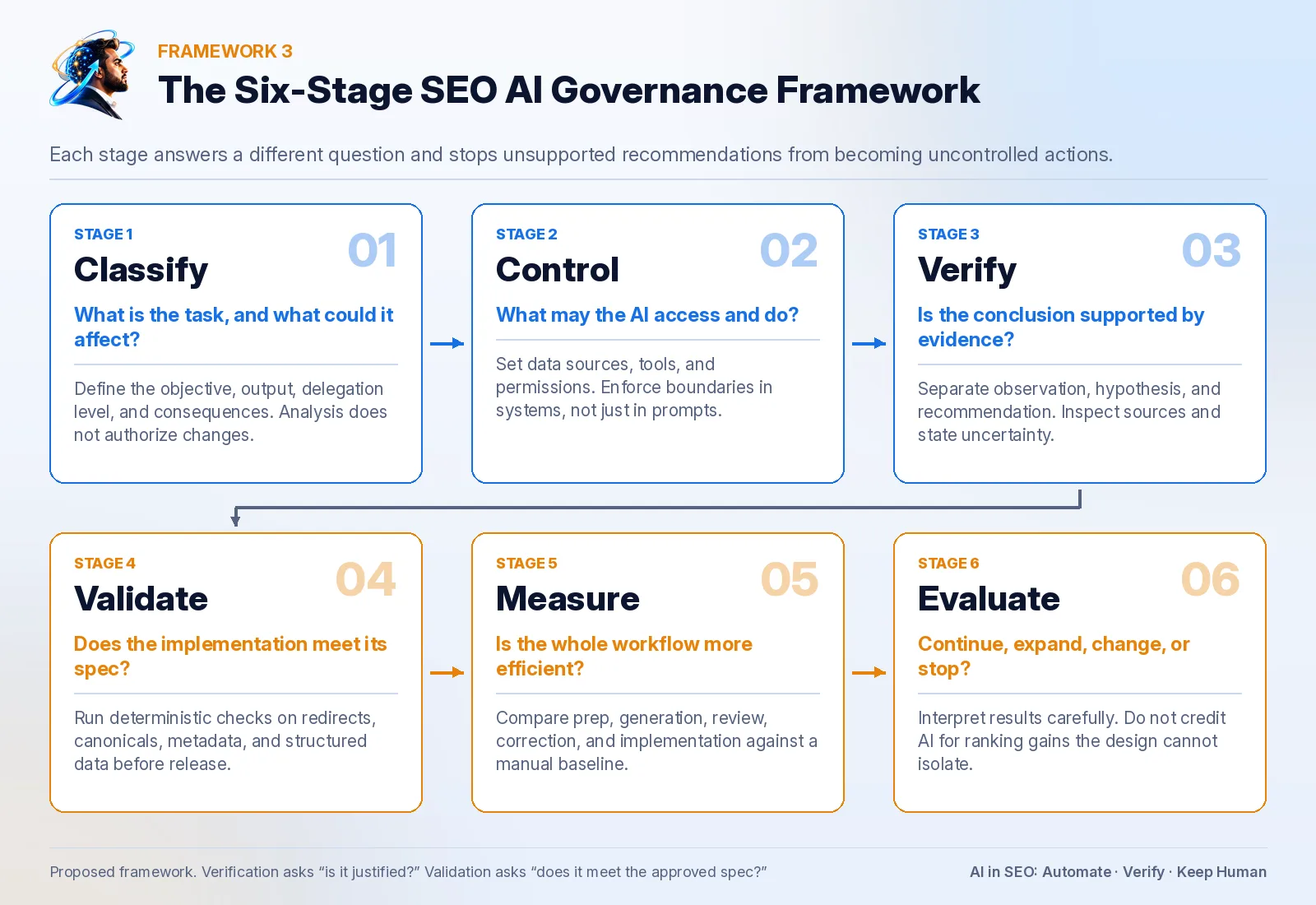
The framework connects task delegation and risk assessment to implementation.
Stage 1: Classify the task
The organization defines the objective, expected output, delegation level, and potential consequences.
For example, a request to investigate declining category-page impressions should begin as an analytical task.
It should not automatically authorize the AI system to modify the affected pages.
The analyst establishes what question must be answered and what evidence would support a reliable conclusion.
If the objective or available information is insufficiently defined, the task should be clarified before automation begins.
Stage 2: Control the operating environment
The organization specifies which data sources, tools, permissions, and integrations the AI system may use.
An analytical assistant may receive read-only access to approved datasets.
A content-drafting system may receive product information without publishing permissions.
A technical execution agent may receive narrowly scoped access to specified configurations or resources.
Critical boundaries should be enforced by the surrounding systems and permissions, not merely by instructions in a prompt.
Stage 3: Verify the evidence
Verification determines whether an AI-generated conclusion is supported by inspectable information.
A reliable verification process distinguishes between an observed condition, a proposed explanation, and a recommended action.
For example:
An observation may show that impressions declined for a group of landing pages.
A hypothesis may suggest that changes in internal linking contributed to the decline.
A recommendation may propose restoring or modifying links.
Each requires a different form of verification.
The analyst should inspect source records, evaluate alternative explanations, and determine whether the available evidence supports the proposed conclusion.
Where the cause remains uncertain, the record should explicitly state that uncertainty.
Stage 4: Validate the implementation
Validation determines whether a proposed implementation satisfies defined technical and operational requirements.
This differs from verification.
Verification asks whether the recommendation is justified. Validation asks whether the implementation meets its approved specification.
For technical SEO, deterministic checks can verify redirect destinations, deployed canonical mappings, required metadata, link behavior, and structured data syntax.
However, technical correctness does not establish strategic suitability.
A valid redirect may still point to an inappropriate destination.
A syntactically correct canonical tag may still identify the wrong preferred URL.
Google also explains that valid structured data does not guarantee eligibility or appearance in every search feature. Its content and feature-specific policies still apply.[4]
Therefore, automated validation should be combined with contextual review where necessary.
Consequential changes should pass the required checks before an authorized release.
Stage 5: Measure operational performance
Measurement determines whether the AI-assisted workflow improves efficiency while maintaining acceptable quality.
The organization should compare the complete process with an appropriate baseline.
That comparison includes preparing inputs, running the system, reviewing outputs, correcting defects, and completing implementation.
The objective is not merely to determine whether AI generated the initial result faster.
It is to determine whether the complete workflow produces an acceptable result more efficiently.
Stage 6: Evaluate outcomes and decide what happens next
Evaluation interprets the measured results and determines whether the workflow should continue, expand, change, or stop.
Operational improvements can often be evaluated relatively quickly.
SEO performance requires more cautious interpretation.
Organic search results are affected by demand, competition, indexing behavior, changes to search results, and other website modifications.
Unless the evaluation design adequately controls for those influences, improvements observed after deployment should not automatically be attributed to the AI-assisted intervention.
The completed evaluation should therefore distinguish observed outcomes from unsupported causal claims.
When Should an AI SEO Recommendation Be Rejected? A Practical Example
An AI-generated SEO recommendation should be rejected when its proposed action is unsupported by available evidence, conflicts with the page’s intent, or poses risks that outweigh its demonstrated benefits.
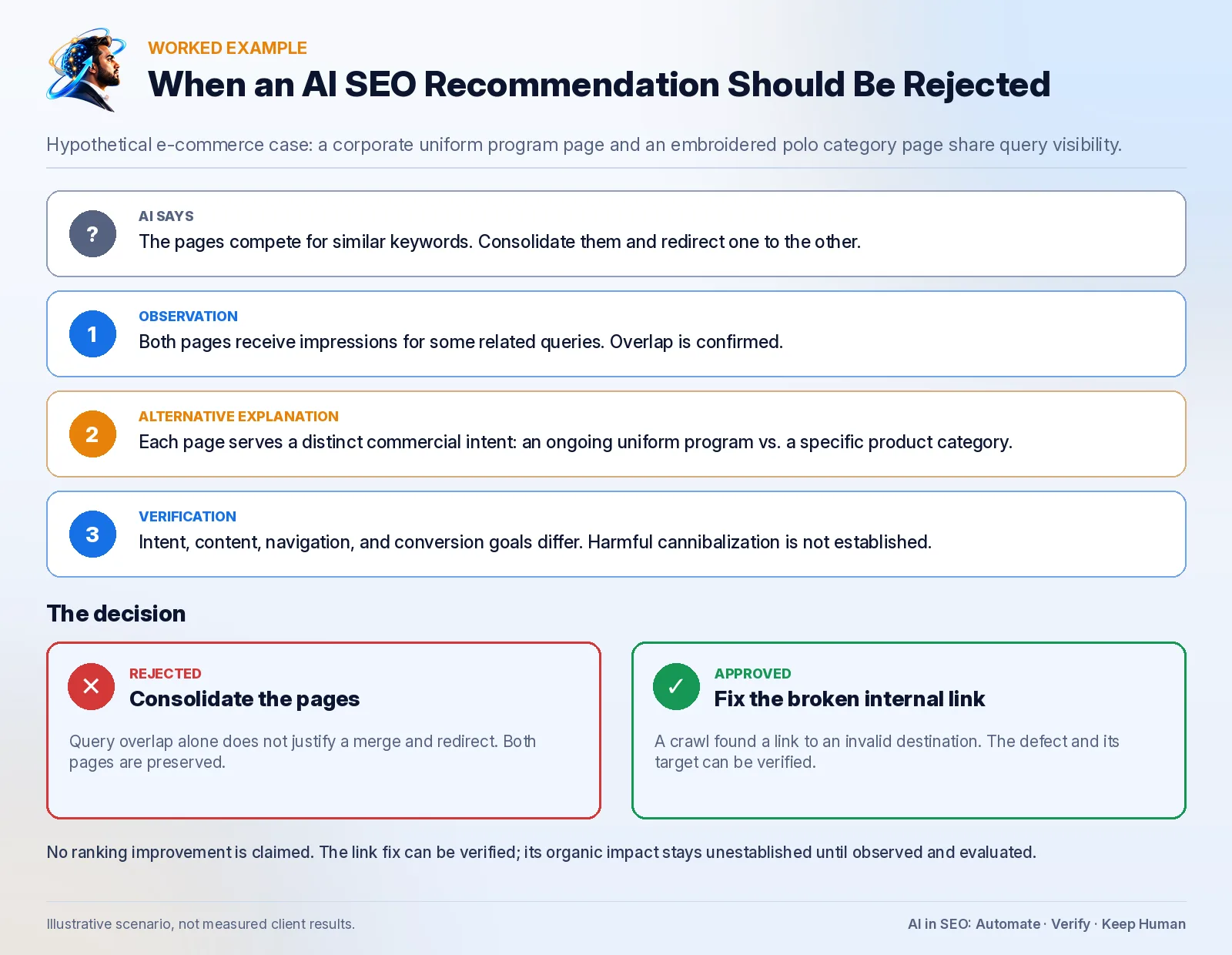
Consider the following hypothetical investigation.
An e-commerce business operates two landing pages:
- A page explaining its corporate uniform programs.
- A category page for custom embroidered polo shirts.
Both pages receive impressions for some overlapping queries related to branded workwear.
An AI assistant analyzes Search Console exports and recommends consolidating the pages because they appear to compete for similar keywords.
The recommendation seems reasonable at first.
However, the SEO specialist investigates the actual purpose of each page.
The corporate uniform page addresses businesses seeking an ongoing program that may involve employee ordering, centralized administration, standardized apparel, and replenishment.
The embroidered polo page serves customers who are evaluating a specific product category.
Although the pages share topical relevance, their commercial purposes differ.
Observation: The pages share organic query visibility
Search Console may show that both URLs receive impressions for related terms.
That observation can be checked against the underlying performance records.
However, query overlap alone does not establish harmful cannibalization.
Google’s Search Console documentation also explains that performance information can be aggregated by canonical URLs and other reporting dimensions, making accurate interpretation important.[1]
Hypothesis: Consolidation could improve performance
The AI assistant assumes that overlapping visibility indicates an architectural problem.
It proposes merging the content and redirecting one page to the other.
However, the specialist identifies a competing explanation: both pages legitimately address related queries because their products and services fall under the same commercial category.
The evidence does not establish that maintaining both pages is harmful.
Verification: Page purpose contradicts the proposed action
The specialist compares search intent, page content, navigation relationships, and conversion objectives.
The review confirms that the pages serve distinct commercial requirements.
The recommendation to consolidate them is therefore rejected.
This is a meaningful outcome.
The value of expert review is demonstrated not by accepting the AI recommendation, but by preventing a change whose justification was insufficient.
Further investigation: A separate technical issue has been identified
During the same hypothetical investigation, a crawl identifies an internal link on the corporate uniform page pointing to an invalid destination.
The issue is independently verifiable.
However, the presence of a broken internal link does not prove that it caused the observed pattern in search performance.
The appropriate action is to correct the verified technical defect while keeping its relationship to organic performance unresolved.
The specialist approves a bounded correction, validates the intended destination, and reviews the deployed change.
Decision: Reject the unsupported action and approve the verified correction
The final decision distinguishes between two outcomes.
The AI-generated consolidation recommendation is rejected because the evidence does not establish that the pages should be merged.
The internal-link correction is approved because the defect and intended destination can be independently verified.
No claim is made that the correction produced a ranking improvement.
That outcome would require subsequent observation and appropriate evaluation.
The SEO AI Decision Record
A practical governance process should preserve the reasoning behind these decisions.
The following record demonstrates how the hypothetical investigation can be documented.
| Decision component | Recorded finding |
|---|---|
| Task objective | Investigate overlap in organic visibility across related commercial pages. |
| Data sources | Approved Search Console exports, page content, navigation, and crawl observations. |
| Verified observation | Both pages receive impressions for some related queries. |
| AI hypothesis | Overlapping visibility indicates harmful keyword cannibalization. |
| Alternative explanation | Both pages legitimately serve different commercial intents. |
| Evidence assessment | Query overlap is confirmed, but harmful cannibalization is not established. |
| Recommendation decision | Reject consolidation and preserve both pages. |
| Separate technical finding | An internal link points to an invalid destination. |
| Approved intervention | Correct the affected link after destination and implementation validation. |
| Decision owner | Authorized SEO specialist or designated website owner. |
| Outcome status | The technical correction can be verified; the organic impact remains unestablished. |
This example is illustrative and does not represent measured client results.
Why the decision record matters
The record separates what the data showed from what the model inferred.
It preserves contradictory evidence and explains why one recommendation was rejected while another action was approved.
This makes the decision inspectable.
It also creates a reusable reference for future investigations.
If similar recommendations repeatedly fail due to AI misinterpreting query overlap, the organization can improve its workflow by adjusting input requirements, verification procedures, or recommendation boundaries.
The objective is not to produce a perfect AI response every time.
It is to establish a process in which unsupported conclusions do not automatically become operational decisions.
How Can AI Scale Content and Technical SEO Safely?
AI can scale repetitive SEO work when outputs are grounded in approved information, checked against explicit quality requirements, handled through defined exceptions, and released through controlled processes.

The benefits of automation become more significant when a business manages hundreds or thousands of products, pages, or technical configurations.
However, scale also increases the consequences of systematic errors.
A single incorrect product description may affect one page. A generation process that repeatedly invents the same technical attribute could affect an entire catalog.
Similarly, an incorrect canonical mapping may be manageable for a single URL but disruptive when applied across a large category structure.
The solution is not simply to introduce more manual editing.
It is to design the production process around information quality and release integrity.
Ground content in authoritative source information
An e-commerce content workflow should begin with verified product records.
These may include product identifiers, materials, dimensions, specifications, applications, and other approved attributes.
The model should use those facts to create useful descriptions.
When required information is missing, it should identify the gap rather than manufacture a plausible answer.
The same principle applies to technical SEO.
A proposed redirect mapping should be based on an approved destination, not merely on similarities between URLs.
A structured data update should reflect information actually present and relevant to the page.
Preserve meaningful differences between pages
AI-generated content should communicate distinctions that matter to users.
Two products belonging to the same category may differ in construction, compatibility, intended application, or purchasing requirements.
Descriptions should preserve those differences rather than replace them with generic variations of the same promotional language.
For informational content, each page should answer a distinct and legitimate information need.
Google’s policies do not prohibit AI-generated content merely because AI was involved. However, generating many pages primarily to manipulate rankings rather than help users can violate its scaled content abuse policy.[5]
The content’s value depends on its purpose and usefulness, not the number of words or variations the model produces.
Establish publication rejection rules
A scalable system must know when not to publish.
For example, a generated product description should be withheld when a required specification cannot be verified.
A proposed technical change should be blocked when its destination, mapping, or implementation requirements cannot be validated.
A recommendation affecting business-critical pages should be escalated when the supporting evidence is insufficient.
These controls are more reliable than expecting reviewers to catch every problem through informal inspection.
The system should record exceptions, identify their causes, and route unresolved cases to the appropriate decision owner.
Combine deterministic checks with risk-weighted review.
Different quality problems require different detection methods.
Automated checks can confirm whether required attributes are present, whether approved values match source records, and whether technical configurations satisfy defined specifications.
Human reviewers should assess usefulness, factual meaning, search intent, and the commercial consequences of proposed changes.
Sampling should reflect the diversity of the affected pages.
For example, reviewing only simple products may fail to reveal defects affecting products with complex specifications or compatibility requirements.
Higher-risk records may require more intensive validation.
Separate generation from release
Creating an output should not automatically authorize publication.
A governed workflow separates preparation, validation, approval, and execution.
For consequential deployments, organizations should maintain change records and establish rollback procedures.
A bounded release can provide evidence about implementation behavior before broader deployment.
However, the size and duration of the initial release should be determined by the risk and nature of the change rather than a universal percentage.
Apply relevant Merchant Center requirements.
E-commerce teams should distinguish website content generation from product data submitted through Google Merchant Center.
Google’s Merchant Center documentation specifies structured_title and structured_description attributes for relevant titles and descriptions created using generative AI. It also requires appropriate metadata for AI-generated product images submitted through supported image attributes.[6]
These requirements are specific to the relevant product data and imagery. They should not be interpreted as a universal labeling requirement for every webpage involving AI assistance.
The broader principle is that content automation must respect the requirements of each publishing and distribution system.
What Security Controls Does AI-Assisted SEO Require?
AI-assisted SEO requires data controls, instruction boundaries, execution permissions, and inspectable records. These safeguards become particularly important when AI agents can access analytics platforms, content systems, or production infrastructure.

The security requirements depend on the task and the systems involved.
An assistant summarizing public web pages presents a different risk profile than an agent with administrative access to a website.
Nevertheless, both should operate within defined boundaries.
Data controls: Limit access to necessary information
SEO systems may process public content, confidential performance data, commercial plans, or customer information.
The organization should classify the relevant information and determine which systems may process it.
Where practical, unnecessary sensitive fields should be removed or aggregated.
Vendor-specific policies must also be reviewed.
For example, OpenAI states that its business products and API do not, by default, use customer inputs and outputs for model training. At the same time, retention controls and applicable processing arrangements depend on the service and configuration. This should not be generalized to all providers or account types.[7]
The appropriate policy is to use approved services under verified configurations rather than rely on assumptions about AI data handling.
Instruction controls: Treat retrieved information as untrusted input
An SEO agent may read webpages, competitor content, documents, or external reports.
Those sources can contain instructions intended to influence automated systems.[8]
The agent should treat retrieved material as information to analyze rather than as authority to modify its assigned task or permissions.
For example, text embedded in a competitor webpage should not be permitted to instruct an AI agent to access internal records or change website settings.
Operational instructions and externally retrieved content must remain separate.
Execution controls: Restrict production authority
Production permissions should be limited to the operations the agent is explicitly authorized to perform.
A system responsible for drafting metadata should not automatically receive publishing credentials.
A system authorized to inspect indexation should not independently modify robots’ directives or canonical configurations.
For high-impact operations, permissions should be restricted through the surrounding software, API credentials, and approval mechanisms.
A prompt telling the model not to perform unauthorized actions is not a substitute for technical access controls.
Decision records: Preserve accountability
A reliable workflow should record the approved objective, relevant inputs, proposed changes, validation results, authorization, and deployment outcome.
The required level of documentation should reflect the consequences of the operation.
This makes it possible to identify what happened, investigate defects, and improve the process without relying on incomplete recollections of an AI conversation.
How Should Businesses Measure the ROI of AI-Assisted SEO?
AI-assisted SEO ROI should be evaluated by comparing the full cost and quality of an automated workflow with its existing baseline, then assessing relevant business outcomes separately.
Reducing initial drafting or analysis time does not automatically reduce the total cost of completing a task.
The complete workflow may include preparing data, configuring tools, generating outputs, reviewing results, correcting defects, and completing implementation.
These costs should be included in the comparison.
Calculate net operating savings
A practical starting point is:
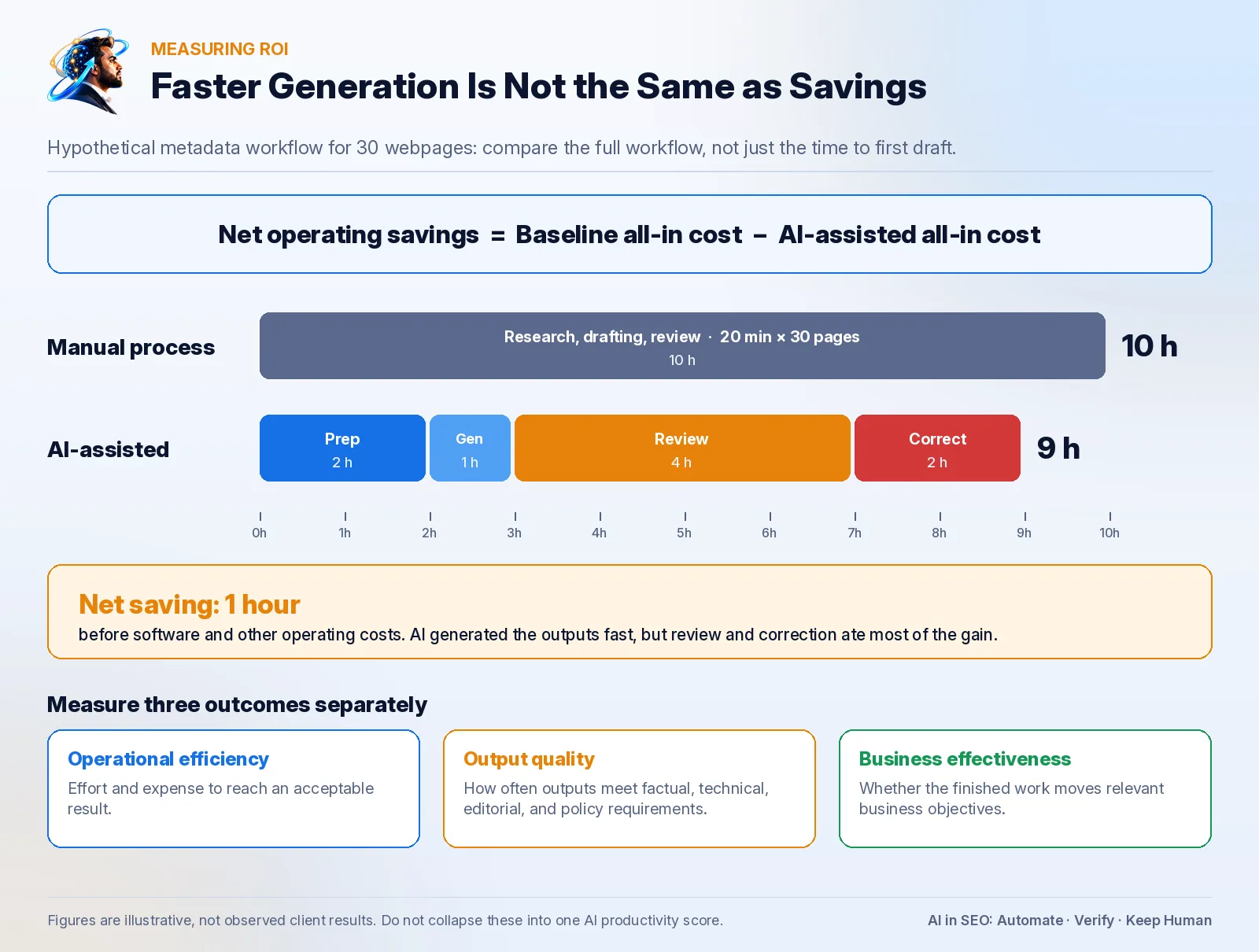
Net operating savings = Baseline all-in workflow cost − AI-assisted all-in workflow cost
The comparison assumes that both processes produce results meeting equivalent quality and risk requirements.
It should include relevant labor, software, verification, corrections, and maintenance expenses.
The result represents an operating cost difference, not necessarily the complete financial return on an AI investment.
Longer-term ROI calculations may also need to account for implementation expenditure and measurable financial benefits.
Example: Faster generation does not always mean substantial savings
Consider a hypothetical metadata production workflow covering 30 webpages.
Under the manual process, research, drafting, and review require an average of 20 minutes per page.
The total effort is 10 hours.
Now, assume the AI-assisted process requires:
- 2 hours preparing source information and workflow instructions.
- 1 hour generating and organizing the outputs.
- 4 hours reviewing the results.
- 2 hours correcting defects.
The total AI-assisted effort is 9 hours.
The workflow saves one hour before accounting for software expenditure or additional operational costs.
Although AI generated the initial outputs quickly, the complete economic benefit is relatively modest.
These figures are illustrative, not observed client results.
The example demonstrates why production time alone can overstate the value of automation.
Measure quality alongside efficiency
A useful workflow assessment should distinguish three outcomes.
Operational efficiency: How much effort and expense are required to produce an acceptable result?
Output quality: How often do outputs satisfy factual, technical, editorial, and policy requirements?
Business effectiveness: Does the completed work contribute to relevant organizational objectives?
These measures should not be collapsed into a single AI productivity score.
For example, an automated technical audit may reduce analysis time without increasing qualified organic traffic.
That can still represent a valid operational benefit.
Conversely, organic performance may improve after an AI-assisted intervention without establishing that the AI workflow caused the improvement.
The analysis must preserve those distinctions.
Evaluate whether automation deserves expansion.
A business should expand a workflow when the evidence demonstrates that its benefits justify the ongoing costs and risks.
If automation merely shifts effort from drafting to correction, the process may need to be redesigned.
If an AI assistant reliably reduces repetitive analytical work while maintaining quality, that narrower application may be more valuable than attempting unrestricted autonomy.
The best workflow is not necessarily the one using the most advanced model.
It is the one producing dependable results at an acceptable total cost.
Does Using AI for SEO Improve AI Search Visibility?
Using AI to perform SEO work does not automatically increase visibility in Google AI Overviews, AI Mode, or third-party AI assistants. Internal workflow automation and external AI search visibility are separate activities that require different measurements.
An organization might use AI to improve its content development process without gaining additional visibility from AI-generated answers.
Similarly, a website can appear in an AI-generated response without using AI in its internal SEO operations.
These distinctions matter because AI search visibility is frequently discussed as a single, universal metric.
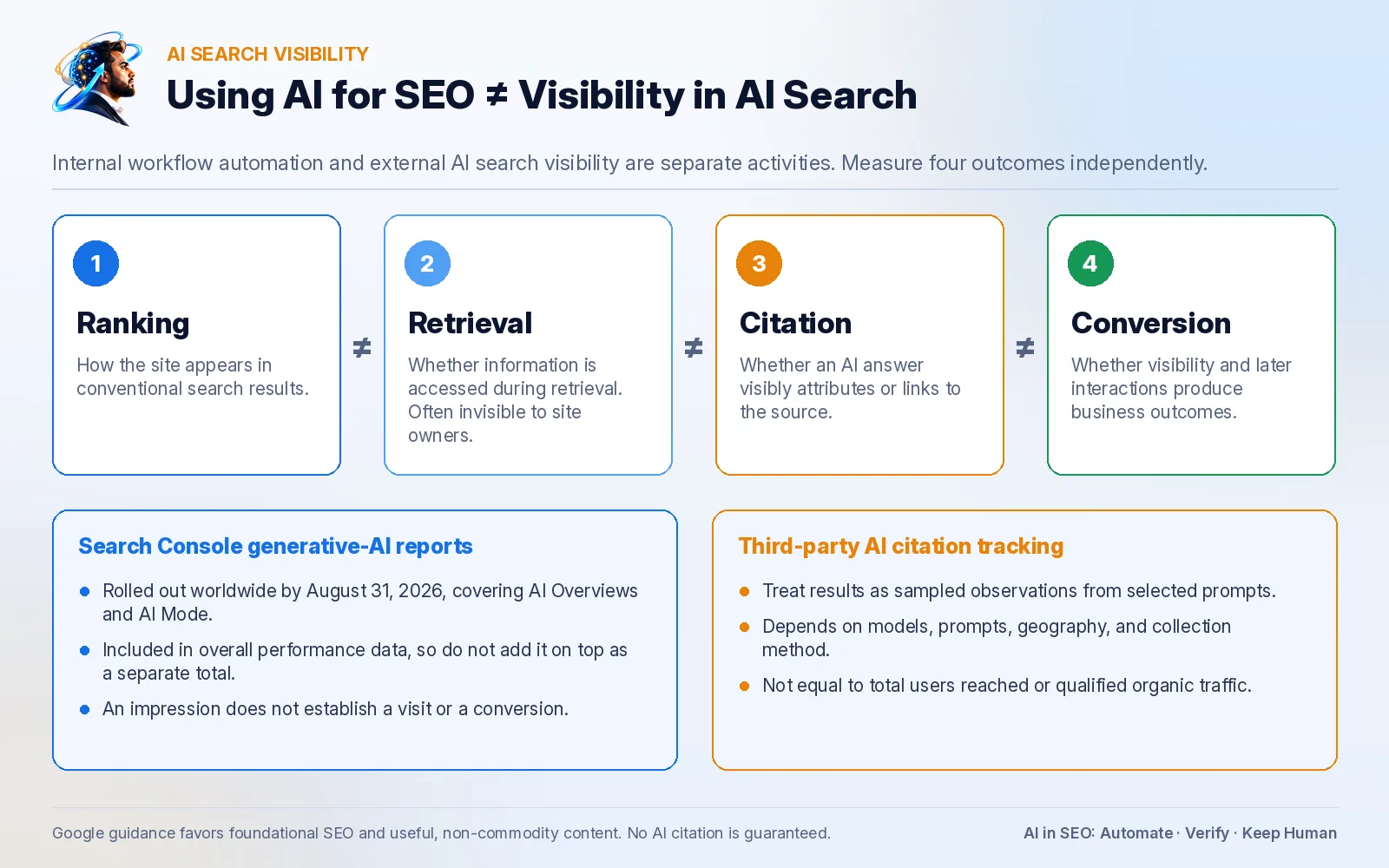
Separate ranking, retrieval, citation, and conversion
Traditional organic search performance, information retrieval, AI citations, and commercial outcomes describe different phenomena.
Ranking concerns how a website appears in conventional search results.
Retrieval concerns whether information is accessed or considered during an information-retrieval process. Much of this activity may not be observable to website owners.
Citation concerns whether an AI-generated answer visibly attributes information to a source or provides a supporting link.
Conversion concerns whether relevant visibility and subsequent user interactions produce meaningful business outcomes.
A website may receive AI citations without receiving measurable referral traffic.
A brand may be mentioned without a link to its website.
A conventional ranking improvement does not guarantee that the same page will appear in a particular generated response.
These outcomes should therefore be measured independently where the necessary data is available.
Use Google’s dedicated generative-AI performance reports correctly
In June 2026, Google introduced dedicated generative-AI performance reporting in Search Console.
Google confirmed that the rollout reached websites worldwide by August 31, 2026.
The reports provide more focused information on visibility within Google’s generative AI features, including AI Overviews and AI Mode in Search, with separate reporting for relevant Discover experiences.[9]
Google also explains that generative AI data is included in overall performance reporting rather than constituting an additional, independent total.
Consequently, the dedicated generative-AI impressions should not simply be added to the overall Search Console impressions as though they represent separate audiences.
The reporting also has limitations.
A property may not display the dedicated report if it has insufficient qualifying impressions.
The report does not provide complete visibility across third-party AI assistants, nor does an impression independently establish a website visit or conversion.
Treat third-party AI citations as sampled observations
AI visibility platforms may monitor whether websites or brands appear in responses to selected prompts.
These observations can be useful for identifying patterns and comparing monitored topics.
However, results depend on the platform’s models, prompt selection, geographic settings, collection methods, and reporting methodology.
A citation count from a monitored set of prompts should not automatically be treated as the total number of real users exposed to the brand.
Likewise, citation frequency should not be presented as equivalent to qualified organic traffic.
Where possible, third-party observations should be evaluated alongside first-party analytics and actual business outcomes.
Prioritize reliable information over speculative AI optimization techniques.
Google’s current guidance on generative-AI search emphasizes foundational SEO, technical accessibility, and unique, useful, non-commodity content.
Google also explains that specialized tactics such as unnecessary content chunking or creating AI-specific files are not substitutes for established SEO practices.
This has an important implication for AI-assisted content production.
A website does not become more useful to search systems simply because its content was generated through sophisticated automation.
The underlying information must still be accurate, accessible, relevant, and valuable to the intended audience.
Clear entity relationships, verifiable facts, original insights, and appropriate technical implementation can support that broader objective.
No guarantees of citation by an AI system.
The practical goal should be to improve the quality and discoverability of useful information rather than pursue unsupported promises of guaranteed AI visibility.
How Do You Implement AI in SEO Through a Controlled Pilot?
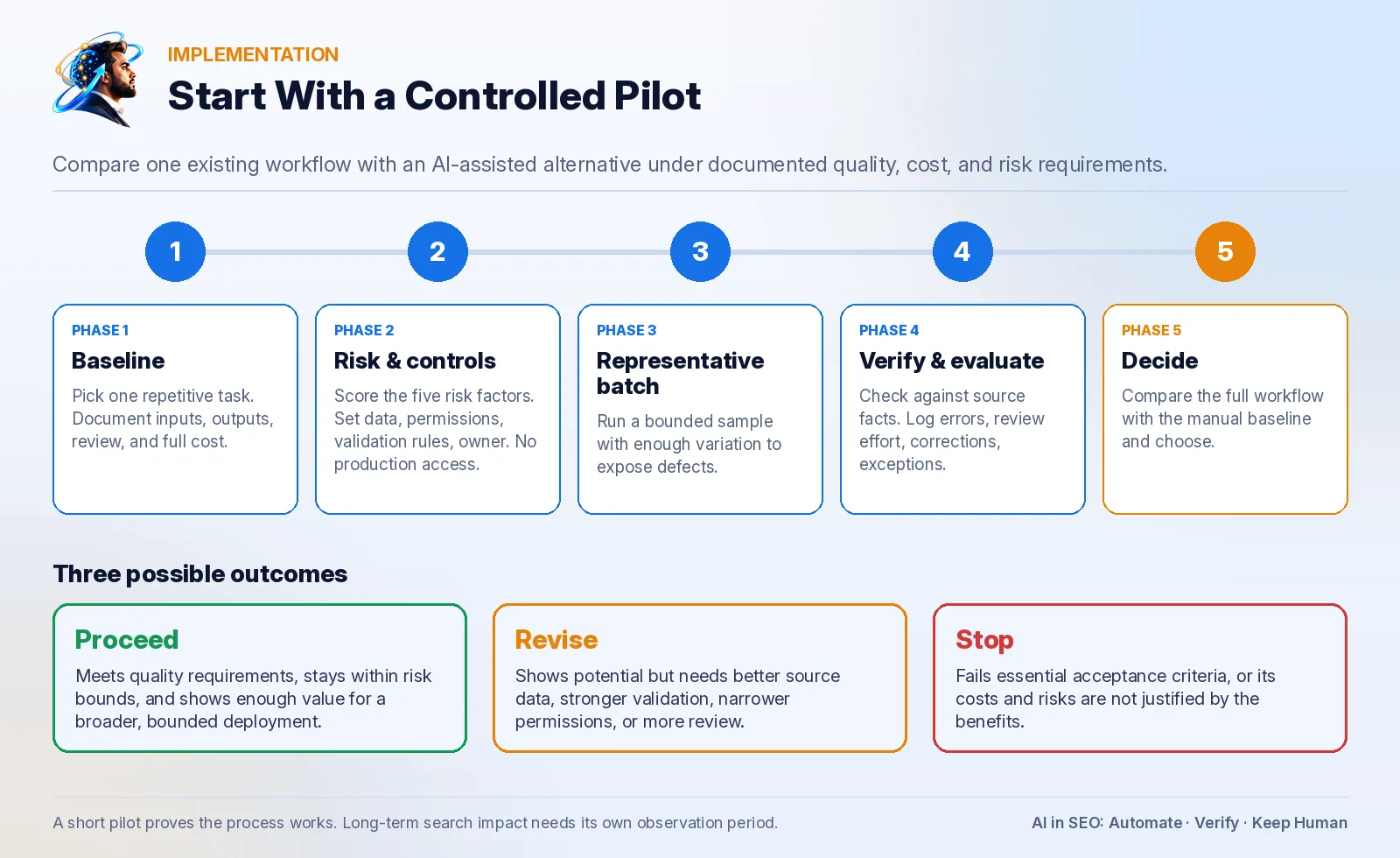
The safest starting point for AI-assisted SEO is a bounded pilot that compares an existing workflow with an automated alternative under documented quality, cost, and risk requirements.
A one-week pilot may be sufficient for a relatively simple activity, such as preparing metadata drafts or classifying an approved keyword dataset.
More complex workflows may require additional time.
The objective is to determine whether automation is operationally worthwhile, not to demonstrate an immediate improvement in ranking.
Phase 1: Establish the baseline
Select one repetitive SEO task and document how it is currently completed.
Define the inputs, expected outputs, review requirements, and complete the operating cost.
The baseline should include relevant preparation and verification work rather than only the time spent producing an initial draft.
Phase 2: Establish the risk and controls
Evaluate the task against the five risk dimensions.
Define the approved data sources, permissions, validation rules, and decision owner.
For an initial pilot, the AI system should generally have no production access unless execution is itself the specifically approved activity.
Phase 3: Run a representative batch
Apply the workflow to a bounded sample reflecting the types of records the organization intends to process.
The sample should include enough variation to expose relevant defects.
Outputs should remain subject to the defined acceptance requirements.
Phase 4: Verify and evaluate
Compare generated results against source facts and documented specifications.
Record errors, review effort, correction costs, and exceptions.
Distinguish defects discovered before release from defects that would affect production.
Compare the complete workflow against the manual baseline.
Phase 5: Make an evidence-based decision
The pilot should conclude with one of three outcomes.
The workflow meets its quality requirements, remains within acceptable risk bounds, and demonstrates sufficient operational value to justify a broader, bounded deployment.
Revise: The process shows potential but requires better source information, stronger validation, narrower permissions, or additional review.
Stop: The workflow fails to meet essential acceptance criteria or introduces costs and risks that are not justified by its benefits.
The same decision process should be repeated when the workflow changes materially.
For activities that affect organic search performance, establish a separate observation period and a comparative evaluation.
A short operational pilot can establish whether a process works reliably.
It cannot necessarily establish the long-term consequences for search performance of that process.
Frequently Asked Questions About AI in SEO
Can AI perform SEO changes without human approval?
AI may execute narrowly authorized SEO changes when appropriate technical permissions, predefined requirements, validation procedures, and recovery controls are in place. However, consequential decisions and changes outside the approved scope should require authorization from an accountable owner.
The appropriate control depends on the task’s impact, reversibility, evidence reliability, data sensitivity, and scale.
How can AI-generated SEO recommendations be verified?
AI recommendations should be checked against the original data, affected pages, relevant technical observations, and plausible alternative explanations.
The analyst should distinguish verified observations from hypotheses, identify contradictory evidence, and document the justification for the proposed action.
A recommendation should not be accepted solely because the model expresses high confidence.
Is AI-generated content bad for Google SEO?
Google’s Search policies do not inherently prohibit AI-generated content.
Google evaluates content according to its usefulness and compliance with applicable policies. Large-scale content produced primarily to manipulate rankings rather than to help users may violate the platform’s scaled content abuse policy, regardless of how it was created.
AI-assisted content should therefore be evaluated for factual reliability, relevance, originality, and legitimate user value before publication.
What is the difference between AI SEO verification and validation?
Verification determines whether an AI-generated conclusion or recommendation is supported by evidence.
Validation determines whether the proposed implementation satisfies its approved technical and operational requirements.
A recommendation can be implemented correctly yet still be strategically inappropriate. Both forms of review are therefore necessary for consequential SEO changes.
How should AI SEO automation success be measured?
Success should be measured using the complete workflow cost, output quality, operational risk, and relevant business outcomes.
Useful operational measures include review effort, correction costs, defect rates, and the time required to complete acceptable work.
Organic performance and commercial outcomes should be evaluated separately using suitable comparison periods and clearly stated limitations.
Can AI SEO automation guarantee visibility in AI Overviews?
No. Using AI to create content, conduct analysis, or automate SEO tasks does not guarantee inclusion in AI Overviews, AI Mode, or other generated responses.
Google’s guidance emphasizes useful content, technical accessibility, and established SEO fundamentals rather than guaranteed AI-specific optimization methods.[10]
The Value of AI in SEO Depends on Decision Quality
AI is changing the economics of SEO research, production, and technical execution. Activities that previously required substantial manual effort can increasingly be supported or completed through automated systems.
However, greater automation does not necessarily lead to better decisions.
A model can identify patterns without correctly explaining them. It can produce technically valid outputs that are inappropriate for the business. It can generate large quantities of content without contributing meaningful information.
The opportunity lies in designing processes that preserve the distinction between analysis, judgment, authorization, and execution.
The SEO AI Delegation Ladder defines which responsibilities can be assigned to AI.
The Five-Dimensional Risk Model determines the safeguards required.
The Six-Stage Governance Framework ensures that recommendations are evidence-based, changes are validated before release, and outcomes are evaluated against meaningful objectives.
These models are proposed operational tools, not substitutes for professional judgment or independently proven ranking methodologies.
Their purpose is to make that judgment more systematic, inspectable, and accountable.
For SEO specialists, this means spending less time on repetitive activities and more time interpreting evidence, challenging assumptions, and prioritizing meaningful improvements.
For business leaders, it means evaluating AI based on its contribution to operational efficiency, reliability, and commercial value rather than on the volume of automated activity.
The governing principle is straightforward:
Automate repeatable work. Verify consequential conclusions. Control production changes. Measure the outcomes that matter.
The future of AI-assisted SEO should not be defined by how much human involvement an organization can eliminate.
It should be defined by how effectively the organization combines automation with evidence, accountability, and informed decision-making.
Apply Evidence-Governed AI to Your SEO Operations
Every website has different technical constraints, content requirements, business priorities, and opportunities for automation.
The most valuable starting point is not selecting another AI tool.
It is identifying where the existing SEO process creates unnecessary effort, where decisions lack reliable evidence, and where automation could improve outcomes without introducing disproportionate risk.
Whether the challenge involves technical SEO, content operations, organic performance, or AI search visibility, the first step is understanding the problem and the evidence available to solve it.
Send the problem, not a brief.
The objective is to determine what deserves automation, what requires expert judgment, and which improvements can create measurable business value.
References and Evidence Ledger
The following sources support the article’s external factual claims. Proposed governance models, hypothetical examples, calculations, and editorial recommendations are identified separately within the text.
Research disclosure: The governance frameworks and work decision record in this article are proposed analytical tools. The e-commerce investigation and financial comparison are illustrative scenarios, not verified client case studies. External factual claims are attributed to their respective primary sources, and the cited sources do not establish that the proposed framework itself improves Google rankings or guarantees AI citations.
- Google. Performance Report: Dimensions and Data Groupings (opens in a new tab) Evidence supported: Anonymized queries, reporting limitations, and data aggregation.
- Majestic. Are You Using AI the WRONG Way in SEO? (opens in a new tab) Evidence supported: Attributed practitioner perspectives on AI adoption, critical thinking, automation, and content quality. Evidence limitation: The transcript documents participant statements and examples. It does not independently validate broader claims about ranking outcomes or the effectiveness of particular automation methods.
- National Institute of Standards and Technology. AI RMF Core (opens in a new tab) Evidence supported: Contextual AI risk management and the Govern, Map, Measure, and Manage functions. Evidence limitation: The SEO AI Delegation Ladder, five-dimensional risk model, and six-stage workflow are proposed adaptations rather than NIST-defined frameworks.
- Google. General Structured Data Guidelines (opens in a new tab) Evidence supported: Structured data validation, content requirements, and the distinction between technically valid markup and guaranteed search appearance.
- Google. Google Search’s Guidance on Using Generative AI Content on Your Website (opens in a new tab) Evidence supported: AI-generated content requirements, accuracy, relevance, and scaled content abuse.
- Google. Product Data Specification (opens in a new tab) Evidence supported: Requirements for generative-AI-created product titles, descriptions, and relevant product image metadata.
- OpenAI. Business Data Privacy, Security, and Compliance (opens in a new tab) Evidence supported: Published data-training and retention commitments for specified business services. Evidence limitation: These commitments are provider- and product-specific and should not be generalized to every AI service.
- OWASP GenAI Security Project. LLM01:2025 Prompt Injection (opens in a new tab) Evidence supported: Prompt-injection risks, untrusted inputs, and the need for appropriate security boundaries.
- Google. Generative AI Performance Reports (opens in a new tab) Evidence supported: Dedicated generative-AI visibility reporting in Search Console and its relationship to overall performance data.
- Google. Optimizing Your Website for Generative AI Features on Google Search (opens in a new tab) Evidence supported: The relationship between foundational SEO, Google’s retrieval systems, and generative search experiences.