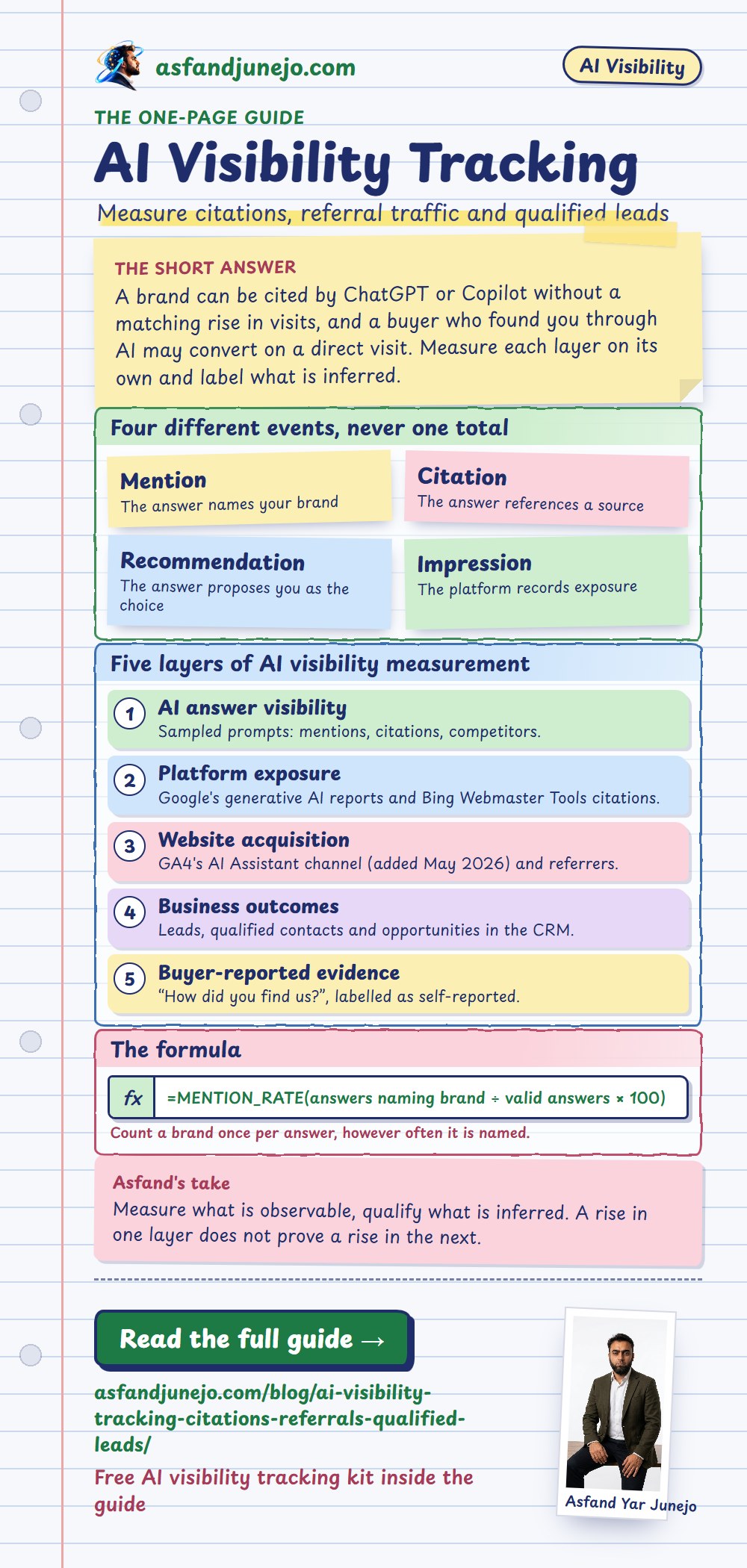
A company may be cited repeatedly by ChatGPT, Perplexity, or Microsoft Copilot without receiving a proportional increase in identifiable website visits. An informational page may receive thousands of reported impressions in Google's AI Overviews while generating little measurable engagement. A prospective customer may also discover a service through an AI assistant, continue researching through Google Search, and eventually submit a form during a direct visit. In that situation, standard acquisition reporting may accurately identify the final recorded channel while failing to describe every earlier source of influence.
Published · Last reviewed · By Asfand Yar Junejo, publisher asfandjunejo.com
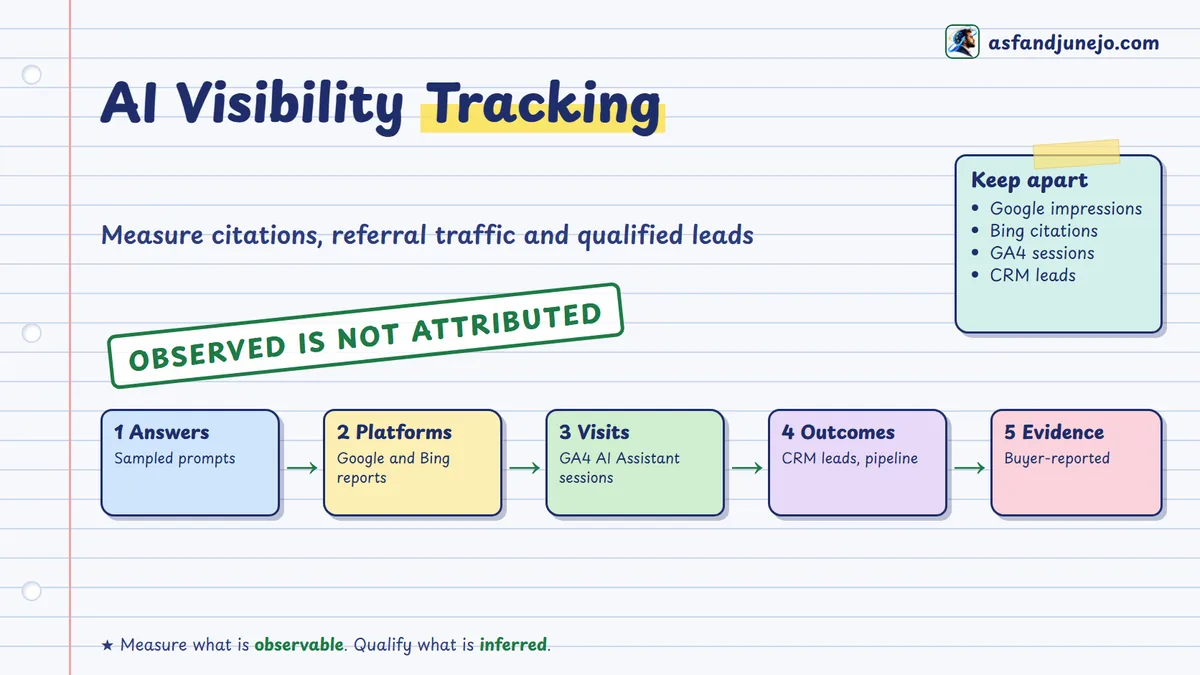
AI visibility tracking measures how a brand, website, or piece of content appears in AI-generated answers and what observable business activity may follow. It includes brand mentions, source citations, recommendations, platform-reported exposure, identifiable referral traffic, and recorded commercial outcomes. Each measurement provides a different kind of evidence, and none independently explains the complete customer journey.
These distinctions make AI search visibility as much a measurement problem as a search optimization problem.
Traditional organic search reporting often begins with search impressions, clicks, landing-page sessions, and conversions. AI-generated answers introduce additional observations before a user reaches the website, including brand recommendations, references to external sources, citations to specific pages, and answers that satisfy the user's immediate question without requiring a click.
The resulting information is distributed across different platforms. Google Search Console reports exposure within Google's supported generative AI features. Bing Webmaster Tools reports citation activity across supported Microsoft AI experiences. Independent answer-monitoring systems can collect sampled mentions and references. Google Analytics 4 records identifiable traffic, while customer relationship management systems preserve lead qualification and commercial outcomes.
These sources cannot be combined indiscriminately. They differ in what they observe, how their metrics are calculated, which interactions they include, and what information remains unavailable.
The objective of a reliable AI visibility tracking system is therefore not to generate the highest possible visibility score. It is to create a consistent method for answering three questions:
Where is the brand visibly represented in AI-generated experiences? What measurable activity follows those exposures? Which commercial conclusions are supported by the available evidence?
Answering these questions requires precise definitions, reproducible observations, and an explicit distinction between visibility, association, and causation.
Why does AI search need its own measurement framework?
AI search visibility requires a dedicated measurement framework because a brand can appear in an AI-generated answer without resulting in a website visit, and identifiable visits may not capture every prior AI interaction. Traditional search metrics remain useful, but they do not fully describe brand mentions, AI recommendations, source citations, or the contribution of those experiences to customer decisions.
The analytical problem begins with the difference between a search results page and a generated answer.
In conventional organic search, a user is commonly presented with a set of links and chooses whether to open a result. Search reporting can measure qualifying impressions and clicks, while website analytics records visits that successfully reach the tracked property.
AI-powered search can also present links, but the answer itself may offer an explanation, a comparison, a recommendation, or a summary compiled from multiple sources. A user can receive substantial information before deciding whether to visit any external website.
A cited company may consequently receive valuable exposure without a recorded session. Conversely, a company can receive a referral from an AI platform without knowing which exact generated answer influenced the visit.
The distinction does not make traditional analytics obsolete. It means the analytical model must recognize additional observable events and preserve the limits of their relationships.
Visibility is not automatically acquisition
Imagine a software company whose documentation is repeatedly referenced in responses to questions about integrating an application programming interface. The company might observe an increase in references to its documentation, but its identifiable AI referral sessions could remain relatively stable.
Several explanations are possible. Some users may find the generated answers sufficiently complete. Others may copy the company name and visit later through another channel. Citation exposure might have increased among users with little purchase intent, or the citation observations might come from a sample that does not represent actual user activity.
The increase in citations is an observable change under the sampling method. The explanation for the lack of growth in referrals remains uncertain.
A rigorous analysis should not automatically classify that difference as poor conversion performance or failed AI optimization.
Acquisition is not automatically commercial value
Suppose an AI assistant directs visitors to an informational article. Website analytics may record the resulting sessions and engagement, but those observations do not establish whether visitors represent qualified buyers.
An increase in AI Assistant sessions can occur alongside unchanged lead-generation activity. Equally, a smaller number of visits may be associated with valuable commercial inquiries.
The appropriate interpretation depends on landing-page intent, defined key events, the quality of submitted leads, and the subsequent customer journey.
The commercial significance of the traffic must therefore be assessed independently of its volume.
Why a single AI visibility score is insufficient
Many tracking tools summarize AI search performance through proprietary visibility scores. Such scores can be useful for monitoring changes within a consistently applied methodology, but their values are not necessarily comparable across vendors.
A score may combine sampled mention frequency, citation occurrences, estimated prompt volume, answer placement, or competitive representation. Another product may use a different prompt set, weighting system, or normalization procedure.
Without a disclosed methodology, a score of 70 from one provider cannot be assumed to indicate greater visibility than a score of 60 from another provider.
Nor does an increase in a proprietary visibility score necessarily establish an increase in real user exposure or business outcomes.
A more defensible reporting system maintains the underlying metrics separately and explains how each one was collected.
The measurement objective
The purpose of AI visibility tracking should be to produce useful answers to specific business questions.
An SEO manager may need to know which technical guides receive citations across supported AI experiences. A content strategist may want to understand which buyer questions generate competitor recommendations. A marketing director may need to distinguish measurable AI-referred sessions from the broader possibility of AI-influenced demand.
These are related questions, but they require different evidence.
A useful measurement framework, therefore, begins with the decision the organization needs to make, identifies the appropriate observable events, and selects only the metrics that support that decision.
What is the difference between AI citations, mentions, recommendations and impressions?
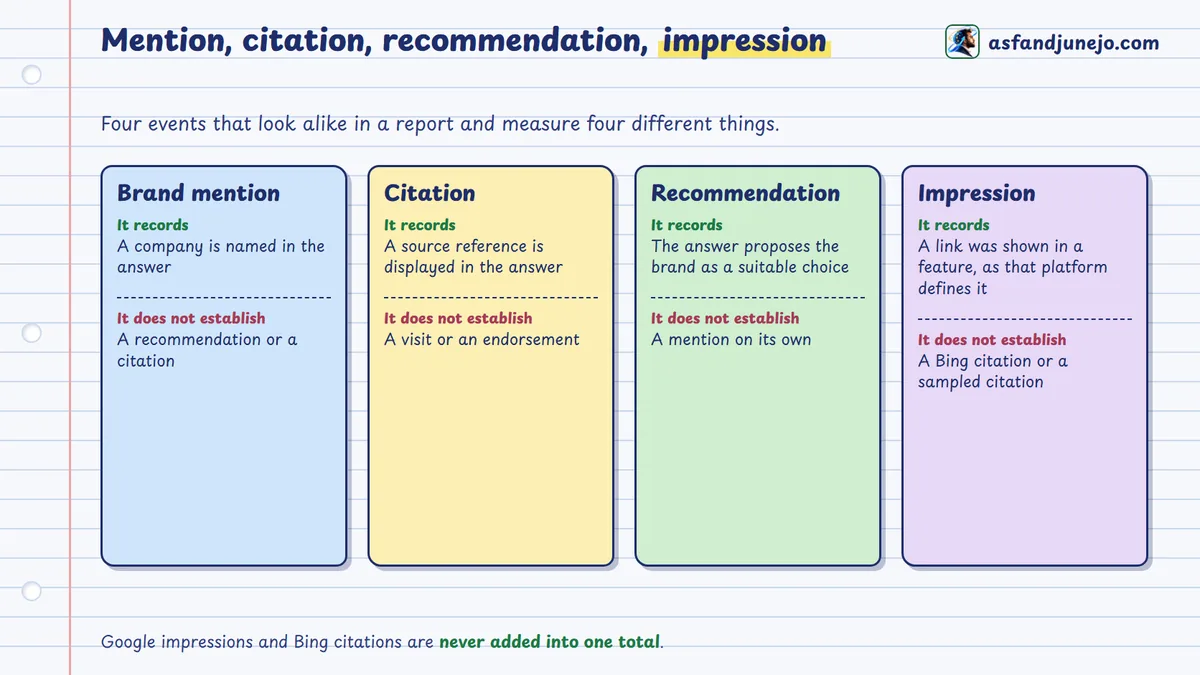
A brand mention occurs when an AI answer names a company; a citation occurs when an answer references a source; a recommendation occurs when an answer proposes a brand as a suitable choice; and an impression occurs when a platform records qualifying exposure under its reporting rules. These measurements can overlap, but their definitions, denominators, and business implications are different.
Understanding these distinctions is essential because an AI-generated answer can simultaneously include several forms of brand visibility.
What is an AI brand mention?
A brand mention is an observable reference to a company, product, service, or identifiable organization within an AI-generated response.
The mention may be favorable, unfavorable, neutral, descriptive, or incidental.
For example, an AI assistant explaining the enterprise gifting market may list several vendors without recommending any. Each named vendor could be recorded as a brand mention under a properly documented classification system.
The measurement should also specify whether the brand appears in the answer body, a source title, a citation label, or another interface element.
Those placements should not automatically receive the same classification if the purpose is to measure explicit brand recommendations.
What is an AI citation?
An AI citation is a source reference displayed or otherwise identified as supporting material within an AI-generated response.
A citation may point to a company's own website, an independent publication discussing that company, or an unrelated source used to establish a broader factual claim.
For commercial reporting, the following distinction is essential.
An owned-domain citation references a URL controlled by the organization being measured.
A third-party citation mentioning the brand references an independent source that discusses the organization.
These events are related but not interchangeable.
A business can receive considerable brand exposure through independent publications without receiving many citations to its own domain. Conversely, its research articles can be cited without the generated answer explicitly naming the company.
An audit that counts every citation adjacent to a brand name as an owned citation will overstate the organization's direct source visibility.
What is an AI recommendation?
A recommendation occurs when the generated answer presents a company, product, or service as a suitable option in response to the user's stated or reasonably inferred needs.
A recommendation is not necessarily a positive endorsement of the organization in every respect. An answer may recommend a provider for one use case while highlighting limitations for another.
The classification should therefore depend on explicit criteria.
For example, "Company A provides enterprise gifting software" is a descriptive mention.
"Company A is an option to evaluate if you require employee gifting and centralized fulfillment" is a conditional recommendation.
"Company A is the best provider in the market" is a stronger evaluative assertion whose factual support would need independent examination.
A measurement system should not classify all three statements identically.
What is an AI impression?
An impression is defined by the reporting platform that records it.
Google's (opens in a new tab)Generative AI Performance report (opens in a new tab) measures how often links from a website are shown to users within supported Google Search generative AI features. It applies Google's own aggregation and impression-counting rules.
Bing's AI Performance reporting, by contrast, focuses on citations to publisher content across supported AI-generated experiences.
A Google generative AI impression is therefore not the same event as a Bing citation occurrence or a citation discovered through manually sampled prompts.
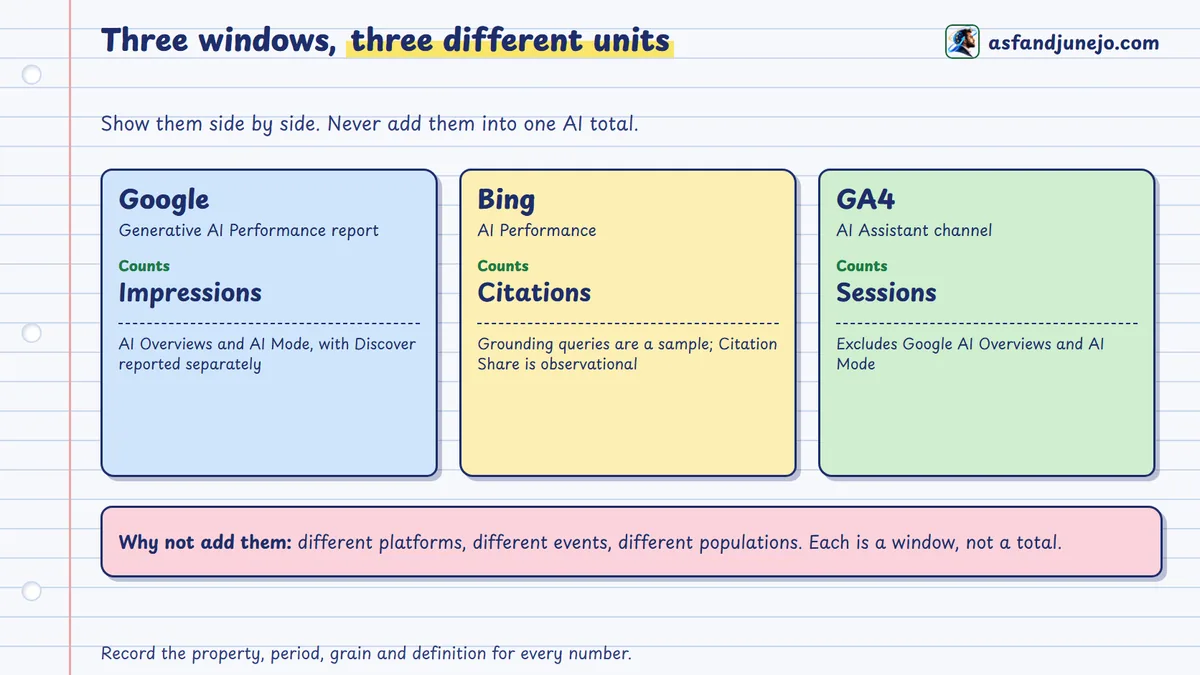
These totals should not be added together and reported as a single total for AI impressions.
AI brand sentiment and answer stance
Some platforms also classify whether an AI answer portrays a brand positively, negatively, or neutrally.
Sentiment analysis can provide contextual information, but it is sensitive to classification rules, language, question framing, and the difference between an answer's overall tone and its evaluation of a particular brand.
A balanced answer discussing both advantages and limitations may be classified differently by two sentiment models.
For practical reporting, recommendation stance and sentiment should be kept separate.
A negative mention, a conditional recommendation, and a neutral comparison can each affect brand perception differently, even when they all contribute to a single recorded brand appearance.
The metric distinction matrix
Each of the four metrics counts a different event, so none can stand in for another.
| Measurement | Unit of observation | What it establishes | What it does not establish |
|---|---|---|---|
| Brand mention | Brand occurrence or answer containing a brand | Brand appeared in the observed answer | Recommendation or citation |
| Owned citation | Reference to an owned URL | The organization's content was cited | Visit or endorsement |
| Third-party citation | Reference to an independent source | External material was cited | Owned-domain visibility |
| Recommendation | Classified advisory statement | Brand was proposed as an option | Purchase intent or conversion |
| Sentiment | Classified evaluative stance | Tone or evaluation under defined rules | Actual user perception |
| Google AI impression | Platform-reported exposure | Link visibility under Google's reporting rules | Lead generation |
| Bing AI citation | Platform-reported source reference | Citation occurrence under Microsoft's reporting scope | Ranking position or referral |
| AI referral session | Analytics-recorded visit | Identifiable website acquisition | Complete AI influence |
The importance of answer structure
A generated answer may cite the same source more than once, reference several pages from one domain, or display multiple sources within a citation panel.
An analyst must decide whether the intended measurement is the number of citation occurrences, the number of unique cited URLs, or the number of answers containing at least one owned citation.
Each is a valid operational metric when properly defined. They are not the same quantity.
This becomes important when comparisons are made over time. A change in an AI interface's citation presentation can increase the number of displayed source references even when underlying brand visibility has not improved proportionally.
The audit methodology should preserve the answer, cited URLs, citation locations where observable, and the counting rule used.
What are the five layers of AI visibility measurement?
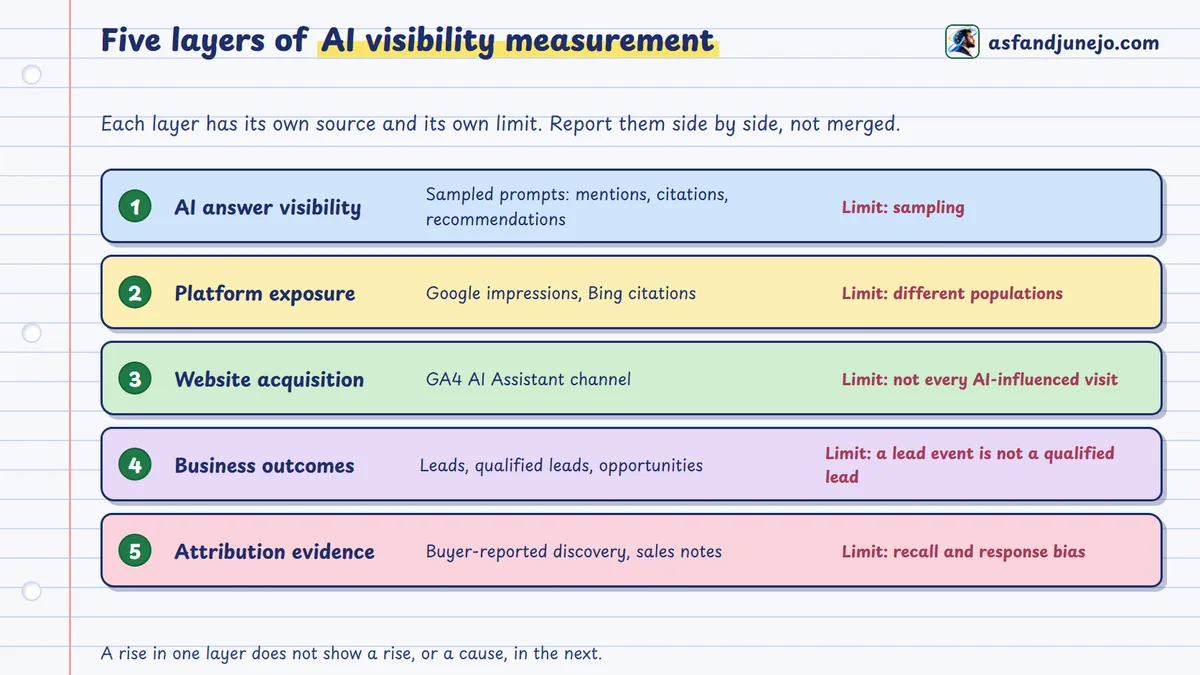
A reliable AI visibility measurement system should distinguish sampled answer visibility, official platform exposure, identifiable website acquisition, commercial outcomes, and additional attribution evidence. These layers provide complementary observations rather than an automatically connected funnel. Relationships between them should be asserted only when the available records and measurement methods support them.
Layer 1: AI answer visibility
This layer records how brands and sources appear within AI-generated answers collected under a documented monitoring method.
Relevant observations include brand mentions, product recommendations, owned-domain citations, third-party citations, competitor appearances, and the stance of the answer.
The information may be gathered through an approved monitoring platform, an authorized API, or a controlled manual research process.
Its principal limitation is sampling.
A collection of prompts cannot automatically represent every question users ask across different locations, models, languages, and contexts.
Therefore, results should be presented as visibility within the monitored sample.
Layer 2: First-party AI platform exposure
This layer contains information reported directly by the platform operating the AI search experience.
Google's dedicated generative AI reports measure supported AI impressions, while Bing Webmaster Tools provides citation and grounding-related information.
These reports offer valuable direct platform observations, but their populations and metrics differ.
A publisher may observe Google AI impressions without access to the individual user prompts that generated those impressions. Bing may provide grounding-query information and citation activity without disclosing every interaction or downstream visit.
The existence of an official report should not be interpreted as complete transparency into the platform's internal source-selection mechanisms.
Layer 3: Identifiable website acquisition
This layer begins when an identifiable visit reaches a website and is recorded by an analytics implementation.
Google Analytics 4 introduced a native AI Assistant channel in May 2026 for recognized assistant referrers, including supported sources such as ChatGPT, Gemini, and Claude. Google's channel rules explicitly exclude AI Overviews and AI Mode from the AI Assistant category.
This means the AI Assistant channel cannot be treated as a complete account of all AI-influenced website visits.
The native channel is useful for measurable acquisition from identifiable sources. At the same time, other AI-generated search experiences may remain associated with conventional search reporting or arrive without sufficiently detailed source information.
Source: (opens in a new tab)Google Analytics, Default Channel Group (opens in a new tab).
Layer 4: Business response and commercial outcomes
This layer records interactions such as lead submissions, qualified contacts, sales opportunities, and completed transactions.
The information may originate from website analytics, CRM systems, and financial records.
A recorded lead-generation event is not automatically equivalent to a unique qualified lead, and a qualified lead does not automatically become a sales opportunity.
The organization's lifecycle definitions, deduplication rules, and record identifiers are necessary to interpret these outcomes.
Attribution to AI-assisted discovery requires additional care because the original AI interaction may not be directly observable.
Layer 5: Additional attribution evidence
This layer contains information that can provide context beyond identifiable website referrers.
Examples include a buyer's response to a discovery-source question, notes from a sales conversation, or an explicitly documented research interaction involving an AI assistant.
Such evidence may reveal sources of influence that are absent from conventional acquisition reporting.
However, self-reported attribution is affected by recall, ambiguity, and response bias. It should be labeled as buyer-reported evidence rather than being presented as a verified technical referrer.
Why the layers must remain separate
Keep the layers separate: a rise in one layer does not show a rise, or a cause, in the next.
Consider a website that records increased citations across a monitored prompt set, higher Google AI impressions, stable GA4 AI Assistant sessions, and a small number of buyers who report discovering the business through AI assistants.
Those observations may collectively suggest an increase in participation in AI-assisted discovery.
They do not automatically demonstrate that the increase in citations caused the recorded leads.
The events may involve different platforms, users, reporting periods, markets, and attribution mechanisms.
A defensible analysis would compare the trends, examine their measurement boundaries, consider alternative explanations, and identify whether any valid record-level connections exist.
Recommended reporting architecture
Report each layer in its own section with its own source, definition and caveat.
| Evidence layer | Core KPI | Source | Reporting confidence |
|---|---|---|---|
| Sampled answers | Owned citation rate | Controlled prompt monitoring | Dependent on sampling |
| Sampled answers | Brand recommendation rate | Classified responses | Dependent on coding quality |
| Google exposure | Generative AI impressions | Search Console | First-party, limited to supported features |
| Bing exposure | Total citations | Bing Webmaster Tools | First-party, aggregated |
| Acquisition | AI Assistant sessions | GA4 | First-party, identifiable sources |
| Commercial outcomes | Qualified leads | CRM | Dependent on lifecycle integrity |
| Additional attribution | Self-reported AI discovery | Forms or interviews | Subject to response bias |
The operational goal is to make the strengths and limitations of each source explicit enough that an executive can distinguish real observations from interpretation.
How do you build a representative AI prompt tracking set?
AI prompt tracking measures brand and source visibility within a defined collection of AI-generated responses. A useful tracking set should reflect real audience needs, include branded and unbranded questions, cover relevant buyer-intent categories, and preserve the exact prompts and collection conditions. Results should describe the selected sample, not an unobserved population of all AI search users.
The design of the question set often determines what the resulting visibility metrics mean.
If a monitoring program repeatedly asks an assistant to discuss a particular brand, the observed brand-mention rate will be mechanically higher than in a set of questions that never identifies the company.
Similarly, a prompt set dominated by educational questions may yield different citation patterns than one dominated by product comparisons or vendor recommendations.
The purpose of sampling is therefore to represent meaningful information needs without engineering the questions to produce a preferred outcome.
Begin with the audience's actual information needs
An effective prompt set should be derived from documented customer questions, search behavior, support inquiries, sales conversations, product evaluation needs, and relevant competitive topics.
A B2B signage company might monitor questions concerning signage planning, permitting, installation, accessibility, multisite programs, or supplier evaluation.
An enterprise software company might instead focus on implementation requirements, integration compatibility, security considerations, vendor comparisons, and commercial procurement questions.
The monitoring categories should correspond with the organization's actual market rather than a generic list of AI prompts.
Separate branded and unbranded prompts
A branded question explicitly identifies the target company or product.
An unbranded question describes a problem, use case, or category without naming the company.
For example:
| Classification | Illustrative prompt |
|---|---|
| Branded | What services does Example Company provide? |
| Unbranded informational | How should a multisite signage installation program be planned? |
| Unbranded comparative | What should retailers compare when selecting national signage providers? |
| Commercial | Which types of signage providers support permitting, fabrication, and installation? |
| Evaluative | What evidence should I request before choosing an enterprise signage partner? |
| Decision-stage | How should I evaluate the risk of outsourcing a national signage rollout? |
These examples describe different user intentions.
A branded prompt is suitable for monitoring the accuracy of information returned about a known organization. It is less suitable for estimating whether the brand is independently recommended to users who have not already named it.
Both are useful, but they should not be conflated into a single, undifferentiated discovery metric.
Establish a prompt sampling frame
A practical pilot can begin with 24 to 40 distinct prompts covering several audience needs and buying stages.
That range is an operational starting point, not a statistically established minimum required by AI search systems.
The appropriate size depends on the market, topic diversity, platform coverage, required precision, and available measurement resources.
A mature program may require a larger, stratified sample. A narrow technical website may obtain useful diagnostic information from fewer carefully selected questions.
Whatever the size, the methodology must document how prompts were chosen and which topics or audiences may be underrepresented.
Define the collection procedure
Each prompt should have a stable identifier and a recorded collection specification.
The record should include:
| Field | Required information |
|---|---|
| Prompt ID | Stable unique identifier |
| Prompt text | Exact wording |
| Audience intent | Educational, comparative, commercial, evaluative, or other defined category |
| Topic | Approved topical classification |
| Brand condition | Branded or unbranded |
| Platform | Exact AI experience |
| Model or mode | Where disclosed |
| Collection timestamp | Date and time |
| Geography and language | Known settings |
| Collection method | Manual, API, or approved platform |
| Answer status | Generated, unavailable, failed, or excluded |
| Brand mention | Present, absent, or ambiguous |
| Recommendation | Defined classification |
| Owned citations | Exact URLs |
| Third-party citations | Exact URLs |
| Raw observation | Saved answer or permitted evidence record |
| Reviewer | Responsible analyst |
The distinction between a failed request, a response without citations, and a response that did not mention the brand is particularly important.
A platform may return an answer without citing any external source. It would be incorrect to treat that outcome as though the entire test had failed.
Test answer variability
AI-generated responses may vary across repeated requests due to model behavior, retrieval updates, context, personalization, location, or changes in the underlying information available to the platform.
A single response should therefore not be presented as a stable ranking outcome.
A monitoring program should record repeated observations using a fixed collection schedule and clearly defined conditions.
Where possible, repeated measurements should preserve the same question set, platform, language, and known location settings.
If prompts are changed between periods, the analysis should identify the change and avoid attributing the resulting visibility movement exclusively to external search performance.
Control classification bias
Recommendation and sentiment classifications may require human judgment.
For example, an answer stating that a provider is suitable for a specific situation may be classified as a conditional recommendation, while an answer describing the provider's capabilities may be classified as a neutral mention.
These distinctions should be written into a coding guide before results are summarized.
For more consequential reporting, a second analyst can independently classify a subset of responses. Disagreements should be reviewed, and the final methodology should explain how ambiguous cases were handled.
A classifier's confidence score should not be treated as proof that its interpretation is correct.
The sample represents monitored visibility
The final report should state that a brand appeared in a specific proportion of the monitored responses under the documented conditions.
It should not claim that the brand appeared in the same proportion of all real user queries.
That broader claim would require evidence about the population of user questions and a sampling process capable of representing it.
Most independent AI answer-monitoring programs do not have complete access to that population.
How do you calculate AI citation rate, brand mention rate and share of voice?
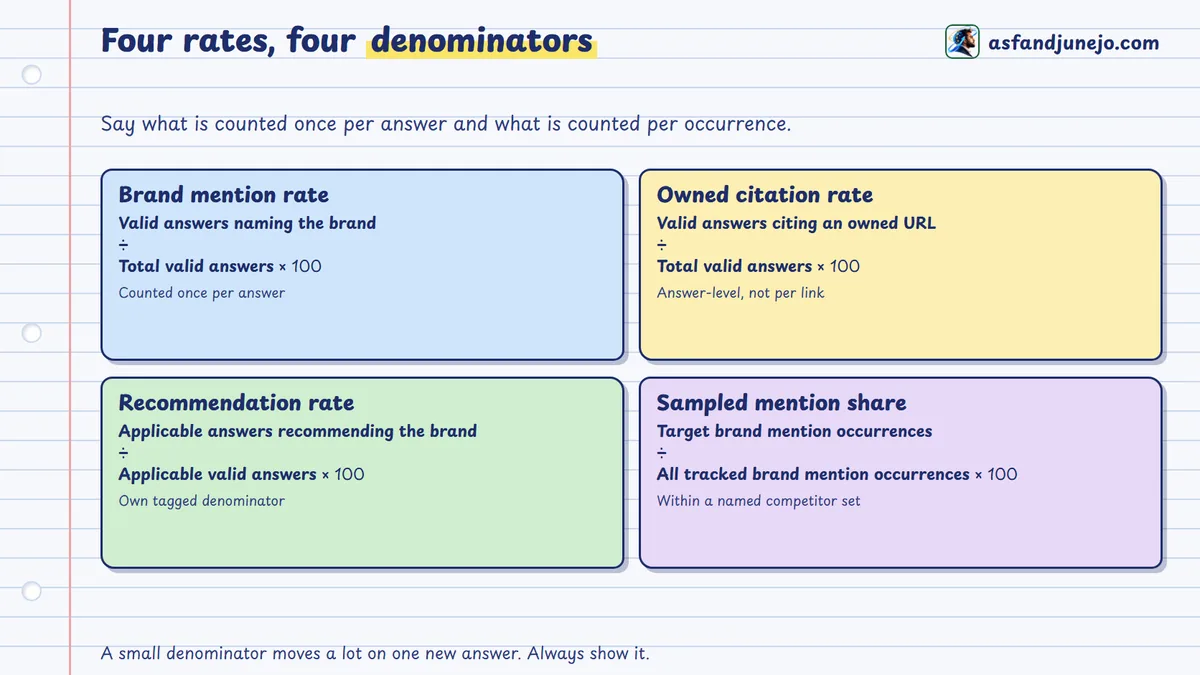
AI visibility rates should be calculated from clearly defined answer populations and reproducible classification rules. Mention rate measures how frequently a brand appears in sampled answers; citation rate measures how often its sources are referenced; and the sampled share of voice measures its relative presence within a specified set of competitors. These formulas do not establish total search demand, impressions, clicks, or commercial impact.
The formulas are straightforward. The more difficult task is consistently defining the numerator and denominator.
Brand mention rate
Brand mention rate is the share of valid answers that name the brand, counted once per answer.
For a sample of valid generated responses:
Brand Mention Rate = Valid Answers Mentioning the Brand ÷ Total Valid Answers × 100If the same response names the brand several times, the answer is counted once under this particular rate definition.
The total number of individual mention occurrences can be tracked separately.
The calculation must identify whether branded prompts are included. For discovering unprompted brand presence, unbranded questions should be analyzed independently.
Owned-domain citation rate
Owned Citation Rate = Valid Answers Citing an Owned URL ÷ Total Valid Answers × 100This is an answer-level rate.
It differs from counting every occurrence of a displayed citation.
For example, an answer containing three citations to two pages on the same owned domain would contribute one answer to the numerator of the owned citation rate. Still, it could contribute three occurrences to a citation-occurrence count.
Neither metric is inherently superior. They answer different questions.
The analyst should specify whether citations are recognized through exact URLs, verified canonical domains, or another documented ownership mapping.
Subdomains, acquired brands, third-party knowledge bases, and syndicated content should be classified according to an explicit ownership policy.
Brand recommendation rate
Recommendation Rate = Applicable Answers Recommending the Brand ÷ Applicable Valid Answers × 100The denominator should contain the answers relevant to the recommendation question being measured.
An educational prompt asking for the definition of a technical concept should not automatically be evaluated as a missed commercial recommendation.
Recommendation measurement is most defensible when the monitored questions actually provide a reasonable opportunity for the model to recommend a provider, product, or approach.
Sampled share of voice
Share of voice is especially sensitive to definition.
A practical sampled mention-share measure can be defined as:
Sampled Mention Share = Target Brand Mention Occurrences ÷ All Tracked Brand Mention Occurrences × 100This measure describes the target brand's proportion of tracked mentions within a defined competitor set and a selected answer sample.
If multiple brands appear in a single answer, each may contribute an occurrence.
An alternative metric may count the proportion of answers containing each brand. Under that method, individual brand percentages can add up to more than 100% because one response can mention multiple brands.
Both methods can be useful, but their definitions and denominators must remain visible.
Sampled mention share should not be labeled as total market share, share of all AI searches, or Google's officially reported citation share.
Avoid overinterpreting small denominators
A visibility rate based on a small number of valid answers can change substantially after a single new observation.
If the underlying sample is limited, the article should disclose the denominator and avoid overstating apparent precision.
For longitudinal monitoring, changes should be interpreted alongside sample consistency, answer-generation rates, platform changes, and the practical magnitude of the observed difference.
Where formal statistical comparisons are warranted, the analyst must account for the sampling design, repeated observations, and dependence between responses.
Repeated answers generated from the same fixed prompt are not necessarily independent observations.
Recommended metric dictionary
Define every KPI by numerator, denominator and interpretation before you report it.
| KPI | Numerator | Denominator | Interpretation |
|---|---|---|---|
| Brand mention rate | Valid answers mentioning brand | Valid sampled answers | Observed answer presence |
| Owned citation rate | Valid answers citing owned domain | Valid sampled answers | Observed source representation |
| Recommendation rate | Applicable answers recommending brand | Applicable valid answers | Observed commercial recommendation |
| Sampled mention share | Target brand mention occurrences | All defined competitor-set mention occurrences | Relative monitored presence |
| Citation occurrences | Total observed owned references | None | Absolute reference count |
| Distinct cited URLs | Unique owned URLs cited | None | Breadth of referenced content |
| Answer-generation rate | Prompts producing valid answers | All attempted prompts | Availability and sample context |
These metrics should be reported together with the source and collection method.
A higher citation rate may reflect stronger source representation, changes in the prompt set, or changes in how citations are displayed. The result should not be attributed to improved content authority without further evidence.
How do you measure Google AI Overviews and AI Mode in Search Console?
Google Search Console provides dedicated generative AI performance reporting for supported AI Overviews and AI Mode experiences. Its Search report measures how frequently links from a website are displayed in those features and allows analysis by page, country, device, and date. The report does not expose a complete prompt-to-click-to-lead attribution path.
Google announced the reports on June 3, 2026, and confirmed worldwide rollout by August 31, 2026.
Source: (opens in a new tab)Google Search Central, Introducing Search Generative AI Performance Reports (opens in a new tab).
This first-party capability changes how publishers should measure exposure to Google's generative AI Search features. It is no longer necessary to rely exclusively on manual searches or third-party estimates to obtain a Google-reported measure of AI visibility.
However, the report must be interpreted in accordance with its published definitions.
Step 1: Locate the Generative AI Performance report
Open the verified property in Search Console and find the Generative AI Performance report.
Open the verified website property in Google Search Console.
Navigate to the dedicated Generative AI performance report for Search, where available.
The report covers supported features, including AI Overviews and AI Mode. Google documents a separate generative AI performance report for Discover, which should not automatically be combined with the Search report.
If the report is unavailable, do not assume that the website has zero AI visibility.
Google explains that the report may be absent when the site has insufficient qualifying impressions. The site's effective generative AI participation setting may also be relevant.
The audit should distinguish unavailable reporting, insufficient data, and documented exclusion.
Step 2: Understand Google's impression definition
Google's report records qualifying impressions when links to pages from the property are shown to users within supported generative AI features.
Google defines the rules for counting and aggregation.
The report should not be treated as a list of every response generated by Gemini, every reference to the brand, or every citation across Google's entire AI ecosystem.
It is a platform-specific report about supported Search features.
That scope must appear in the report title and methodology.
Step 3: Examine the available dimensions
The report supports analysis by the exposed pages, the countries where impressions originated, the devices used for Search, and the dates.
| Dimension | Analytical purpose |
|---|---|
| Pages | Identify URLs appearing in generative AI features |
| Countries | Examine geographic distribution |
| Devices | Compare desktop, mobile, and tablet exposure |
| Dates | Monitor visibility changes over time |
| Search type | Distinguish supported text-based and multimodal Web Search contexts |
Google uses Pacific Time for date reporting.
This is important when the data is later compared with Google Analytics properties that use a different reporting time zone.
A date labeled October 20 in Search Console does not necessarily correspond to the same absolute 24-hour period as October 20 in a GA4 property configured for another time zone.
Step 4: Understand property-level and page-level aggregation
Google's report contains a chart and dimension-specific tables, and their aggregation methods can differ.
The chart generally aggregates impressions at the property level. If multiple results from the same property appear in a qualifying feature, they may contribute one property-level impression for that occurrence under the documented rules.
Page-level reporting instead assigns impressions to individual URLs.
Consequently, the total impressions across page rows may not always equal the property's chart total.
A discrepancy between these two views should not automatically be classified as missing data or a reporting defect.
Google also documents canonical URL handling, meaning that some performance information is assigned to the canonical page rather than another version of the URL.
Source: (opens in a new tab)Google Search Console, Generative AI Performance Report (opens in a new tab).
Step 5: Review data freshness and limitations
The most recent dates in Search Console may contain preliminary data, which Google may revise as processing completes.
For stable period comparisons, select finalized historical ranges when possible and identify any preliminary data included in the analysis.
Google's reporting also retains row limits and other constraints associated with its performance infrastructure.
A critical export detail is that values shown as unavailable in the interface may appear as zero in downloaded data. Analysts should distinguish an unavailable value from a genuine measured zero rather than treating every exported zero as evidence of no exposure.
The report should preserve the original reporting context and any known missingness.
Step 6: Avoid unsupported attribution
The report is particularly valuable for understanding which pages receive exposure in Google's supported AI features.
It cannot independently establish which exact prompt led to a lead submission, whether a user remembered the brand and returned later, or how much incremental revenue resulted from the exposure.
Nor should impressions be treated as equivalent to website clicks.
For example, a company might observe that a service page receives more generative AI impressions during a particular reporting period. That is a valid trend under the platform's definition.
If direct or branded-search visits also increase, the timing may warrant further investigation, but the two changes do not establish that AI impressions caused those visits.
A practical Search Console reporting procedure
Record the same fields every month: property, feature, search type, dates, aggregation and availability.
For each monthly reporting cycle, record the property, selected feature, Search type, start and end dates, comparison period, overall impressions, important exposed pages, available country and device patterns, and reporting limitations.
Inspect which pages contribute most heavily to the observed exposure and whether the distribution changes over time.
Where a page's impressions decline, consider whether the movement may reflect query demand, competitive source selection, platform behavior, seasonality, or incomplete data.
The correct outcome is an evidence-led investigation list, not an automatic instruction to rewrite every page with declining impressions.
How do you track AI citations in Bing Webmaster Tools?
Bing Webmaster Tools provides first-party AI citation reporting for supported Microsoft Copilot, Bing-generated answers, and selected partner experiences. Its AI Performance reporting identifies cited pages, total citation activity, grounding-query information, and trends. Additional 2026 features provide thematic and competitive context, but these measurements should not be interpreted as traditional rankings or direct measures of website acquisition.
Microsoft introduced the AI Performance report in public preview on February 10, 2026.
Unlike Google's generative AI impressions report, Bing's initial reporting is explicitly organized around references to publisher content within AI-generated answers.
Source: (opens in a new tab)Microsoft Bing, Introducing AI Performance (opens in a new tab).
Step 1: Understand total citations
Total Citations reports the number of citations displayed for the publisher's content across supported AI-generated experiences during the selected period.
This metric indicates how often the content was referenced as a source under Microsoft's reporting rules.
It does not identify a conventional ranking position and should not be converted into an estimate of website clicks without an independent basis for measurement.
A citation displayed in an AI-generated answer does not necessarily mean that a user opened the link.
Step 2: Review average cited pages
Average Cited Pages describes the average number of unique pages from the property displayed as sources per day across the selected reporting period.
This metric provides a view of the breadth of cited content.
A publisher whose citations are concentrated in a single research article may have a different content footprint from a publisher whose citations are distributed across many relevant pages, even if their total citation counts are similar.
However, broader distribution is not automatically more valuable. The significance depends on the page's purpose, the topic's importance, and the publisher's objectives.
Step 3: Examine page-level citation activity
The page-level view identifies specific URLs receiving citations.
This can help publishers understand which resources are already referenced in supported AI experiences.
The analysis should distinguish absolute citation counts from the broader relevance and business value of each page.
A technical glossary or public research study might attract references because it provides narrowly useful factual information. A service page might receive fewer citations while contributing more directly to a commercial decision.
The two pages should not be evaluated solely by comparing citation totals.
Step 4: Interpret grounding queries correctly
Bing provides grounding query information associated with the retrieved material used to support AI-generated answers.
Microsoft states that the displayed grounding queries represent a sample of citation activity.
They should not be treated as an exhaustive list of every user prompt.
A grounding query also reflects the retrieval context identified by Microsoft's system. It is not necessarily equivalent to the exact wording entered by the original user.
This difference matters when an analyst attempts to reconstruct audience intent.
A query classified as commercial may reveal useful thematic context, but it does not establish the complete user journey that produced the generated answer.
Step 5: Use the June 2026 AI visibility enhancements
On June 16, 2026, Microsoft expanded AI Performance with additional capabilities named Intents, Topics, Citation Share, and Compare.
These features add context to basic citation counts.
Intents classify grounding queries such as informational, commercial, research, navigation, and other supported user needs.
Topic groups related grounding queries into broader thematic clusters.
Citation Share measures the proportion of citations attributed to a publisher for a specific grounding query relative to all cited sources for that query within the supported reporting data.
Compare enables examination of changes between reporting periods.
Source: (opens in a new tab)Microsoft Bing, New AI Visibility Insights (opens in a new tab).
Citation Share is particularly important because its name resembles the share-of-voice metrics used by independent AI monitoring tools.
However, the underlying calculations are different.
Bing's Citation Share is based on Microsoft-observed citation activity for a grounding query. A third-party-sampled share-of-voice metric may instead count brand mentions or citations across a manually selected set of prompts.
The two should not be presented as equivalent.
Microsoft also states that Citation Share is an observational measure rather than a ranking system or a competitive score.
Step 6: Review the October 2026 Topics Portfolio beta
Microsoft introduced Topics Portfolio in beta on October 13, 2026.
The feature organizes relevant grounding queries into thematic portfolios associated with the publisher's observed presence.
It includes measurements such as Topic Size, Sites Cited, and Queries, as well as identified opportunity queries.
Topic Size represents an approximate total of citations across the ecosystem for a topic. Sites Cited provides an approximate count of cited sites, while Queries provides an approximate count of distinct grounding queries associated with that topic.
These measures can help publishers understand which subject areas attract substantial AI citation activity and where competing sources are already represented.
However, Microsoft explicitly identifies the beta values as directional rather than exact. AI-based systems generate topic classification, and the results depend on sufficient data availability.
The feature may be unavailable for websites with limited qualifying citation activity.
An opportunity query should therefore be interpreted as a candidate for research rather than proof that publishing a new page will secure a citation.
Source: (opens in a new tab)Microsoft Bing, Introducing Topics Portfolio Beta (opens in a new tab).
What Bing's citation reports can and cannot establish
Bing's citation metrics show observed references to your content, not rankings, traffic or conversions.
| Bing metric | Useful interpretation | Not established |
|---|---|---|
| Total citations | Recorded source-reference activity | Clicks or conversions |
| Average cited pages | Breadth of cited URLs per day | Overall content quality |
| Cited pages | URLs receiving references | Ranking position |
| Grounding queries | Sampled retrieval context | Complete user prompt history |
| Citation Share | Share of citations for a grounding query | Market share or traffic share |
| Topics | AI-classified thematic presence | Definitive entity authority |
| Topic Size | Approximate citation activity in a topic | Exact user demand |
| Opportunity queries | Candidate gaps within reported themes | Guaranteed publishing opportunity |
Compare periods without overstating causes
A publisher can use Bing's reporting to observe whether citation activity has increased, decreased, or shifted between topics.
The next analytical step should examine whether the movement might reflect content changes, query demand, competing information, platform updates, or changes in the reporting population.
A content update followed by an increase in citations is not sufficient to establish causality.
A more credible evaluation would document when the content changed, what changed, which topics were affected, whether relevant competing pages also experienced shifts, and what alternative explanations remain possible.
Where those additional observations are unavailable, the conclusion should remain descriptive.
Google and Bing should remain separate reporting populations
Google's generative AI impressions and Bing's AI citation counts are both useful indicators of publisher participation in AI-powered search.
They are not interchangeable units.
A combined executive report can display them side by side. Still, it should not add them into a universal citation total or calculate a cross-platform citation rate without a clearly defined and defensible measurement method.
The appropriate interpretation is that each platform provides a different observable window into the publisher's content exposure.
This is the foundation for the next stage of analysis: connecting identifiable website acquisition data, where available, to appropriately defined engagement and commercial outcomes.
How do you track AI assistant referral traffic in Google Analytics 4?
Google Analytics 4 can identify website sessions originating from recognized AI assistants through its native AI Assistant channel. Introduced in May 2026, this classification provides a starting point for measuring identifiable traffic from services such as ChatGPT, Gemini, and Claude. It does not capture every visit influenced by AI-generated search, particularly visits originating from Google's AI Overviews and AI Mode.
This distinction substantially changes how an AI referral tracking workflow should be implemented. Before May 2026, many published tutorials recommended creating custom channel groups or regular expressions to separate AI assistant referrals from conventional referral traffic. Those methods remain useful for specific reporting needs, but they should no longer be presented as the universal first step.
Google's (opens in a new tab)May 13, 2026 Analytics update (opens in a new tab) introduced three relevant changes: a dedicated AI Assistant category in the Default Channel Group, an automatically assigned ai-assistant medium for recognized sources, and an (ai-assistant) campaign value associated with that traffic.
The practical starting point is therefore the existing GA4 acquisition reporting, followed by source-level verification and optional customization only where a legitimate measurement gap remains.
Step 1: Open the Traffic acquisition report
Sign in to Google Analytics, select the appropriate GA4 property, and navigate to Reports → Acquisition → Traffic acquisition.
The Traffic acquisition report describes how users reach the website across sessions. Its default channel-group dimension helps organize activity from sources such as Organic Search, Paid Search, Referral, Direct, Email, and recognized AI assistants.
Select a reporting period that has sufficient processed data to support the intended analysis. When comparing performance over time, ensure that the date ranges and report filters are consistent.
Look for AI Assistant within the Session default channel group.
If the category is absent, do not immediately conclude that the integration has failed or that AI assistants never referred visitors. The selected period may contain no qualifying sessions, recognized referrers may be absent, or another attribution or implementation condition may affect the reported information.
Google's (opens in a new tab)Traffic acquisition documentation (opens in a new tab) explains the report and its session-scoped dimensions.
Step 2: Inspect the actual source and medium values
A channel-group label is useful for executive reporting, but it does not provide the complete underlying acquisition detail.
Change the primary dimension or add a relevant secondary dimension to examine the recorded sources.
For an AI referral investigation, the most useful dimensions include:
| GA4 dimension | What it helps establish |
|---|---|
| Session default channel group | The channel assigned to the recorded session |
| Session source | The source associated with the session |
| Session medium | The acquisition medium |
| Session source/medium | The combined acquisition classification |
| Session campaign | The recorded campaign value |
| Landing page | The landing-page path associated with the session |
| First user source/medium | The source associated with initial user acquisition |
The session-scoped dimensions should form the foundation of the initial referral analysis.
For example, if a recognized AI platform appears as a session source with medium ai-assistant, that record provides evidence of traffic attributed under GA4's rules.
It does not identify the exact AI-generated answer that produced the visit.
Step 3: Evaluate traffic quality
Once the relevant acquisition population has been identified, inspect how visitors interacted with the website.
Relevant metrics include sessions, engaged sessions, engagement rate, average engagement time, landing-page activity, and correctly configured key events.
These measurements help answer whether meaningful website interactions accompany identifiable AI-referred visits.
However, engagement should be interpreted in the context of the page's purpose.
A visitor who reaches an informational article may find an answer and leave without taking a lead-generation action. A visitor reaching an enterprise service page may be expected to review capabilities, request information, or initiate a commercial inquiry.
The two page types should not automatically be evaluated against identical conversion expectations.
A more useful analysis groups landing pages by their intended role before examining engagement and business events.
Step 4: Validate the default classification
Google's (opens in a new tab)Default Channel Group documentation (opens in a new tab) defines the native AI Assistant channel through recognized source behavior and the ai-assistant medium.
However, recognition should not be treated as universal coverage of every AI assistant, application, or future referral domain.
Inspect the source values available within the property, particularly when traffic appears under Referral, Organic Search, or another channel despite evidence suggesting an AI-related source.
A useful validation record should contain the observed source, observed medium, assigned channel, relevant reporting dates, and analyst's classification decision.
Source values should be taken from actual GA4 records rather than invented for illustration and then presented as measured data.
Step 5: Create a custom channel group only when necessary
GA4 supports custom channel groups, and Google's (opens in a new tab)official documentation (opens in a new tab) includes an example for classifying traffic from AI assistants.
Custom channel groups can help organizations create supplementary reporting definitions, particularly when they need more specific segmentation or when some recorded referrers are not grouped as expected.
However, broad matching patterns introduce classification risk.
For example, a regular expression that matches the letters ai anywhere in a source value may classify unrelated domains as AI assistants.
A stronger implementation maintains a list of verified referrer domains, considers the actual source values collected on the property, and tests the matching logic before adopting it for reporting.
If custom channel rules are used, their order matters because overlapping conditions can affect classification. Google's documentation specifically instructs readers to place relevant custom rules before broader referral rules when required.
A custom group should supplement the native channel when it addresses a defined measurement need. It should not create duplicate reporting populations or silently change the meaning of an existing executive metric.
Step 6: Do not combine different attribution scopes
Google Analytics distinguishes acquisition at the user, session, and event levels.
The First user dimensions describe initial recognized user acquisition. The Session dimensions describe acquisition associated with sessions. Event-scoped attribution specifies how credit is assigned to qualifying key events according to the property's attribution settings.
These scopes answer different questions.
For example, a user may first discover a website through Google Search, return later through ChatGPT, and subsequently submit an inquiry during a different session.
A first-user acquisition report, a session acquisition report, and a key-event attribution report can assign different sources to different portions of that journey without necessarily contradicting each other.
Google explains these differences in its (opens in a new tab)traffic-source scope documentation (opens in a new tab).
The article's reporting model should therefore identify the exact scope used for each metric. A source value should never be detached from its attribution definition.
Step 7: Record the validated acquisition population
Keep a monthly table of the validated AI Assistant population with its property, period, scope and counts.
A consistent monthly AI Assistant reporting table should contain:
| Reporting field | Required record |
|---|---|
| GA4 property | Exact approved property |
| Reporting period | Start and end dates |
| Time zone | Property reporting time zone |
| Acquisition scope | Session, first user, or event attribution |
| Channel | Native AI Assistant or documented custom group |
| Source and medium | Actual values returned |
| Sessions | GA4-reported sessions |
| Engaged sessions | GA4-reported engaged sessions |
| Landing pages | Relevant page dimensions |
| Key events | Explicitly selected events |
| Limitations | Missing referrers, attribution uncertainty, filtering |
This approach creates a repeatable basis for analyzing identifiable AI referral traffic without presenting the resulting session count as the complete population of AI-influenced visits.
The platform metrics are covered. The free AI Visibility Tracking Workbook gives each source its own tab, with KPI definitions, evidence checks and a dashboard that never adds incompatible units.
Why does AI referral traffic not capture every AI-influenced visit?
Identifiable AI referral traffic represents only the website visits that analytics can associate with recognized AI sources under the selected reporting rules. Some AI interactions produce no click, while others lead to later visits through search, direct navigation, email, or another channel. Referral data is therefore a valid acquisition measurement but an incomplete measure of total AI influence.
This is arguably the most important attribution limitation in AI search measurement.
A citation displayed in ChatGPT does not require the user to visit the cited website. A generated answer might resolve the question completely, or it might introduce a brand that the user researches later through another route.
Similarly, a user may copy a URL from an AI answer and paste it into a browser, potentially arriving without an identifiable AI referrer.
These scenarios have different attribution implications, yet they may all follow meaningful exposure within an AI-generated experience.
Google AI Overviews complicate source classification
Google's native GA4 AI Assistant channel explicitly excludes AI Overviews and AI Mode.
This is important because a visit resulting from a Google AI search feature may remain associated with Google Search rather than receiving a standalone AI Assistant classification.
Google Search Console's dedicated generative AI performance reporting provides a separate view of exposure to supported AI. Still, it does not provide a universal identifier that connects each impression to a subsequent GA4 session and CRM outcome.
Therefore, Google's AI impressions and GA4 AI Assistant sessions should be reported as different measurements.
Adding the two values together would create a meaningless total because they represent different events and may involve overlapping or entirely separate audiences.
Referral information can be incomplete
Browser behavior, application navigation, privacy controls, redirects, and conditions for analytics collection can affect the source information available for a session.
A visitor may arrive from an AI platform without that platform being identifiable within GA4.
An analytics implementation may also lose or misclassify information if tracking is absent from the landing page, consent conditions prevent data collection, or acquisition parameters change unexpectedly.
A source categorized as Direct should not automatically be assumed to represent AI traffic merely because the visit occurred during a period of increased AI citations.
Direct traffic is an acquisition classification, not a hidden category that can reliably be redistributed among suspected earlier influences.
The same buyer can interact with several channels
One buyer can touch several channels, so a single AI referral does not describe the whole journey.
Consider the following illustrative customer journey:
- A buyer asks Claude how to evaluate enterprise signage providers.
- Claude mentions a company and cites an independent industry resource.
- The buyer later searches for the company's name on Google.
- The buyer visits the company's website via an organic search result.
- Several days later, the buyer returns directly and requests a proposal.
The recorded acquisition source may legitimately be Google Search or Direct, depending on the report and attribution scope.
The initial Claude interaction could still have influenced the buyer's research.
However, without additional evidence, the analyst cannot establish that the buyer saw the specific response, relied on it, or would not have contacted the business otherwise.
The correct methodological response is to maintain recorded acquisition and separately collected evidence of influence, rather than rewriting the source to fit a preferred narrative.
Referral traffic should not be used as a proxy for citation effectiveness
A citation can serve several possible functions. It may support factual credibility, introduce a brand, answer a user's immediate question, or provide a link for further research.
The resulting visits depend on multiple factors, including user intent, answer completeness, interface design, link prominence, and the attractiveness of the next step.
Consequently, dividing GA4 AI Assistant sessions by total sampled AI citations does not produce a reliable universal citation click-through rate.
The numerator and denominator may come from different platforms, user populations, periods, and collection methods.
A citation-to-click calculation is only defensible when the relevant exposure and click observations belong to a properly linked and consistently defined population.
How do you connect AI-associated visits to qualified leads and CRM records?
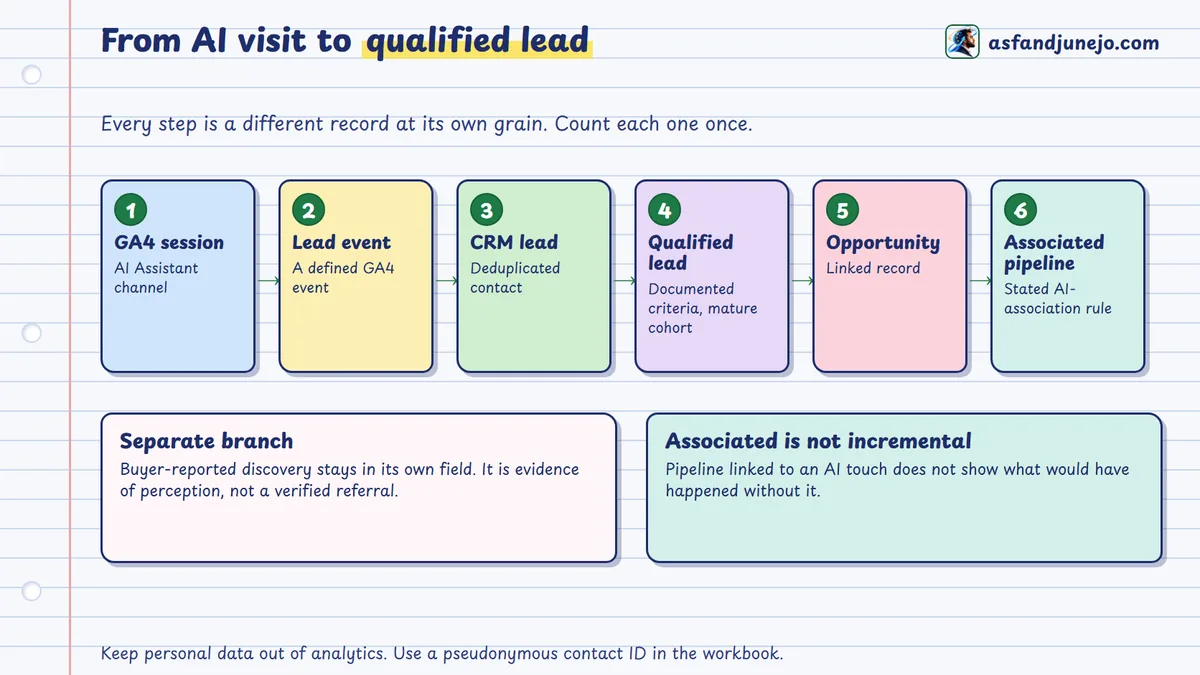
AI-associated lead reporting requires more than tracking form submissions. A dependable workflow must preserve the source of an identifiable website visit, create or update a CRM contact under controlled identity rules, distinguish lead-generation events from qualified leads, and associate opportunities with documented evidence of acquisition or influence. These records should not be connected through assumptions or fabricated identifiers.
Google Analytics provides useful information about website behavior, but it is not necessarily the organization's authoritative record for sales qualification and revenue.
A form submission can represent a genuine buyer, an existing customer, a support request, an unrelated inquiry, or automated spam.
The commercial meaning of that event becomes clearer when the record has been validated and classified through a controlled lead-management process.
Start with properly defined lead events
Google's (opens in a new tab)recommended GA4 events (opens in a new tab) include several names associated with lead generation and lifecycle progression.
| Event | Intended meaning |
|---|---|
generate_lead | A lead has been generated, such as through a form submission |
| working_lead | A representative is working with the lead |
| qualify_lead | The lead meets the defined qualification criteria |
| disqualify_lead | The lead has been rejected under the organization's rules |
| close_convert_lead | A qualified lead has become a customer |
| close_unconvert_lead | A lead has been closed without conversion |
These are recommended event names, not evidence that the corresponding events have already been implemented.
The organization must verify which events are actually collected, how they are triggered, and whether they correspond to reliable CRM states.
For example, automatically recording qualify_lead whenever someone submits a contact form would undermine its purpose if sales qualification has not occurred.
Separate analytics events from CRM entities
A single visitor may submit more than one form. One person may generate multiple events, while several sessions may relate to one eventual CRM contact.
The number of generate_lead events should therefore not automatically be reported as the number of unique leads.
A CRM can apply deduplication rules based on legitimate identity information and maintain a unique contact record.
The relationship between an analytics event and a CRM entity should be established through an approved tracking and integration design.
Where available, a non-personally identifiable internal identifier can be used for appropriate reconciliation in accordance with the platform's policies.
The organization should avoid passing names, email addresses, telephone numbers, or other prohibited personally identifiable information into Google Analytics. Google's (opens in a new tab)PII guidance (opens in a new tab) explicitly restricts the use of such data.
Preserve original acquisition and later influence
A suitable CRM data model should preserve multiple fields rather than attempt to store the entire customer journey in a single, changing source value.
| CRM field | Purpose |
|---|---|
| First recorded acquisition source | Preserve initial known acquisition |
| Latest recorded acquisition source | Identify a more recent recognized source |
| First landing page | Preserve an initial website context |
| Relevant campaign data | Record approved campaign attribution |
| AI-related referral source | Identify recorded AI acquisition where available |
| Self-reported discovery source | Preserve the buyer's own answer |
| Qualification status | Distinguish lead from qualified lead |
| Opportunity ID | Connect the contact to an opportunity where appropriate |
| Opportunity value | Record associated commercial pipeline |
| Closed-won amount | Record completed business under the company's accounting definitions |
The acquisition fields and self-reported fields must remain distinct.
If the buyer reports first learning about a company through ChatGPT while the website records Google Search as the initial observed acquisition source, both observations may be correct within their respective definitions.
Overwriting the technical acquisition source with the self-reported answer would destroy useful evidence.
Integrate lifecycle reporting carefully
Organizations may choose to send appropriate offline lifecycle events from a CRM into GA4 via supported mechanisms, such as Measurement Protocol or other data import methods.
However, these integrations require careful consideration of identity matching, event timestamps, attribution, consent, and platform rules.
Google's (opens in a new tab)Measurement Protocol documentation (opens in a new tab) includes restrictions on event timing and guidance for integrating server-side events with previously collected website activity.
An offline deal closing months after the original visit should not be artificially backdated into the initial session merely to produce a more favorable channel report.
Likewise, a CRM transaction should not be sent with a made-up identifier to create an unsupported connection.
Where a reliable integration is unavailable, separate CRM reporting with documented acquisition fields may be more honest than a technically sophisticated but inaccurate attribution model.
Define qualified leads before calculating performance
A business should establish its own marketing and sales qualification criteria.
These may include organizational fit, geographic coverage, budget suitability, required capabilities, purchase timeframe, project scope, or other criteria relevant to the business.
The exact model varies by organization.
Once the criteria are established, the report should identify the lead population and the lifecycle stage used to classify a lead as qualified.
For example, a marketing-qualified lead is not necessarily a sales-qualified lead, and neither is equivalent to a won opportunity.
The report should also distinguish the date a lead was created from the date it became qualified. A lead acquired during one month may reach a later stage in another month.
Without that distinction, a monthly lead conversion rate can become misleading.
How do you use self-reported AI discovery without inflating attribution?
Self-reported attribution captures what buyers remember about discovering or evaluating a brand, including the possible influence of AI assistants. It is valuable because not every AI-assisted interaction produces an identifiable website referral. However, it is affected by memory, question wording, response selection, and missing answers, so it should supplement rather than overwrite recorded acquisition evidence.
Self-reported discovery is especially useful for organizations whose buyers conduct substantial research before contacting sales.
A potential customer may evaluate several providers through search engines, AI assistants, professional networks, industry articles, and direct conversations.
By the time the customer completes a form, only part of that research history may be visible in the website analytics.
A simple discovery question can provide useful additional context, as long as its purpose and limitations are understood.
Ask two different questions
The first question should identify the buyer's initial source of discovery.
Where did you first hear about our company?
The second should identify sources that influenced the decision to make contact.
Which sources did you use to research or evaluate us before reaching out?
These questions should not be combined into a single field because initial discovery and subsequent influence are distinct events.
A suitable response design may include Google or another search engine, an AI assistant, a professional recommendation, social media, an industry publication, an event, other, and don't remember.
An optional follow-up can ask which specific AI assistant was used.
Where appropriate, allow respondents to choose multiple research influences while keeping initial discovery as a separate question.
Do not lead the respondent toward AI
A question such as "Did ChatGPT help you find us?" may overemphasize one possible source and encourage a different response pattern than a neutrally worded discovery question.
If an organization wants to study AI-assisted discovery, it can ask a neutral first question before adding an optional clarification.
The survey design should be consistent across reporting periods.
Changes in question wording or available response options should be documented because they may alter response distributions independently of actual market behavior.
Report response rates and ambiguity
If only a portion of the lead population responds, the reported percentage identifying AI assistants should use the responding population as its explicit denominator.
The response rate should be presented alongside the result.
For example, a claim describing AI discovery among survey respondents is not equivalent to a claim about all acquired leads.
Nonrespondents may differ systematically from respondents.
Responses may also be ambiguous. Some users refer to Google AI Mode as Google Search, while others identify Gemini, ChatGPT, or an unnamed AI assistant.
The classification should preserve the original answer and distinguish confident interpretations from ambiguous cases.
Treat self-reported influence as evidence of reported perception
A buyer who reports using an AI assistant provides evidence of a prior AI-related interaction.
That does not independently verify the exact prompt, the generated response, the source citation, or the assistant's causal importance.
The data can still be valuable.
For example, a sustained increase in buyers mentioning AI-assisted research may justify more detailed investigation into the organization's visibility across relevant decision-stage questions.
But it should not be used to claim that every associated opportunity was generated incrementally by AI search.
What are the AI visibility KPI formulas and measurement governance rules?
AI visibility KPI calculations should use consistent numerator and denominator definitions, clearly identified source systems, and appropriately matched reporting periods. Sampled citation rates, identifiable AI referral sessions, qualified lead rates, and revenue-associated measures operate at different analytical levels. They should be reported separately and joined only when reliable evidence permits the relationship.
The following definitions provide a practical reference for recurring reporting.
AI Assistant engagement rate
AI Assistant engagement rate is engaged sessions divided by sessions within the identified AI Assistant population.
For GA4's identified AI Assistant session population:
AI Assistant engagement rate = AI Assistant engaged sessions ÷ AI Assistant sessions × 100This is based on the GA4 engagement definition and uses the correct session population.
It should not be confused with brand engagement in AI-generated answers.
AI Assistant lead-event rate
The lead-event rate is the share of eligible AI Assistant sessions that contain at least one defined lead event.
For a defined lead-generation event:
Lead-event rate = Eligible AI Assistant sessions containing at least one defined lead event ÷ Eligible AI Assistant sessions × 100This requires a session-level calculation or an appropriately configured equivalent metric.
Simply dividing total generate_lead event occurrences by total sessions may count multiple events within a session, yielding a different measure.
The organization must decide whether to report events per session, per session with a lead event, or per distinct lead associated with qualifying sessions.
These are separate metrics.
Qualified lead rate
Qualified lead rate is qualified leads divided by eligible leads within the same cohort.
For a cohort of appropriately linked CRM leads:
Qualified lead rate = Qualified leads in the defined cohort ÷ Eligible leads in that cohort × 100Qualification must be based on documented business rules.
The numerator and denominator must use the same population and a clearly defined observation window.
If the reporting period ends before many leads have had sufficient time to qualify, the rate may be incomplete.
A mature-cohort view may therefore be more useful than comparing recently acquired leads with older leads that have had longer to progress.
Lead-to-opportunity rate
Lead-to-opportunity rate = Deduplicated leads that became opportunities ÷ Eligible deduplicated leads × 100
This measure requires a documented association between the lead and opportunity records.
It should not count the same lead more than once when multiple opportunities are created unless the report explicitly defines an opportunity-based measure.
AI-associated pipeline
AI-associated pipeline can be defined as the sum of the opportunity values of records that satisfy a stated AI-association rule.
For example, the rule could require a verified first acquisition source of AI Assistant or a separate self-reported AI discovery field.
The two categories should be reported separately where they overlap.
An associated pipeline is not an incremental pipeline. A valid association does not establish what would have happened without the AI interaction.
Cost and ROI
Operational expenditure may include monitoring software, analyst time, research costs, integrations, content production, and relevant implementation work.
A useful cost-efficiency measure can be calculated where the population is defined:
Cost per recorded AI-acquired qualified lead = Allocated program cost ÷ Qualified leads meeting the verified AI acquisition ruleThis remains an accounting and attribution measure, not a causal proof of incremental customer acquisition.
A rigorous incremental ROI calculation requires a credible estimate of incremental financial benefit relative to what would have happened without the investment.
Without an appropriate experimental or quasi-experimental design, revenue associated with AI touchpoints should not be labeled as revenue caused by the AI visibility program.
Measurement dictionary
Version each metric's definition, source, unit and caveat so trends stay interpretable.
| Metric | Measurement source | Unit | Primary caveat |
|---|---|---|---|
| Brand mention rate | Controlled prompt sample | Percentage of valid answers | Sampling bias |
| Owned citation rate | Controlled prompt sample | Percentage of valid answers | Citation counting rules |
| Google AI impressions | Google Search Console | Impressions | Platform-specific reporting |
| Bing AI citations | Bing Webmaster Tools | Citations | Not equivalent to impressions |
| AI Assistant sessions | GA4 | Sessions | Identifiable sources only |
| Engaged AI Assistant sessions | GA4 | Sessions | Engagement definition |
| AI lead-generation events | GA4 | Events | Not unique leads |
| AI-acquired leads | CRM | Deduplicated leads | Source quality and identity matching |
| AI-associated qualified leads | CRM | Qualified records | Association rule |
| AI-associated pipeline | CRM | Currency | Not incremental revenue |
| Self-reported AI discovery rate | Buyer survey | Percentage of respondents | Recall and nonresponse bias |
The definition of each metric should be versioned so historical trends remain interpretable if classification rules change.
How do you evaluate AI visibility tracking tools?
An AI visibility tracking platform should be evaluated by the evidence it can preserve, the platforms and prompts it actually covers, its classification methodology, and its ability to export reproducible observations. A proprietary visibility score or a large advertised prompt database is not sufficient evidence that a tool can answer an organization's most important business questions.
The category includes dedicated AI answer-monitoring platforms, broader SEO suites, first-party search reporting products, and analytics systems.
These products solve related but different problems.
Separate monitoring from attribution
A platform that runs repeated prompts through AI assistants may be well suited to tracking mentions, citations, answer changes, and competitor representation.
It may not be able to determine whether a real customer who later visited the website saw one of those monitored answers.
Likewise, Google Analytics can provide useful session and event measurement without exposing the full population of AI-generated answers shown to users.
A complete operating system may require several complementary tools rather than a single product that claims to measure every stage.
Compare documented capabilities
Current commercial examples include Ahrefs Brand Radar, Semrush's AI Visibility Toolkit, Profound, Peec AI, and other dedicated answer-monitoring platforms.
For example, the (opens in a new tab)Ahrefs Brand Radar documentation (opens in a new tab) defines its measurement of mentions and citations, and the (opens in a new tab)custom prompt documentation (opens in a new tab) explains how to configure monitoring.
These products are examples of the category, not endorsements or evidence that their measured visibility values are interchangeable.
An appropriate comparison should examine the specific features, coverage, collection frequency, export permissions, and contract terms available in the plan under consideration.
Vendor evaluation criteria
Judge tools by documented capability, data provenance and what they can and cannot attribute.
| Evaluation area | Questions to ask |
|---|---|
| Platform coverage | Which AI experiences are measured in the purchased tier? |
| Collection method | Is the answer observed directly, estimated, or inferred? |
| Prompt selection | Who chooses the prompts and how representative are they? |
| Geography and language | Can the intended market be monitored consistently? |
| Citation handling | Are cited URLs, owned domains, and third-party citations separated? |
| Brand classification | How are ambiguous mentions and recommendations treated? |
| Data exports | Are raw answer records and timestamps available? |
| Update frequency | How often are comparable observations collected? |
| Historical consistency | Can changes in methodology be identified? |
| Privacy and permissions | What data can the provider access and retain? |
| Business integrations | Can outputs be reconciled with analytics and CRM data? |
| Cost | Is pricing based on prompts, responses, platforms, users, or exports? |
When comparing tools, insist on sample exports using a defined set of prompts.
A useful pilot can evaluate whether two products consistently classify the same small set of answers, whether cited URLs are preserved accurately, and whether their reported metrics can be reproduced from the underlying records.
Differences should be investigated rather than resolved by selecting the tool with the highest score.
What does a reproducible AI visibility measurement experiment look like?
An effective AI visibility experiment should test whether changes in observed mentions and citations are accompanied by corresponding changes in identifiable referrals or business outcomes, while preserving the limitations of each data source. The study must use a fixed collection design, stable metric definitions, and documented observation periods. Its findings should remain descriptive unless the research supports stronger causal conclusions.
The principal research question is:
To what extent does observed AI answer visibility correspond with identifiable website acquisition and qualified lead activity?
The purpose is not to prove in advance that AI citations generate customers. It is to evaluate whether the available evidence supports that relationship and where important gaps remain.
Establish the research population
Select an authorized website with functioning GA4 reporting, access to relevant first-party search reports, and a CRM or equivalent lead-management system.
Define the subject areas relevant to the website and create a fixed set of prompts representing meaningful buyer questions.
A starting observation window of 28 days may be practical for an initial operational baseline, but it does not guarantee sufficient statistical power.
The adequacy of the sample depends on observed event counts, variability, market conditions, and the effects being investigated.
Collect separate evidence datasets
The experiment should maintain five datasets.
| Dataset | Core evidence |
|---|---|
| A: AI answer observations | Prompts, brands, recommendations, citation URLs and dates |
| B: Google AI reporting | Reported generative AI impressions and exposed pages |
| C: Bing AI reporting | Reported citations, cited pages and grounding context |
| D: Website analytics | Identifiable AI Assistant sessions, landing pages and key events |
| E: CRM and buyer reporting | Deduplicated leads, qualifications, opportunities and self-reported discovery |
Each dataset must retain its native definitions and reporting boundaries.
An answer-monitoring tool's citation count should not be relabeled as a Google impression. CRM opportunities should not be counted as unique visitors. Missing source records should not be populated through unsupported inference.
Define hypotheses before reviewing the outcome
A suitable initial hypothesis is that pages receiving greater observed source representation may also attract more identifiable AI referral traffic.
A competing possibility is that citations primarily provide information within the AI interface, resulting in little incremental activity on the website.
Another explanation is that citation and referral activity may be driven by shared changes in search interest rather than by one causing the other.
These explanations should be defined before the analysis so that the most convenient interpretation is not selected after seeing the results.
Examine page-level relationships carefully
Match the cited URLs to the website's canonical and landing-page records where appropriate.
Document how subdomains, trailing slashes, parameters, redirects, and alternative URL forms are handled.
For each relevant page, compare changes in sampled citations with changes in identifiable AI Assistant sessions.
This comparison may be informative, but it does not represent a direct citation-to-click conversion rate because the observed answers and recorded sessions are usually not drawn from the same complete population of users.
Correlation, if present, should be reported with the relevant sample size and limitations.
Analyze leads at the appropriate cohort level
Identify qualifying CRM contacts whose acquisition information meets the defined AI source rule.
Record the lead creation date and qualification date separately.
For additional influence research, analyze buyers reporting AI-assisted discovery as a distinct population.
Where an identifiable AI referral and a buyer-reported AI influence record belong to the same legitimately matched contact, document both observations without counting the contact twice.
Do not assign unlinked sampled citations to individual leads.
Consider alternative explanations
Observed changes may reflect seasonal demand, website releases, broader brand campaigns, indexing changes, paid media, industry events, changes in AI answer behavior, or changes in the tracking infrastructure.
The analysis should inspect significant known events during the observation window.
Where these conditions cannot be controlled, conclusions should remain descriptive.
A before-and-after comparison is not automatically an experiment capable of identifying causal impact.
Report results even when the evidence is weak
The investigation should be considered useful if it establishes clear measurement boundaries, identifies data-quality weaknesses, or demonstrates that specific metrics do not consistently correlate within the observed sample.
A finding that citation frequency cannot reliably predict qualified leads may be commercially important.
It could prevent an organization from using an attractive but unsupported KPI as the foundation of its budget decisions.
Required research record
Each finding should preserve the source, period, population, calculation, uncertainty, competing explanations, and its relevance to the decision.
An illustrative research register is shown below.
| Research question | Source | Status |
|---|---|---|
| Did the sampled owned-domain citation rate change? | Dataset A | Not Tested |
| Did Google AI exposure change? | Dataset B | Not Tested |
| Did Bing citation activity change? | Dataset C | Not Tested |
| Did identifiable AI referrals change? | Dataset D | Not Tested |
| Did AI-acquired qualified leads change? | Dataset E | Not Tested |
| Are the observed movements associated? | Reconciled datasets | Not Tested |
| Can causality be established? | Research design assessment | Not Established |
These statuses are intentionally unverified. They must be replaced with genuine research observations before the article presents results from a completed case study.
How do you build an executive AI visibility and lead attribution dashboard?
An executive AI visibility dashboard should present measured AI answer exposure, first-party platform reporting, identifiable website acquisition, qualified lead outcomes, and data-quality limitations, without combining incompatible units into a single score. The objective is to support decisions about content investment, technical priorities, acquisition quality, and measurement reliability.
A useful dashboard should answer questions at two levels.
The first is operational: Are the relevant sources of information being collected accurately and consistently?
The second is commercial: Are the observable indicators of AI visibility accompanied by meaningful activity that warrants further investment or investigation?
A dashboard that displays citation counts without their collection method may create more confidence than the evidence supports.
Organize the dashboard into five reporting groups
AI answer visibility should display sampled brand-mention rates, owned-citation rates, recommendation rates, and relevant competitor comparisons.
First-party platform exposure should include Google's reported generative AI impressions and Bing's reported citation activity, each defined as such.
Website acquisition should include GA4 AI Assistant sessions, recognized sources, landing pages, engagement, and verified key events.
Commercial outcomes should display qualified leads, opportunities, and revenue-associated records under defined CRM attribution rules.
Evidence quality should identify missing source information, sample changes, unverified records, measurement interruptions, and unresolved discrepancies.
Executive scorecard specification
The scorecard shows each measurement with its source, definition and confidence, never a single composite score.
| Reporting area | Primary KPI | Reporting frequency |
|---|---|---|
| AI answer visibility | Sampled owned citation rate | Weekly or monthly |
| Brand presence | Sampled brand mention rate | Weekly or monthly |
| Google exposure | Generative AI impressions | Monthly |
| Bing visibility | Reported AI citations | Monthly |
| AI website acquisition | GA4 AI Assistant sessions | Weekly or monthly |
| Engagement | Engaged AI Assistant sessions | Monthly |
| Lead generation | Recorded qualifying lead events | Monthly |
| Lead quality | CRM-qualified AI-associated leads | Monthly, by cohort |
| Pipeline | AI-associated opportunity value | Monthly or quarterly |
| Revenue context | Closed-won AI-associated records | Quarterly or longer |
| Measurement confidence | Known data gaps and audit status | Every reporting cycle |
The schedule should reflect data availability and the organization's actual decision cycle.
A small number of citations or leads may not justify daily trend analysis. Longer windows can sometimes provide a clearer perspective, although they do not automatically correct bias or attribution limitations.
Separate activity changes from interpretation
A useful dashboard should distinguish the reported change from the proposed explanation.
For example:
Observed: AI Assistant sessions increased during the reporting period.
Possible interpretation: More visitors arrived from recognized AI assistant sources.
Unresolved: Whether overall AI exposure increased, whether conversion quality changed, and whether the increase resulted from content improvements.
Decision: Investigate source distribution, landing-page performance, and qualified lead outcomes before changing the investment allocation.
This format enables decision-makers to use the data without accepting unsupported causal narratives.
Include a measurement confidence register
Each reporting block should identify its source, date range, definition, completeness, and known limitations.
Where the dashboard combines information from GA4 and a CRM, the methodology should explain how records were reconciled and which records could not be matched.
A lead total should not be described as verified simply because it appears in an automatically refreshed dashboard.
Automation improves data availability. It does not remove the responsibility to validate what the data means.
What are the common AI visibility measurement errors?
The most damaging AI visibility reporting errors occur when metrics from different populations are treated as interchangeable, sampled answers are generalized to all users, or associations with leads and revenue are presented as causal results. Avoiding these errors requires explicit definitions, consistent denominators, source verification, and independent review of commercially consequential conclusions.
Error 1: Treating citations as impressions
A Google generative AI impression, a Bing citation, and a third-party observed citation are not identical measurements.
They should not be added to a single total without a valid normalization or measurement model.
Error 2: Treating brand mentions as recommendations
A neutral reference to an organization is not automatically a recommendation.
Use defined classification criteria and preserve ambiguous cases.
Error 3: Calling sampled share of voice market share
A prompt-monitoring sample describes the selected prompts and collection conditions.
It does not automatically represent the full population of AI search activity.
Error 4: Treating GA4 AI Assistant sessions as all AI-influenced visits
Google's AI Overviews and AI Mode are excluded from GA4's native AI Assistant channel.
Referral loss, cross-channel behavior, and later visits can also produce unobserved AI influence.
Error 5: Counting all lead events as qualified leads
A lead-generation event is not the same as an approved CRM contact or a qualified commercial opportunity.
Use the appropriate event and lifecycle definitions.
Error 6: Combining first-user and session attribution
These scopes measure different acquisition relationships.
A report should never compare them without identifying the difference.
Error 7: Treating missing data as zero
Unavailable platform reporting, failed prompt collection, incomplete survey responses, and absent CRM identifiers require separate missing-data states.
Error 8: Double-counting AI-associated leads
A contact may have both an identifiable AI referral and a self-reported AI discovery answer.
The two sources can support the same record, but they should not produce two unique leads.
Error 9: Misclassifying sources through broad matching rules
An excessively permissive custom channel regex may classify unrelated sources as AI assistants.
Validate against observed source values and document rule changes.
Error 10: Treating a citation increase as proof of commercial impact
Citation exposure may have value, but the size and cause of downstream commercial effects require independent investigation.
Error 11: Comparing inconsistent reporting periods
Google Search Console, Bing reporting, GA4, and CRM systems may use different time zones, processing delays, and cohort dates.
Make these differences explicit.
Error 12: Presenting a proprietary visibility score as an objective benchmark
A composite score should only be interpreted within the methodology that produced it.
Vendor scores should not be presented as official AI search ranking metrics.
Error 13: Sending sensitive CRM data into analytics without appropriate controls
Personal information should be protected in accordance with applicable privacy requirements and the receiving platform's data policies.
A CRM integration must not be used as an excuse to transmit prohibited identifying information to GA4.
What is the AI visibility tracking checklist?
A repeatable AI visibility measurement program requires documented definitions, stable collection rules, source verification, and a clear decision process. The objective is to produce comparable observations over time rather than continuously changing the measurement system in response to the latest reported result.
The following checklist can be used as the foundation for a monthly monitoring and review process.
A. AI answer monitoring
Answer monitoring means a versioned prompt set, a recorded collection method and separate counts for mentions, recommendations and citations.
B. Platform reporting
Platform reporting means collecting Google impressions and Bing citations separately under each platform's own definitions.
C. GA4 acquisition
GA4 acquisition means checking the native AI Assistant channel and the actual source values before any custom rule.
D. CRM attribution
CRM attribution means defined qualified-lead criteria, preserved source fields and a separate self-reported field.
E. Data quality and governance
Governance means consistent periods, recorded denominators, verified calculations and a dated correction log.
Recommended resource package
The most useful downloadable resources include an AI visibility measurement workbook, a prompt observation template, a GA4 AI referral validation guide, a CRM lead attribution template, a KPI dictionary, and a monthly executive reporting scorecard.
The workbook should retain separate tabs for answer observations, platform metrics, identifiable sessions, CRM records, calculation definitions, and evidence-quality assessments.
Templates should begin with blank or clearly labeled demonstration records rather than fabricated performance data.
The resources should also include a methodology document describing which metrics can be compared, which can be reconciled through genuine identifiers, and which remain independent observations.
Where can you get the free AI visibility tracking kit?
Join Search Signals with your email and three files unlock on this page straight away: the complete tracking kit (ZIP), the tracking workbook (Excel) and a printable KPI and QA checklist (PDF).
The workbook has ten tabs: prompt observations, Google AI exposure, Bing citations, GA4 AI referrals, CRM lead mapping, an evidence and QA register, a KPI dictionary, a source register, an executive dashboard and a start-here guide. The kit also holds six blank CSV templates, a prompt monitoring protocol, a GA4 validation guide, a CRM and buyer-survey guide, a methodology and an executive dashboard guide. Every template is blank or marked Not Tested, and nothing in it is a simulated result.
- AI Visibility Tracking Kit (ZIP)Workbook, checklist, CSV templates and guides, branded PDFs plus editable files
- AI Visibility Tracking WorkbookExcel workbook, 10 tabs
- KPI and QA checklistPDF, printable analyst sign-off
Frequently asked questions about AI visibility tracking
What is AI visibility tracking?
AI visibility tracking measures how a brand or website appears in AI-generated answers and related platform reporting. It can include mentions, recommendations, source citations, Google AI impressions, Bing citation activity, identifiable AI referrals, and associated business records. Because these measurements describe different events, a reliable system reports them separately and explains their limitations.
How do I track ChatGPT traffic in Google Analytics 4?
Open GA4's Traffic acquisition report and inspect the native AI Assistant channel. Review the Session source and Session medium dimensions to identify recognized traffic from ChatGPT and other supported assistants. The measurement captures identifiable visits under GA4's attribution rules, not every interaction or brand mention occurring within ChatGPT.
Does GA4 automatically recognize AI assistant traffic?
Google introduced a native AI Assistant channel in May 2026. Recognized AI referrals can receive the ai-assistant medium and appear within that channel. Coverage depends on the sources and acquisition information available to GA4. Google's AI Overviews and AI Mode are excluded from the native AI Assistant channel.
Can I measure how many times ChatGPT cites my website?
A suitable monitoring platform or an approved observation workflow can record citations that appear in sampled responses from ChatGPT. Those observations should identify exact URLs, prompts, collection dates, and counting rules. They do not automatically reveal the total number of citations shown to every ChatGPT user.
What is the difference between an AI citation and an AI brand mention?
A citation references a source, usually through a displayed URL or source link. A brand mention identifies the company or product in the answer text. A brand can be mentioned without being cited, and an owned source can be cited without the answer explicitly naming the company.
Can Google Search Console measure AI search visibility?
Google Search Console provides dedicated generative AI performance reporting for supported AI Overviews and AI Mode experiences. It measures qualifying impressions in accordance with Google's reporting rules. The report does not establish complete prompt-level attribution, every citation shown by Google's products, or the number of leads generated by AI exposure.
Can Bing Webmaster Tools track AI citations?
Yes. Bing Webmaster Tools provides AI Performance reporting for supported Microsoft and partner AI experiences, including citation counts, cited pages, and related grounding context. Additional 2026 features provide thematic and comparative reporting. These measurements are not equivalent to conventional search rankings or website conversions.
What is AI search share of voice?
AI search share of voice is a term used to refer to a brand's relative presence within a defined set of AI answer observations or platform-specific reporting. Its exact meaning depends on the methodology. A sampled mention-share metric is not equivalent to Bing's officially reported Citation Share or to market share across all AI searches.
Why do AI citations not always result in referral traffic?
Users may obtain sufficient information from the AI answer without visiting a website, or they may return later through another channel. Citation observations and identifiable referrals may also cover different platforms and user populations. A citation does not guarantee a click.
How can I track leads generated by AI assistants?
Start with identifiable AI Assistant referrals in analytics, validate lead-generation events, and preserve acquisition information in the CRM. Deduplicate contacts and apply documented qualification rules. Maintain self-reported AI discovery separately from verified technical acquisition, and do not assign unmatched citations to individual leads.
Can I calculate the ROI of AI search visibility?
A business can report costs, AI-associated acquisitions, qualified leads, pipeline, and revenue under clearly defined attribution rules. However, a claim about incremental AI search ROI requires credible evidence of what outcomes would have occurred without the investment. Correlation between citations and revenue is not sufficient.
How often should AI visibility be measured?
The reporting schedule should reflect sample stability, event volume, platform reporting availability, and business decision needs. Weekly monitoring may help identify changes in sampled answer behavior, while monthly or quarterly periods may be more appropriate for business outcomes. A fixed set of prompts and consistent definitions are essential for meaningful longitudinal comparison.
Final analysis: measure what is observable, qualify what is inferred
AI visibility measurement has advanced beyond manually searching for brand names in generated answers. Google now provides dedicated generative AI impression reporting, Bing Webmaster Tools provides publisher citation information, and GA4 recognizes identifiable traffic from supported AI assistants. These capabilities enable a broader measurement system, but they do not eliminate the differences among search exposure, source references, website acquisition, and commercial outcomes.
A brand may appear in an AI-generated answer without receiving a visit. A cited article may attract visitors who never submit a form. A customer influenced by AI-assisted research may ultimately arrive through a conventional search result or another recorded channel. Each observation contributes information, but the relationships between them must be established rather than assumed.
The most reliable approach is to preserve the distinct measurement sources. AI answer-monitoring data explains what occurred within a documented response sample. Google and Bing provide platform-defined views of exposure and citation activity. Google Analytics records identifiable acquisition and engagement. CRM systems establish the progression of contacts through qualification and commercial stages. Buyer-reported discovery adds contextual evidence where technical attribution cannot observe the earlier interaction.
These sources can support stronger decisions when they are interpreted together without losing their individual definitions.
For SEO professionals, the immediate opportunity is to build repeatable monitoring that identifies relevant changes and produces verifiable investigations. For marketing leaders, the opportunity is to distinguish apparent visibility growth from commercially meaningful performance. For organizations investing in AI search optimization, the priority should be establishing which outcomes are measurable, which remain uncertain, and what additional evidence is required before attributing business results to the program.
A citation is evidence of source representation. A referral is evidence of identifiable acquisition. A qualified lead is evidence of an accepted commercial prospect. Revenue is a separate business outcome.
Their relationship may be important, but it cannot be established through proximity on a dashboard.
Measure citations as citations, referrals as referrals, leads as leads, and commercial influence according to the evidence that can actually support it.
Sources and method
The platform definitions and methods in this guide rest on the primary documentation below; the examples and templates are illustrations, not measured results.
The following official sources support the technical requirements, definitions, and measurement methods discussed throughout this article.
- Google Analytics: What's New (opens in a new tab). Native AI Assistant traffic classification introduced in May 2026.
- Google Analytics: Default Channel Group (opens in a new tab). AI Assistant channel definition and recognized acquisition rules.
- Google Analytics: Traffic Acquisition Report (opens in a new tab). Session reporting, source dimensions, and engagement.
- Google Analytics: Custom Channel Groups (opens in a new tab). Optional channel customization and rule ordering.
- Google Analytics: Traffic Source Dimension Scopes (opens in a new tab). User, session, and event attribution distinctions.
- Google Analytics: Recommended Events (opens in a new tab). Lead-generation and lifecycle event definitions.
- Google Analytics: Measurement Protocol (opens in a new tab). Supported server-side event collection and timing limitations.
- Google Analytics: Avoid Sending Personally Identifiable Information (opens in a new tab): privacy and data-collection constraints.
- Google Search Console: Generative AI Performance (opens in a new tab). Supported Google AI impression reporting.
- Bing Webmaster Tools: AI Performance (opens in a new tab). Microsoft AI citations and publisher reporting.
- Bing: AI Visibility Insights (opens in a new tab). Intent, topic, citation share, and comparison features.
- Bing: Topics Portfolio Beta (opens in a new tab). October 2026 thematic citation reporting.
- Ahrefs: AI Visibility Metric Definitions (opens in a new tab). An example of a third-party answer-monitoring measurement methodology.
- Research disclosure: The technical methods described here are based on published documentation. The proposed cross-platform experiment is a research protocol, not a completed study. No AI citation counts, referral totals, lead results, or causal effects have been fabricated or represented as observed findings.