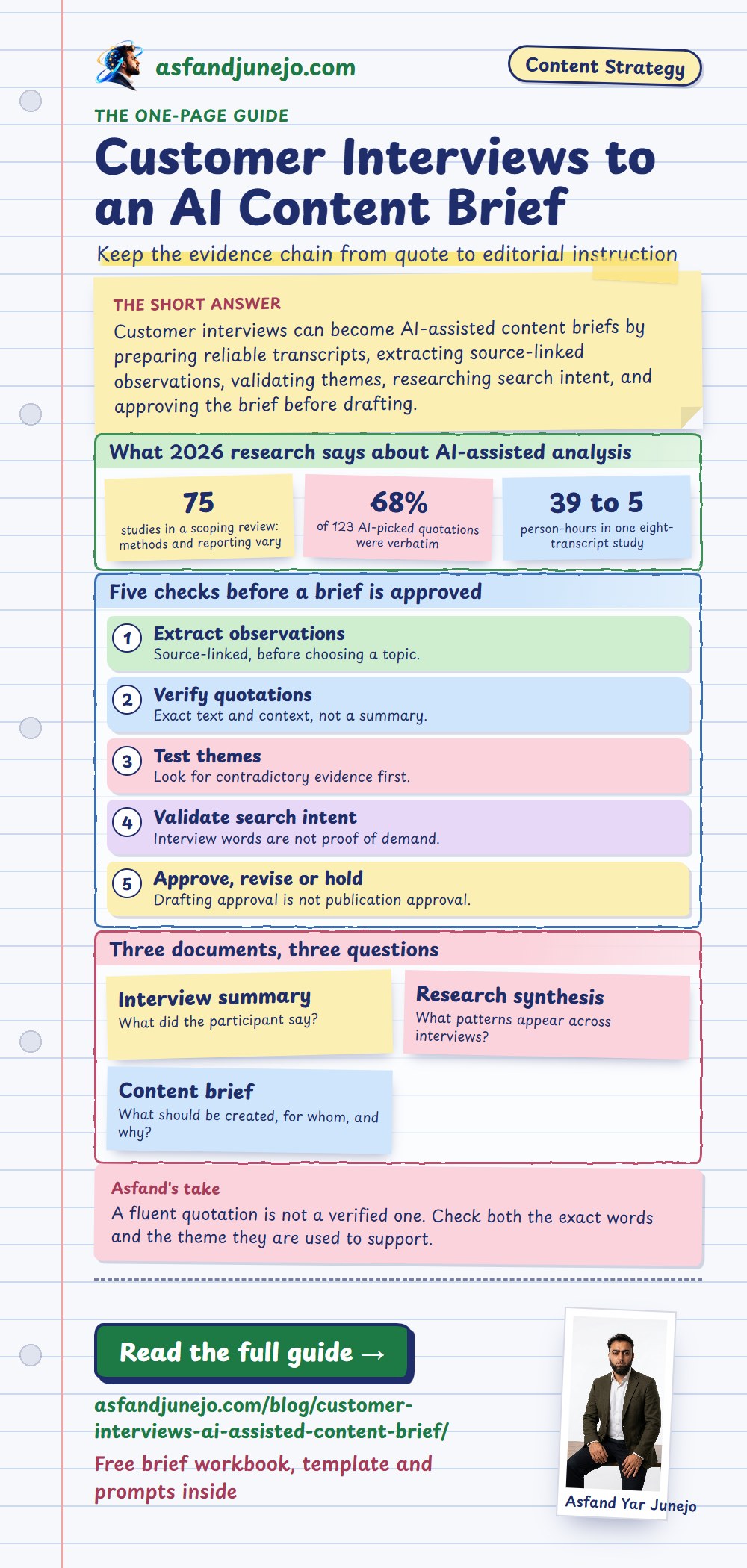
Customer interviews can be transformed into AI-assisted content briefs by preparing reliable transcripts, extracting source-linked observations, identifying and validating themes, researching the corresponding search intent, and translating approved findings into editorial instructions. AI can accelerate portions of this process, but the reliability of the resulting brief depends on the accuracy of its source material, the defensibility of its interpretations, and the review decisions made before a writer receives it.
Published · Sources checked · By Asfand Yar Junejo, publisher asfandjunejo.com
The distinction matters because generating a convincing content brief is relatively easy. Establishing that the brief addresses a real audience problem, rather than a plausible problem invented during analysis, is considerably more demanding.
Consider a marketing director who says that connecting organic traffic with business opportunities requires reconciling several reports. An AI assistant might recommend an article comparing reporting dashboards. That recommendation could be relevant, but it does not necessarily follow from the statement. The difficulty may concern disconnected systems, inconsistent lead definitions, delayed approvals, or a decision-making process that no new dashboard would resolve.
A dependable workflow must preserve these distinctions.
This guide combines published research on AI-assisted qualitative analysis with an instructional demonstration using six synthetic interview records. It also includes independently retrieved keyword research, examples of contradictory evidence, a source-to-claim verification matrix, and a completed working content brief.
The synthetic interviews illustrate the method. They are not presented as actual customer research or evidence about the prevalence of marketing problems.
The workbook, Word brief template, prompt pack and QA checklist behind this method are free for Search Signals subscribers.
What are the key takeaways?
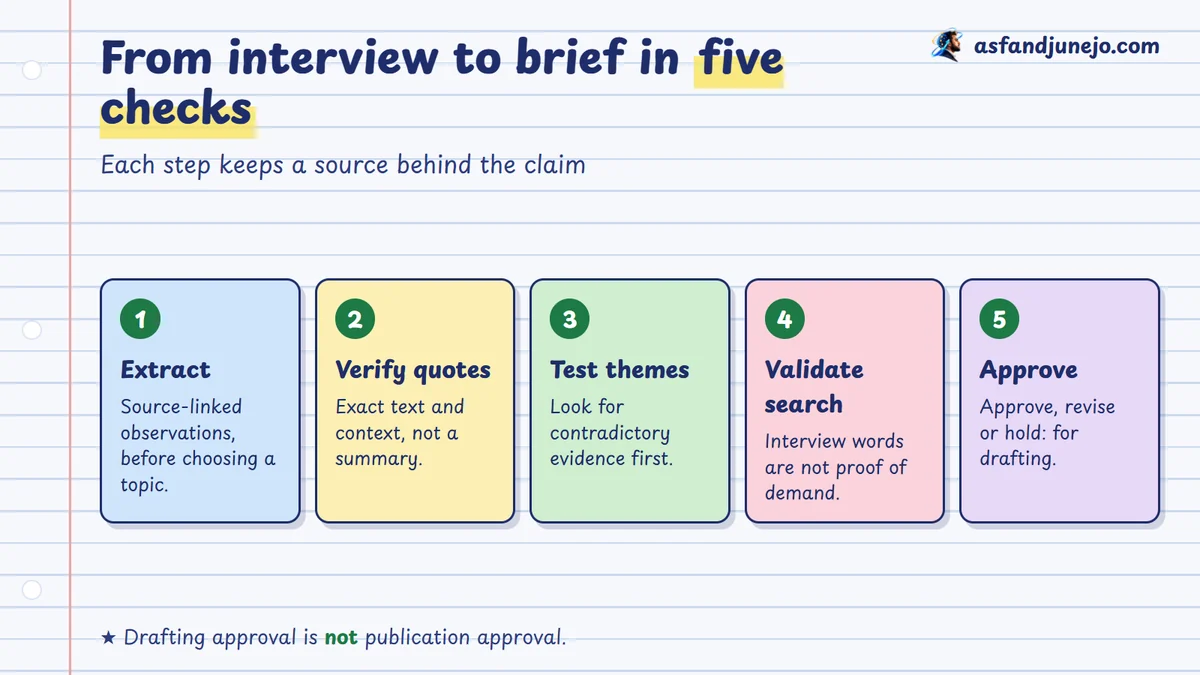
Treat interviews as evidence, not instructions: extract source-linked observations, verify every quotation, test themes against contradictions, validate search intent separately, and approve the brief before a writer starts.
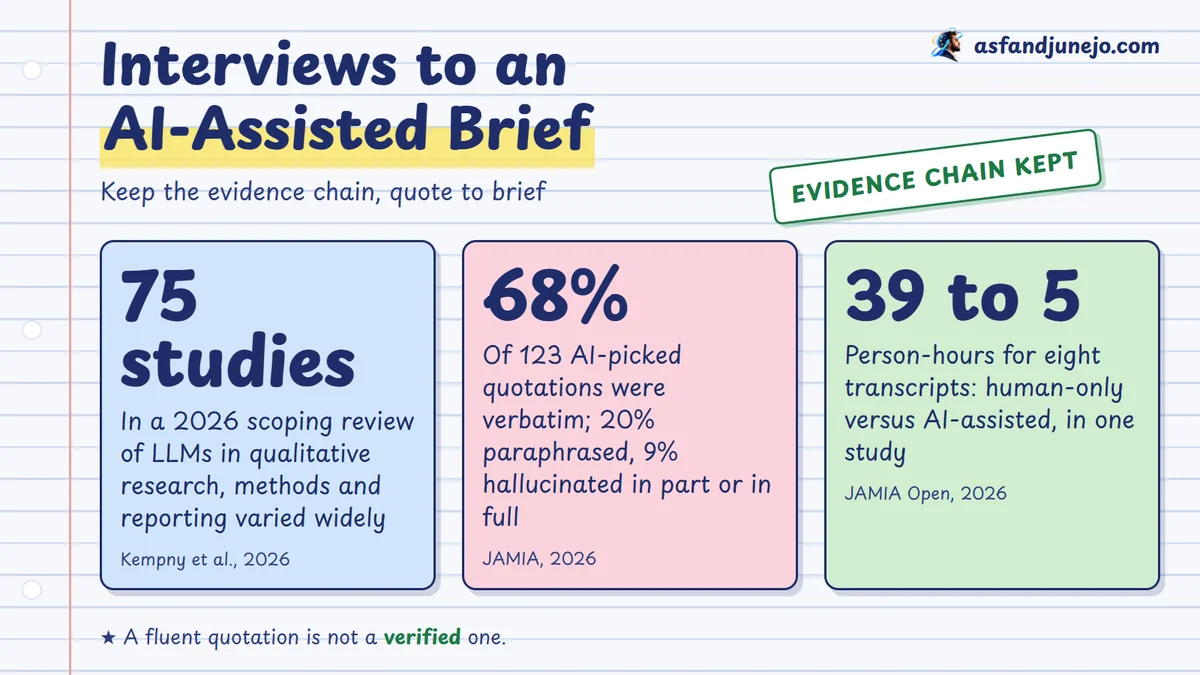
- AI-assisted interview analysis is feasible, but outcomes vary. A 2026 review of 75 studies found considerable variation in methods and reporting quality.
- Source verification is essential. A 2026 study found that only 68% of 123 evaluated AI-generated representative quotations reproduced the source wording verbatim.
- Performance improvements are possible but contextual. One eight-transcript clinical research study reported approximately 39 person-hours for human-only analysis and five for an AI-assisted process.
- Search intent needs independent validation. Customer language can suggest useful content questions, but it does not establish keyword demand or the appropriate search-result format.
- A credible content brief preserves its evidence chain. Important recommendations should be grounded in interview observations, independently verified information, or explicitly identified editorial judgments.
The practical objective is to produce a brief that a writer can execute, an editor can verify, and a reader can use.
What is an AI-assisted content brief?
An AI-assisted content brief is an editorial planning document prepared using AI-supported research and drafting processes. It defines the intended audience, reader problem, search intent, proposed argument, required questions, supporting evidence, content structure, and publication requirements.
AI may help organize the source material and develop a draft, but the document should remain subject to human review.
A conventional SEO brief often begins with a target keyword and a competitive search analysis. An interview-informed brief begins earlier, with evidence about what customers experience, which decisions they struggle with, and how they describe their needs.
These approaches serve different purposes.
Keyword research investigates search behavior. Customer interviews investigate reported experiences, motivations, objections, and decision-making contexts. A reliable editorial process combines the information without treating either source as a substitute for the other.
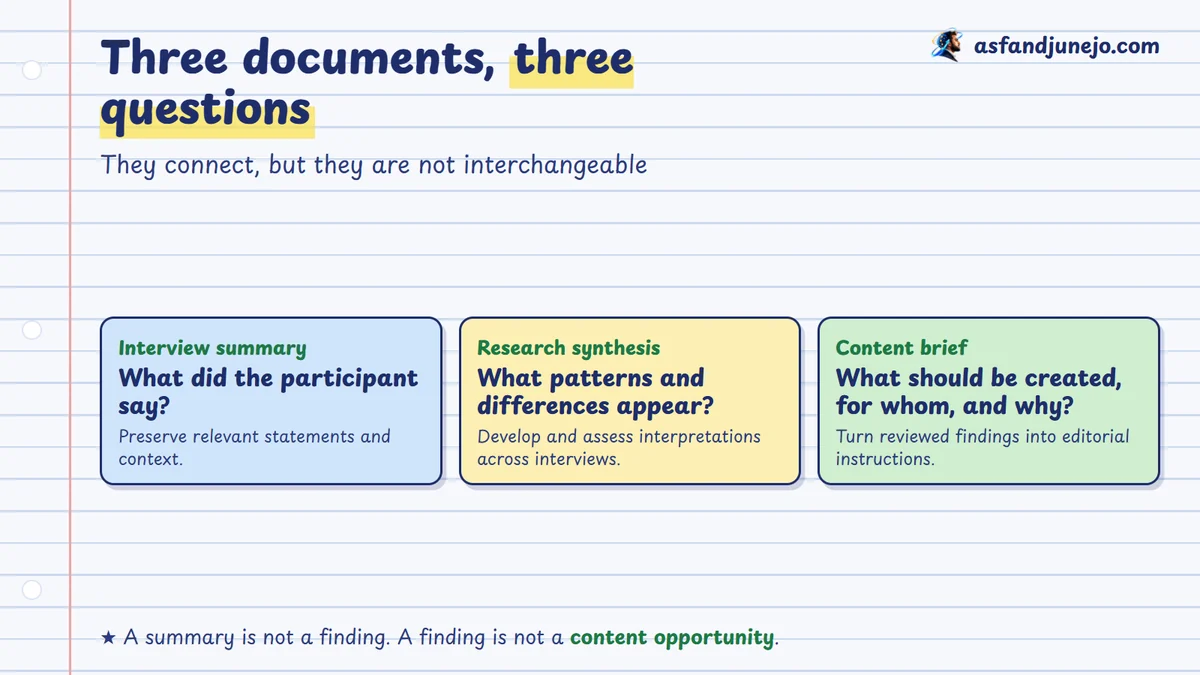
Interview summary versus research synthesis versus content brief
| Output | Main question | Purpose |
|---|---|---|
| Interview summary | What did the participant say? | Preserve relevant statements and context |
| Research synthesis | What patterns and differences appear across interviews? | Develop and assess interpretations |
| Content brief | What content should be created, for whom, and why? | Convert reviewed findings into editorial instructions |
These documents are connected but should not be treated as interchangeable.
An interview summary is not automatically a validated research finding. A research finding is not automatically a content opportunity.
The decisions connecting these stages must be documented.
What does published research tell us about AI-assisted qualitative analysis?
Published research indicates that large language models can support qualitative coding, theme discovery, and research organization, but their performance depends on the task, model, prompts, source material, and validation process. The evidence does not establish that AI systems can independently replace experienced qualitative researchers or reliably create accurate customer insights without review.
To investigate the evidence, a targeted literature review was conducted on October 30, 2026, using peer-reviewed studies and published methodological research from 2025 and 2026.
The review focused on four questions:
- Can AI identify useful themes from interview or other qualitative material?
- How accurately do models preserve supporting quotations?
- What evidence exists for improvements in research efficiency?
- Which methodological controls improve reliability and reproducibility?
This was a targeted evidence review, not a systematic review or meta-analysis. The selected studies use different datasets, methods, and evaluation standards, so their performance estimates should not be pooled.
Evidence review: Six relevant studies
| Study | Research setting | Key finding | Important limitation |
|---|---|---|---|
| Kempny et al., 2026 | Scoping review of 75 studies | LLM use is widespread across coding and theme-identification tasks, but technical reporting is inconsistent | Included studies are heterogeneous and predominantly health-related |
| Goyanes et al., 2025 | 30 qualitative interviews | A six-stage ChatGPT research protocol supported thematic exploration | Findings depend on dataset, prompting, and researcher interpretation |
| JAMIA, 2026 | 122 clinical consultation and interview transcripts | Human and AI analyses produced complementary themes; quotation fidelity required review | Clinical setting, specific models, and specific research protocol |
| JAMIA Open, 2026 | Eight de-identified clinical interview transcripts | Human-only analysis required approximately 39 person-hours versus five for the AI-assisted approach | Small dataset and study-specific staffing, costs, and methods |
| Jafarian, October 2026 | 2,952 publicly available Reddit posts | A validated human-in-the-loop coding protocol achieved Cohen’s κ = 0.91 | Reddit posts are not customer interviews; result is protocol-specific |
| Ashwin et al., 2025 | Interviews with Rohingya refugees and Bengali hosts | LLM coding errors could be nonrandom across participant characteristics | Specific social research setting; not a marketing interview benchmark |
Sources: BMC Medical Research Methodology (opens in a new tab), Quality & Quantity (opens in a new tab), JAMIA (opens in a new tab), JAMIA Open (opens in a new tab), Behavior Research Methods (opens in a new tab), and Sociological Methods & Research (opens in a new tab).
Finding 1: The quality of methodological reporting matters
A June 2026 scoping review by Kempny and colleagues examined 75 peer-reviewed studies involving large language models in qualitative research.
Of those studies, 43 used LLMs for coding assistance, while 41 used them for theme identification. The review also identified substantial gaps in reporting the technical conditions under which analyses were performed.
Among the 75 studies, 56 reported no model parameter settings, 34 did not specify the deployment configuration, and 10 provided no prompting details. Reported agreement between LLM and human coders ranged from 36% to 99%, although those figures came from studies using different tasks and evaluation designs.
The findings do not mean that every omitted parameter affected research quality. They demonstrate that incomplete technical reporting can prevent another researcher from understanding how a result was produced or assessing whether it is reproducible.
Source: Kempny et al., (opens in a new tab)The use and methodological reporting of large language models in qualitative research: a scoping review (opens in a new tab), 2026 (opens in a new tab).
Implication for content teams: Preserve the source version, instructions, model or tool identification, execution context, output, and review decisions where these details materially affect the analysis.
A prompt alone is not a complete research methodology.
Finding 2: Quotation fidelity cannot be assumed
A study published online in August 2026 in the Journal of the American Medical Informatics Association examined a hybrid qualitative analysis workflow using 122 transcripts, comprising 61 clinical consultations and 61 reflexive interviews.
The researchers compared human-led and AI-assisted thematic analysis, including the relationships between generated themes and their supporting quotations.
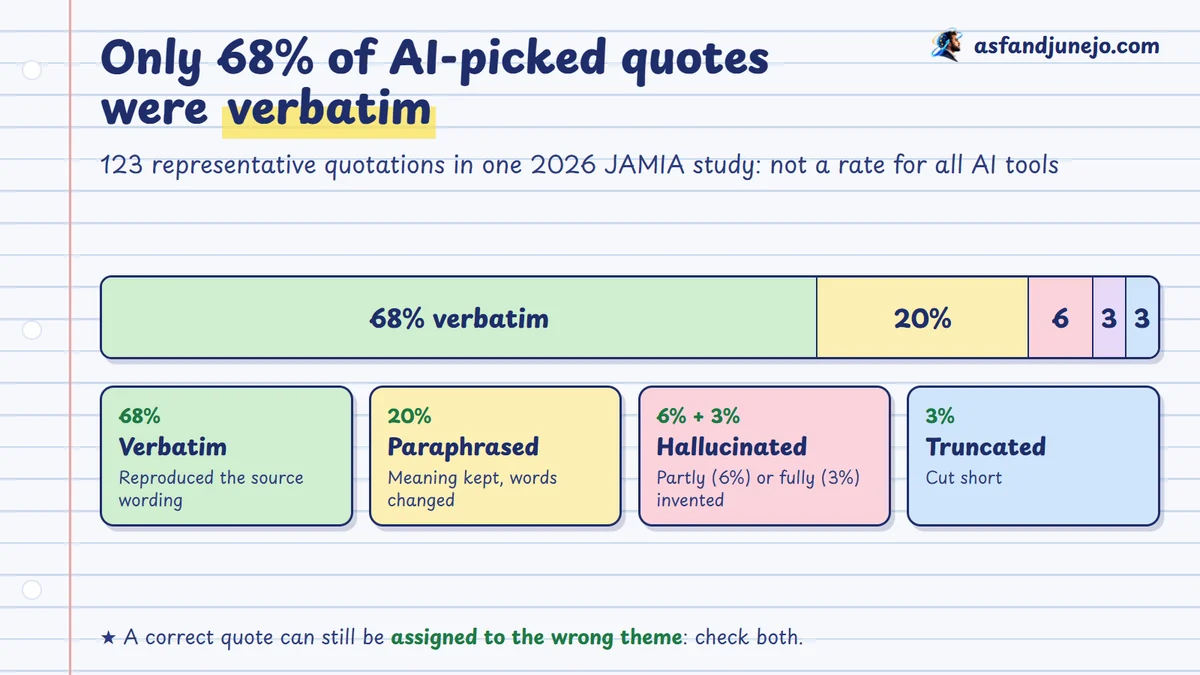
In an evaluation of 123 AI-generated representative quotations, 68% were verbatim, 20% were paraphrased, 6% contained partial hallucinations, 3% contained full hallucinations, and 3% were truncated.
The researchers also observed that an accurately reproduced quotation did not necessarily provide adequate support for the theme to which it had been assigned.
Source: Developing and evaluating human-led and large language model-assisted hybrid deductive-inductive workflows for qualitative analysis (opens in a new tab), 2026 (opens in a new tab).
These percentages apply to the evaluated quotations in that particular study, not to all AI systems or customer interview workflows.
Nevertheless, the methodological lesson is relevant.
Quotation accuracy and interpretive validity are separate checks.
A model may reproduce the customer’s words correctly while misunderstanding their meaning. Alternatively, it may produce a plausible interpretation while misrepresenting the supporting quotation.
An editorial workflow must test both.
Finding 3: AI-assisted analysis can reduce effort under controlled conditions
A September 2026 study in JAMIA Open compared human-only and LLM-assisted thematic analyses using eight de-identified interview transcripts on older adults’ experiences with digital health tools.
The researchers reported approximately 39 person-hours for the human-only analysis and five person-hours for the AI-assisted process. Estimated labor and subscription costs in that study were approximately $1,924 and $237, respectively.
The LLM-assisted method involved code generation, code refinement, and theme consolidation, with human oversight and evaluation against the human-generated reference.
Source: Sociotechnical analysis of qualitative data using a large language model-assisted framework with performance compared to a human-only coded reference standard (opens in a new tab), 2026 (opens in a new tab).
The result demonstrates that substantial efficiency gains are possible in a defined setting.
It does not establish that a marketing team should expect an equivalent reduction in research time or cost.
The sample contained only eight transcripts, and the result depended on the study’s staffing, tasks, methods, and cost assumptions.
For content operations, the responsible approach is to measure total effort, including verification and correction, rather than relying on a general promise that AI makes research a particular percentage faster.
Finding 4: Reproducibility improves when AI and human analysis are compared
An October 19, 2026 methodological study by Mandana Jafarian introduced a structured human-in-the-loop workflow for large-scale thematic analysis.
The research used 2,952 publicly available Reddit posts. The process established an initial codebook through manual analysis, refined prompts by comparing human and model outputs on a subset, and then applied the validated workflow to a larger corpus.
Under the reported controlled conditions, human and LLM coding achieved Cohen’s κ = 0.91.
The study also made reproducibility materials available.
Source: Human-in-the-loop LLM-assisted thematic analysis: A validated, reproducible tutorial for large-scale qualitative research (opens in a new tab), 2026 (opens in a new tab).
The agreement result should not be transferred directly to customer interviews, commercial content briefs, or other models.
Its more general contribution is procedural: an AI analysis workflow can be evaluated against human-coded material before being applied more broadly.
For a content team, that suggests starting with a small reviewed dataset rather than immediately processing every available interview.
Finding 5: Errors may not be evenly distributed
Research published in Sociological Methods & Research by Julian Ashwin, Aditya Chhabra, and Vijayendra Rao examined LLM-assisted analysis of qualitative interviews involving Rohingya refugees and Bengali hosts in Bangladesh.
The study found that model coding errors could vary systematically with participant characteristics, creating the possibility of biased substantive conclusions.
Source: Using Large Language Models for Qualitative Analysis Can Introduce Serious Bias (opens in a new tab).
This finding is particularly relevant when an interview dataset includes different customer segments, languages, organizational roles, or cultural contexts.
A global accuracy figure may conceal errors concentrated in particular groups.
Researchers should therefore inspect how well the method preserves meaning across relevant participant categories rather than treating an overall average as sufficient evidence of reliability.
What the research supports
Taken together, these studies support a controlled process involving source preservation, structured extraction, transparent prompts, human comparison, quotation verification, and interpretation review.
They do not establish that a particular AI assistant can consistently identify the correct content strategy from customer interviews.
That requires evaluation of the specific workflow, source material, and intended editorial outcome.
What information should you collect before analyzing interviews?
Before using AI, collect the research objective, authorized transcripts, relevant participant context, stable source identifiers, and the information needed to interpret the conversation.
The objective is to make the source evidence usable without losing the circumstances that explain it.
An interviewer should begin with questions about specific experiences rather than prompts that assume a preferred answer.
For a B2B marketing research project, useful questions might investigate how performance decisions are made, what information teams rely on, where difficulties arise, and what alternatives they have already attempted.
Nielsen Norman Group’s (opens in a new tab)User Interviews 101 (opens in a new tab) recommends defining research goals, asking open-ended questions, and exploring specific experiences. The guidance also distinguishes reported experiences from observed behavior.
A participant’s account may provide important qualitative evidence, but it does not independently establish every operational fact described.
Establish a source register
| Required field | Purpose |
|---|---|
| Interview ID | Identifies the source without unnecessary personal details |
| Participant role | Explains the relevant decision-making context |
| Research objective | Connects the interview to the investigation |
| Transcript version | Identifies the analyzed source |
| Source location | Allows quotations to be retrieved and checked |
| Authorization status | Documents permitted processing and publication uses |
| Reviewer | Establishes responsibility for verification |
| Review decision | Records whether the source is accepted, corrected, or excluded |
Where personal information is involved, organizations should establish an appropriate legal basis and confirm that processing is permitted under the applicable agreements and requirements.
The UK Information Commissioner’s Office guidance on research safeguards (opens in a new tab) emphasizes data minimization and distinguishes anonymous from pseudonymous information.
Pseudonymization does not necessarily remove data protection obligations.
The source register should help researchers verify claims, not expose confidential information to people who do not need access.
How should transcripts be prepared for AI analysis?
Transcripts should be checked against the available recordings or authoritative source records, particularly for statements that may influence editorial recommendations.
The review should identify incorrect terminology, speaker confusion, missing context, uncertain figures, and omitted qualifications.
For example, a statement about lead quality could be materially misinterpreted if transcription software records lead quantity.
Likewise, a participant saying that a process became difficult after a particular organizational change is not equivalent to saying that the process was always difficult.
Keep the source and reviewed working version distinguishable.
Meaningful corrections should be documented, and source identifiers should remain stable across subsequent analysis.
Qualitative research methods emphasize familiarization with the source material before developing themes. Both Nielsen Norman Group’s thematic analysis guidance (opens in a new tab) and the BMJ practical thematic analysis methodology (opens in a new tab) support a structured process of reading, coding, and interpretive review.
AI can assist with this process but does not establish that the transcripts have been understood correctly.
Worked example: From six synthetic interviews to a content brief
To demonstrate source traceability, six fictional B2B marketing interview excerpts were constructed for this article.
Hypothesis Six synthetic interview records used to teach the method; they are not real customer research or evidence about how common any marketing problem is
The records are synthetic. They do not represent real customers, collected interviews, or observed business conditions.
Their purpose is to show how an analytical workflow should preserve different explanations of a superficially similar problem.
The six source records
P01-E01: Marketing Director
“We can see where organic traffic is coming from, but when leadership asks which opportunities it influenced, we have to reconcile several reports.”
P02-E01: Revenue Operations Manager
“The numbers are available. Our bigger problem is that marketing and sales use different definitions of a qualified lead.”
P03-E01: Head of Growth
“Our reporting is reasonably clear. What slows us down is deciding which landing pages deserve attention when several teams have competing priorities.”
P04-E01: Marketing Operations Lead
“I don’t want another dashboard. The CRM export is fine. Approvals for the monthly analysis arrive after the board meeting.”
P05-E01: Sales Operations Manager
“Our marketing and sales teams agree on what a qualified lead means. We struggle with assigning landing-page owners.”
P06-E01: Demand Generation Manager
“We launched a new dashboard last month, and it solved the reporting lag, but it didn’t change how we prioritize campaigns.”
The excerpts were deliberately designed to contain differences and contradictions.
P02 identifies disagreement over qualification definitions, while P05 reports agreement on those definitions. P03 reports reasonably clear reporting, while P06 describes a dashboard that resolves reporting delays but not prioritization.
P04 identifies approval timing rather than software availability as the obstacle.
These differences create a more useful test of analytical discipline than a dataset in which every participant repeats the same problem.
Step 1: Extract observations without deciding the final article topic
A source-grounded AI instruction can require the system to identify exact statements, descriptive codes, preliminary interpretations, and uncertainty, without immediately generating editorial conclusions.
Example extraction prompt
Analyze the six supplied interview excerpts. For each observation, record its source ID, a short exact quotation, a descriptive code, and any interpretation that requires verification. Preserve contradictions. Do not merge participants into a single theme unless the evidence supports it. Do not invent quotations, participant counts, search volume, or market-wide conclusions. Do not recommend article topics during this extraction stage.
Step 2: Build the observation matrix
| Source | Verbatim source fragment | Descriptive code |
|---|---|---|
| P01-E01 | “We have to reconcile several reports” | Cross-system reconciliation |
| P02-E01 | “Marketing and sales use different definitions of a qualified lead” | Lead-definition disagreement |
| P03-E01 | “Our reporting is reasonably clear” | Reporting is not the primary obstacle |
| P04-E01 | “Approvals for the monthly analysis arrive after the board meeting” | Approval delay |
| P05-E01 | “Our marketing and sales teams agree on what a qualified lead means” | Contradictory evidence concerning lead definitions |
| P06-E01 | “It solved the reporting lag, but it didn’t change how we prioritize campaigns” | Reporting improvement without prioritization improvement |
These are analyst-constructed codes derived from the synthetic excerpts. They illustrate the kind of output an AI system could assist with, rather than constituting an independent benchmark of an AI model.
Step 3: Verify the extracted quotations
A deterministic source check was performed on the six records.
The check required that each extracted quotation match the text in its assigned source record exactly. It also verified that each source identifier resolved to a single record.
| Technical check | Result |
|---|---|
| Synthetic source records | 6 |
| Extracted quotation fragments | 6 |
| Valid source references | 6/6 |
| Exact quotation matches | 6/6 |
| Missing or mismatched excerpts | 0 |
Interpretation: The six selected fragments were traceable to the source text used in this instructional example.
This result verifies literal excerpt matching only.
It does not measure the accuracy of AI interpretation, the completeness of extraction, the quality of an independently executed model, or performance on real interviews.
A real AI benchmark would require logged model inputs and outputs, a predefined human reference, consistent scoring rules, and ideally repeated or independently reviewed evaluations.
Step 4: Test interpretations against contradictory evidence
The next task is not to find the most convenient common theme. It is to decide whether a proposed theme adequately represents the source material.
| Candidate conclusion | Relevant evidence | Decision |
|---|---|---|
| All participants need better dashboards | P04 rejects another dashboard; P06 reports a dashboard solved one issue but not prioritization | Reject |
| All participants disagree about qualified leads | P02 reports disagreement; P05 reports agreement | Reject |
| Performance information can be available while decisions remain difficult | P02, P03, P04, P05, and P06 describe different decision-related obstacles | Retain as a provisional cross-record interpretation |
| Reporting reconciliation is a universal problem | P01 describes reconciliation; other participants describe different difficulties | Reject |
| Different operational barriers may require different solutions | The six records show reconciliation, definitions, approvals, ownership, and prioritization issues | Retain as an editorial hypothesis |
The broad interpretation is deliberately qualified.
The examples illustrate different barriers, but they do not prove how common those barriers are in real marketing organizations.
The immediate research implication is that the proposed article should help readers diagnose which type of problem they face, rather than recommending a dashboard to everyone.
How do customer interview themes become SEO opportunities?
Customer interview themes become SEO opportunities when the underlying reader problem is compared with actual search behavior, competing content, existing site coverage, and the organization’s ability to provide a useful answer.
An interview phrase is not automatically a target keyword.
The proposed topic should be evaluated through several independent questions: Does a relevant audience need this information? Are there corresponding searches? What kind of content currently addresses the need? Can the proposed page offer something more useful than existing explanations?
Evidence-to-search mapping
| Synthetic observation | Candidate search question | Potential content direction |
|---|---|---|
| P01: Reporting reconciliation | How can marketing performance be connected with business opportunities? | Reporting and attribution explanation |
| P02: Qualification definitions | Why do marketing and sales disagree about qualified leads? | Measurement governance guide |
| P03: Prioritization | How should teams prioritize landing-page improvements? | SEO decision framework |
| P04: Approval delays | How can marketing reporting workflows be improved? | Reporting process checklist |
| P05: Ownership | Who should own landing-page optimization decisions? | Responsibility and workflow guide |
| P06: Dashboard without prioritization improvement | Why do better dashboards not always lead to better decisions? | Diagnostic article |
These are candidate questions, not proven search opportunities.
Independent keyword research
A U.S. keyword research check conducted on October 30, 2026, using Google Keyword Planner data returned the following directional averages.
| Search phrase | Reported average monthly searches |
|---|---|
| marketing dashboard | 720 |
| marketing reporting template | 140 |
| marketing performance report | 40 |
| marketing reporting best practices | 10 |
| marketing attribution reporting | 10 |
| sales and marketing lead definitions | 0 |
These values are not estimates of the traffic a proposed article will receive.
They also do not establish organic ranking difficulty, buyer intent, or the relative commercial value of the terms.
The broader phrase “marketing dashboard” has the highest reported volume in this set, but it does not necessarily reflect the needs described in the synthetic records.
A dashboard comparison may attract a different audience from a diagnostic guide about organizational decision-making.
This is why search research must investigate intent rather than treating the highest-volume phrase as the automatic target.
What does the competing content reveal?
A targeted review identified existing articles addressing marketing reporting and decision-making.
Funnel’s Marketing reporting best practices: From dashboards to decisions (opens in a new tab), published in March 2026, discusses the gap between reporting activity and decision-making.
Leadous’ Why Most Marketing Reports Don’t Drive Decisions (And How to Fix It) (opens in a new tab), published in January 2026, explores reporting clarity and the relationship between measurements and actions.
These pages demonstrate that general discussions of the usefulness of reporting are already in place. They are contextual competitor examples, not a complete ranking audit.
A new article simply repeating that dashboards should help decisions would have limited differentiation.
A more useful approach would show readers how to distinguish reconciliation, measurement definitions, approval delays, ownership, and prioritization problems.
That diagnostic angle is an editorial inference developed from the synthetic demonstration and the reviewed search context.
It is not a validated finding from real customer interviews.
Decide whether a new page is justified
Before approving a new article, evaluate whether the proposed topic provides a useful distinction not already covered by an existing resource.
A customer insight may be better addressed through a revised FAQ, an improved service explanation, an internal process document, or a sales enablement resource.
New publication should follow from audience usefulness and supporting evidence, not from the availability of another generated title.
How do you create the final AI-assisted content brief?
The content brief should translate approved insights and independently validated search findings into instructions that a writer can execute without inventing facts.
The following example demonstrates how the synthetic interview scenario can produce a working editorial document.
Its fields are populated, but it remains conditional, as real customer evidence and publication-specific search validation would be required for an actual campaign.
Example: Completed working editorial brief
Working title: Why Marketing Reports Fail to Drive Decisions: Five Problems to Diagnose Before Buying Another Dashboard
Audience: B2B marketing leaders, Heads of Growth, marketing operations managers, and revenue operations stakeholders.
Reader problem: Marketing performance information may be available without addressing the organizational and analytical barriers that prevent its effective use.
Primary search intent: Informational and diagnostic.
Working search direction: Marketing reporting best practices, performance reporting, reporting templates, attribution issues, and related diagnostic questions.
Core editorial argument: Teams should distinguish data reconciliation, measurement definitions, approval timing, ownership, and prioritization problems before selecting an intervention.
Source basis: Synthetic records P01-E01 through P06-E01, used to demonstrate the content planning process. These records are not empirical support for industry-wide claims.
Search evidence: Directional U.S. keyword metrics retrieved October 30, 2026, and a targeted review of related published articles.
Original information requirement: Create a diagnostic matrix explaining each problem type, relevant questions, possible evidence sources, and appropriately qualified next steps.
Recommended content format: Practical diagnostic guide with a decision table and worked examples.
Required verification: Independently support factual claims about reporting technology, organizational measurement, and business outcomes. Conduct final query-specific search validation before publication.
Next reader action: Apply the diagnostic framework to an existing reporting process.
Editorial approval status: Conditional. Suitable as an instructional demonstration, not as a publication-ready industry research finding.
Proposed article architecture
| Section | Purpose |
|---|---|
| Why can accurate reports still fail to support decisions? | Explain the difference between reporting and decision usefulness |
| Problem 1: Disconnected information | Diagnose reconciliation issues |
| Problem 2: Inconsistent definitions | Identify measurement governance problems |
| Problem 3: Delayed approvals | Investigate process timing |
| Problem 4: Unclear ownership | Examine responsibility for action |
| Problem 5: Competing priorities | Explain why available information may not resolve decisions |
| What should teams fix first? | Provide conditional diagnostic guidance |
| How should improvement be evaluated? | Define relevant operational and decision measures |
Each section has a specific informational function.
The structure avoids combining different causes under a generic claim that marketing reporting software is inadequate.
Create a source-to-claim matrix
A writer should know which statements are supported, which are illustrative, and which must be rejected.
| Proposed claim | Evidence status | Editorial decision |
|---|---|---|
| One fictional participant reconciles several reports | Supported within synthetic P01 | Use only as a fictional illustration |
| Another fictional participant experiences approval delays | Supported within synthetic P04 | Use only as a fictional illustration |
| A fictional dashboard improvement did not resolve prioritization | Supported within synthetic P06 | Use only as a fictional illustration |
| Marketing reporting publications discuss the gap between data and decisions | Supported by reviewed external articles | May be stated with appropriate attribution |
| Most B2B companies need new reporting software | Unsupported | Reject |
| AI-assisted research always produces better content briefs | Unsupported | Reject |
| Diagnosing the source of a reporting problem before selecting a solution is advisable | Editorial recommendation | Present as practical guidance, not a measured outcome |
The matrix preserves the relationship between evidence and writing instructions.
That relationship is the central quality control of the entire process.
Prompt for producing the working brief
Act as an editorial research assistant. Use only the approved interview evidence, verified search findings, documented business context, and supplied editorial requirements.
Identify the intended reader problem and explain which source records support it: separate direct statements, descriptive codes, interpretations, and editorial recommendations.
Prepare a content brief that includes the audience, reader problem, buyer stage, working title, search intent, central argument, required questions, proposed structure, sources, original evidence requirements, internal link opportunities, and appropriate next action.
Preserve contradictory evidence and document unresolved questions.
Do not invent customer quotations, participant consensus, search demand, rankings, conversion improvements, or industry statistics.
Where evidence is insufficient, mark the relevant field as requiring verification.
Return a draft for human review rather than a publication approval.
This is a source-grounding specification, not a guarantee that the system will comply correctly.
The output must be reviewed against its source records.
Is AI-assisted analysis faster or better than manual analysis?
AI-assisted analysis may reduce the effort needed for certain research tasks, but speed and analytical quality must be evaluated separately.
The eight-transcript JAMIA Open study described earlier provides empirical evidence that an AI-assisted method can reduce time and estimated labor costs within a defined research setting.
Other studies demonstrate that theme agreement, quotation fidelity, and interpretation quality can vary substantially.
Therefore, no single efficiency or accuracy figure should be generalized across all content teams.
Choosing an appropriate approach
| Approach | Suitable use | Main consideration |
|---|---|---|
| Manual qualitative analysis | Small, sensitive, or interpretation-heavy projects | Researcher attention and available time |
| General-purpose AI assistance | Source organization, preliminary coding, comparison, drafting | Verifiability and data handling |
| Specialized research software | Repeated studies, team collaboration, coded research repositories | Governance, features, training, and cost |
A solo consultant may require only a controlled evidence spreadsheet and source-grounded assistance.
A recurring B2B research program may need standardized coding conventions, review logs, and a shared repository.
An enterprise team may require additional security, legal, access-control, and retention procedures.
The underlying principle remains the same: important claims must remain connected to supporting evidence.
How should efficiency be measured?
Measure the total effort required to produce an approved brief, including transcript preparation, extraction, validation, search research, revisions, and sign-off.
A useful pilot compares the same source material under clearly documented methods and acceptance criteria.
It should distinguish the time required to generate an initial output from the time required to make that output accurate and usable.
A quick draft that requires extensive correction is not necessarily an efficient workflow.
What are the most common mistakes?
The most consequential failures arise when information moves from source material into editorial recommendations without a documented justification.
Invented or altered quotations: A fluent quotation may not reproduce the participant’s words. Verify exact text and context.
Overgeneralized findings: Several excerpts from a small sample do not establish a market-wide trend.
Suppressed contradictions: Disagreement may reveal meaningful differences among audiences or weaknesses in the proposed theme.
Unsupported keyword recommendations: Interview terminology is not proof of search demand.
Inappropriate data processing: Access to a transcript does not automatically authorize its use with an external AI system or its public disclosure.
Unverified commercial claims: A plausible workflow does not establish that it improves ranking, revenue, or productivity.
Missing methodological details: Without source versions, prompts, review criteria, and decision records, another reviewer may be unable to explain how the conclusion was reached.
The remedy is not simply a longer prompt.
It is a controlled research process in which interpretations can be challenged and corrected.
How should an AI-assisted content brief be approved?
An AI-assisted content brief should be approved when its central audience problem is clear, important claims are supported, source information is sufficiently traceable, search intent has been examined, and the writer can execute the requirements without manufacturing missing evidence.
Use three possible decisions.
Approve: The brief meets the requirements for the intended drafting stage.
Revise: The content direction is reasonable, but source, analysis, or editorial corrections are necessary.
Hold: Essential evidence, authorization, or interpretation is inadequate.
A practical approval record should include the research objective, dataset version, reviewer, review date, outstanding limitations, and required follow-up actions.
The distinction between drafting approval and publication approval should remain explicit.
A brief may be sufficiently developed for a writer to begin while still requiring subject-matter review, additional supporting sources, or technical publication checks.
Final quality-control checklist
- The research objective and intended reader are defined.
- Source material is authorized for the intended analysis.
- Important excerpts have stable, retrievable references.
- Quotations have been verified.
- Observations are separated from interpretations.
- Material contradictions have been reviewed.
- Participant counts and denominators are accurately described.
- Search intent has been investigated independently.
- Existing content has been taken into account before recommending another page.
- The proposed article makes a useful contribution.
- Important claims have appropriate supporting evidence.
- The writer has clear requirements and limitations.
- Relevant privacy, attribution, and approval rules are satisfied.
- Unresolved research questions remain visible.
- The final content has a meaningful next action.
A failure involving source integrity, authorization, or unsupported central conclusions should prevent approval until the issue is corrected.
Where can you get the AI-assisted content brief kit?
Join Search Signals with your email and three files unlock on this page straight away: the complete AI-Assisted Content Brief Kit (ZIP), the interview-to-brief workbook (Excel) and the editable brief template (Word).
The workbook has nine tabs: start here, interview register, evidence matrix, theme review, search intent, brief builder, approval gate, a six-record synthetic demo and literal quote checks. The ZIP also holds the prompt pack, the publication QA checklist and the two synthetic CSV files.
- AI-Assisted Content Brief Kit (ZIP)Workbook, Word template, prompt pack, QA checklist, synthetic CSVs
- Interview-to-Brief WorkbookExcel workbook, 9 tabs
- Editable content brief templateWord document
Directional Templates and prompts with fictional sample data, not legal advice, and not a guarantee of any ranking, revenue or productivity gain
Frequently asked questions
Can ChatGPT or Claude accurately analyze customer interviews?
They can assist with extracting observations, organizing data, and proposing themes. Published studies show that agreement with human analysis can be substantial under some conditions, but performance varies. Quotations and important interpretations should be verified against source records.
How many customer interviews are enough to create a content brief?
There is no universal number. The appropriate sample depends on the research objective, participant diversity, intended conclusions, and available complementary evidence. A few interviews may support useful hypotheses, but not necessarily representative claims about a larger market.
Should customer interview themes be used directly as SEO keywords?
No. Customer wording can inform search research, but query demand and search intent must be investigated independently. A phrase that matters in an interview may not describe the information users seek in search results.
Can AI-generated quotations be used in published content?
Only when the wording has been checked against the source and publication is appropriately authorized. Paraphrases should not be presented as verbatim statements.
Can AI-assisted qualitative analysis reduce research costs?
Published studies have documented time and cost reductions in specific settings, including an eight-transcript clinical research comparison. Those figures do not establish a universal cost reduction. Teams should measure their own complete workflow, including verification and corrections.
What is the difference between thematic analysis and keyword research?
Thematic analysis develops interpretations of qualitative material. Keyword research investigates search queries and related search behavior. The methods can inform each other, but they answer different questions.
Does a content brief need special optimization for AI search engines?
No special document format guarantees AI search visibility. Google’s guidance emphasizes useful, original content and established technical SEO practices. There is no requirement to use artificial chunking, dedicated AI text files, or specialized markup to be included in Google’s generative search features.
Source: Google Search Central, (opens in a new tab)Guide to Optimizing for Generative AI Features (opens in a new tab).
How often should interview-based content be updated?
Review the underlying evidence when meaningful changes occur in customer needs, products, business processes, research findings, or search behavior. The purpose is to maintain accuracy and usefulness, not merely to display a recent date.
Evidence should determine the content
Turning customer interviews into AI-assisted content briefs is a research and editorial decision process, not simply a transcription or prompting task.
The process begins with a defined question and reliable source material. Observations are extracted without being mistaken for conclusions. Themes are tested against context and contradictions. Search behavior is investigated independently. Only then should an editorial recommendation be made.
The published research reviewed here demonstrates that AI can meaningfully contribute to qualitative analysis. It also demonstrates why speed, quotation fidelity, interpretive validity, and reproducibility need to be evaluated separately.
The six-record instructional example shows how different customer statements can lead to distinct hypotheses even when they concern the same general business problem.
An evidence-led content brief should preserve those distinctions instead of simplifying them into a convenient but unsupported claim.
The objective is not to generate the largest number of briefs.
It is to produce content decisions that can be explained, verified, challenged, and improved.
A useful AI-assisted content brief should tell a writer what to create. A defensible one should also explain why the available evidence justifies creating it.
Apply the method
Begin with a clearly defined research question, appropriately authorized interview material, and source identifiers that make relevant statements retrievable. Extract observations before recommending content, validate interpretations, and investigate search intent separately.
For organizations working to improve SEO research, AI-assisted editorial processes, and evidence-led content decisions, explore Asfand Yar Junejo’s services.
Research methodology and limitations
Review date: October 30, 2026.
This article combines a targeted review of publicly available research, an instructional synthetic dataset, a deterministic quotation-matching check, and directional search research.
The literature review selected peer-reviewed work relevant to AI-assisted qualitative analysis, reporting transparency, quotation fidelity, analytical bias, and efficiency. It was not a systematic search of all published research, did not apply a formal risk-of-bias scoring framework, and did not combine study outcomes statistically.
The six fictional participant records were constructed for methodological illustration. Their coding and interpretations are examples prepared for this article. The literal-match check verified six selected excerpts and six source identifiers; it did not independently benchmark an AI model, measure interpretation accuracy, or evaluate real customer interviews.
The search research used a small set of U.S. keyword estimates retrieved on October 30, 2026, plus a targeted review of relevant public articles. It was not a comprehensive competitive analysis or traffic forecast.
No original customer interviews were conducted for this publication. No controlled comparison of content briefs produced with and without AI was undertaken, and no increase in rankings, conversions, or AI citations was measured.
The article’s methodological recommendations therefore draw on published research, clearly labeled instructional examples, and editorial reasoning. Where empirical support is absent, conclusions remain qualified.
References
- Kempny, C., Frings, J., Rust, P., and colleagues. (2026). The use and methodological reporting of large language models in qualitative research: a scoping review (opens in a new tab). BMC Medical Research Methodology.
- Goyanes, M., Lopezosa, C., and Jordá, B. (2025). Thematic analysis of interview data with ChatGPT: designing and testing a reliable research protocol for qualitative research (opens in a new tab). Quality & Quantity.
- Developing and evaluating human-led and large language model-assisted hybrid deductive-inductive workflows for qualitative analysis (opens in a new tab). (2026). Journal of the American Medical Informatics Association.
- Sociotechnical analysis of qualitative data using a large language model-assisted framework with performance compared to a human-only coded reference standard (opens in a new tab). (2026). JAMIA Open.
- Jafarian, M. (2026). Human-in-the-loop LLM-assisted thematic analysis: A validated, reproducible tutorial for large-scale qualitative research (opens in a new tab). Behavior Research Methods.
- Ashwin, J., Chhabra, A., and Rao, V. (2025, online publication). Using Large Language Models for Qualitative Analysis Can Introduce Serious Bias (opens in a new tab). Sociological Methods & Research.
- Nielsen Norman Group. User Interviews 101 (opens in a new tab).
- Nielsen Norman Group. How to Analyze Qualitative Data from UX Research: Thematic Analysis (opens in a new tab).
- Practical thematic analysis: a guide for multidisciplinary health services research teams engaging in qualitative analysis (opens in a new tab). (2023). The BMJ.
- Information Commissioner’s Office. What are the appropriate safeguards? (opens in a new tab).
- Google Search Central. Creating helpful, reliable, people-first content (opens in a new tab).
- Google Search Central. Guide to optimizing for generative AI features on Google Search (opens in a new tab).
- Funnel. Marketing reporting best practices: From dashboards to decisions (opens in a new tab). March 2026.
- Leadous. Why Most Marketing Reports Don’t Drive Decisions (And How to Fix It) (opens in a new tab). January 2026.