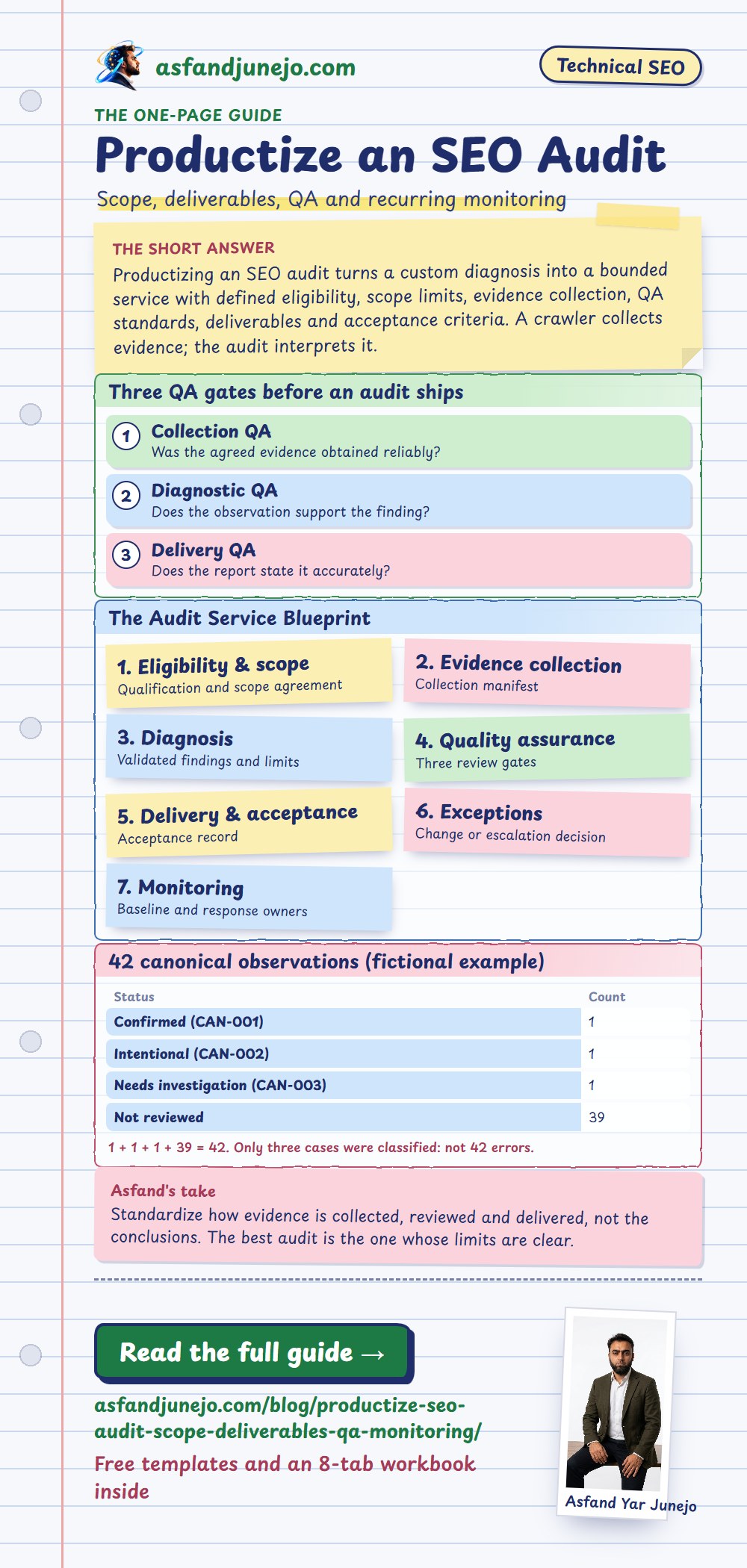
Productizing an SEO audit means converting a customized diagnostic process into a clearly bounded service with defined eligibility requirements, scope limits, evidence-collection methods, quality-assurance standards, deliverables, and acceptance criteria. Instead of negotiating every activity from the beginning, the provider establishes what will be examined, how findings will be validated, what the customer will receive, and which circumstances require additional investigation or a separate agreement.
Published · Research reviewed · By Asfand Yar Junejo, publisher asfandjunejo.com
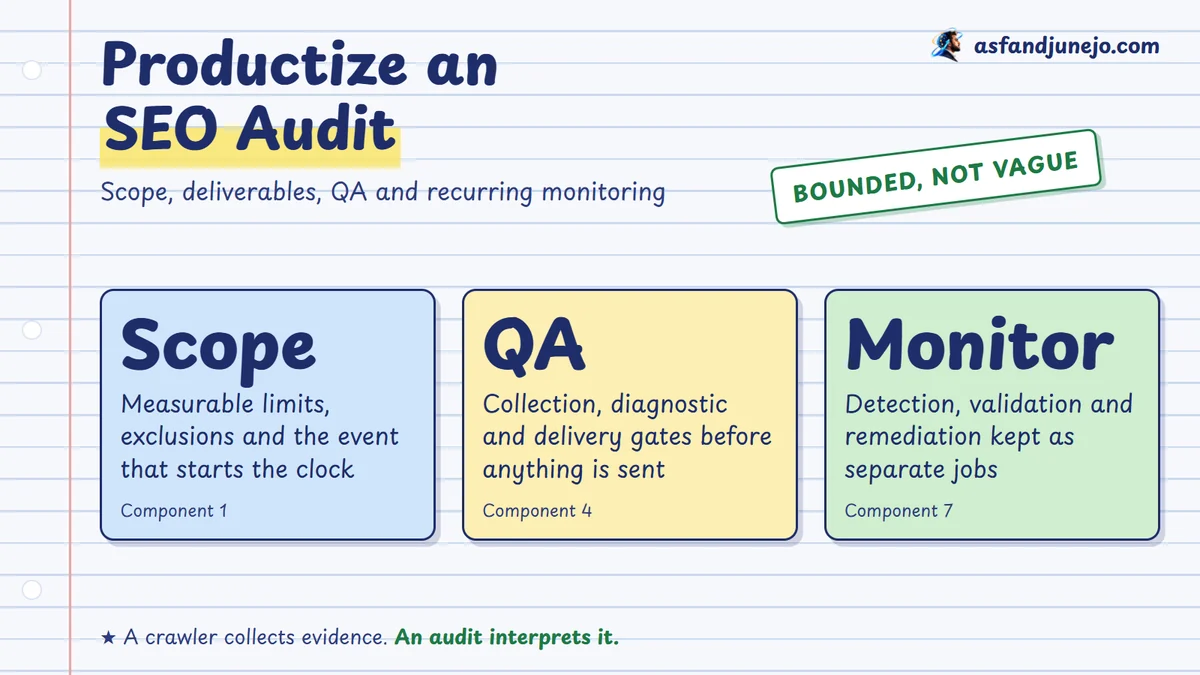
However, a productized SEO audit should not be confused with an automated crawler report offered at a fixed price. Crawlers can identify HTTP response problems, canonical declarations, internal-link conditions, metadata patterns, and other technical observations. Determining whether those observations represent meaningful SEO problems requires interpretation, corroborating evidence, and an understanding of the website’s intended behavior.
The challenge is to make the service repeatable without making its diagnosis superficial.
A consultant may be able to standardize how evidence is collected, how reports are structured, how findings are reviewed, and how customers receive recommendations. Yet two websites undergoing the same process can reach different conclusions because their technical architectures, business priorities, and search visibility requirements differ.
This distinction becomes particularly important when customers expect a “complete audit,” a fixed delivery deadline, or continuing support after the initial report. Without explicitly defined boundaries, a productized service can gradually become an unlimited consulting engagement. Without reliable quality checks, it can become a polished report that reproduces tool warnings without establishing which issues deserve action.
This guide introduces the Audit Service Blueprint, a seven-component operating framework covering scope, evidence collection, diagnosis, quality assurance, deliverable acceptance, change management, and recurring monitoring.
The templates and the eight-tab operating workbook behind it are free for Search Signals subscribers.
A continuous hypothetical case demonstrates how these components work together, including how a crawler’s 42 canonical observations can result in a confirmed finding, an intentional configuration, an unresolved case, and a remaining population that must not be misrepresented as validated.
The objective is not to make every audit identical. It is to make the delivery process consistent, the evidence inspectable, and the limits of each engagement explicit.
What are the key takeaways?
Treat an audit as a bounded diagnosis: agree measurable scope, validate evidence before calling anything an error, review in three QA gates, and keep monitoring separate from fixing.
- A productized SEO audit is a defined diagnostic service, not merely a collection of automated warnings. Its value depends on the interpretation of evidence and the development of actionable recommendations.
- Scope boundaries must be measurable. URLs, hostnames, templates, markets, data sources, exclusions, and incomplete coverage should be explicitly documented.
- Technical observations require validation. A non-self-referencing canonical, redirect, or indexing directive is not necessarily an error.
- Quality assurance requires separate checks for collection, diagnostics, and delivery. Passing one does not establish that the entire audit is reliable.
- Severity and implementation priority are different decisions. Technical consequences must be evaluated alongside business importance, confidence, effort, and risk.
- A fixed price requires controlled scope. Additional properties, complex investigations, and implementation responsibilities should follow clearly defined commercial rules.
- Monitoring is not remediation. Detecting a change, investigating its cause, implementing a fix, and verifying the outcome are separate responsibilities.
- A repeatable audit must be measurable. Delivery effort, rejected findings, review disagreements, exceptions, and customer acceptance all provide information about service quality.
What is a productized SEO audit?
A productized SEO audit is a predefined technical and search visibility assessment delivered through a repeatable operating process. It specifies which websites qualify, what evidence will be collected, which findings will be reviewed, what deliverables will be supplied, and what constitutes completion.
The principal difference between a productized audit and a fully customized consulting engagement is the degree of scope definition before work begins.
A custom engagement may require discovery interviews, platform-specific technical investigation, multiple data sources, complex stakeholder involvement, or research questions that evolve as new evidence becomes available.
A productized audit establishes the service boundary in advance and uses that boundary to determine what can be delivered consistently.
This does not mean that the conclusions are predetermined.
Two websites may receive identical technical checks but require entirely different recommendations. One may contain intentional canonical consolidation, while another has incorrect canonical targets. One may have genuine internal-link issues, while another may receive crawler warnings due to the agreed-upon collection configuration.
The standardized process should identify those differences rather than ignore them.
Productized audit versus automated report versus custom engagement
| Dimension | Automated SEO report | Productized SEO audit | Custom SEO engagement |
|---|---|---|---|
| Purpose | Detect configured conditions | Deliver a bounded diagnosis | Investigate a broader or specialized problem |
| Scope | Defined primarily by software settings | Defined by an agreed service specification | Negotiated around the customer’s requirements |
| Evidence | Tool-generated observations | Retained and validated evidence | Evidence selected for the investigation |
| Human analysis | May be limited | Required for consequential findings | Determined by complexity and risk |
| Deliverables | Exports, warnings, dashboards | Defined findings, recommendations, and handoff | Customized reports and strategic outputs |
| Quality assurance | Tool-dependent | Explicit acceptance and review gates | Investigation-specific review procedures |
| Exceptions | Software limitations | Governed by scope-change rules | Managed within the consulting agreement |
| Implementation | Usually separate | Included only when specified | Contract-dependent |
| Commercial model | Subscription or scan | Fixed or tiered bounded fee | Individually scoped |
A crawler is an evidence collection tool. An audit is a professional interpretation of that evidence.
The distinction is essential because a tool can accurately detect a condition without establishing that the condition requires correction.
Does productization mean making an audit cheaper?
Not necessarily.
Productization describes how a service is structured and delivered. It does not require a particular price, duration, or level of technical depth.
A narrow diagnostic package may require relatively little analyst effort. A larger productized engagement may include rendering investigations, reviews of representative templates, interpretation of search performance, and independent QA.
Both can qualify as productized services if their promises and boundaries are clear.
As a commercial example, O8 Agency describes converting a customized SEO audit into a $750 productized offering (opens in a new tab) with a stated 24-hour delivery model. The agency explains that it redesigned the workflow and distinguished the productized baseline from a deeper bespoke engagement.
Those are O8’s descriptions of its own offer. They should not be treated as independently established market averages or universal pricing recommendations.
Directional Company-described offer, checked on O8's own site on October 31, 2026; not a market benchmark
The transferable principle is that a repeatable service requires deliberate decisions about which activities can be standardized and which must remain custom.
What is the Audit Service Blueprint?
The Audit Service Blueprint is a proposed operating framework for turning technical SEO assessment into a bounded service while maintaining evidence quality and professional accountability.
The framework consists of seven connected components.
| Component | Primary question | Required output |
|---|---|---|
| 1. Eligibility and scope | What qualifies, and what is included? | Qualification decision and scope agreement |
| 2. Evidence collection | How will observations be obtained? | Collection manifest and supporting records |
| 3. Diagnostic interpretation | Which observations represent problems? | Validated findings and limitations |
| 4. Quality assurance | How will correctness be established? | Collection, diagnostic, and delivery review results |
| 5. Delivery and acceptance | What constitutes completed service? | Defined deliverables and acceptance record |
| 6. Exception management | What happens outside the agreed scope? | Documented change or escalation decision |
| 7. Recurring monitoring | What should be checked after the audit? | Baseline, monitoring rules, and response responsibilities |
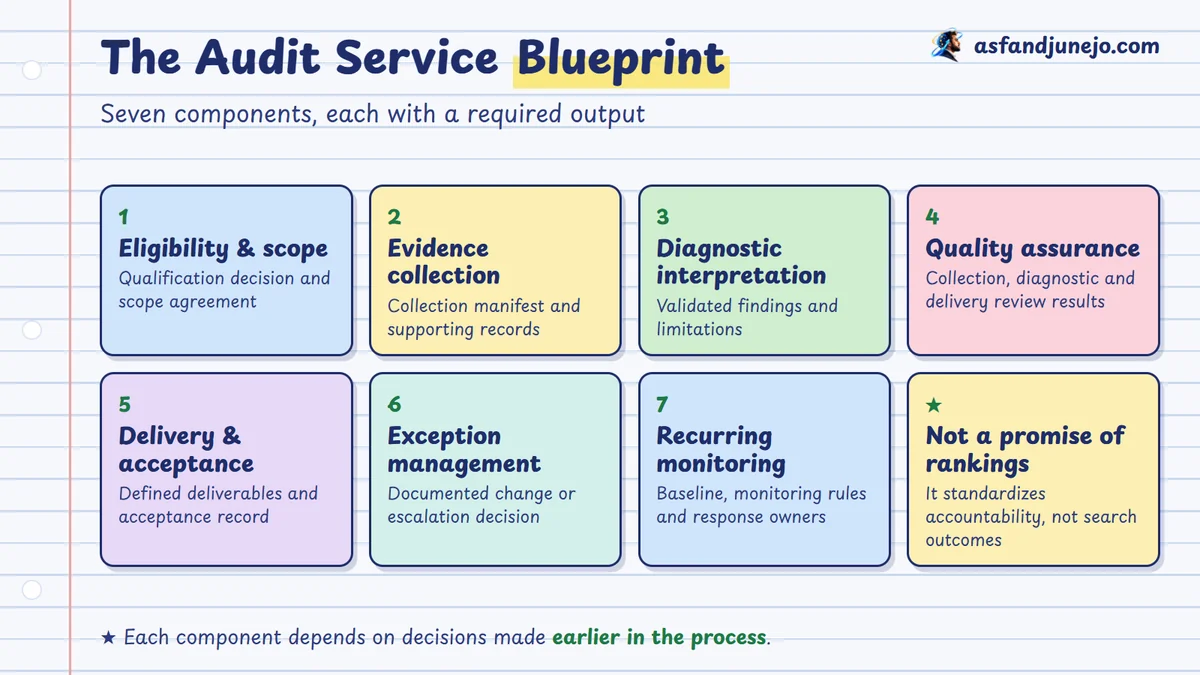
Each component depends on decisions made earlier in the process.
Scope determines what evidence can be collected. Evidence supports diagnostic interpretation. Quality assurance determines whether the interpretation is defensible. Delivery communicates the results, while exception handling and monitoring define what happens when the initial engagement ends or new conditions emerge.
The framework standardizes accountability rather than guaranteeing particular search outcomes.
It has not been evaluated in a controlled study, and adopting it should not be presented as evidence of higher rankings, lower delivery costs, or improved customer retention.
Its value is operational: it makes the responsibilities behind a professional audit explicit enough to be inspected, reviewed, and improved.
When should an SEO audit be productized?
An SEO audit is suitable for productization when its inputs, assessment boundaries, evidence requirements, and deliverables can be defined before work begins. Websites requiring extensive custom investigation, unusual access arrangements, major migrations, or complex cross-system analysis may need a separate engagement.
Website size matters, but it is not the only determinant of complexity.
A website with thousands of URLs generated from a small number of stable templates may be relatively straightforward to assess through carefully selected samples.
A much smaller site may be difficult to audit if critical content depends on unusual JavaScript behavior, authenticated environments, or complicated routing.
The appropriate decision should be based on the technical requirements and the provider’s demonstrated delivery capability.
Define customer eligibility
A qualification process should assess whether the standard package can address the customer’s primary question.
| Website condition | Potential suitability | Reason |
|---|---|---|
| Small business site with conventional HTML pages | Often suitable | Predictable technical coverage |
| Single-domain B2B marketing website | Often suitable | Representative page templates can be identified |
| Content-heavy website with consistent templates | Conditional | Sampling and coverage must be documented |
| Ecommerce website with extensive faceted navigation | Conditional or custom | URL combinations and technical behavior may exceed standard limits |
| Multilingual website spanning several markets | Conditional or custom | Language and regional relationships may require deeper assessment |
| Website undergoing migration | Usually custom | Historical URLs, redirects, timing, and implementation risk matter |
| JavaScript-heavy application | Depends on the rendering requirements | Raw HTML and rendered content may differ materially |
| Multi-domain enterprise platform | Often custom | Multiple systems, owners, and properties increase complexity |
These are proposed qualification categories, not universal rules.
A provider specializing in large ecommerce websites may create a repeatable service appropriate for sites that another consultant would reasonably decline to work on.
The essential requirement is consistency between the service promise and the provider’s ability to deliver it reliably.
What should customer intake establish?
Before accepting a fixed-scope audit, collect the website properties, approximate URL inventory, primary market, critical business pages, known technical changes, available data sources, and the customer’s principal concern.
The intake should also establish whether the customer expects diagnosis, implementation, strategic consulting, or ongoing monitoring.
Those expectations involve different deliverables and responsibilities.
A customer who requests an explanation for the decline in organic traffic may need more than a technical crawl. Search demand, competition, tracking changes, indexing problems, content quality, and other factors may contribute.
A bounded audit may identify relevant technical evidence and recommend further investigation, but it should not promise to establish every possible cause.
Worked example: An ambiguous audit request
Consider a fictional B2B company whose website inventory contains approximately 8,000 discovered URLs.
The customer requests:
“We need a complete SEO audit. Find everything wrong with the website, compare us with competitors, and tell the development team exactly what to fix.”
The request is commercially understandable but operationally incomplete.
“Complete” does not define which properties, page types, or checks are included.
“Everything wrong” implies exhaustive discovery, which may not be feasible or meaningful even in a comprehensive engagement.
“Compare us with competitors” does not identify the comparison set, markets, queries, or methodology.
“Tell the developers exactly what to fix” may imply anything from a technical recommendation to implementation-ready specifications and deployment assistance.
The provider must clarify these expectations before offering a fixed fee.
| Customer statement | Required scope decision |
|---|---|
| Audit the entire website | Define eligible properties, URL population, and assessment coverage |
| Find every issue | State which technical areas are tested and what limitations apply |
| Compare competitors | Identify competitors, markets, queries, and comparison dimensions |
| Provide developer instructions | Define the level of technical implementation guidance |
| Deliver quickly | Establish prerequisites and the delivery-clock starting event |
| Explain declining traffic | Confirm which search, analytics, and historical evidence is available |
The qualification process may establish that the customer is suitable for a bounded baseline diagnosis.
It may also reveal that the original request requires a broader custom engagement.
A provider should make that distinction before the work starts rather than after the report has been delivered.
How do you define the scope, limits, and exclusions of an SEO audit?
An SEO audit scope should specify the properties, URLs, templates, data sources, technical checks, geographical coverage, deliverables, exclusions, and conditions governing additional work. Limits must be measurable so that both the customer and provider can determine what was actually assessed.
A phrase such as “audit up to 500 pages” is not sufficiently precise on its own.
Does the limit include redirects, unsuccessful requests, alternate URL variations, PDFs, or JavaScript-generated routes? Does it refer to discovered URLs, attempted requests, successfully fetched pages, or analyzed HTML documents?
These distinctions affect diagnostic coverage and the service’s commercial obligation.
Illustrative fixed-scope audit specification
For the fictional 8,000-URL website, consider the following proposed baseline package.
| Scope dimension | Illustrative service boundary |
|---|---|
| Website property | One approved hostname |
| Request coverage | Up to 500 unique in-scope HTML URL requests under a documented selection rule |
| Priority pages | Up to 25 nominated business-critical URLs within the agreed 500-URL coverage |
| Geographic scope | One primary country and language |
| Technical assessment | Defined crawlability, indexing signals, canonicals, redirects, internal links, metadata, and representative templates |
| Rendering | Raw HTML checks plus agreed representative JavaScript-rendered checks |
| Search data | Read-only Search Console access where authorized and available |
| Competitors | Up to three agreed competitors under a defined research method |
| Page performance | Representative templates rather than every page |
| Deliverables | Executive summary, coverage report, findings, priorities, and handoff |
| Implementation | Excluded unless separately agreed |
| Monitoring | Separate optional engagement |
| Exceptions | Documented change-request process |
These are hypothetical package design choices, not a published commercial offer or a universal industry standard.
Hypothesis Illustrative package for a fictional 8,000-URL site; test real limits against eligible websites
A provider should select actual limits after testing the workflow against representative eligible websites.
Distinguish URL counts correctly
A professional coverage report should distinguish the following measurements.
Discovered URLs are addresses identified through links, sitemaps, or approved discovery sources.
In-scope URLs satisfy the package’s inclusion rules.
Attempted URLs are unique eligible URLs for which a request was made.
Successfully fetched URLs returned a response usable for the intended assessment.
Analyzed HTML pages received the required page-level checks.
Rendered pages were evaluated under a specified JavaScript-capable configuration.
These numbers can differ.
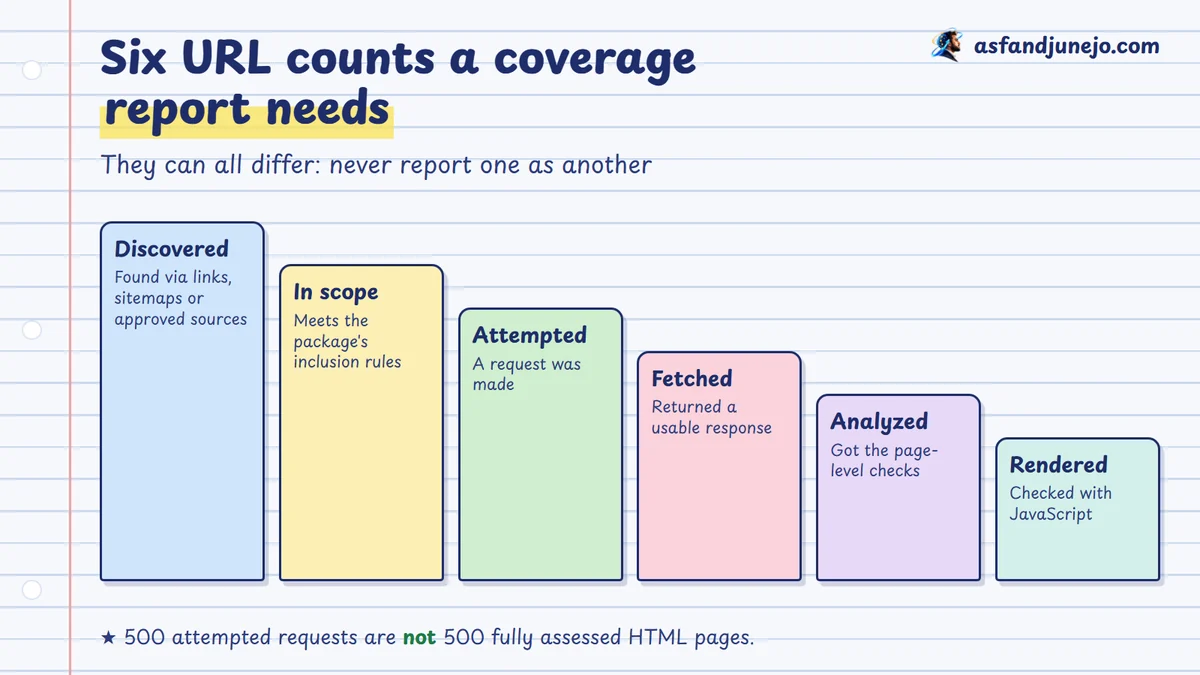
If the audit attempts 500 URLs but receives incomplete or inaccessible responses for some, the report should not claim that 500 HTML pages were fully assessed.
It should state the actual coverage and any limitations arising from missing evidence.
Why sampling needs a defined method
A first-500-URLs crawl may overrepresent blog archives, navigation paths, or parameter variations while omitting important service pages.
A stronger process identifies critical business URLs and representative page templates before selecting the sample.
For a B2B website, the sample may include the homepage, key commercial landing pages, service pages, editorial hubs, selected articles, and templates that illustrate architectural patterns.
The method should explain why those URLs were selected and which parts of the site are excluded from the assessment.
A problem discovered on sampled pages may justify a broader recommendation to investigate a shared template. It does not establish that every URL generated by that template is affected unless the wider condition has been verified.
Standardize tools without confusing tool limits with scope
Screaming Frog’s SEO Spider configuration guide (opens in a new tab) documents controls for crawl depth, URL limits, path inclusion, JavaScript rendering, extraction, and request speed.
Its free edition has a 500-URL crawl limit, while licensed configurations support expanded limits and controls.
The software’s technical limits are separate from the contractual scope of service.
A provider using a licensed crawler might still reasonably offer a 500-request productized assessment because the intended deliverable involves selected URLs and human validation.
Conversely, running a 500-URL free crawl does not constitute a 500-page professional audit.
The collection method must match the promised diagnostic output.
What should be excluded?
A bounded audit should explicitly address activities that are not included.
Examples may include implementing code changes, comprehensive content rewriting, extensive backlink investigations, migration execution, unlimited competitor analysis, international architecture redesign, and ongoing technical support.
Any of these activities can be included in an appropriately designed package, but they should be named rather than assumed.
Exclusions are especially important where the customer expects an audit to identify and immediately resolve every issue.
Diagnosis and remediation require different permissions, resources, risks, and acceptance tests.
When does the delivery period begin?
The service terms should identify the event that starts the delivery period.
Payment alone may not be sufficient if mandatory access or required information remains unavailable.
A practical agreement may begin the delivery clock after the engagement is accepted, essential intake information is received, and agreed access has been confirmed.
The terms should also establish how inaccessible resources, outages, customer delays, and approved scope changes affect the schedule.
Predictability depends on defining these operational conditions before they become the subject of disputes.
What should a productized SEO audit deliver?
A productized audit should provide a documented diagnosis showing what was assessed, which findings were confirmed, what evidence supports them, what actions are recommended, and which limitations remain unresolved. The deliverables should enable implementation planning without requiring the customer to reconstruct the entire analysis from raw crawler exports.
A large report is not necessarily a useful report.
The quality of the deliverable depends on whether the customer understands the findings and can distinguish confirmed problems from warnings, unresolved questions, and intentional configurations.
Seven essential deliverables
| Deliverable | Purpose | Acceptance criterion |
|---|---|---|
| Executive summary | Explain major findings and decision priorities | Conclusions accurately reflect the underlying evidence |
| Coverage manifest | Document the assessed scope | Includes collection configuration, counts, exclusions, and missing evidence |
| Findings register | Preserve technical observations and decisions | Consequential findings have evidence, validation status, and affected scope |
| Priority roadmap | Translate findings into proposed actions | Priorities, dependencies, and reasoning are documented |
| Ownership matrix | Support implementation planning | Responsible roles and prerequisites are identifiable |
| Measurement baseline | Establish the observed starting condition | Sources, collection dates, and limitations are recorded |
| QA and delivery record | Document completion and review | Applicable acceptance checks and unresolved exceptions are visible |
These outputs may be delivered in a single report and supporting workbook rather than seven separate files.
The essential requirement is that the information remains understandable and internally consistent.
Finding-level evidence requirements
Every consequential finding should have a stable identifier and enough supporting detail to be independently reviewed.
| Field | Required information |
|---|---|
| Finding ID | Stable reference |
| Observed condition | What was detected |
| Affected scope | Verified URLs or templates |
| Evidence | Relevant crawl output, response, source extract, or other records |
| Expected behavior | Intended or appropriate technical configuration |
| Validation method | How the interpretation was checked |
| Status | Confirmed, intentional, false positive, unresolved, or not tested |
| Severity | Potential consequence if the problem is genuine |
| Confidence | Strength and completeness of evidence |
| Recommendation | Specific corrective action or investigation |
| Dependencies | Required decisions or prerequisite changes |
| Owner | Responsible implementation role |
| Acceptance test | How the correction will be verified |
A finding should not be considered actionable merely because the audit tool assigns it a severity label.
The recommendation needs to follow from a documented interpretation of the evidence.
Make the executive summary useful
An executive summary should communicate the meaning of the findings rather than simply count them.
For example, “42 canonical errors” is not a defensible conclusion if the audit has only detected 42 non-self-referencing canonical relationships.
A stronger summary distinguishes what was detected, which cases were examined, what was confirmed, and which observations remain unresolved.
The summary should never imply more diagnostic coverage than the underlying records support.
How do you standardize SEO audit evidence collection?
Evidence collection becomes repeatable when the provider documents source systems, URL selection rules, crawl configurations, rendering methods, collection dates, and coverage outcomes. Standardization should make observations reproducible without assuming that a single configuration will capture all relevant conditions on every website.
An automated crawl is a technical measurement process.
Its results depend on what was requested, how the requests were made, which resources were accessible, and whether the selected tools could observe the behavior being investigated.
Record the collection manifest
The audit should preserve details such as the approved hostname, crawler and version, user agent, collection timestamp, rendering settings, inclusion and exclusion rules, request limits, and relevant access restrictions.
For the hypothetical B2B audit, the collection manifest might contain these planned fields.
| Field | Illustrative value |
|---|---|
| Engagement ID | B2B-AUDIT-001 |
| Approved hostname | www.example.com |
| Coverage limit | 500 unique in-scope HTML URL requests |
| Selection method | Priority URLs plus documented template sampling |
| Initial rendering | Raw HTML |
| Additional rendering | Selected JavaScript-dependent templates |
| Search geography | United States, English |
| Search Console | Approved read-only access, if available |
| Crawl rate | Agreed with the website owner |
| Collection time | Recorded at execution |
| Known exclusions | Documented before and during collection |
This is an example of a collection specification. No live crawl of the fictional website was performed for this article.
Hypothesis Fictional collection specification; no crawl was run
Evaluate crawlability and access
Relevant checks may include HTTP response behavior, redirects, internal linking, robots directives, XML sitemaps, and the availability of important resources.
However, an inaccessible URL is not necessarily an SEO defect.
Administrative pages, restricted environments, and intentionally excluded resources may be inaccessible for valid reasons.
The auditor should distinguish intended restrictions from accidental barriers to important public content.
Separate raw HTML and rendered behavior
A JavaScript-powered website may expose different content or links in its initial HTML and rendered output.
Google describes crawling, rendering, and indexing as distinct stages in its JavaScript SEO documentation (opens in a new tab).
A repeatable audit should therefore identify which pages were inspected in raw HTML and which were evaluated through JavaScript rendering.
Testing a representative template does not automatically establish the behavior of every route using that template.
Coverage must remain explicit.
Treat indexing signals as evidence, not commands
Google’s canonicalization documentation (opens in a new tab) explains that canonical selection considers several signals, including redirects, canonical annotations, and sitemap information.
A website can specify its preferred canonical URL, but Google may select a different representative URL.
An audit should evaluate the consistency of the configuration and the intended relationship between the pages.
A non-self-referencing canonical should not automatically be reported as an error.
Distinguish live website observations from indexed-state data
The Google URL Inspection API (opens in a new tab) reports the version Google’s index knows.
It does not perform a live URL indexability test.
A live crawler may show that a page currently returns HTTP 200 and declares a particular canonical, while Search Console reports information collected and processed by Google at an earlier time.
Both observations can be useful, but they measure different conditions.
The audit should record their sources and timestamps rather than treating them as interchangeable.
Interpret structured data and performance correctly
Structured data should be evaluated for syntax, applicability, consistency with visible content, and relevant Google feature requirements.
Google’s structured data policies (opens in a new tab) state that valid markup does not guarantee a rich result.
Performance analysis should similarly distinguish laboratory testing from field measurements.
A test conducted under a simulated environment does not automatically describe every visitor’s experience.
The package should identify which templates were examined and which conclusions are supported by the available measurement sources.
Report incomplete evidence
Collection failures should remain visible.
The report should distinguish attempted requests, successful responses, analyzed pages, rendered templates, excluded records, and unresolved checks.
Missing evidence should not be silently classified as a passed test.
If important commercial pages cannot be accessed or rendered, the limitation may materially affect the value of the audit.
In that case, the provider should determine whether additional authorized collection is needed, whether a qualified finding is appropriate, or whether the engagement must be re-scoped.
How do you QA automated SEO findings?
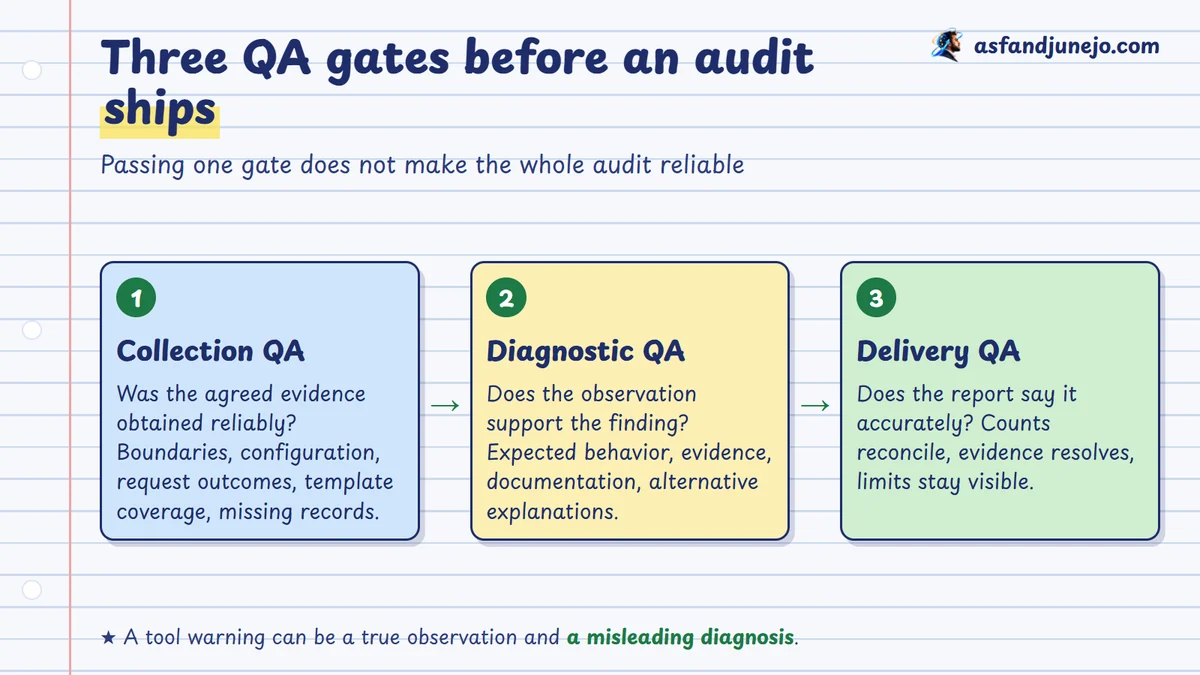
Automated findings should pass three separate review gates: collection QA, diagnostic QA, and delivery QA. These checks determine whether the evidence was gathered correctly, whether the interpretation is justified, and whether the resulting report accurately communicates the diagnosis.
The quality of an SEO audit cannot be established by the number of warnings it produces.
A professional audit must determine which observations represent genuine problems and which should be documented without corrective action.
Gate 1: Collection QA
Collection QA evaluates whether the agreed evidence was obtained reliably.
The reviewer should check the crawl boundaries, source configuration, request outcomes, relevant template coverage, rendering settings, and missing records.
An incomplete crawl does not automatically invalidate the entire engagement, but its limitations must be understood.
For example, successful collection of hundreds of informational pages may be insufficient if the audit fails to examine the commercial templates central to the customer’s concern.
The reviewer should assess the composition of coverage, not simply the percentage of successful requests.
Gate 2: Diagnostic QA
Diagnostic QA determines whether an observation supports the reported finding.
The reviewer should examine the expected website behavior, the actual evidence, relevant technical documentation, and plausible alternative explanations.
A tool warning may be genuine as an observation while misleading as a diagnosis.
This distinction becomes particularly clear in canonicalization analysis.
Worked example: Reconciling 42 canonical observations
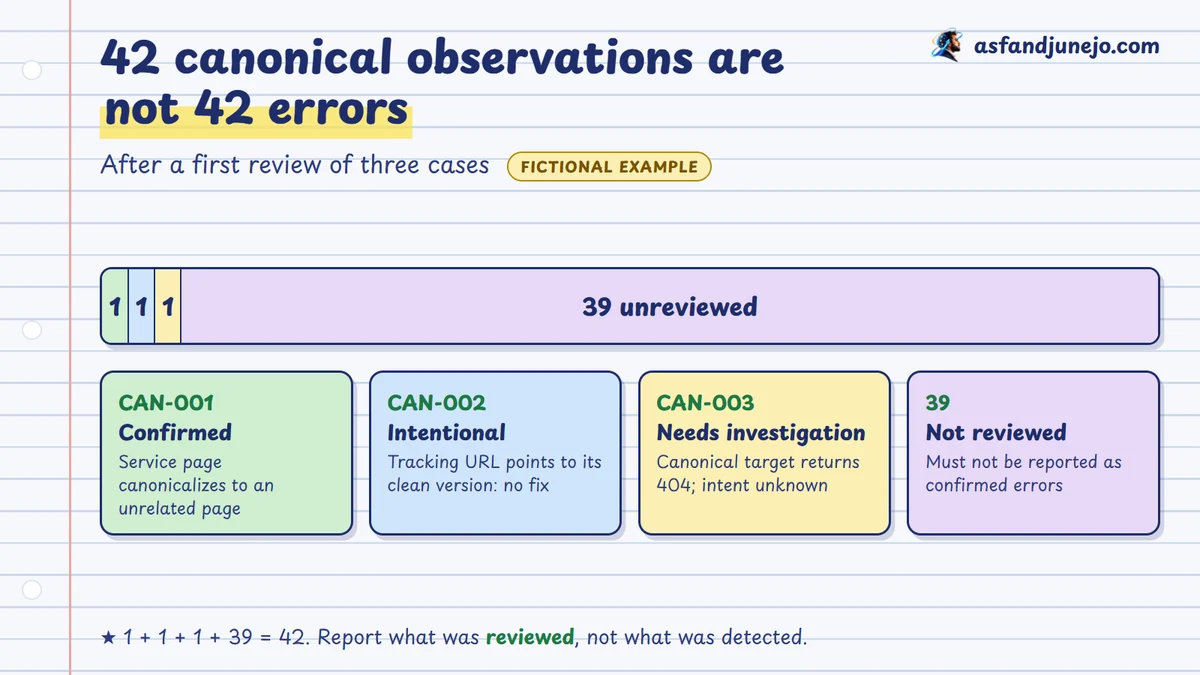
Suppose the hypothetical 500-request audit identifies 42 URLs with non-self-referencing canonical annotations.
The number 42 represents a constructed detection population for this instructional scenario. It is not the result of a live crawl.
The auditor should not describe these as 42 canonical errors.
A limited illustrative review considers three representative observations.
CAN-001: Distinct service page canonicalizes to an unrelated service page.
In the fictional example, further inspection reveals that the pages serve different purposes and that the canonical annotation conflicts with the approved site structure.
The finding is classified as Confirmed for the constructed example.
CAN-002: Tracking-parameter URL canonicalizes to its clean equivalent.
The source and canonical target represent the intended duplicate relationship, and the configuration is consistent with the site’s documented preference.
The finding is classified as Intentional Configuration.
It is excluded from the remediation queue.
CAN-003: Canonical target returns HTTP 404.
The observation suggests a potentially unsuitable canonical destination, but the intended replacement target and the condition’s persistence have not been established.
The finding is classified as Needs Investigation.
Reconciliation of the complete hypothetical detection population
| Classification after the illustrative first review | Count |
|---|---|
| Confirmed finding, CAN-001 | 1 |
| Intentional configuration, CAN-002 | 1 |
| Needs investigation, CAN-003 | 1 |
| Remaining observations not individually reviewed | 39 |
| Total detected observations | 42 |
Hypothesis Constructed teaching example; no real crawl or client data
This reconciliation is deliberately explicit.
Only three illustrative observations have been examined in detail. The other 39 remain unreviewed.
Therefore, the example does not establish that all 42 observations have been validated or that the complete canonical detection population has passed QA.
It demonstrates a first review stage, not a completed real-world audit.
Before a provider can claim complete disposition of the detected population, the remaining records must be reviewed using an agreed method or explicitly retained as unresolved within the contractually permitted coverage.
A report may communicate a confirmed issue based on its verified evidence, but it must not imply that the entire detection category has received exhaustive review when it has not.
Why the intentional configuration matters
CAN-002 is an example of a valuable negative decision.
The auditor found a detectable condition and deliberately recommended no corrective action because the observed canonical relationship was appropriate.
This matters because a professional audit should be judged partly by its ability to prevent unnecessary changes.
A service that converts every warning into a recommended fix can create work without improving the website.
Correctly classifying intentional behavior protects the customer’s technical configuration and helps focus resources on verified problems.
Convert the confirmed issue into a usable finding
The fictional CAN-001 finding can be documented as follows.
| Field | Example record |
|---|---|
| Finding ID | CAN-001 |
| Category | Canonicalization |
| Observed condition | Distinct service page declares an unrelated canonical target |
| Affected scope | Verified URL in the illustrative example; wider template impact not established |
| Evidence | Source canonical declaration, target response, content comparison, intended URL mapping |
| Expected behavior | Canonical preference aligns with approved page identity |
| Validation status | Confirmed within the fictional demonstration |
| Confidence | High for the examined URL, not for unreviewed URLs |
| Severity | Requires evaluation against the affected page’s business and search role |
| Recommendation | Correct the inappropriate canonical relationship |
| Dependency | Confirm approved target and responsible template or CMS configuration |
| Implementation owner | Authorized development team |
| Acceptance test | Verify source output, target accessibility, and related signal consistency |
| Search outcome | Observe separately after Google processes the changed configuration |
The finding now has a clearer relationship between evidence, interpretation, action, and verification.
It does not assume that a single URL diagnosis proves a sitewide problem.
Gate 3: Delivery QA
Delivery QA determines whether the final report is accurate, internally consistent, and suitable for the customer.
The reviewer should confirm that finding counts reconcile, the executive summary agrees with the register, evidence references resolve, recommendations are actionable, and unresolved limitations remain visible.
For the hypothetical canonical review, a delivery summary could state:
A bounded review identified 42 non-self-referencing canonical observations. Three illustrative cases were examined: one was classified as a confirmed configuration problem, one was intentional, and one requires further investigation. The remaining 39 observations were not individually classified in this demonstration, so no complete-population error estimate is reported.
That wording is less dramatic than “42 canonical errors,” but it is substantially more defensible.
A report claiming comprehensive validation would require additional work before delivery approval could be granted.
How should QA disagreements be resolved?
Two reviewers may disagree about an issue’s severity, confidence, or recommended correction.
The review process should preserve the competing interpretations, supporting evidence, decision owner, and final disposition.
A disagreement should not automatically be resolved by choosing the most severe classification.
Instead, additional evidence may be required, or the recommendation may remain conditional.
This creates consistency without pretending that every complex technical question has a simple automated answer.
Build repeatable QA measurements
Agencies can use accepted audits to improve their service model, but quality metrics need careful interpretation.
Recommended measures include:
| QA measure | What it reveals | Limitation |
|---|---|---|
| Source-reference accuracy | Whether supporting records can be retrieved | Does not establish that the interpretation is correct |
| Finding confirmation rate | Share of reviewed tool warnings accepted as genuine findings | Depends on the reviewed population |
| Rejected-warning rate | Conditions intentionally excluded or classified as false positives | May vary substantially by tool and website |
| Reviewer agreement | Whether independent reviewers reach similar decisions | Agreement does not automatically establish correctness |
| Post-review correction rate | Problems detected before or after delivery | A low rate may reflect weak review rather than excellent quality |
| Reopened finding rate | Findings requiring reconsideration after delivery | May result from new evidence or changing website conditions |
A useful service-improvement practice is to have a second qualified reviewer examine a defined sample of accepted findings, including a mix of severity categories and technical issue types.
The organization should record whether the reviewer agrees with the diagnosis, priority, and proposed action.
When disagreements occur, their causes should be examined and used to refine the workflow.
This is stronger evidence of service quality than simply counting how many issues the software detected.
For a broader discussion of automated observations, hypotheses, and human approval, see AI in SEO: What to Automate, What to Verify, and What to Keep Human.
How should SEO audit findings be prioritized?
Audit recommendations should be prioritized using verified technical consequences, the importance of affected pages, evidence confidence, implementation effort, dependencies, and the risks of making changes. Technical severity helps inform priority, but it should not determine the implementation order on its own.
A widespread warning may be less consequential than a confirmed problem on one critical business page.
Conversely, an apparently serious problem may need further investigation before implementation because the available evidence is incomplete.
Separate three decisions
Finding validity: Has the diagnosis been established?
Severity: What are the plausible consequences of the confirmed condition?
Priority: How urgently should the business act, given its objectives, available resources, and risks?
These decisions should be documented independently.
A practical prioritization matrix
| Evaluation dimension | Question |
|---|---|
| Evidence confidence | Is the finding confirmed or still conditional? |
| Search consequences | Can the condition materially affect relevant crawling, indexing, or search presentation? |
| Business relevance | Are important pages or journeys affected? |
| Scope | Is the issue isolated or shared across verified templates? |
| Implementation effort | What resources are needed? |
| Dependencies | Must another change or decision happen first? |
| Change risk | Could the correction create new problems? |
| Time sensitivity | Is there an operational deadline or immediate consequence? |
A numerical priority score may be useful when its assumptions have been tested.
However, an unexplained formula can create false precision.
A transparent decision table is often more valuable than an arbitrary score of 87 out of 100.
Prioritizing the hypothetical canonical findings
| Finding | Evidence status | Recommended treatment |
|---|---|---|
| CAN-001 | Confirmed within the constructed scenario | Prioritize correction according to page importance and implementation risk |
| CAN-002 | Intentional | No corrective work |
| CAN-003 | Needs investigation | Validate the target and intended configuration |
| Remaining 39 observations | Unreviewed | Do not classify as confirmed errors; complete or qualify review according to scope |
The important distinction is that prioritization begins with the quality of the evidence.
CAN-002 should not receive remediation simply because it appeared in the crawler’s warning category.
CAN-003 should not receive a definitive correction until the missing information is obtained.
CAN-001 can proceed to implementation planning now that its hypothetical diagnosis has been established.
Implementation acceptance versus search outcome
For CAN-001, the development team’s acceptance test should verify that the approved canonical configuration has been deployed correctly.
That may involve checking the live source output, target accessibility, relevant redirects, internal links, and applicable sitemap signals.
These checks establish whether the implementation meets the technical requirement.
They do not guarantee that Google will select the preferred canonical immediately or improve the page’s rankings.
Google’s canonical selection is based on multiple signals and may change after further crawling and processing.
The audit should distinguish implementation verification from subsequent search-engine observations.
How should fixed pricing and delivery economics work?
A productized SEO audit should be priced based on a defined workload, the resources required to meet the agreed quality standard, the expected operational risk, and a sustainable commercial margin. Fixed pricing is most appropriate when the provider can estimate the work and apply enforceable scope boundaries.
The cost of delivery includes more than collecting crawl data.
Qualification, configuration, evidence review, technical interpretation, QA, report preparation, handoff, and corrections all contribute to the workload.
Price the complete delivery process
| Cost category | Typical work |
|---|---|
| Qualification | Eligibility review and intake |
| Collection | Crawl configuration and source retrieval |
| Analysis | Diagnostic interpretation and prioritization |
| QA | Reproduction, independent review, and corrections |
| Reporting | Deliverables and handoff preparation |
| Support | Agreed clarification and acceptance process |
| Infrastructure | Tools, storage, and operational services |
| Exceptions | Reasonably anticipated in-scope complications |
The provider should estimate these requirements using observed delivery effort where possible.
A hypothetical time allocation may help establish an initial model, but the package should be refined against actual engagements.
A basic pricing relationship
When using a target gross-margin approach, one possible calculation is:
Required price = Expected delivery cost ÷ (1 − Target gross-margin rate)
The result depends on consistent definitions of cost and margin.
It does not establish a universal market price or account automatically for every tax, overhead, payment-processing fee, or risk adjustment.
More importantly, pricing formulas cannot compensate for unlimited scope.
If the service promises every conceivable investigation, the expected delivery cost becomes difficult to control.
Choose a suitable commercial model
| Model | Appropriate use |
|---|---|
| Single fixed fee | Similar websites with predictable requirements |
| Tiered packages | Distinct standardized levels of complexity or coverage |
| Fixed diagnostic plus extensions | Stable baseline with separable additional work |
| Custom quotation | Complex, unusual, or high-risk engagements |
A provider may combine these models.
For example, a standard audit can cover one hostname and a defined set of templates, while migration analysis, additional international properties, and extensive custom investigation require separate approval.
Corrections are different from new scope
The service agreement should distinguish three categories.
A correction addresses an inaccurate in-scope finding, an incomplete agreed-upon deliverable, or a QA failure.
A clarification explains a delivered finding within an agreed review period.
A scope extension introduces new properties, questions, investigations, or implementation work.
A provider should remain responsible for correcting agreed deliverable defects.
However, that responsibility should not be confused with an obligation to perform unlimited additional consulting.
How should scope changes and exceptions be managed?
Scope changes should follow a documented process that identifies the new requirement, evaluates its effect on resources and delivery, and establishes whether the work is included, deferred, declined, or separately priced.
Productization does not eliminate exceptions.
It creates a controlled way to handle them.
Worked example: Two additional subdomains
Suppose the hypothetical customer purchases an assessment covering one approved hostname.
After collection begins, the customer requests an audit of two additional international subdomains.
The request may introduce additional URL populations, language or regional relationships, access requirements, and technical checks.
| Change-request field | Illustrative assessment |
|---|---|
| Original agreement | One hostname |
| New request | Two international subdomains |
| Collection impact | Additional URL populations |
| Diagnostic impact | Potential international SEO complexity |
| Access impact | Additional permissions may be necessary |
| QA impact | New evidence and review requirements |
| Commercial decision | Separate scope, revised package, or custom engagement |
| Approval | Required before additional work starts |
If the customer declines the extension, the provider should complete the original scope and identify the unassessed subdomains as excluded.
The report should not imply they were examined.
Exception categories
A repeatable service may recognize access exceptions, coverage exceptions, technical complexity, client-requested changes, evidence-quality limitations, and delivery interruptions.
Each category should have an accountable decision.
If the limitation materially prevents the agreed diagnosis, the provider may need to pause, revise, or decline the engagement.
If the limitation affects only a minor peripheral check, transparent disclosure may be sufficient.
The importance of the missing evidence and the contractual requirements should guide the decision.
How should an audit be delivered and accepted?
An SEO audit should be delivered through versioned, source-linked materials that explain the assessed scope, validated findings, recommendations, limitations, and implementation responsibilities. Acceptance should depend on the agreed quality and delivery requirements, not on whether the website has already achieved better search rankings.
The delivery process should distinguish several events.
Delivered: The agreed materials have been supplied.
Accepted: The agreed acceptance conditions have been satisfied.
Implemented: An authorized team has deployed a recommended correction.
Technically verified: The correction meets its defined acceptance test.
Search outcome observed: Subsequent evidence describes how the search system is processing or presenting the affected pages.
These events may occur at different times and involve different people.
An audit acceptance matrix
| Deliverable | Acceptance question |
|---|---|
| Executive summary | Do conclusions agree with the underlying findings? |
| Coverage manifest | Are assessed and unassessed areas accurately disclosed? |
| Findings register | Are important diagnoses traceable and appropriately classified? |
| Priority roadmap | Are recommendations, dependencies, and decisions explained? |
| Ownership information | Can implementation responsibilities be identified? |
| QA record | Have required review gates been completed? |
| Limitations | Are unresolved questions and inaccessible areas visible? |
| Handoff | Can the relevant team understand the next actions? |
The hypothetical canonical example illustrates why this matters.
A report containing one confirmed issue, one intentional configuration, one unresolved observation, and 39 unreviewed detections must not present all 42 as confirmed errors.
Whether the final package can be accepted depends on what the agreement promised.
If the contract requires individual classification of every detected canonical observation, the remaining review work must be completed.
If the package provides representative validation and clearly limits exhaustive classification, the report must explicitly communicate that method and limitation.
Versioning and corrections
SEO audits represent conditions observed at particular times.
A finding may become outdated after a deployment, migration, or content change.
Reports should therefore identify their versions, material revisions, relevant collection periods, and the relationship between current findings and earlier observations.
A corrected report should retain enough history for an authorized reviewer to understand what changed and why.
Versioning also supports monitoring by establishing a documented baseline for later comparison.
How should confidential audit data be handled?
A productized audit should establish appropriate rules for accessing, storing, sharing, retaining, and deleting customer information. The audit agreement should distinguish between permission to inspect data and permission to modify the website or reuse the data for other purposes.
SEO assessments may involve Search Console exports, analytics records, commercially sensitive URLs, server configuration details, internal documents, and account access.
Not every engagement contains the same level of sensitivity, but the provider should define its obligations before collecting information.
Minimum data-handling controls
| Area | Recommended control |
|---|---|
| Access | Use the least privilege necessary for the agreed task |
| Credentials | Avoid storing passwords or tokens in reports |
| Collection | Gather only information needed for the assessment |
| Storage | Use approved locations with appropriate access restrictions |
| Sharing | Limit distribution to authorized recipients |
| Retention | Define how long evidence and deliverables will be kept |
| Deletion | Establish procedures for removing data when required |
| Reuse | Obtain appropriate authorization before using client material in examples or marketing |
| Change permissions | Separate read-only analysis from implementation authority |
A read-only Search Console authorization, for example, does not grant permission to change a website’s production configuration.
Similarly, access to proprietary site data does not automatically authorize publication of that information in a case study.
Retention requirements may depend on the service agreement, applicable law, and the need to preserve supporting evidence.
The article does not prescribe one universal retention period because legal and commercial obligations vary.
The appropriate approach is to specify the policy, implement it consistently, and explain how it affects the customer’s access to evidence after delivery.
How do you turn a one-time SEO audit into recurring monitoring?
Recurring SEO monitoring translates selected audit findings and key website conditions into scheduled or event-driven checks against an agreed-upon baseline. The monitoring agreement should define the covered properties, signals, collection frequency, alert thresholds, validation responsibilities, support availability, and response process.
Monitoring is different from repeating an entire audit every month.
An audit investigates a defined condition and produces a diagnosis.
Monitoring observes specific conditions over time and identifies changes that may require attention.
Remediation is the work of implementing corrections, while consulting may involve broader investigation or strategic decisions.
These services can be combined, but their responsibilities should remain explicit.
Audit versus monitoring versus remediation
| Service | Main purpose | Typical output |
|---|---|---|
| One-time audit | Diagnose a defined scope | Validated findings and recommendations |
| Recurring monitoring | Detect changes against agreed conditions | Alerts, verification records, periodic summaries |
| Remediation | Implement approved corrections | Deployed changes and acceptance tests |
| Custom consulting | Investigate broader or unusual problems | Context-specific analysis and recommendations |
A monitoring service should not silently become an unlimited remediation commitment.
The agreement must specify which actions the provider is authorized and equipped to perform.
Establish a monitoring baseline
A useful baseline records the agreed URL set, expected technical conditions, observation dates, source systems, and unresolved limitations.
For example, once CAN-001 is corrected and its technical acceptance test passes, the approved canonical target can be added to the monitoring baseline.
A later unexpected change may trigger an alert.
However, the alert would establish only that the monitored configuration changed.
It would not automatically prove that Google deindexed the page or that rankings declined.
Monitoring signals and responses
| Signal | Example condition | Validation | Response |
|---|---|---|---|
| Critical-page availability | Unexpected response failure | Repeat request and inspect context | Escalate confirmed outage |
| Indexability directive | Unexpected noindex | Check live output and approved configuration | Open investigation |
| Canonical target | Change from approved baseline | Verify current source and intended behavior | Review and classify |
| Robots directives | Material rules change | Compare old and new relevant directives | Investigate impact |
| Redirects | Important destination changes | Trace the redirect and target | Assess corrective action |
| Internal links | Critical navigation links disappear | Compare crawl and template evidence | Review discoverability |
| Structured data | Previously valid markup becomes invalid | Revalidate affected output | Create finding if consequential |
| Core Web Vitals | Material change in field measurements | Examine affected groups and periods | Investigate patterns |
| Search performance | Sustained deviation from baseline | Examine queries, pages, demand, and context | Open diagnostic review |
| Deployment | New release changes monitored templates | Compare before and after observations | Determine re-audit need |
Thresholds should reflect the site’s importance and the provider’s actual monitoring capability.
An arbitrary traffic percentage should not automatically be treated as evidence of a technical incident.
Google’s traffic-drop debugging guidance (opens in a new tab) explains that demand changes, competition, technical conditions, site moves, and broader search changes can affect traffic.
Define monitoring frequency according to the signal
A critical availability check may justify frequent collection.
Search performance data may require a longer observation period because of reporting delays and normal variation.
Field experience measurements can use different aggregation windows from live technical checks.
The following illustrates possible monitoring categories rather than a universal service-level commitment.
| Check category | Illustrative schedule | Limitation |
|---|---|---|
| Critical URL availability | Frequent automated checks | Requires suitable infrastructure and escalation arrangements |
| Canonical and indexability changes | Daily or after relevant deployments | Covers only the approved monitored set |
| Robots and redirect behavior | Daily or change-triggered | Requires validation against intended changes |
| Structured data | Weekly or after template changes | Validity does not guarantee search features |
| Search performance | Periodic trend analysis | Aggregated and delayed data |
| Core Web Vitals | Periodic field-data review | Not a live test of every visitor |
| Full re-audit | Separately scheduled or triggered by material changes | Outside routine monitoring unless explicitly included |
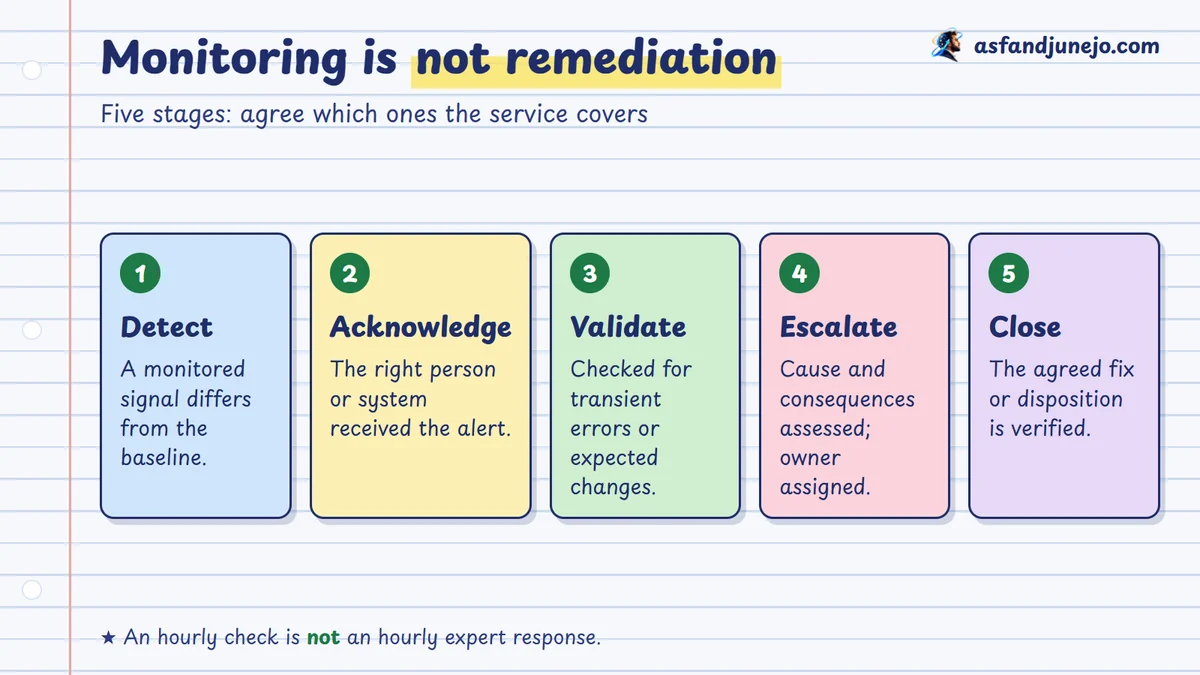
A provider should not promise an hourly expert response merely because an automated check runs every hour.
Detection, acknowledgment, and remediation are separate
A complete monitoring process should distinguish five stages.
Detection: A monitored signal differs from the baseline.
Acknowledgment: The alert has been received by the appropriate person or system.
Validation: The condition has been checked for transient errors, collection problems, or expected changes.
Investigation and escalation: The likely cause and relevant consequences have been assessed, and responsibility has been assigned.
Closure: The agreed disposition or corrective action has been verified.
The contract should specify which stages are included and which are owned by others.
Define support availability
Monitoring services should identify their actual operating coverage.
For example, a provider may run automated checks continuously but offer human investigation only during specified business hours.
An alert detected outside those hours may be queued, automatically forwarded, or escalated through a separately agreed incident process.
The agreement should define:
- Monitoring hours and check schedules.
- Human support availability.
- Acknowledgment expectations.
- Escalation contacts and channels.
- Responsibility for urgent incidents.
- The difference between notification and active investigation.
- Whether remediation is included.
- Conditions requiring separate authorization.
These details prevent a customer from interpreting continuous detection as continuous staffed support.
Worked example: CAN-001 monitoring handoff
Suppose the fictional development team corrects CAN-001, and the live technical acceptance checks confirm the approved canonical target.
The monitoring record can then contain:
| Field | Illustrative monitoring configuration |
|---|---|
| Reference | CAN-001 |
| Monitored URL | Approved service URL |
| Expected canonical | Approved canonical target |
| Baseline status | Implementation verified |
| Detection rule | Canonical declaration differs from the approved target |
| Validation | Repeat fetch and check source output |
| Initial response | Notify the designated contact after confirmation |
| Investigation | Determine whether the change is intentional or harmful |
| Remediation | Separately authorized unless included |
| Closure | Verify the approved configuration is restored or formally changed |
If a later deployment changes the canonical target, the monitoring system may detect that change.
The provider should confirm the new configuration and determine whether it represents an approved update or unexpected regression.
The monitoring alert itself does not establish Google’s subsequent canonical selection.
That outcome requires separate search-engine evidence, potentially observed after Google processes the page.
Monitoring coverage is not sitewide assurance
A service checking 25 critical URLs cannot claim to monitor every technical condition across an 8,000-URL website.
Likewise, the absence of an alert does not prove that no SEO problems exist.
The monitoring product must identify its URL coverage, collection methods, signal limitations, and excluded conditions.
This is the same principle applied during the original audit: the strength of a conclusion depends on the evidence actually collected.
When should monitoring trigger a re-audit?
A re-audit may be appropriate after a major migration, redesign, international expansion, platform change, sustained unexplained decline in search, or substantial technical regression outside the monitoring system’s coverage.
The decision should reflect the size and nature of the change.
One temporary warning does not necessarily justify a full re-audit.
Conversely, a major architecture change may invalidate important assumptions in the original baseline.
Monitoring should therefore include clear escalation rules for deciding when the bounded service can no longer answer the customer’s question.
When should an SEO audit remain a custom engagement?
A custom engagement is appropriate when the customer’s central question cannot be investigated reliably within the predefined scope or when the technical and organizational complexity requires specialized methods.
Common examples include extensive faceted navigation, complex international SEO, recent migrations, unusual JavaScript rendering, enterprise-scale multi-property environments, and investigations requiring detailed historical or commercial data.
Website size is not the only factor
A website with many URLs may still have a small number of stable templates.
A smaller website can have substantial technical complexity because of rendering behavior, routing, authentication, or platform-specific constraints.
The relevant issue is whether the standard method can obtain sufficiently representative evidence and support defensible conclusions.
For example, advanced crawl-budget management should not automatically be included in every small-site audit. Google’s crawl-budget guidance (opens in a new tab) identifies approximate categories where advanced analysis is particularly relevant, including sites with around 1 million or more pages updated moderately often, sites with at least 10,000 pages changing very rapidly, and sites with significant discovery problems.
These are approximate categories, not rigid thresholds or automatic requirements.
A baseline should not be designed merely to create an upsell
A productized audit may reveal that deeper investigation is justified.
However, the provider should not withhold important in-scope findings or deliberately weaken the paid baseline to force the customer into a larger engagement.
The original service must deliver the value it promised.
When an issue exceeds scope, the report should identify the relevant observation, explain the limitation, and describe the additional investigation necessary.
The customer can then decide whether to commission further work.
For organizations needing a broader technical and semantic investigation, the SEO and AI Visibility Services described on asfandjunejo.com include a separate 17-phase audit engagement.
That comprehensive assessment should remain distinguishable from the hypothetical fixed-scope baseline designed in this article.
How do you measure the success of a productized SEO audit?
A productized audit should be evaluated through delivery reliability, diagnostic accuracy, client usefulness, implementation progress, and appropriate business outcomes. These measurements should remain separate because a profitable service is not necessarily accurate, and an accurate audit does not guarantee higher search rankings.
A provider needs to understand whether the process can be delivered consistently.
The customer needs to understand whether the diagnosis is relevant and actionable.
The website’s subsequent performance provides additional context, but it is affected by implementation decisions and factors outside the audit provider’s control.
Operational success measures
| Metric | Purpose | Caution |
|---|---|---|
| Scope-exception rate | Evaluate package suitability | A high rate may reflect poor qualification or complex customers |
| Delivery effort | Compare actual and planned workload | Requires consistent time recording |
| QA correction rate | Track problems caught in review | Low corrections do not necessarily prove high accuracy |
| Independent reviewer agreement | Assess consistency of decisions | Agreement is not equivalent to technical truth |
| Rejected-warning rate | Measure conditions excluded after validation | Depends on the tool and website population |
| Reopened finding rate | Track diagnoses needing reassessment | May reflect new information or changed conditions |
| Delivery timeliness | Evaluate schedule reliability | Must account for documented client pauses |
| Acceptance outcomes | Determine whether outputs met the agreed criteria | Acceptance is not the same as implementation success |
These metrics can guide service improvement, but they should not be interpreted without examining the underlying cases.
For example, an audit team reporting almost no corrections may have highly accurate analysts or an inadequate review process.
A sample of independently reviewed findings can help distinguish these possibilities.
Client and implementation outcomes
Client-facing evaluation can consider whether stakeholders understand the findings, whether recommendations can be assigned to responsible teams, whether approved corrections are implemented, and whether their technical acceptance tests pass.
Search performance changes can then be evaluated through appropriate observation periods.
However, an improvement in ranking after implementation does not establish that the audit caused it.
Changes in search demand, competition, indexing, content, and other conditions may have contributed.
The audit should not promise a causal outcome that cannot be demonstrated.
How should monitoring be measured?
A recurring monitoring service should track the completion of agreed checks, alert validity, acknowledgment reliability, escalation outcomes, and the proportion of incidents resolved or properly dispositioned under the contract.
A useful monitoring report should distinguish between:
- Checks completed.
- Checks that failed or lacked data.
- Alerts detected.
- Alerts confirmed.
- Alerts rejected as transient or expected changes.
- Incidents escalated.
- Corrective actions verified.
- Open or unresolved conditions.
This establishes whether the monitoring process is functioning as agreed.
It does not claim that every technical problem on the website is being observed.
Where can you get the productized SEO audit templates?
Join Search Signals with your email and three files unlock on this page straight away: the complete Productized SEO Audit Kit (ZIP), the operating workbook (Excel) and the printable templates and playbook (PDF).
The workbook has eight tabs: start here, scope and exclusions, evidence manifest, findings QA, delivery acceptance, monitoring and escalation, change requests and the case reconciliation. The playbook holds five fill-in templates (scope and exclusions, a finding-level QA register, deliverable acceptance, monitoring and escalation, and change-request control), the fictional 42-observation case and source notes, as an editable Word file and a printable PDF.
- Productized SEO Audit Kit (ZIP)Workbook, Word templates, printable PDF, read-me and checksums
- Productized SEO Audit Operating WorkbookExcel workbook, 8 tabs
- Templates and playbookPDF, 6 pages, printable fill-in templates
Directional Service-design templates with fictional sample values, not legal advice or a guarantee of any SEO outcome
Frequently asked questions
What makes an SEO audit productized?
An SEO audit becomes productized when its eligibility, scope, collection methods, deliverables, QA standards, acceptance criteria, and exception rules are defined in advance. The process becomes repeatable without requiring identical conclusions for every website.
How is a productized audit different from a custom audit?
A productized audit follows a predefined service specification. A custom audit is designed to address broader or unusual requirements that cannot be adequately investigated within the standard package.
Can an SEO audit be fully automated?
Many evidence collection and reporting tasks can be automated. However, automated warnings still require appropriate interpretation, and consequential recommendations may need human verification and contextual investigation.
What should a fixed-scope audit include?
It should specify the assessed properties and URLs, technical checks, evidence sources, quality requirements, deliverables, limitations, and handoff responsibilities.
How should SEO audits be priced?
Prices should reflect expected delivery effort, tool costs, quality assurance, operational risk, overhead, and a sustainable margin. The model should match the agreed service boundaries rather than an unsupported universal market price.
Is Google Search Console access required?
Not for every technical observation. Publicly accessible website conditions can often be checked without it. However, some indexing and search performance questions require authorized Search Console data, and the absence of that data may limit the diagnostic process.
Does an SEO audit include fixing problems?
Only if implementation is included in the agreement; diagnosis, remediation, and verification are distinct activities that may require different permissions and responsibilities.
What happens when a website exceeds the URL limit?
The provider should apply the agreed sampling or coverage method, disclose what was assessed, and determine whether additional coverage requires a scope change. Limited coverage should not be represented as an exhaustive sitewide audit.
How do you validate automated SEO warnings?
Check the underlying observation, examine expected technical behavior, verify relevant evidence, assess the affected scope, and determine whether the recommended action follows from the diagnosis.
How often should SEO monitoring run?
Frequency depends on signal importance, site changes, available data, and the agreed response model. Critical availability checks may run more frequently than aggregated search performance reviews.
What is the difference between monitoring and a recurring audit?
Monitoring repeatedly observes a defined set of conditions. A recurring audit reassesses a broader range of technical or strategic questions. Monitoring does not automatically include comprehensive re-audits or implementation.
Can a productized audit guarantee rankings?
No. An audit can identify and explain relevant technical conditions, but search performance depends on implementation and many external factors. A ranking outcome should not be guaranteed by the diagnosis alone.
When should a provider recommend a custom engagement?
When the website’s complexity, data requirements, implementation risk, or principal business question exceeds the standardized package’s ability to provide a reliable answer.
Final perspective: standardize delivery without removing expert judgment
Productizing an SEO audit is an exercise in service design, evidence governance, and operational accountability.
The process begins by establishing which customers qualify and defining the assessment the provider can responsibly deliver. Evidence collection must follow a documented method, and observations must be interpreted before they become recommendations. Quality assurance should distinguish confirmed findings from intentional configurations, false positives, missing evidence, and unresolved questions.
These responsibilities continue after the report is prepared.
Pricing depends on bounded effort. Scope changes require explicit decisions. Deliverable acceptance should be based on agreed standards. Monitoring needs its own coverage, alert validation, support availability, and escalation rules.
The technical expertise remains essential throughout.
Automation can make collection, comparison, and reporting more consistent, but it cannot independently establish every website’s intended configuration or the business significance of each detected condition.
That judgment must remain grounded in the relevant evidence.
A repeatable audit should therefore standardize the activities that benefit from consistency while preserving the flexibility to investigate uncertain or complex conditions.
The result is not a promise that every website can be diagnosed quickly or inexpensively.
It is a service model in which customers understand what they are purchasing, providers understand what they must deliver, and consequential recommendations can be examined and verified.
The strongest productized SEO audit is not the one that generates the most warnings or delivers the fastest report. It is the one that consistently provides a bounded, defensible diagnosis and makes the limits of that diagnosis clear.
Put the Audit Service Blueprint into practice
Begin with one narrowly defined package and test it against representative websites for which appropriate assessment permissions are in place.
Record the actual effort required for qualification, collection, analysis, QA, reporting, and handoff.
Measure where scope changes occur, which automated findings are rejected, how often reviewers disagree, and whether customers can implement the resulting recommendations.
Use those results to refine the service before expanding its scope or making stronger delivery promises.
For a working example of a fixed-scope offer, see my own AI visibility audit: it publishes two scopes, Lite and Standard, with question counts, platforms, pages reviewed and delivery times, and it states what the audit does not do.
For businesses requiring a comprehensive assessment beyond a productized baseline, explore the SEO and AI Visibility Services available through asfandjunejo.com and request an appropriately scoped investigation.
Research methodology and limitations
Research and technical review: October 30, 2026.
This article presents the Audit Service Blueprint as a proposed service-design methodology supported by official technical documentation, an attributed commercial example, and a constructed instructional scenario.
The fictional B2B website with approximately 8,000 discovered URLs, the proposed 500-request scope, the 42 canonical observations, and the CAN-001 through CAN-003 records are synthetic examples. They do not represent an audit conducted on a real customer website.
The reconciliation of 42 observations accounts for one constructed confirmed issue, one intentional configuration, one unresolved case, and 39 unreviewed records. It does not claim to completely validate the hypothetical detection population.
The scope definitions, pricing considerations, QA procedures, and monitoring schedules are recommended operating practices. They have not been evaluated through a controlled study demonstrating particular improvements in profitability, diagnostic accuracy, customer retention, or search performance.
The O8 Agency example describes that company’s publicly stated commercial offer and is not used as representative market-pricing evidence.
The article does not claim that implementing a recommended change guarantees indexing, rankings, traffic growth, or AI citation visibility.
References and further reading
Technical SEO and auditing
- Google Search Central: What Is Canonicalization? (opens in a new tab). Canonical selection, duplicate content, and representative URLs.
- Google Search Central: How to Specify a Canonical URL (opens in a new tab). Canonical signals and their relative influence.
- Google Search Central: Fix Canonicalization Issues (opens in a new tab)—investigation of unexpected canonical selection.
- Google Search Central: JavaScript SEO Basics (opens in a new tab). Crawling, rendering, and indexing of JavaScript-powered pages.
- Google Search Console API: URL Inspection (opens in a new tab). Indexed-state data and the limitation on live testing.
- Google: Crawl Budget Management (opens in a new tab). Advanced crawling considerations for large and frequently updated websites.
- Screaming Frog: SEO Spider Configuration (opens in a new tab). Crawl boundaries, limits, rendering, and extraction.
- Google Search Central: Structured Data Policies (opens in a new tab). Structured data eligibility and limitations.
Search performance and content quality
- Google Search Central: Debugging Search Traffic Drops (opens in a new tab). Investigation of search performance changes.
- Google Search Central: Creating Helpful, Reliable, People-First Content (opens in a new tab). Originality, sourcing, authorship, and reader usefulness.
- Google Search Central: Search Console Overview (opens in a new tab). Search performance and indexing information.
Commercial example
- O8 Agency: How We Turned a $5K SEO Audit Into a $750 Productized Service (opens in a new tab). A provider-described example of productized audit packaging.
Related work on asfandjunejo.com
- AI in SEO: What to Automate, What to Verify, and What to Keep Human. Governance and evidence verification for automated SEO workflows.
- AI Visibility Audit Example. A separate, real-world example of transparent audit results, including passed, failed, observational, and untested checks.
- Schema Markup for AI Search: What It Can and Cannot Do. Appropriate structured data use and limits of unsupported AI search claims.