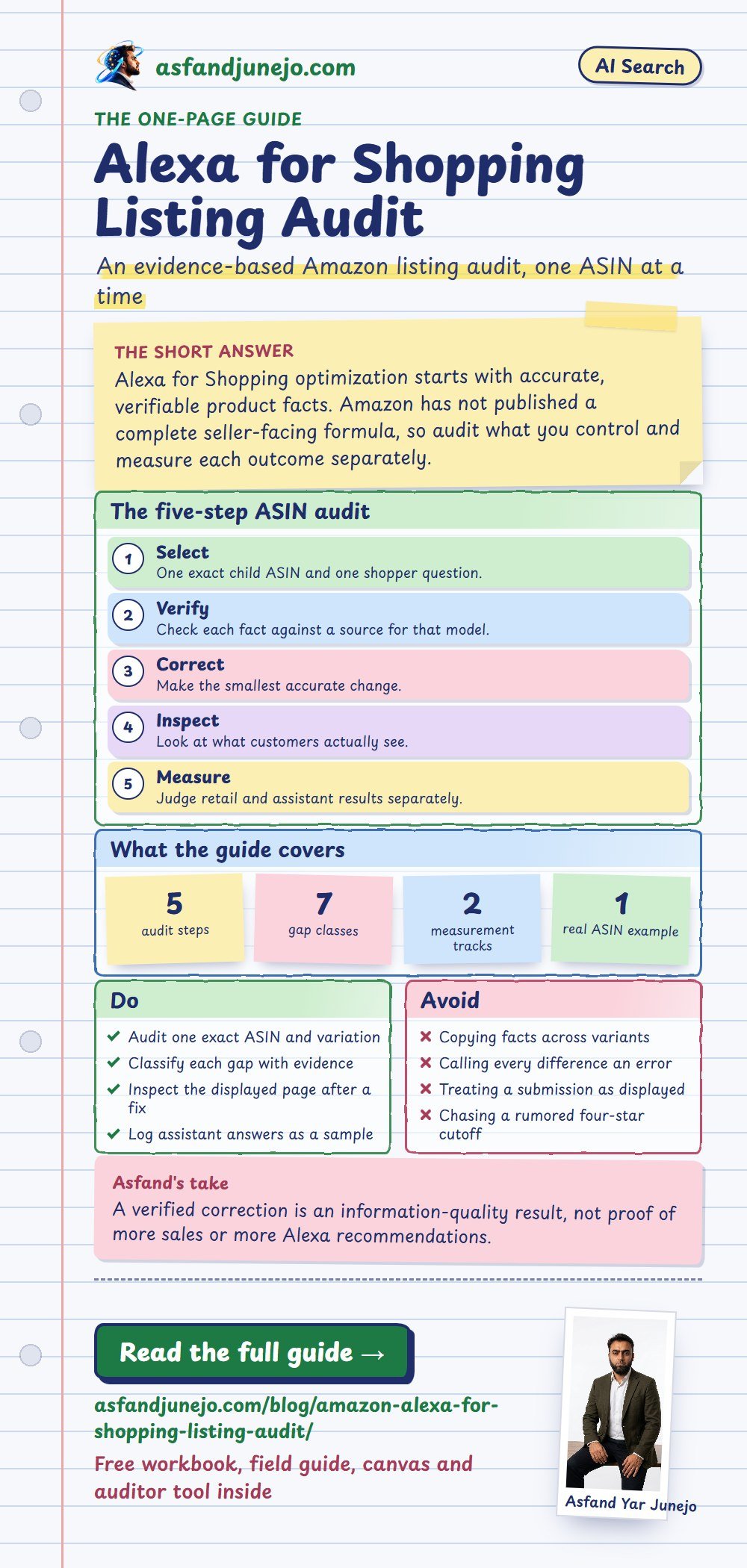
Amazon Alexa for Shopping Optimization starts with accurate, specific, and verifiable product information. Sellers should identify what customers need to know, confirm the facts that determine whether a product satisfies those needs, and ensure that the Amazon listing communicates those facts consistently. The objective is to improve product discoverability and purchasing clarity without relying on speculative AI ranking techniques or unsupported guarantees.
Published · Sources checked · By Asfand Yar Junejo, publisher asfandjunejo.com
A customer searching for a travel mug may need to know whether it fits a particular cup holder, how much liquid it holds, and whether its lid is dishwasher-safe. Someone comparing replacement chargers may need an exact compatibility list, power specifications, and confirmation of what comes in the package.
These requirements cannot be answered reliably through generic promotional language.
Descriptions such as “perfect for every adventure,” “universal compatibility,” or “premium quality” may communicate positioning, but they rarely provide enough information to establish product suitability.
Conversational shopping makes this distinction more visible.
Instead of searching for “digital watch,” a customer can ask for a lightweight watch with an alarm, a long-lasting battery, and suitable water resistance for a particular activity.
The assistant may suggest products and explain why they appear relevant.
However, the presence of a product in an AI-generated recommendation does not establish that every claim in the explanation is accurate.
The underlying product information must still be verified.
This is where responsible Amazon listing optimization differs from advice built around supposed AI ranking shortcuts.
Amazon has disclosed some information about how its product-search systems use customer behavior and product data. It has also explained important aspects of its shopping assistant’s retrieval architecture.
But those disclosures do not constitute a complete seller-facing formula for determining which products Alexa for Shopping will recommend, how they will be grouped, or where they will appear in every response.
The practical opportunity is therefore to improve what sellers can legitimately control: product facts, relevant listing contributions, search terminology, offer information, and the quality of evidence supporting customer-facing claims.
This guide examines that process through Amazon’s official documentation, an independent analysis of the 100,000-prompt Alexa for Shopping study, and a real product-information audit of the Casio F-91W digital watch.
The objective is not to reverse-engineer an undisclosed algorithm.
It is to establish how sellers can verify, correct, submit, inspect, test, and maintain product information while separating actual marketplace outcomes from observations of AI-assisted shopping.
The workbook, field guide, printable canvas and an offline copy of the auditor are free for Search Signals subscribers, and the free Amazon listing gap auditor runs in your browser.
What are the key takeaways?
Alexa for Shopping optimization starts with accurate, verifiable product facts. Amazon has disclosed some of how product search matches and ranks, but not a complete seller-facing formula, so audit what you control and measure each outcome separately.
- Audit one exact ASIN and variation at a time, and never copy a fact from one variant to another.
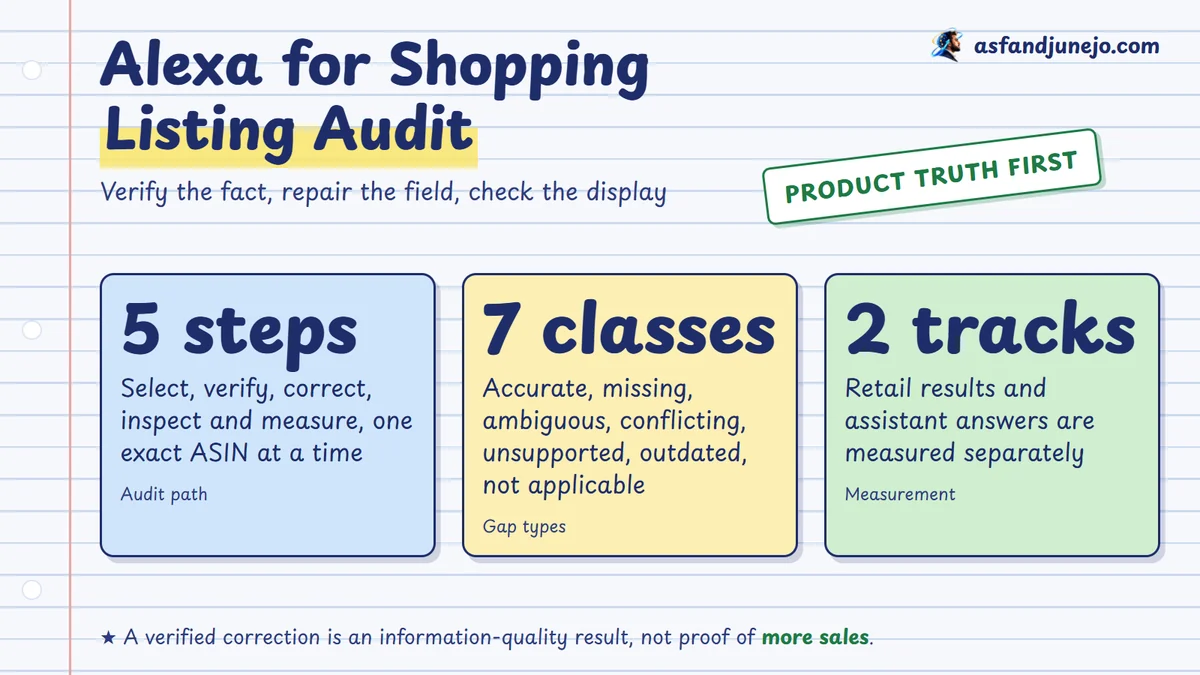
- Classify each difference as accurate, missing, ambiguous, conflicting, unsupported or outdated before changing anything: some differences are not errors.
- A submitted catalog correction is not a displayed one, so inspect the customer-facing page.
- Keep retail results and Alexa answer observations in two tracks, and do not turn them into one score.
- Treat universal rules (a four-star cutoff, a bullet count, a keyword density) as unproven: none was established in the sources reviewed.
What Is Alexa for Shopping, and What Changed in 2026?
Alexa for Shopping is Amazon’s AI-powered shopping assistant for discovering products, comparing alternatives, evaluating purchase requirements, and performing supported shopping activities through conversational interactions. Previously called Rufus, the experience was renamed on May 13, 2026, and expanded substantially during the year.
Confirmed Amazon's own page and trade coverage give May 13, 2026 as the date Rufus was renamed Alexa for Shopping (checked November 3, 2026)
Amazon introduced Rufus in 2024 to help customers ask questions about product categories, purchasing considerations, and individual items.
The assistant could provide contextual information, compare products, and help shoppers investigate different options.
In May 2026, Amazon rebranded the experience as Alexa for Shopping.
The distinction between the old and new names matters when researching Amazon’s published technology.
Some of the most detailed technical explanations still refer to Rufus because they were published before the rename.
Those documents provide historical architectural evidence, not necessarily a complete description of the current system.
Amazon’s overview of generative and agentic AI in shopping (opens in a new tab) explains the relationship among conversational discovery, personalized shopping, visual search, and services that help customers act on their purchasing decisions.
What can customers do with Alexa for Shopping?
Amazon describes several connected shopping activities.
Customers can explore unfamiliar product categories, compare items, request personalized recommendations, review product information, track price history, and set alerts for shopping interests.
The assistant can also support selected shopping actions.
A customer might ask for a recommendation based on previously expressed preferences, request a comparison between alternative products, or investigate whether a particular item is suitable for a specific purpose.
These interactions may depend on different types of information.
A product comparison may require specifications, relevant prices, and differences between available models.
A compatibility question may require precise technical attributes.
A recommendation based on previous shopping activity may involve contextual information unavailable to an external observer.
For sellers, the important point is that customers can describe needs that go beyond an ordinary product-category keyword.
That does not make conventional search terms irrelevant.
It means those terms should be supported by accurate information about the conditions under which the product is suitable.
Amazon’s October 2026 expansion
On October 29, 2026, Amazon announced more than 100 additional Alexa for Shopping capabilities (opens in a new tab).
These included managing shopping lists, registries, Subscribe & Save deliveries, account information, payments, and other shopping-related tasks.
Amazon also reported that more than 400 million customers had used Alexa for Shopping during the preceding 12 months.
The number of customers using its agentic features had increased more than eightfold since the beginning of 2026.
These are Amazon-reported adoption measures.
They do not independently establish the number of purchases caused by AI recommendations, the commercial value of product citations, or the ranking impact of listing edits.
Nevertheless, the announcement shows that Alexa for Shopping has developed into a broader shopping experience rather than remaining only a conversational product-search tool.
Confirmed Amazon's announcement page reports 100+ new capabilities, more than 400 million customers in the last 12 months and agentic features up more than eightfold since the start of the year. These are Amazon-reported figures, and the page shows no date, so the October 29 date comes from the research behind this guide (checked November 3, 2026)
Discovery, evaluation, and shopping actions are different
A useful way to understand the experience is to distinguish three customer activities.
Discovery occurs when a shopper identifies possible products.
Evaluation occurs when the shopper examines specifications, suitability, differences, limitations, and purchasing conditions.
Action occurs when the shopper adds an item to a list, manages a subscription, initiates a purchase, or completes another supported task.
These activities are connected but not interchangeable.
A customer can discover a product without purchasing it.
A product may appear in a comparison without being recommended as the best option.
An assistant may accurately explain that a product does not satisfy a particular requirement.
That last outcome is important.
Product suitability should not be treated as a competition to appear in every possible shopping answer.
If a product cannot meet the customer’s need, an accurate explanation may exclude it.
For sellers, this means optimization should communicate genuine applicability rather than manufacture broad promises.
Personalization complicates ranking claims
Amazon describes using shopping history, preferences, browsing behavior, and conversational context to personalize recommendations.
Consequently, a product’s appearance in one Alexa response should not be interpreted as a universal ranking position.
A seller observing the assistant through one account, device, or shopping session may encounter results different from those shown to another customer.
Availability, price, shopping context, and product information may also change.
A single screenshot demonstrates what appeared under the observed circumstances.
It does not establish how the same ASIN will appear across every customer interaction.
This distinction should influence the design of any AI shopping visibility report.
Alexa can also surface products outside Amazon’s store
Amazon’s current explanation of Alexa for Shopping (opens in a new tab) describes Shop Direct and related experiences that can introduce products offered by external merchants.
In some circumstances, customers can visit the merchant’s website or use supported purchasing arrangements.
This means the broader shopping experience should not be described as exclusively a ranking interface for Amazon ASINs.
However, a seller’s ability to edit an Amazon listing does not automatically provide control over external merchants or the information used in those experiences.
This article therefore concentrates on Amazon product-detail quality and the evidence that sellers can verify.
Confirmed Amazon's guide to the assistant describes Shop Direct, products available through other stores, and a Buy For Me option for eligible items (checked November 3, 2026)
Does Alexa replace traditional Amazon SEO?
No.
Amazon continues to provide official guidance on relevant search terminology, product titles, bullet points, descriptions, attributes, and customer-friendly listing information.
Its Amazon SEO guide (opens in a new tab) explains how search terms and product details help customers find relevant items.
Conversational discovery introduces additional information requirements, but it does not eliminate the importance of precise product identity.
A customer may search using a specific replacement part number.
Another may describe the intended device and ask which component is compatible with it.
The listing must preserve the correct product number and explain the verified compatibility relationship.
Effective product optimization should support both types of information needs.
What Does Amazon Actually Reveal About Product Matching, Ranking, and AI Shopping Answers?
Amazon has disclosed that its product-search systems distinguish product matching from product ranking and consider factors that include product information and past customer actions. Its historical Rufus documentation also describes retrieval-augmented generation and the use of multiple shopping-information sources. These disclosures provide useful evidence, but they do not reveal the complete current Alexa for Shopping recommendation algorithm.
The distinction between what is known and what remains undisclosed is central to responsible seller guidance.
A claim that Amazon has disclosed no relevant ranking information would be inaccurate.
A claim that sellers now possess a complete Alexa ranking formula would be equally misleading.
Amazon’s 2025 regulatory disclosure
In its March 6, 2025 Digital Markets Act compliance report (opens in a new tab), Amazon discussed the design of product search in the context of its European Union marketplace.
The relevant explanation appears in Annex 1, particularly paragraphs 92 to 99.
Amazon describes two distinct stages.
First, its systems identify a set of products that match the customer’s shopping intent.
Second, the products in that set are ordered using ranking models.
The disclosure identifies examples of ranking inputs, including past customer actions, such as how often an item was purchased, and product information, such as titles, prices, and descriptions.
It also explains that different product categories can involve different ranking models.
Importantly, Amazon states that the explanation of ranked product search is also relevant when Rufus suggests specific products from the Amazon Store.
This is meaningful primary evidence.
However, the report concerns Amazon’s 2025 EU regulatory disclosure.
It should not be generalized into a complete description of the current U.S. Alexa for Shopping experience, nor used to infer the weight assigned to each input.
Confirmed Annex 1 of Amazon's DMA compliance report, paragraphs 93 to 97, describes a matching step that builds a match-set and a ranking step using models that score each product. Its examples of inputs are past customer actions (how often an item was bought) and product information (title, price, description), and paragraph 92 says the explanation also applies to Rufus product suggestions (checked November 3, 2026)
Matching, ranking, and answer presentation
Three concepts should remain separate.
| Process | Purpose | What the disclosure supports |
|---|---|---|
| Product matching | Identify relevant products for the customer’s shopping intent | Amazon describes a matched set of relevant catalog items |
| Product ranking | Order products within that relevant set | Amazon identifies examples of product and customer-action inputs |
| AI answer presentation | Explain, group, and present products conversationally | Historical and current Amazon materials describe AI shopping assistance, without disclosing every presentation rule |
A seller may correctly improve a product description without being able to determine how the change affects each process.
For example, adding a verified compatibility fact could make a product easier to understand.
That does not establish whether the item entered a different match set, received a different ranking score, or was presented differently by the assistant.
Those outcomes require separate evidence.
What Amazon Science disclosed about Rufus
Amazon Science published The Technology Behind Amazon’s GenAI-Powered Shopping Assistant, Rufus (opens in a new tab) in October 2024.
The article described a shopping-focused language model system that uses retrieval-augmented generation (RAG).
It explained that Rufus could use information from product catalogs, reviews, community questions and answers and relevant Stores APIs, and that the underlying model was built with public web information.
This helps establish why a product’s title alone should not be assumed to determine the complete answer.
A customer asking about technical compatibility may need information different from a shopper evaluating customer experiences or comparing general product categories.
However, the document describes the earlier Rufus architecture.
It does not establish current field-specific weights or a universal ordering formula for Alexa for Shopping in November 2026.
Confirmed The Amazon Science article is dated October 4, 2024. It describes retrieval-augmented generation with several evidence sources, including customer reviews, the product catalog and community questions and answers, and says Rufus calls Stores APIs; public web information is described as part of how the model was built (checked November 3, 2026)
What is known versus unknown?
| Question | Supported conclusion |
|---|---|
| Does Amazon use product information in search ranking? | Yes. Its 2025 EU disclosure identifies examples such as title, price, and description |
| Can previous customer behavior matter? | Yes. The disclosure identifies past customer actions among possible ranking inputs |
| Can multiple sources inform shopping AI answers? | Yes. Amazon’s historical Rufus explanation describes several source categories |
| Does Amazon publish the exact current weight of each listing field for Alexa? | No complete current seller-facing formula was established from the reviewed public materials |
| Does a particular number of bullets guarantee recommendations? | No such universal rule was established |
| Does a seller need a minimum four-star rating for all Alexa recommendations? | No universal official cutoff was established |
| Does a clearer listing guarantee higher AI visibility? | No causal guarantee was established |
These distinctions prevent product-information advice from becoming a set of unsupported algorithm claims.

Why review ratings should not be treated as a simple eligibility rule
Some marketplace optimization guides claim that Alexa excludes products below four stars.
Amazon’s public rating guidance does not establish a universal four-star recommendation threshold.
Customer ratings and reviews may provide relevant information about product experiences.
But a displayed star rating is not the same as a directly observed AI selection rule.
Nor does a favorable rating independently establish that a product satisfies a specific technical requirement.
A seller should respond to legitimate product problems and customer feedback rather than attempt to manipulate ratings to satisfy a rumored cutoff.
The U.S. Federal Trade Commission’s Consumer Reviews and Testimonials Rule (opens in a new tab), effective October 21, 2024, prohibits specified deceptive review practices, including certain fake reviews and incentives conditioned on review sentiment.
Review integrity is a consumer-protection responsibility, not an AI optimization shortcut.
Confirmed The FTC's questions and answers page says the Consumer Reviews and Testimonials Rule took effect on October 21, 2024, and lists fake reviews, incentives conditioned on sentiment, undisclosed insider reviews, review suppression and fake social media indicators among the prohibited practices (checked November 3, 2026)
The practical interpretation
Amazon’s disclosures justify paying attention to product identity, relevant information, and genuine customer behavior.
They do not justify promising that a particular wording pattern will produce a recommendation.
The most defensible approach is to improve the accuracy and usefulness of product information, then observe outcomes under documented conditions.
This distinction also applies beyond Amazon.
The guide on ranking, retrieval, and citation at asfandjunejo.com explains why being discovered, included, recommended, clicked, and converted represent different outcomes.
That general measurement principle is useful here, although Amazon’s marketplace reporting should be evaluated according to Amazon’s own definitions.
How Do You Select an ASIN for a Product Listing Audit?
Select an ASIN for review when a meaningful customer requirement, an information inconsistency, a performance concern, or a product change warrants investigation. Start with one exact product and variation rather than rewriting an entire catalog. Establish what problem is being examined, what evidence exists, and which outcome a correction should accomplish.
The first task is identifying the proper unit of analysis.
An Amazon Standard Identification Number, or ASIN, identifies a product within Amazon’s catalog.
A seller SKU is an inventory identifier used by the seller.
A variation family may contain several related ASINs representing different sizes, colors, capacities, or configurations.
These identifiers should not be treated as interchangeable.
A specification applying to one variation may not apply to another.
For example, the dimensions of a 20-ounce bottle should not be copied to a 32-ounce variation merely because both belong to the same product family.
Likewise, a newer generation of an electronic device may support features absent from an earlier version.
Choose products with meaningful information needs
A product may deserve review because customers repeatedly ask about compatibility.
Another may have conflicting measurements across listing fields.
A third may experience returns associated with misunderstood package contents.
A newly launched product may require a preventive accuracy audit even when there is little sales history.
The appropriate priority depends on the potential consequence of the information problem.
An unclear decorative feature may be less consequential than an inaccurate electrical compatibility statement.
The audit should consider business significance, available evidence, customer impact, and the feasibility of implementing a reliable correction.
Search volume alone cannot determine which error matters most.
Use Amazon Brand Analytics within its actual reporting scope
Amazon’s Brand Analytics documentation (opens in a new tab) describes several reporting tools available to eligible brands.
Search Catalog Performance helps examine how products appear and perform across Amazon search activity, including impressions, clicks, cart additions, and purchases.
Search Query Performance provides query-level information about customer search activity and associated engagement or purchasing measures.
Top Search Terms helps examine popular marketplace queries and the products customers interact with after searching.
These reports can identify products and information needs worth investigating.
However, they do not establish what Alexa for Shopping recommended in every personalized conversation.
A product receiving substantial search exposure but weak conversion may have an information problem.
It may also have an unsuitable price, poor availability, a less competitive offer, or genuine product limitations.
The data identifies an issue to investigate, not necessarily its cause.
Confirmed Amazon's Brand Analytics page describes Search Catalog Performance, Search Query Performance and Top Search Terms for brands enrolled in Brand Registry with a Professional selling account; impressions, clicks, cart adds and purchases are reported in the first two, and Top Search Terms reports click and conversion shares (checked November 3, 2026)
Distinguish product information from offer competitiveness
A clear listing cannot compensate for every commercial disadvantage.
A product may be accurately described but unavailable in the required size.
It may be priced above relevant alternatives.
Its delivery conditions may not meet the customer’s requirements.
Its quality may be unsuitable for the intended application.
These circumstances may justify product, inventory, pricing, or operational decisions rather than copy changes.
A responsible audit must determine whether the problem concerns the facts shown on the detail page, the offer available to the shopper, or the product itself.
A minimum ASIN selection record
Before beginning the detailed review, record:
- Exact ASIN, product model, variation, and marketplace.
- Seller SKU where applicable.
- Audit trigger and intended shopper requirement.
- Existing product information and available manufacturer evidence.
- Relevant search or customer observations.
- Responsible product and catalog owners.
- Date of the initial listing inspection.
- Intended decision: verify, correct, test, or retain.
The purpose is to establish a reproducible scope.
A seller should be able to explain why the product was selected and what would constitute a successful audit.
How Do You Verify Product Facts and Identify Real Listing Gaps?
Verify product facts against the exact model and variation before rewriting the listing. Compare manufacturer specifications, approved test results, packaging information, applicable instructions, and customer-facing Amazon fields. Classify differences according to whether information is accurate, missing, ambiguous, contradictory, unsupported, or outdated.
This stage determines whether the proposed content improvement has a factual foundation.
A product claim does not become accurate because it appears on several websites.
Nor should a reviewer’s interpretation override the manufacturer’s documented specifications without appropriate supporting evidence.
The task is to establish what the product actually does and which conditions matter.
Build a source-backed product-fact register
A useful register includes the product’s identity, relevant dimensions, materials, capacity, compatibility, package contents, performance limitations, and any applicable safety or care instructions.
Each consequential fact should be associated with a source and review status.
Different claims require different evidence.
A manufacturer specification may establish nominal dimensions.
A controlled test may establish performance under specified conditions.
An instruction manual may establish operating limitations.
Packaging records may establish included components.
Customer reviews may reveal possible problems, but they do not independently certify technical performance.
The evidence must support the exact proposition being published.
Preserve model and variation differences
A compatibility statement for one model should not automatically be copied to another.
A product’s parent variation family may contain items with different dimensions, materials, capacities, or accessories.
This creates a particular risk when listing copy is generated from a shared template.
A statement that is accurate for one child ASIN may become misleading when reused across the entire family.
The same problem can occur when AI-generated copy blends facts from several similar models.
Every material specification should remain connected to the correct product.
Diagnose the actual type of gap
| Finding | Meaning | Appropriate next action |
|---|---|---|
| Accurate and complete | The relevant information is present and supported | Retain |
| Missing | A meaningful product fact is absent | Verify and add it where appropriate |
| Ambiguous | A field or claim permits materially different interpretations | Clarify meaning |
| Conflicting | Two sources or displayed fields appear inconsistent | Investigate definitions and source authority |
| Unsupported | The claim exceeds available evidence | Remove, qualify, or obtain verification |
| Outdated | Product or policy information has changed | Update from the current approved source |
| Not applicable | The requirement does not concern this product | Do not force the information into the listing |
These classifications should not be converted into a supposed Alexa quality score.
They are editorial controls for deciding which information requires attention.
Compatibility and safety claims need stronger review
Compatibility, electrical requirements, materials, physical fit, water resistance, and other technical claims may affect whether the product is appropriate for a customer.
A device with a USB-C connector is not necessarily compatible with every USB-C device.
A product described as water-resistant is not necessarily suitable for every water-related activity.
A nominal battery capacity does not establish the runtime of every connected device.
The relevant conditions are part of the claim.
Where applicable regulations, testing requirements, or marketplace restrictions apply, the statement should be reviewed by an appropriate specialist.
A seller should not use an attractive marketing phrase to conceal an important limitation.
Reviews are diagnostic inputs, not definitive specifications
Customer reviews may identify recurring concerns about size, fit, included components, or durability.
However, an individual report may involve the wrong variation, incorrect use, a defective item, a shipping error, or a misleading listing.
The seller should investigate the underlying cause.
If the product itself is defective, the appropriate response may be quality control or product improvement.
If the problem is inaccurate copy, the listing should be corrected.
If the customer selected an unsuitable variation, clearer size or compatibility information may help.
A review should begin the investigation, not automatically determine its conclusion.
How Should Sellers Improve Titles, Bullets, Attributes, Images, and A+ Content?
Different Amazon listing fields should communicate different parts of the same verified product story. Titles identify the item, bullets explain meaningful characteristics, structured attributes provide specific facts, images clarify physical or functional details, and A+ Content can provide additional context. The fields should agree with one another without unnecessarily repeating every statement.
The objective is consistency across information elements.
A product title should not identify one capacity while the structured attributes identify another.
An image should not imply that an optional accessory is included.
A description should not promise a technical capability absent from the manufacturer’s documentation.
The listing should help customers determine what they are actually purchasing.
Titles should prioritize product identity
Amazon’s January 2025 title policy update (opens in a new tab) introduced requirements for most product categories, including a 200-character ceiling, restrictions on specified special characters, and limits on repeating the same word.
These restrictions include stated exceptions and should be checked against the current requirements for the relevant marketplace and category.
The 200-character ceiling is a maximum for applicable categories, not a target length.
An effective title should identify the brand, the relevant product type, the model or variation, and key differentiators without unnecessary repetition.
The seller should preserve precise terminology customers use to find the product.
It should not turn the title into a sequence of AI prompts.
Directional Amazon's seller help page on product title requirements (opens in a new tab) and trade coverage give a 200-character ceiling, restricted characters (! $ ? _ { } ^ ¬ ¦) and a limit on repeated words from January 21, 2025; limits differ by category and sources disagree on the repetition threshold, and Seller Central pages need a seller login, so confirm the current rule before relying on it
Bullets should connect verified features with practical meaning
A useful bullet explains a relevant characteristic and its conditions.
For example, a travel mug’s verified base diameter may help shoppers assess cup-holder fit.
A replacement part’s confirmed compatibility range may help customers avoid buying the wrong model.
A rechargeable product’s included charging cable should be distinguished from any adapter sold separately.
A bullet should not convert a conditional fact into a universal promise.
The correct number and length of bullets depend on current marketplace and category requirements.
No established rule guarantees that Alexa will recommend based on a listing’s number of bullets.
Product attributes should contain accurate structured facts
Attributes can describe dimensions, materials, color, size, capacity, compatibility, and other category-specific information.
Their purpose is to represent product characteristics consistently.
A title may summarize a product’s capacity, while the structured attributes preserve the exact measurement.
An image may illustrate fit, while the attribute records the underlying dimension.
These fields should reinforce rather than contradict one another.
Images can clarify information that text alone may not communicate
Dimensioned images can show which parts of a product were measured.
Package-content graphics can identify included components.
Compatibility images may help customers identify which device models are supported.
However, visual claims require the same factual verification as written claims.
An image showing a product with an accessory should not imply that the accessory is included when it is not.
A dimension graphic should describe the correct product variation.
The seller should also comply with Amazon’s current image requirements for the relevant category and image type.
A+ Content has additional restrictions
Eligible brands can use A+ Content to add richer product explanations, imagery, and supported comparison modules.
However, Amazon’s A+ Content guidelines (opens in a new tab) impose content restrictions.
These include limitations involving promotional pricing, external links, certain warranty or guarantee statements, claims, and competitor-related comparisons.
A seller should not copy material from a general competitive comparison into A+ Content without checking its eligibility.
A+ Content can be valuable for explaining differences among a brand’s own products, where the relevant module and policies permit that use.
It should not introduce unsupported specifications or contradict the main listing.
Backend search terms remain relevant to conventional Amazon search
Amazon’s keyword research guidance (opens in a new tab) describes backend search terms that sellers can manage through appropriate Seller Central fields.
These terms can help convey relevant product language that is not adequately covered in the visible copy.
They should remain relevant to the product and comply with current field requirements.
The seller should not treat backend terms as a shortcut for a disclosed Alexa ranking.
The purpose is to support legitimate product discovery through conventional marketplace search without sacrificing factual clarity.
AI-generated listing copy must be verified
AI tools can assist with organizing specifications and drafting readable product descriptions.
However, generated copy may introduce unsupported benefits, combine variation details, or turn a feature into a stronger performance claim.
A drafting tool may describe an item as waterproof when the evidence supports only water resistance.
It may infer that an accessory is included because it appears in an image.
It may extend compatibility across an entire device family without supporting documentation.
The approval process should compare generated copy against the product-fact register.
This follows a broader principle discussed in AI in SEO: What to Automate, What to Verify, and What to Keep Human: generating an output and establishing its correctness are different responsibilities.
Shared ASIN pages require display verification
Amazon’s product detail-page guidance (opens in a new tab) explains that detail pages are shared spaces.
Multiple sellers may submit information about the same product, while Amazon determines which contributions appear to customers.
A seller can therefore submit a supported correction without necessarily causing that value to appear immediately.
The process should distinguish among the approved fact, the submitted contribution, Amazon’s response, and the displayed value.
Amazon also provides guidance for suggesting changes to product detail pages (opens in a new tab).
The correction should not be marked complete until the relevant customer-facing information has been inspected.
A submitted update and a displayed update are different outcomes.
Which Product Claims Need Stronger Verification?
Product claims warrant additional scrutiny when an error could render an item unsuitable, pose a safety risk, or materially alter purchasing expectations. Compatibility, physical dimensions, included components, performance, care requirements, and water resistance are common examples because customers may interpret general marketing language more broadly than the underlying specifications allow.
The most important question is not whether a claim sounds persuasive.
It is whether the evidence supports the exact meaning a customer may reasonably take from it.
Compatibility must be specific
An accessory that supports a particular connector does not necessarily support every device with that connector.
A replacement component should identify the relevant models or part numbers.
A software-connected product may require a particular version or configuration.
When conditions apply, the listing should state them clearly.
Dimensions must identify what was measured
Product dimensions, package dimensions, assembled dimensions, and component measurements can describe different objects.
A customer asking whether a watch fits a narrow wrist may need case measurements and strap-size compatibility.
A customer assessing storage requirements may need external dimensions.
A seller should not compare values without establishing their definitions.
Water resistance is not universal permission for water-related use
A product described as water-resistant may not be intended for swimming, showering, or prolonged submersion.
The applicable usage conditions should follow the manufacturer’s documentation and relevant product specifications.
If a numeric depth field appears alongside practical use restrictions, the seller should verify the meaning of the rating before making stronger claims.
Battery and performance claims require conditions
A battery’s nominal capacity is not equivalent to a guaranteed runtime.
Runtime can depend on operating mode, output, device load, temperature, and other conditions.
A product may deliver a particular result only under a defined test.
The seller should preserve the relevant conditions rather than publish the strongest number without explanation.
Package contents should be unambiguous
Customers should be able to understand which components are included and which are optional.
Images, titles, bullets, and package information should not create conflicting expectations.
A visible accessory does not necessarily form part of the sale.
Reviews cannot replace technical evidence
Customer feedback may reveal important questions, but a review is not automatically a controlled product test.
A seller should investigate whether the reported experience reflects a genuine product defect, variation mismatch, incorrect use, or inaccurate listing information.
The correct intervention depends on the verified cause.
What Does the 100,000-Prompt Alexa for Shopping Study Actually Show?
The ReFiBuy 100,000-prompt study documents patterns in Alexa for Shopping product explanations, recommendation groups, displayed positions, reviews, and other characteristics within its selected research samples. It offers useful observations for designing product-information audits, but it does not establish the causal effects of individual listing edits or reveal Amazon’s complete recommendation formula.
The study was published through RetailPlaybook in September and October 2026.
Its author, Andrew Bell, is associated with ReFiBuy, which provides services related to agentic commerce and AI shopping visibility.
That commercial context should be disclosed.
The findings should be evaluated according to the study’s stated methodology, rather than treated as official Amazon ranking documentation.
Use-case suitability was a frequent explanation theme
Part 1 of the study (opens in a new tab) reported that use-case suitability appeared in 53.58% of the coded product explanations in its analyzed population.
This means the explanations frequently discussed how products related to shopping needs.
It does not mean Amazon allocates 53.58% of a ranking score to use-case terms.
Nor does it prove that adding phrases such as “ideal for travel” increases the probability of a recommendation.
The useful lesson is to examine whether the product’s real characteristics support the intended use.
Confirmed Part 1 of the study (September 30, 2026) says use-case suitability appeared in 53.58% of explanations, against 6.82% expressing comparative advantage (checked November 3, 2026)
Recommendation groups complicate position reporting
The researchers described groups of recommendations organized around different needs or product characteristics.
They reported that 64.52% of products leading their group appeared below the first overall position in the analyzed responses.
A product could therefore be first within a relevant group without being the first product in the complete answer.
For accurate observation, three positions may need recording:
- Overall position across the response.
- Order of the recommendation group.
- Position within that group.
These are observational coordinates proposed by the researchers, not official Amazon seller metrics.
A single label such as “ranked first” may conceal these distinctions.
Ratings, reviews, and price patterns were not universal rules
Part 2 of the study (opens in a new tab) examined median review counts, prices, and ratings across selected product categories and displayed positions.
The reported relationships differed by category.
Review counts were often higher for products appearing earlier, but the relationship was not perfectly consistent.
Rating distributions sometimes overlapped substantially across positions.
Price patterns also varied.
These observations do not establish a universal rating cutoff, an ideal price, or a minimum review count requirement.
A product with many reviews may also differ from its competitors in age, availability, brand recognition, offer quality, and other factors.
An observed association cannot establish causality without a suitable research design.
The study has important limitations
The prompts were designed for benchmarking rather than sampled from a representative population of actual customer purchases.
Some category captures were incomplete.
Later recommendation positions came from responses long enough to contain those positions, creating differences in the contributing populations.
The reported data did not adequately identify sponsored status for the relevant analysis.
Consequently, the findings cannot establish a universal separation of organic and sponsored recommendation behavior.
They also cannot prove that a specific listing edit caused a particular product to move within an answer.
Confirmed Part 2 of the study (October 7, 2026) says its prompt set was the authors' own, Electronics and Home captures were incomplete, later positions have fewer observations, sponsored status was not recorded, and the findings do not disclose Amazon's ranking formula or show that a listing change would move a product (checked November 3, 2026)
What sellers should do with the research
Use the findings to investigate whether product details support meaningful shopping requirements.
If Alexa describes a product as suitable for an activity, compare that claim with the manufacturer’s actual specifications.
If an external source describes a product model differently, verify whether it refers to the correct variation.
If a product appears within a recommendation group, record the group and overall position rather than reducing the observation to a single rank.
The purpose is to improve the quality of evidence and interpretation.
It is not to manufacture phrases that resemble the assistant’s previous explanations.
Real ASIN Case Study: Casio F-91W Product Information Audit
The Casio F-91W digital watch provides a practical example of how to compare Amazon listing information with manufacturer specifications without assuming that every difference is an error. Its publicly accessible product information reveals important distinctions involving watch-case measurements, general product dimensions, water resistance, material descriptions, and an unusually specific product disclaimer.
Product reviewed: Casio F-91W series, Amazon.com ASIN B000GAWSDG.
Research review date: November 3, 2026.
Source limitation: The accessible Amazon page was a cached public snapshot approximately three months old at the time of review. Its exact capture date was not established. The observations below therefore describe that retrieved snapshot, not a verified live Seller Central listing on November 3.
The manufacturer source is Casio’s official F-91W-1 specification page (opens in a new tab).
No product was purchased, dismantled, or tested.
No listing edit was submitted.
No Alexa response was captured for this ASIN.
No ranking, conversion, or revenue improvement is claimed.
Establish the manufacturer-supported facts
Casio publishes the following specifications.
| Attribute | Casio F-91W-1 specification |
|---|---|
| Case dimensions | 38.2 × 35.2 × 8.5 mm |
| Watch weight | 21 g |
| Case and bezel | Resin |
| Band | Resin |
| Glass | Resin glass |
| Battery life | Approximately seven years using CR2016 |
| Water resistance | Water-resistant |
| Stopwatch | 1/100-second |
| Other features | Alarm, hourly signal, LED light, calendar, 12/24-hour time |
These establish a reference for evaluating the product information.
The audit does not assume that every regional model identifier and package configuration is identical.
The accessible Amazon listing uses identifiers including F-91W-1X and F-91W-1.
A seller intending to correct model-specific information should first verify the relationship between these identifiers and the exact product offered.
Directional Casio's specification pages returned an access error to automated checks on November 3, 2026, so the values in this table are reported from the research behind this guide and were not re-read here; confirm them on Casio's page before relying on them
What the accessible Amazon listing already explains accurately
The retrieved Amazon product page (opens in a new tab) describes the watch’s stopwatch, alarm, calendar, LED light, and approximate seven-year battery life.
These statements are broadly consistent with Casio’s published specifications.
The listing also provides a practical water-resistance warning.
It states that the watch is not intended for swimming, bathing, showering, or submersion.
This is a useful limitation because it reduces the risk of a customer interpreting the water-resistance feature as permission for unrestricted underwater use.
The case should therefore not be presented as an example of a listing that lacks all relevant information.
Several important facts are already present.
Case dimensions versus general product dimensions
The accessible Amazon listing includes case-specific measurements:
- Case diameter: 35 mm.
- Case thickness: 8 mm.
- Band width: 18.5 mm.
Casio specifies a case measuring 38.2 × 35.2 × 8.5 mm.
These values are broadly compatible when the manufacturer’s dimensions, the Amazon field definitions, and potential rounding are taken into account.
The manufacturer reports three dimensions, while Amazon separates diameter and thickness.
This is not evidence of a material contradiction.
However, the same Amazon page also displays general product dimensions of 3.54 × 13.39 × 15.35 inches and an item weight of 1.9 ounces.
These figures differ substantially from Casio’s watch-case measurements and 21 g specification.
The accessible page does not clarify whether the larger measurements refer to the package, another catalog object, or a field-mapping issue.
The defensible conclusion is that the measurement scope remains unresolved, not that the listing is definitely incorrect.
A seller with authorized catalog access should identify what was measured and determine whether the relevant field communicates the appropriate definition.
Water resistance requires contextual explanation
The Amazon snapshot includes a structured field showing a water-resistance depth of 30 meters.
Elsewhere, it explains that the watch should not be submerged or used for swimming.
Casio’s F-91W series overview (opens in a new tab) discusses the watch’s intended everyday water-resistance characteristics.
A numerical depth classification should not automatically be interpreted as permission to use a product at that depth during an activity.
The practical use conditions matter.
For a shopper asking whether the watch is suitable for swimming, the correct evaluation should consider the manufacturer’s intended limitations, not simply the presence of a numeric depth field.
The existing warning is valuable.
The audit opportunity is to ensure that the structured attribute and practical explanation are consistent and not misleading when considered together.
Material terminology needs verification
Casio specifies resin glass.
The accessible Amazon field uses the more general term “Glass” to refer to the crystal material.
This may reflect a broad category label, a field-mapping decision, or an imprecise material description.
The available evidence does not establish which explanation is correct.
The appropriate action is to confirm the intended attribute and, where supported by Amazon’s field options, use the precise manufacturer designation.
This is an information-quality recommendation.
It is not evidence that Alexa currently misunderstands the watch.
The included-components field offers limited information
The retrieved Amazon page identifies the included components as “All.”
That description does not tell the reader much about the exact contents of the purchase.
However, the audit cannot infer that an accessory is missing or incorrectly advertised.
A catalog owner could verify the package configuration and determine whether a more informative description is appropriate.
The purpose is to clarify the offer, not manufacture a product deficiency.
A specific disclaimer deserves investigation
The accessible Amazon listing includes a legal disclaimer stating that a micro-light can change colors with a press-and-hold action.
Casio’s official F-91W-1 specification identifies an LED light but does not substantiate that particular multicolor behavior.
This creates a potential unsupported-capability claim in the reviewed snapshot.
It is not proof that the seller intentionally misrepresented the product.
The disclaimer’s source, intended model, and relationship to the offered variation remain unverified.
A responsible correction process would investigate its origin, confirm whether the claim applies to the exact product, and remove or revise it if the evidence does not support it.
This is a stronger audit finding than merely identifying a difference between two dimensions.
It concerns a specific capability that a customer could reasonably rely on.
Case-study findings
| Finding | Evidence classification | Recommended action |
|---|---|---|
| Stopwatch, alarm, battery-life description | Broadly consistent | Retain and maintain |
| Amazon case diameter and thickness versus Casio case specifications | Broadly consistent, subject to measurement definitions | Do not label as an error |
| Larger general dimensions and item weight | Unresolved measurement scope | Investigate and clarify |
| Water-resistance depth and practical warning | Context-dependent information | Preserve the usage limitation |
| Glass versus resin glass | Material terminology requiring verification | Check the supported catalog field |
| Included components: “All” | Limited descriptive value | Verify actual package contents |
| Multicolor-light disclaimer | Capability not established by the cited manufacturer specification | Investigate before retaining the claim |
The case demonstrates why a real product audit should classify evidence rather than simply count differences.
Some information is already accurate.
Some differences reflect potentially legitimate measurement conventions.
Some fields require clarification.
Other statements need stronger supporting evidence.

Directional The Amazon information comes from an older cached snapshot with an unknown capture date, so none of these findings describes the live listing; no listing edit, test or Alexa answer capture was done
What this case study does not prove
The audit does not establish that these issues caused customer confusion or product returns.
It does not establish that Casio or an Amazon seller has submitted any correction.
It does not establish that the current live page still contains the same information.
It does not demonstrate that Alexa for Shopping incorrectly recommended the watch.
And it does not establish an increase in recommendations after an optimization.
These limitations are essential to the case study’s validity.
The evidence supports an actionable product-information review, not a manufactured before-and-after success story.
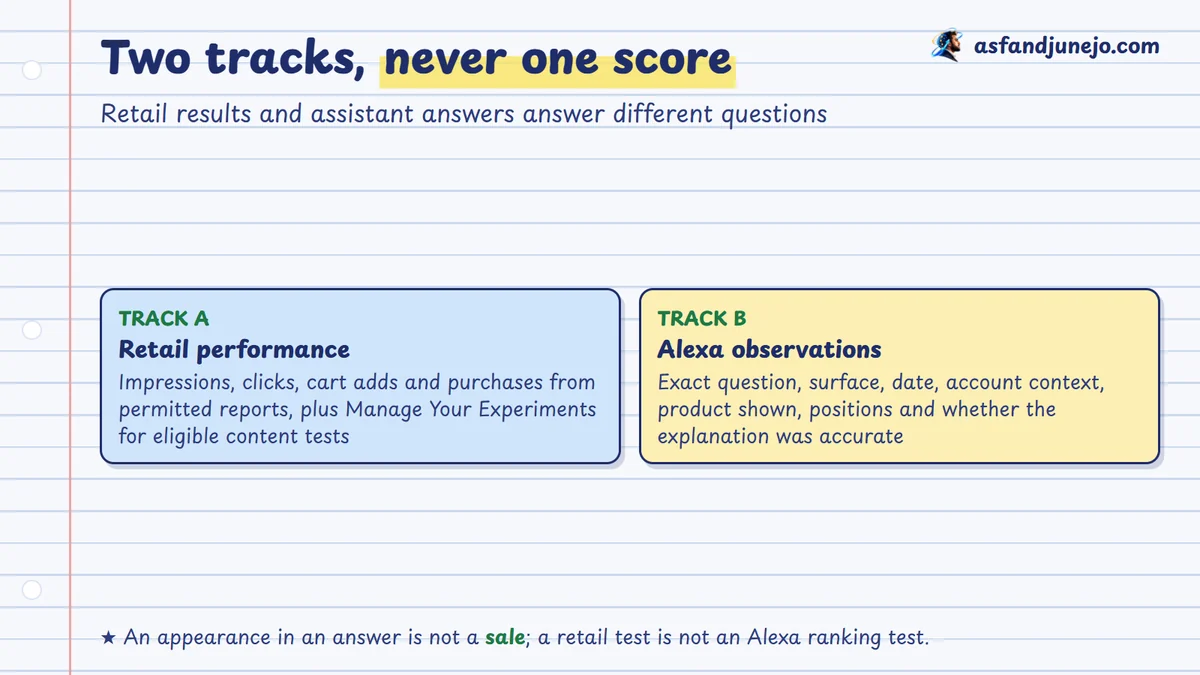
How Should Sellers Measure Retail Results and Alexa Recommendations?
Amazon retail performance and Alexa for Shopping observations should be measured separately. Marketplace reports can describe conventional search activity, customer interactions, and purchases. Assistant checks can document which products were displayed for selected questions and how they were explained. Neither measurement source independently establishes the entire commercial influence of AI-assisted shopping.
The first step is to define the intended outcome.
A factual correction aims to make the product information accurate.
A content experiment may aim to improve customer understanding or conversion.
An observational Alexa test may assess whether the assistant accurately presents a product for a particular shopping need.
These objectives should not be combined into one unexplained score.
Track A: Retail performance
Amazon Brand Analytics can help eligible sellers evaluate search impressions, clicks, cart additions, and purchasing activity.
Other available seller reports may provide information about returns, refunds, sales, and relevant business performance.
These measures should be interpreted according to their definitions.
A product with fewer purchases may be experiencing a pricing or availability issue rather than a listing copy issue.
An increase in conversions may coincide with promotions, seasonal demand, or changes in competition.
Financial evaluation may also require product costs, Amazon fees, advertising expenses, fulfillment costs, and refunds.
A higher number of sales does not automatically establish higher profitability.
Track B: Alexa observations
A reproducible assistant-observation protocol should specify the exact product and testing conditions.
For each observation, record:
- The exact shopping question.
- Marketplace and available interface information.
- Observation date.
- Account or personalization context where known.
- Product or ASIN included.
- Recommendation group and overall position where identifiable.
- Explanation presented.
- Relevant cited or supporting sources.
- Factual accuracy against product documentation.
- Any material limitation affecting comparability.
The test set should include both broad and constraint-specific questions.
For the Casio example, relevant research questions could include:
Does the Casio F-91W have an alarm?
What are its case dimensions?
Is it suitable for swimming?
Does its light support multiple colors?
These are proposed test questions.
They have not been executed as part of the case study.
An answer correctly explaining that a product does not meet a requirement should not automatically be classified as an optimization failure.
Accuracy matters independently of inclusion.
Repeat observations without manufacturing statistical certainty
A single response may differ from later responses because of personalization, pricing, availability, product updates, competition, or changes in the assistant.
Repeated observations can improve understanding of variability.
However, repeating a prompt several times does not automatically produce a representative estimate of all customer interactions.
The sampling method and conditions must remain visible.
Both positive and negative observations should be retained.
If a product appears in some responses but not in others, the report should describe the observed frequency in the actual sample rather than claim a universal recommendation share.
The general distinction is discussed in Ranking, Retrieval, and Citation: Why Measure Them Separately?.
For Amazon, the same discipline should be applied to product inclusion, recommendation grouping, and commercial outcomes without assuming those metrics are defined identically across platforms.
What Manage Your Experiments can establish
Amazon’s Manage Your Experiments (opens in a new tab) allows eligible brands to test different versions of selected listing content.
Amazon describes randomly dividing customers who view a product detail page into groups and reporting on supported outcomes such as units sold, sales, conversion, and sample size.
The tool requires the applicable selling and Brand Registry permissions, as well as eligible products.
This can provide stronger evidence about how customer-facing content performs.
It does not disclose Alexa’s recommendation formula or demonstrate that the winning variation in an experiment produces more AI-assisted visibility.
A retail experiment should begin with a testable hypothesis and compare accurate, policy-compliant alternatives.
It should not test whether misleading claims convert better than truthful ones.
Confirmed Amazon's Manage Your Experiments page says customers who view the detail page are randomly split into groups, lists units sold, sales and conversion among the reported metrics, and requires a Professional selling account and Brand Representative status for an enrolled brand (checked November 3, 2026)
Factual corrections should not wait for A/B tests
If a listing contains an unsupported compatibility or safety statement, the correct response is to verify and repair the information.
The seller should not leave misleading content visible merely to compare its conversion performance with a corrected version.
Experiments are appropriate for evaluating permissible presentation choices.
They are not a substitute for product accuracy.
Attribution is not causation
A product may appear in an Alexa answer and later receive additional sales.
That sequence does not independently establish that the assistant caused the increase.
The seller would need to examine alternative explanations and the available attribution evidence.
Similarly, an assistant recommendation may influence a customer who later purchases an ordinary search journey.
That influence may not be visible in standard retail reporting.
A responsible report should distinguish observed inclusion, measured customer interactions, commercial outcomes, and causal conclusions.
The evidence available for each may differ.
How Do Sellers Maintain Product Information as Amazon’s AI Shopping Experience Evolves?
Product information should be maintained through a documented process that connects source specifications, approved claims, catalog submissions, displayed values, and subsequent observations. A one-time listing rewrite cannot ensure lasting accuracy when manufacturers revise products, category requirements change, or several sellers contribute information to the same ASIN.
The maintenance process begins with ownership.
The product or technical owner should establish the factual specifications.
The appropriate compliance reviewer should evaluate consequential claims.
The catalog owner should manage authorized submissions.
The marketing team should translate approved information into useful customer-facing content.
The responsible reviewer should confirm what appears on the live product page.
The analytics team should evaluate outcomes within the limits of the available reports.
In a smaller business, one person may hold several responsibilities.
The important requirement is that the responsibilities remain explicit.
Maintain a source-of-truth register
Each material product fact should have an identifiable source and applicable version.
When a product changes, the associated claims should be reviewed.
A revised model may introduce different compatibility.
Packaging changes may alter included components.
A manufacturer instruction update may affect a usage limitation.
A material change may require correction of an attribute or image.
The seller should not update these claims independently across several assets without checking the authoritative product information.
Track catalog corrections through completion
A useful change record distinguishes the following states:
Proposed: A possible issue has been identified.
Verified: The product fact has been approved.
Submitted: The correction has been sent through an authorized catalog process.
Displayed: The customer-facing page has been checked, and the value is visible.
Unresolved: The submitted and displayed information do not agree, or the necessary evidence remains unavailable.
Recheck required: A material change triggers renewed verification.
These statuses prevent a common reporting error: presenting a successful submission as proof that the customer-facing page has been corrected.
Revalidate when facts or policies change
Relevant review triggers include changes to manufacturer specifications, product models, packaging, compatibility, regulatory conditions, or Amazon marketplace requirements.
Customer feedback may also identify a new issue.
Repeated assistant observations that materially misrepresent a product may justify investigating the available source information.
However, a change in Alexa placement does not automatically mean the product listing is inaccurate.
The team should first establish what actually changed.
Maintain independent measurement records
Catalog quality, conventional retail performance, and Alexa observations should remain distinct.
This allows the business to determine whether a correction was implemented successfully even when no immediate sales effect can be established.
It also prevents speculative claims about optimization from becoming accepted internal knowledge.
An audit may conclude that no change is necessary.
That decision can be correct when the information is already accurate, the product does not satisfy a particular use case, or the proposed change lacks sufficient evidence.
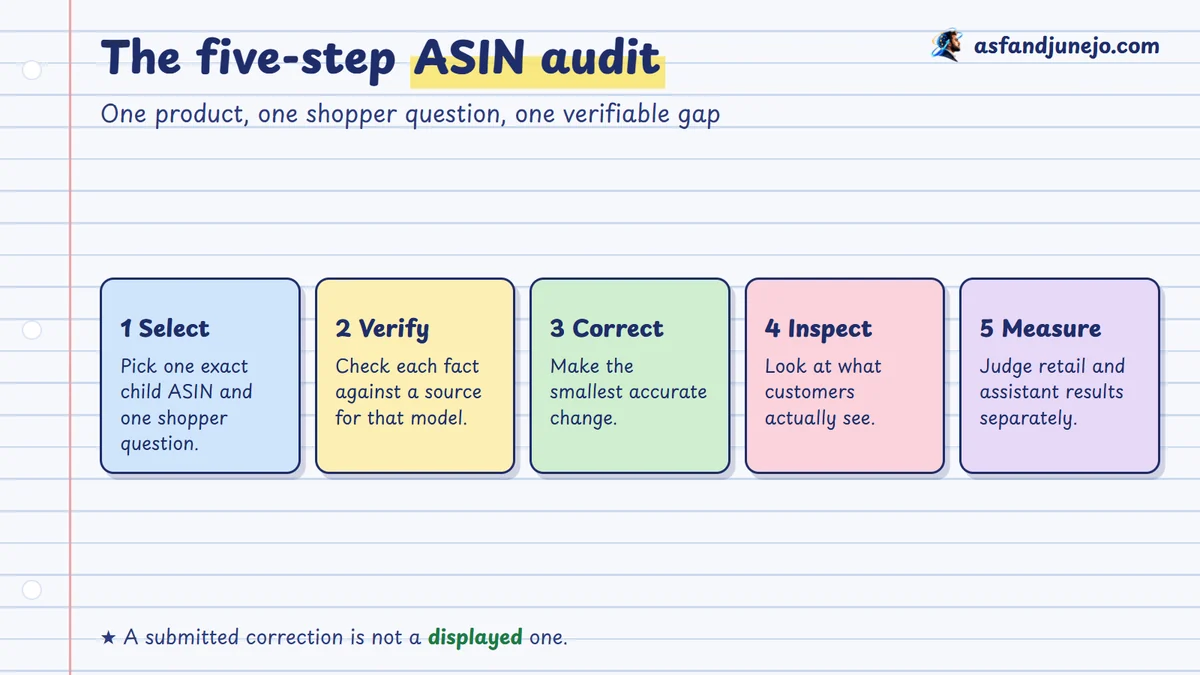
A practical one-ASIN operating cycle
A seller can begin with a single product.
Identify one meaningful shopping requirement.
Establish which exact product variation is involved.
Verify the relevant facts.
Compare those facts with the customer-facing listing.
Select the smallest appropriate correction.
Submit it through the applicable process.
Inspect the displayed result.
Then evaluate any relevant retail or assistant observations separately.
This creates a repeatable process without assuming that every listing requires complete rewriting.
Is there a free tool to run this audit?
Yes. The free Amazon listing gap auditor runs the audit in this guide in your browser: you paste the displayed listing, register your source evidence, classify each gap, track each correction from proposed to displayed, log assistant answers in a separate step and export a report. Nothing is uploaded, and it gives no score or ranking prediction.
- It classifies each finding as accurate, missing, ambiguous, conflicting, unsupported, outdated or not applicable, and keeps the evidence linked to the finding.
- It cross-checks listed lengths, weights and volumes against your sources, converting units and allowing for rounding, and flags a figure that matches nothing as "not found" rather than as an error.
- It checks a title against Amazon's published title rules and flags superlative or approval wording for evidence.
- It asks for the date you checked the customer-facing page before it accepts a correction as Displayed.
- It loads the Casio F-91W example from this guide so you can see a finished audit.
Open the Amazon listing gap auditor →
Directional A review aid that cannot see the live Amazon page, Seller Central or Alexa for Shopping; a clean report does not establish ranking, recommendation or sales
Where can you get the Alexa for Shopping listing audit kit?
Join Search Signals with your email and three files unlock on this page straight away: the Listing Audit Kit (ZIP), the 12-sheet ASIN evidence workbook (Excel) and the evidence field guide (PDF).
The ZIP holds the workbook, the eight-page field guide, a one-page printable one-ASIN canvas, an offline copy of the auditor, and the Casio F-91W sample audit as JSON and CSV.
- Alexa for Shopping Listing Audit Kit (ZIP)Workbook, field guide, canvas, offline auditor, Casio sample files, read-me and checksums
- ASIN Evidence WorkbookExcel workbook, 12 sheets
- Evidence Field GuidePDF, 8 pages
Directional Templates and a public-source example, not legal advice and not a guarantee of any ranking, recommendation or sales outcome
Frequently Asked Questions
Is Amazon Rufus now called Alexa for Shopping?
Yes. Amazon renamed Rufus to Alexa for Shopping on May 13, 2026. The experience has continued to expand, with more than 100 additional shopping and account-management capabilities announced in October 2026.
Does Amazon disclose how Alexa selects products?
Amazon has disclosed examples of product-search matching and ranking inputs, including product information and customer actions, and previously described Rufus’s retrieval architecture. It has not established a complete current seller-facing formula for every Alexa for Shopping recommendation.
Does Alexa require a minimum four-star rating?
No universal four-star recommendation cutoff was established in the official Amazon guidance reviewed. Sellers should not treat a rumored threshold as an official ranking rule.
Should sellers optimize product bullets for conversational prompts?
Bullets should answer meaningful customer questions using verified product facts. Repeating generated prompts or inserting unsupported use-case claims does not establish better Alexa visibility.
Does Amazon use product information outside titles and bullets?
Amazon’s historical Rufus explanation identified catalog information, reviews, community questions and answers and Stores APIs, and said the model was built with public web information. The current weighting and selection rules for each source are not fully disclosed.
Can a seller control every field on an ASIN detail page?
Not necessarily. Amazon describes product detail pages as shared spaces and determines which contributed information appears to customers. A seller should verify the displayed result after submitting an update.
Are backend keywords an Alexa recommendation factor?
Amazon documents backend search terms as part of conventional product keyword optimization. The reviewed public guidance does not establish them as a guaranteed shortcut to an Alexa recommendation.
Can A+ Content include comparisons with competing brands?
Amazon’s A+ Content rules restrict certain competitor comparisons and other promotional content. Sellers should review the applicable guidelines before creating comparison modules.
Can Manage Your Experiments measure Alexa ranking improvements?
Not directly. The tool measures supported retail outcomes from eligible content experiments. It is not documented as a test of Alexa’s recommendation algorithm.
Does the Casio case prove the Amazon listing is incorrect?
No. The audit identifies several information fields requiring clarification or verification. Some measurements are broadly consistent, while other fields have unresolved definitions or unsupported specificity in the accessible evidence.
How often should sellers review product information?
Review frequency should reflect product complexity and risk. Important changes to specifications, packaging, compatibility, marketplace requirements, or customer feedback should trigger additional verification.
Optimize Product Truth Before Its Presentation
Alexa for Shopping has changed how customers can investigate, compare, and act on product information.
But conversational discovery does not eliminate the need for accurate specifications, clear product identities, meaningful restrictions, and trustworthy customer expectations.
Amazon has disclosed some of the inputs relevant to product search and explained important aspects of its shopping AI architecture.
Those disclosures should inform responsible investigation.
They should not be transformed into unsupported guarantees about the effect of a specific bullet, keyword, rating, or content format.
The ReFiBuy study provides useful observational evidence about product explanations and recommendation groups.
The Casio F-91W case demonstrates how actual product specifications can be compared with marketplace information and why apparent differences require careful classification.
Together, these examples support a practical operating principle.
Start with the product’s verified capabilities. Identify the shopper’s actual requirement. Make the relevant information clear. Confirm what Amazon displays. Measure any subsequent outcome according to the evidence available.
Sometimes the correct action is updating a product attribute.
Sometimes it is clarifying an image or package description.
Sometimes it is correcting a misleading claim.
And sometimes the correct decision is not to change the listing at all.
The purpose of optimization is not to convince Amazon’s assistant that an unsuitable product is appropriate.
It is to ensure that a product’s real capabilities and limitations are accurately represented wherever customers evaluate it.
A smaller collection of reliable, maintained product facts is more valuable than a large collection of unsupported AI optimization claims.
The most defensible starting point is one exact ASIN, one meaningful shopping question, and one verifiable information gap.
For a broader look at how search and AI systems should be evaluated without confusing visibility with commercial outcomes, read how results are recorded in the measurement method.
Research Methodology and Disclosure
This article combines Amazon’s official platform documentation, its March 2025 EU Digital Markets Act compliance disclosure, Amazon Science’s historical Rufus explanation, published seller guidance, third-party observational research, and an independent public-source product-information audit.
The Casio F-91W case compares manufacturer specifications against an accessible Amazon.com listing snapshot associated with ASIN B000GAWSDG.
The Amazon snapshot was approximately three months old when reviewed on November 3, 2026. The exact snapshot capture date was not established.
No authenticated Seller Central inspection, product test, catalog correction, Alexa prompt test, or commercial experiment was performed for the reviewed ASIN.
The findings should therefore be understood as a documented public-source audit, not a verified live listing intervention or an experimental performance study.
The ReFiBuy study is vendor-produced research based on the use of designed shopping prompts. Its results describe observed responses within its methodology and should not be generalized to Amazon’s undisclosed ranking weights.
Editorial recommendations are distinguished from verified platform requirements and measured outcomes.
Primary sources and references
Opened and read on November 3, 2026: Amazon's Alexa for Shopping announcement and user guide, the DMA compliance report, the Amazon Science article, Brand Analytics, Manage Your Experiments, the FTC page and both parts of the ReFiBuy study. Not opened: the Casio pages (they returned access errors to automated checks), the Amazon product page, and every Seller Central page and forum thread (seller login required). The Amazon SEO and keyword research guides were not re-read for this check. Statements about those sources are reported from the research behind this guide.
- Amazon: Generative and agentic AI in shopping (opens in a new tab)
- Amazon: Alexa for Shopping adds 100+ new capabilities (October 2026, undated page) (opens in a new tab)
- Amazon: How to use Alexa for Shopping (opens in a new tab)
- Amazon: Amazon SEO guide (opens in a new tab)
- Amazon: DMA compliance report 2025, Annex 1 (March 6, 2025) (opens in a new tab)
- Amazon Science: The technology behind Amazon's GenAI-powered shopping assistant, Rufus (October 4, 2024) (opens in a new tab)
- FTC: Consumer Reviews and Testimonials Rule, questions and answers (opens in a new tab)
- Amazon: Brand Analytics (opens in a new tab)
- Amazon Seller Forums: product title requirements thread (seller login) (opens in a new tab)
- Amazon Seller Central: Product title requirements and guidelines (seller login) (opens in a new tab)
- Amazon Seller Central: A+ Content guidelines (seller login) (opens in a new tab)
- Amazon: Keyword research (opens in a new tab)
- Amazon Seller Central: Product detail-page guidance (seller login) (opens in a new tab)
- Amazon Seller Central: Suggesting changes to product detail pages (seller login) (opens in a new tab)
- Andrew Bell, ReFiBuy: 100K Alexa for Shopping Prompt Study, Part 1 (September 30, 2026) (opens in a new tab)
- RetailPlaybook: 100K Alexa for Shopping Prompt Study, Part 2 (October 7, 2026) (opens in a new tab)
- Casio: F-91W-1 product specifications (opens in a new tab)
- Amazon.com: Casio F-91W, ASIN B000GAWSDG (the live page may differ from the reviewed snapshot) (opens in a new tab)
- Casio: F-91W series overview (opens in a new tab)
- Amazon: Manage Your Experiments (opens in a new tab)