Programmatic SEO at scale involves creating and maintaining search-focused pages through structured datasets, reusable templates, and automated publishing systems. Its effectiveness depends on whether those pages serve distinct user needs, contain reliable information, and remain technically accessible as the website grows.
Published · Sources checked · By Asfand Yar Junejo, publisher asfandjunejo.com
The challenge is not generating thousands of URLs. It is ensuring that every published page has a legitimate purpose, accurate supporting data, appropriate indexing instructions, and an accountable owner.
A single template error can affect an entire page family. Incorrect canonical annotations may link unrelated pages, missing database values can lead to misleading claims, and poorly controlled filters can generate unnecessary crawlable URLs.
These failures become harder to manage when publication volume replaces evidence-based review.
Google does not prohibit programmatic SEO, templates, or AI-assisted content creation. Its spam policies (opens in a new tab) address practices that manipulate rankings while providing little or no value to users.
Confirmed Google's spam policies describe scaled content abuse as many pages generated mainly to manipulate search rankings, and say automation or generative AI is not prohibited by itself. The page states no publication date (checked November 10, 2026)
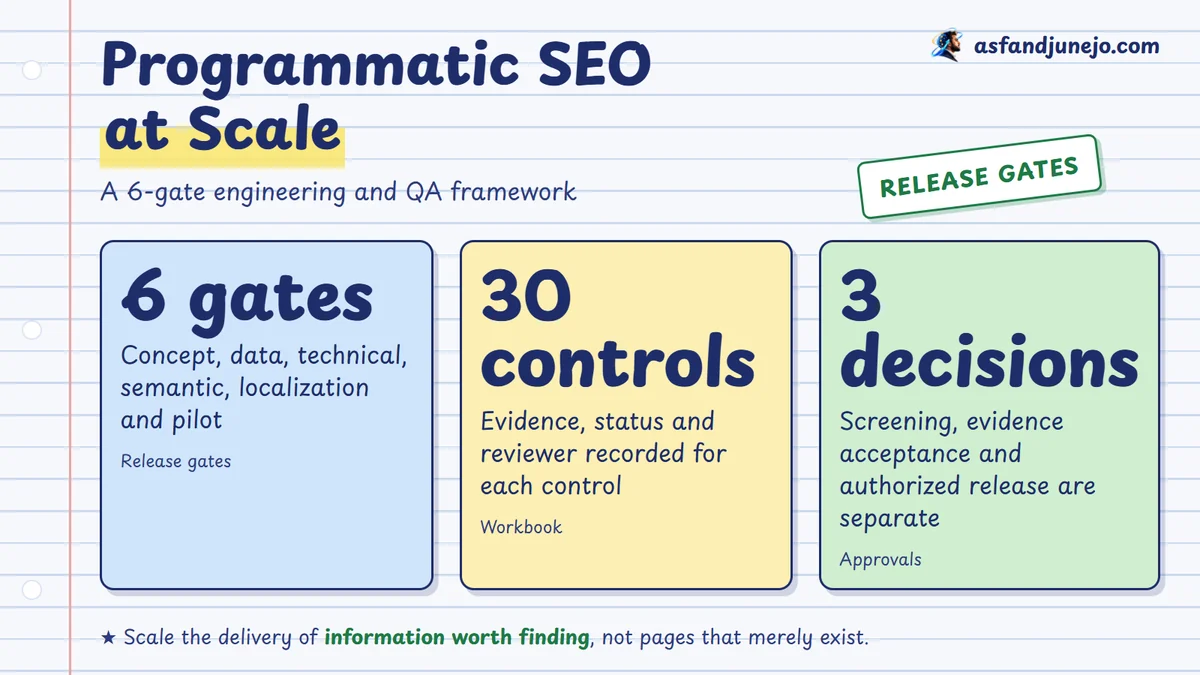
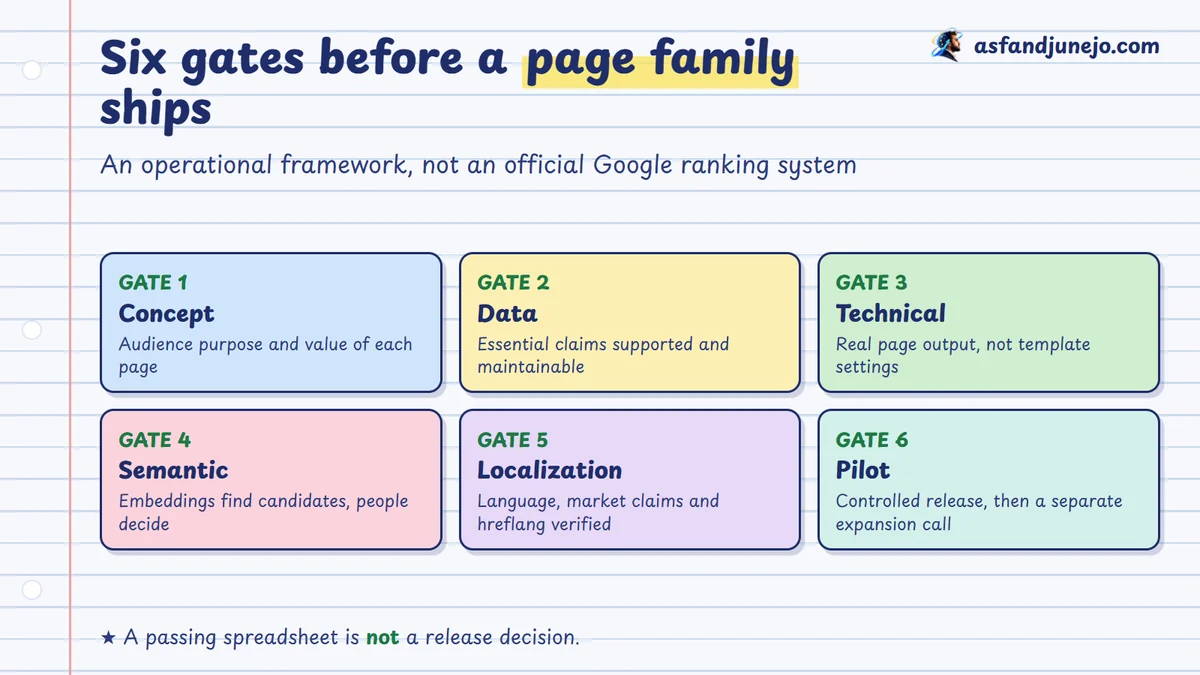
The engineering-led approach introduced here uses six release gates covering audience intent, data eligibility, technical delivery, semantic relationships, localization, and controlled deployment.
These gates are an operational framework, not an official Google ranking system.
The accompanying Programmatic SEO Release-Gate Workbook helps teams document evidence, identify failures, and distinguish preliminary screening from authorized publication decisions.
The objective is straightforward: create a repeatable system that can explain why a page should exist, what supports its claims, and whether it remains useful after publication.
The 11-tab release-gate workbook behind this framework is free for Search Signals subscribers.
What are the key takeaways?
Programmatic SEO is not prohibited, but every generated page needs a reason to exist, supporting evidence, correct technical delivery and an accountable owner. Use six release gates, pilot before you scale, and keep screening, evidence acceptance and release authorization as separate decisions.
- A database record is not an indexable page: define a data contract with essential, conditional, optional and governance fields.
- Scaled content abuse, doorway abuse and ordinary duplicates are different problems with different fixes.
- Test the actual page output, including rendering, canonicals, structured data and crawler access, not only the template.
- Embedding similarity finds candidates for review. It never decides consolidation, canonicals or internal links alone.
- Pilot first, measure technical, search, audience and commercial results separately, then expand, improve and retest, or stop.
When Does a Programmatic Page Family Deserve to Exist?
A programmatic page family deserves to exist when its individual URLs address distinguishable user tasks using accurate information or functionality that a consolidated page cannot provide as effectively. Search volume and keyword variations may reveal opportunities, but they do not, on their own, justify creating separate pages.
Consider a software company maintaining records for 300 potential integrations.
A template could generate pages titled [Software] Integration With [Application]. However, some records may describe native integrations, others may require third-party connectors, and several may represent unsupported capabilities.
Publishing every record would turn database availability into a public claim of functionality.
A useful integration page should explain verified capabilities, configuration requirements, technical restrictions, and supported actions. If those details are unavailable, the record should not automatically be marked as an indexable page.
The same principle applies to regional service pages. Changing a city name does not create meaningful local value unless the page explains the availability of relevant services, operational conditions, or location-specific requirements.
Before creating another URL, determine whether an existing resource already satisfies the user’s task.
A consolidated comparison may be more useful than several overlapping pages. A dedicated page becomes appropriate when the underlying information supports a materially different decision.
Proprietary data is not mandatory. Original testing, useful calculations, expert analysis, and well-organized public information can also create value.
Google’s people-first content guidance (opens in a new tab) emphasizes usefulness and original value rather than a particular production method.
Release Gate 1: Approve the page concept only when its audience purpose, informational value, and relationship to existing pages can be justified.
When Does Programmatic SEO Become Scaled Content Abuse or Doorway Abuse?
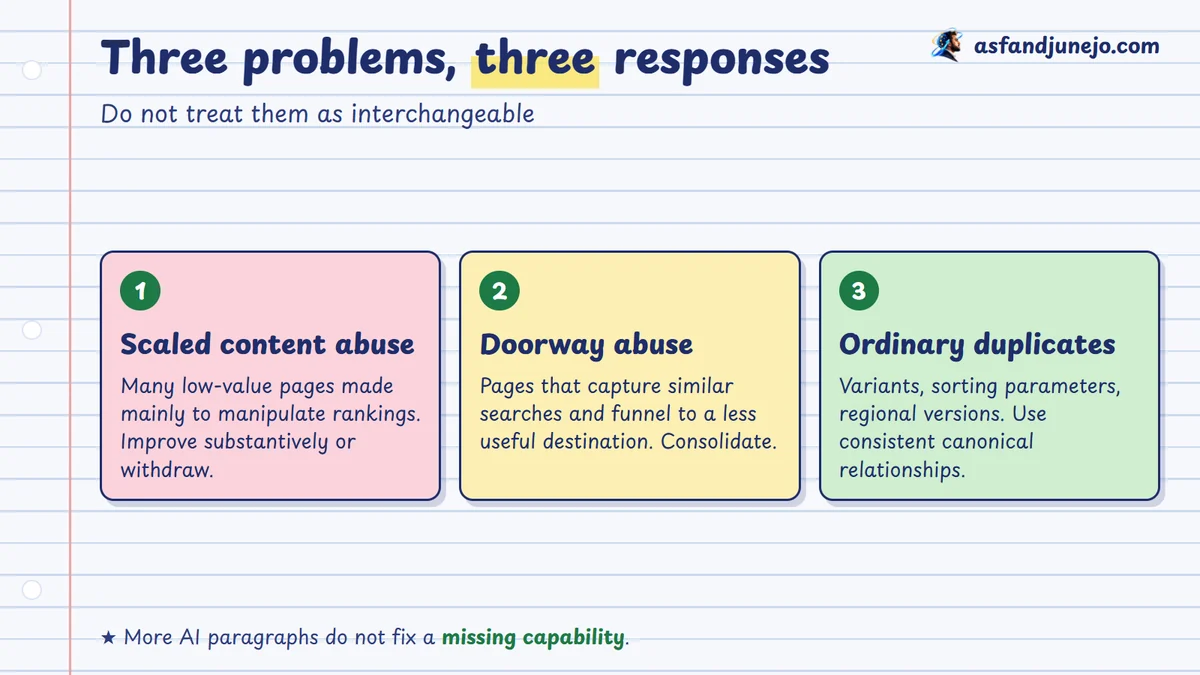
Programmatic SEO becomes a search-policy risk when numerous pages are created primarily to manipulate rankings rather than provide meaningful value. Google distinguishes scaled content abuse, doorway abuse, and ordinary duplicate content. These categories should not be treated as interchangeable.
Scaled content abuse concerns the production of many low-value pages, primarily for search manipulation, regardless of whether AI, conventional automation, or human writers created them.
Doorway abuse involves pages designed to capture similar searches while functioning as unnecessary intermediate destinations.
For example, a national service provider may legitimately publish regional pages, each explaining verified coverage, relevant local requirements, and distinct customer considerations.
Creating hundreds of near-identical city pages that offer no meaningful local information presents a different risk.
However, sharing a contact form or reusable template does not automatically establish doorway abuse.
The distinction depends on the pages’ purpose and independent usefulness.
Duplicate content requires separate consideration. Product variants, sorting parameters, and regional versions may legitimately produce similar URLs. Google generally attempts to identify an appropriate canonical rather than treating ordinary duplication as a spam violation.
The engineering response should therefore match the underlying issue.
Low-value generated content may require substantive improvement or withdrawal. Unnecessary doorway-style pages may warrant consolidation. Legitimate duplicate URLs may need consistent canonical relationships.
Adding more AI-generated paragraphs does not resolve missing product capabilities, unsupported regional claims, or indistinguishable audience tasks.
Google’s Search spam policies (opens in a new tab) provide the governing definitions.
Release Gate 1 also prevents policy risk: The review must establish meaningful page utility before technical optimization or publication begins.
How Should Data Contracts Determine Page Eligibility?
A data contract establishes the information required to support a generated page, identifies its authoritative sources, and defines the conditions under which that page may be published or updated. A database record should not automatically become an indexable URL.
Consider an integration record containing an application name, description, authentication method, supported actions, and implementation documentation.
The application name alone cannot substantiate a claim that an integration is available.
Authentication requirements and supported actions may be essential to the page’s purpose, while screenshots or supplementary examples may be optional.
The contract must distinguish these fields.
| Field | Classification | Required action |
|---|---|---|
| Integration capability | Essential | Verify before publication |
| Supported actions | Essential | Confirm against product documentation |
| Authentication method | Conditional | Include when relevant and verified |
| Screenshot | Optional | Omit when unavailable |
| Last verification date | Governance | Record and maintain |
Missing information should not be interpreted automatically as a negative finding.
An empty authentication field may indicate missing documentation rather than unsupported functionality. AI-generated text must not invent an explanation to complete the template.
Each consequential field should also have a source, a responsible owner, a relevant verification date, and a review trigger.
When product capabilities change, affected pages should be reassessed rather than continuing to publish outdated statements.
This approach aligns with the distinction between automation and human verification discussed in AI in SEO: What to Automate, What to Verify, and What to Keep Human.
Release Gate 2: A page becomes eligible for publication only when its essential claims are supported, its required fields are valid, and its information can be maintained.
Which URL Lifecycle States Should a Programmatic SEO System Support?
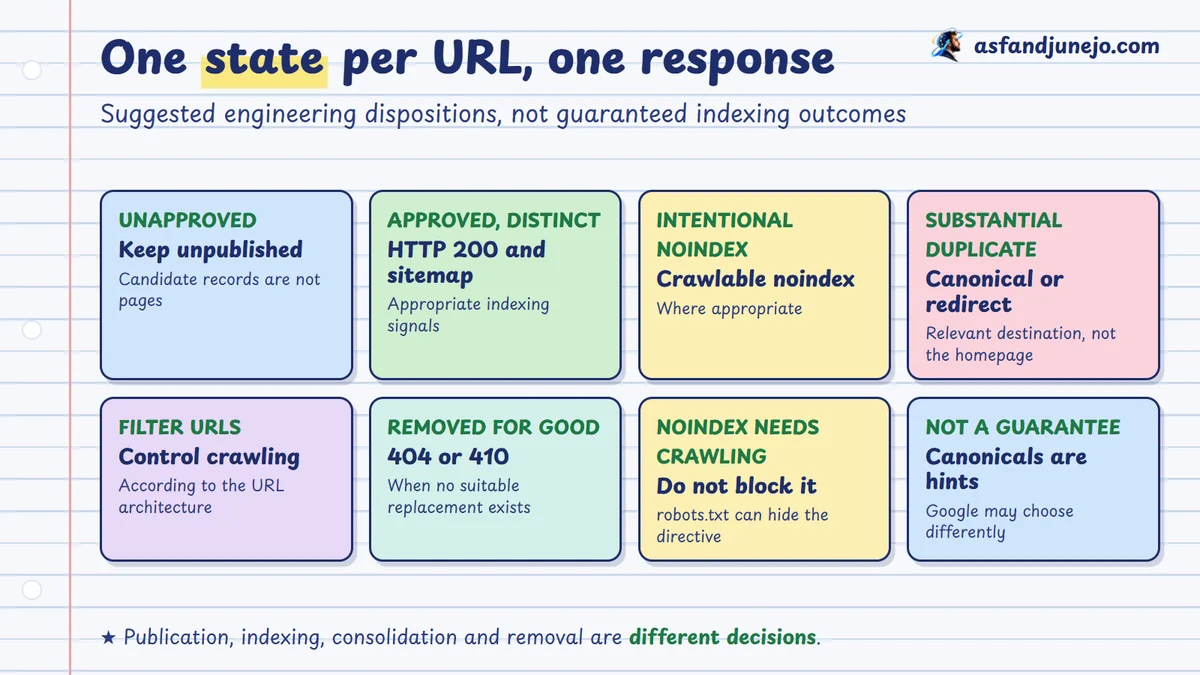
A programmatic SEO system should assign URL states according to content validity, search eligibility, duplication, and resource availability. Publication, indexing, consolidation, and removal are distinct decisions that require different technical responses.
A useful lifecycle model distinguishes the following conditions:
| Record condition | Appropriate treatment |
|---|---|
| Unapproved candidate | Keep unpublished |
| Approved, distinct page | HTTP 200, appropriate indexing signals, and sitemap inclusion |
| Public page intentionally excluded from indexing | Crawlable noindex, where appropriate |
| Substantially duplicate URL | Relevant canonical relationship or redirect |
| Unnecessary long-term filter URL | Control crawling according to the URL architecture |
| Permanently removed resource | HTTP 404 or 410 when no suitable replacement exists |
These are suggested engineering dispositions, not guaranteed indexing outcomes.
A noindex directive requires crawler access to be observed. Blocking the same URL through robots.txt can prevent Google from reading that directive.
Canonical annotations communicate preferred URLs but do not guarantee canonical selection.
Permanent redirects should lead to genuinely relevant replacements rather than arbitrary homepage destinations.
Temporary product unavailability also requires judgment. An out-of-stock product page may remain useful when it contains specifications, accurate availability information, and relevant alternatives.
It should not automatically be removed from search consideration.
Google’s canonicalization guidance (opens in a new tab) and robots meta tag documentation (opens in a new tab) explain the applicable distinctions.
Lifecycle transitions should record their reason, supporting evidence, responsible owner, and affected URLs.
A published page must also be reconsidered when its underlying information changes.
Release Gate 2 establishes eligibility. Release Gate 3 verifies that the selected technical URL state is implemented correctly.
What Technical SEO Checks Should Block a Programmatic Release?
Technical release QA should verify the actual page output, not merely the template configuration. A generated page must return an appropriate response, reliably expose its central information, and maintain consistent indexing, navigation, and structured data signals.
Consider a product template that successfully renders ordinary records but fails when compatibility tables become unusually large.
The URL may return HTTP 200 while its main content remains empty after an API timeout.
Testing one successful page would not reveal the defect.
A representative technical review should examine several conditions.
Rendering: Compare initial HTML with the rendered DOM. Confirm that essential content, links, canonical annotations, and indexing instructions remain available. Google documents JavaScript rendering as part of its crawl-render-index process (opens in a new tab).
Faceted navigation: Determine which filter combinations deserve independent URLs. Unnecessary parameters can multiply crawlable inventory without creating corresponding user value.
Structured data: Verify that markup describes visible information. Empty fields must not generate fabricated prices, ratings, or product capabilities.
Performance: Assess relevant templates against Google’s Core Web Vitals thresholds: LCP of 2.5 seconds or less, INP of 200 milliseconds or less, and CLS of 0.1 or less, using appropriate field-data measurements.
Crawler access: Verify actual delivery conditions where possible. Googlebot, OAI-SearchBot, and GPTBot have different documented purposes and should not be treated as interchangeable.
Google’s AI search guidance (opens in a new tab) does not require special AI schema or llms.txt for AI Overviews and AI Mode.
Technical validation establishes eligibility under tested conditions, not guaranteed indexing or citations.
Release Gate 3: Block deployment when consequential rendering, delivery, indexing, or content-representation failures remain unresolved.
How Can Semantic Embeddings Improve Deduplication and Internal Linking?
Semantic embeddings can identify potentially redundant pages and suggest relevant internal-link candidates, but similarity scores cannot independently determine search intent, canonical decisions, or ranking potential. Their proper function is candidate discovery followed by evidence-based review.
The all-MiniLM-L6-v2 model converts text into 384-dimensional vectors for semantic comparison. Its default processing truncates inputs beyond 256 word pieces, making deliberate passage selection important.
Confirmed The model card says it maps sentences and paragraphs to a 384-dimensional vector space and that input longer than 256 word pieces is truncated by default (checked November 10, 2026)
For programmatic SEO, two distinct applications are useful.
Defensive application: Sibling-page review.
Suppose two integration pages contain nearly identical descriptions. An embedding model may flag them as similar.
However, one integration may support bidirectional synchronization while the other supports only one-way data transfer.
The pages may deserve separate treatment despite their semantic similarity.
Reviewers must examine actual capabilities and audience tasks before deciding whether consolidation is appropriate.
Constructive application: Internal-link discovery.
A technical audit article may naturally link to a guide explaining faceted navigation, even when their overall text similarity is moderate.
That relationship is valuable because the destination answers a relevant follow-up question.
The linking process should therefore consider task progression, topical relevance, destination eligibility, and site architecture separately.
Google recommends crawlable <a href> links with descriptive anchor text. It does not prescribe a universal similarity threshold or number of internal links.
Automated recommendations should exclude invalid destinations and remain reviewable as page states change.
The model documentation (opens in a new tab) supports semantic similarity applications, not claims about guaranteed SEO performance.
Release Gate 4: Use semantic models to prioritize review, then authorize consolidation and internal links according to genuine page relationships and reader value.
How Should Multilingual and Regional Programmatic Pages Be Validated?
Multilingual programmatic pages should be published only when their language, market-specific claims, technical relationships, and maintenance requirements have been verified. Translating a template does not automatically create a useful regional page.
Consider a software company offering services in the United States, United Kingdom, and France.
Its core functionality may remain consistent, but pricing, contractual terms, support arrangements, and product availability may differ. A technically accurate translation can still mislead customers when these commercial differences are ignored.
A localization review must therefore examine both visible content and underlying market data.
For example, the three markets may require different treatments:
| Market | Language | Verification priority |
|---|---|---|
| United States | en-US | Product availability and US-specific terms |
| United Kingdom | en-GB | Local pricing, terminology, and support |
| France | fr-FR | French-language content and market-specific conditions |
Google recommends distinct URLs for appropriate language or regional alternatives and supports reciprocal hreflang annotations (opens in a new tab). Each cluster should reference its intended alternatives, including the current version. Canonical signals must also remain consistent with the actual relationship between pages.
For example, an eligible French-language product page should not automatically canonicalize to its English equivalent merely because both use the same template.
Likewise, identical regional pages should not be published separately without evaluating their independent usefulness.
Language selectors must allow visitors to access available versions without forced redirects that hide alternatives.
Release Gate 5: Approve localized pages only when their visible information, commercial applicability, canonical relationships, and language alternatives are accurate and maintainable.
How Do You Pilot a Programmatic Page Family Before Scaling?
A programmatic SEO pilot should validate representative records, technical behavior, and operational controls before authorizing the generation of additional pages. It should include normal records and likely failure conditions rather than selecting only pages expected to succeed.
A responsible pilot follows three distinct stages.
Stage 1: Pre-release validation
Select a representative sample containing complete records, missing optional fields, similar sibling pages, complex data structures, and relevant localized variants.
Verify evidence quality, intended search tasks, rendering, canonicals, internal links, and applicable technical requirements.
A failed essential control prevents publication until resolved.
Stage 2: Controlled publication
Publish only records that have passed the required pre-release checks and received authorized approval.
Document the released URLs, deployment date, template version, data sources, and rollback conditions.
The release must serve legitimate content consistently to visitors and search crawlers. Google’s website-testing guidance (opens in a new tab) specifically warns against cloaking and recommends appropriate handling of canonical and temporary redirects for experiments.
Stage 3: Post-release evaluation
Monitor indexing, search visibility, technical failures, user behavior, and relevant business outcomes over an appropriate observation period.
Where feasible, compare similar page groups while documenting concurrent changes and potential spillover.
A technically successful release does not establish that every page will be indexed or commercially valuable.
The pilot should conclude with one of three decisions: expand, improve and retest, or stop.
Release Gate 6 distinguishes two approvals: Pre-release evidence can authorize a controlled pilot; expansion requires documented pilot observations and a separate investment decision.
This distinction is essential because search performance cannot be verified before a page becomes publicly discoverable.
How Does the Six-Gate Workbook Evaluate Programmatic SEO Releases?
The release-gate workbook organizes evidence and review decisions across 30 controls in six gates, but populated fields and passing formulas cannot independently prove that a page is ready for publication. An authorized reviewer must evaluate evidence.
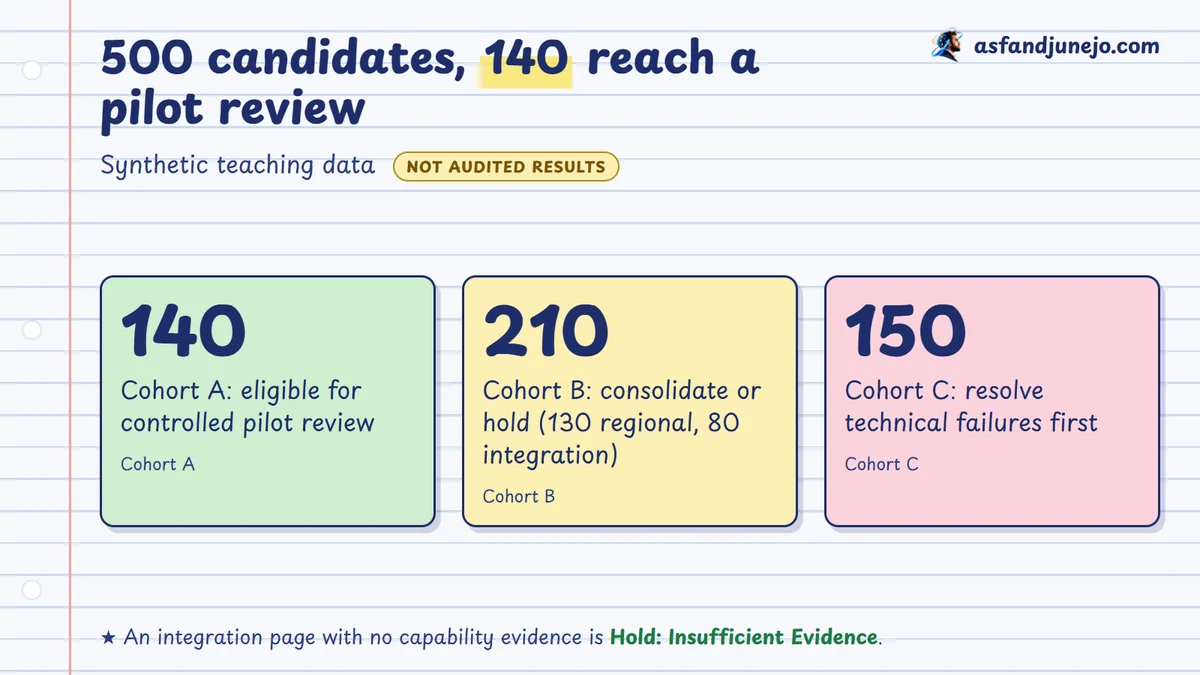
Consider a hypothetical B2B company preparing 500 candidate pages: 300 software integrations and 200 regional service pages.
Its initial assessment produces three groups.
| Cohort | URLs | Preliminary disposition |
|---|---|---|
| A | 140 | Eligible for controlled pilot review |
| B | 210 | Consolidate or hold |
| C | 150 | Resolve technical failures |
These figures are synthetic teaching data, not audited client results.
Within Cohort B, 130 regional records lack meaningful differentiation, while 80 integration records require stronger evidence of capability.
Cohort C contains rendering and delivery defects that must be corrected before release.
Now consider an individual integration page.
Its title, canonical, and rendered content are technically valid, but its database record lacks evidence confirming the advertised capability.
The appropriate result is Hold: Insufficient Evidence, not approval.
The workbook should distinguish three outcomes: preliminary screening, evidence acceptance, and authorized release.
A blank Core Web Vitals measurement must not count as a pass. Placeholder evidence must not authorize publication. Semantic similarity scores must not automatically trigger consolidation.
Version 2.0 of the workbook builds in those corrections. The dashboard cannot authorize a full-scale release from populated statuses, and pilot approval and expansion approval are separate steps. A control counts as accepted only with a confidence level, an evidence reference, recorded acceptance, a named reviewer and a review date. A blank Core Web Vitals value is marked Not Tested, and lab-only data is marked as not field-verified.
Even so, it remains a review and planning workbook. It can check that fields are complete and consistent. It cannot confirm that a linked document is genuine or that a reviewer is authorized to approve the release.
Directional The workbook's release notes (version 2.0, QA correction dated November 10, 2026) list the corrections. A spreadsheet can check that fields are complete, not that evidence is genuine or that a reviewer has authority
A valid release decision requires substantiated evidence, appropriate reviewer authorization, and a recorded disposition, not merely completed spreadsheet cells.
Which SEO, AI Visibility, and Business Metrics Matter After Launch?
Programmatic SEO performance should be evaluated through separate technical, search, audience, and commercial measurements. Indexing, impressions, AI citations, conversions, and revenue represent different events and should not be combined into a single success score.
Technical monitoring verifies that released pages remain accessible, render correctly, and maintain their intended canonical relationships.
Google Search Console provides indexing information and search performance observations, including relevant queries, impressions, clicks, and average position.
However, indexed pages are not necessarily useful or commercially successful.
Google’s Generative AI Performance report separately provides impressions for supported AI Overviews and AI Mode experiences. Those impressions are already included in overall Web performance totals and must not be added again.
Confirmed Google's launch post (opens in a new tab) (June 3, 2026) says the report shows impressions in generative AI features and that the data is included in the overall performance report. A note on the post says it reached all websites on August 31, 2026 (checked November 10, 2026)
The report may be unavailable when a site has insufficient generative AI impressions. Its newest data may also be preliminary, and chart totals may differ from page-level tables due to aggregation.
Bing Webmaster Tools measures citation activity across supported Microsoft AI experiences. Its citation counts do not represent clicks, rankings, or revenue, and the data is aggregated rather than a complete log of every AI interaction.
Directional Industry coverage describes Bing's AI Performance report as a public preview from February 2026 that counts citations in Copilot and Bing AI summaries and has no click data. I did not open Microsoft's own documentation, so treat the scope details as unconfirmed (checked November 10, 2026)
Business measurement requires separate evidence from analytics, backend systems, and CRM records.
A form click is not necessarily a completed inquiry, and a completed inquiry is not automatically a qualified opportunity.
Where possible, compare the pilot and control groups while documenting concurrent campaigns, technical releases, and internal link changes.
Release Gate 6: Evaluate technical reliability, search exposure, audience behavior, and commercial outcomes independently before recommending further investment.
When Should You Scale, Improve, Consolidate, or Stop a Page Family?
A programmatic page family should expand only when its usefulness, technical reliability, data quality, and ongoing business justification support additional investment. More indexed pages or higher impressions do not, on their own, justify scaling.
The decision should be based on the evidence collected during the pilot.
Scale: Expand when representative records consistently pass the required controls, the publishing process is stable, and the pilot provides sufficient support for additional investment. New templates or markets may still require fresh validation.
Improve and retest: Correct specific implementation failures when the underlying page concept remains valuable. Rendering defects, incomplete source data, or inconsistent canonical signals may be repairable without abandoning the family.
Consolidate: Merge records when multiple URLs provide substantially overlapping answers and a smaller structure would serve visitors more effectively. Preserve useful information, internal navigation, and relevant redirect relationships.
Stop or defer: Suspend expansion when essential evidence remains unavailable, audience differentiation is insufficient, or operational costs cannot be justified.
Maintenance economics deserve particular attention.
A page family may attract organic traffic while requiring expensive data subscriptions, technical updates, manual verification, and customer-support resources.
Its business contribution should therefore be assessed against the cost of maintaining the information’s accuracy and accessibility.
A high-value enterprise page may justify maintenance despite limited traffic. A high-impression page family may be unattractive when it produces little useful engagement or commercial value.
No universal revenue-per-page threshold can determine the correct decision.
The scaling decision should explain what was observed, which assumptions remain uncertain, and why the next investment is justified.
Who Owns Programmatic SEO Quality After Publication?
Programmatic SEO requires continuous ownership because the information and technical conditions supporting a published page can change without the page itself being manually edited. Release approval establishes an initial standard, not permanent accuracy.
Consider a software integration page that successfully passes every publication check.
Three months later, the integration provider changes its authentication requirements.
The page still returns HTTP 200, renders correctly, contains valid structured data, and receives internal links.
Yet its setup instructions are outdated.
A conventional technical crawl may not identify the factual problem.
The source data owner must therefore detect the product change, identify the affected records, and initiate revalidation.
Engineering may need to update the template. Content reviewers must verify the revised instructions. SEO owners should confirm that the resulting URLs remain technically consistent.
This illustrates why accountability must follow the source of the risk.
Product specialists verify capabilities. Engineers maintain technical delivery. SEO teams review search accessibility and architecture. Qualified market reviewers assess localized claims.
A smaller organization may assign several responsibilities to a single person, but consequential approvals still require clear ownership.
Relevant changes, including API updates, product discontinuation, pricing revisions, regional availability changes, and deployment regressions, should trigger maintenance.
Exceptions should document the affected control, supporting justification, authorized reviewer, and review condition.
Unsupported central claims should not be approved merely because publication is commercially desirable.
Long-term quality depends on preserving the relationship between verified data, useful content, reliable delivery, and accountable review.
A scalable system should explain not only why a page was published, but why it remains accurate and useful.
Where can you get the programmatic SEO release-gate workbook?
Join Search Signals with your email and the workbook unlocks on this page straight away: an 11-tab Excel file for documenting evidence across the six gates.
The tabs cover a start-here guide with adjustable thresholds, a dashboard, a 30-control checklist, lifecycle state rules, rendering and Core Web Vitals QA, link and embedding QA, locale and hreflang QA, a synthetic 500-URL cohort, an AI crawler and sources matrix, regression test cases and release notes.
- Programmatic SEO Release-Gate WorkbookExcel workbook, 11 tabs, version 2.0
Directional A planning and evidence-review workbook with synthetic examples. It does not authorize a release, and it is not a guarantee of any ranking, citation, referral or revenue outcome
Frequently Asked Questions About Programmatic SEO at Scale
Does programmatic SEO still work in 2026?
Yes. Programmatic SEO can be effective when generated pages address distinct needs with accurate, useful information. Google does not prohibit automation or templates, but content abuse at scale and doorway abuse remain policy risks.
Can you give an example of programmatic SEO?
A software company can generate verified integration pages containing application-specific capabilities, setup requirements, and restrictions. Each page should explain a distinct supported integration rather than merely change application names.
How many programmatic pages should a website publish?
There is no universal target. Publish the number of pages justified by distinct audience tasks, reliable data, and ongoing maintenance capacity.
Can AI generate programmatic SEO pages?
AI can assist with drafting and automation, but essential product facts, availability, technical specifications, and commercial claims require verification. Missing information must not be invented to complete templates.
Is programmatic SEO possible with WordPress?
Yes. WordPress can support structured fields, custom post types, reusable templates, and automated generation. Data quality, indexing controls, rendering, and maintenance still require validation.
Do semantic embeddings prevent keyword cannibalization?
Not automatically. Embeddings identify potentially similar pages. Search-intent overlap, consolidation decisions, and internal-link relevance require additional editorial and technical review.
Can programmatic pages appear in AI-generated answers?
They may be eligible when the relevant search or AI system can access and use their content. However, technical accessibility, indexing, structured data, or crawler permission does not guarantee an AI citation.
Scale Reliable Information, Not URL Production
Programmatic SEO succeeds as an operational system when page generation is governed by evidence, usefulness, technical validation, and continuous accountability.
The six-gate framework connects the decisions that determine whether a page should exist, whether its information is reliable, how it should be delivered, and when further expansion is justified.
Its accompanying workbook provides a structure for documenting these decisions, while qualified reviewers remain responsible for accepting evidence and authorizing releases.
The objective is not to publish the largest possible inventory.
It is to maintain a website where each approved page serves a meaningful purpose, remains technically reliable, and contributes to a defensible audience or business outcome.
Programmatic SEO should scale the delivery of information worth finding, not the production of pages that merely exist.
For organizations evaluating large-scale content architecture, technical search eligibility, and publishing governance, explore my SEO and AI visibility assessment services at asfandjunejo.com.
Primary sources and references
Opened and read on November 10, 2026: Google's spam policies, the Hugging Face model card and Google's generative AI performance report launch post. The other Google documents were confirmed to load that day but were not re-read in full. Bing's AI Performance report is described from industry coverage only.
- Google Search Central: Spam policies for Google web search (opens in a new tab)
- Google Search Central: Creating helpful, reliable, people-first content (opens in a new tab)
- Google Search Central: Consolidate duplicate URLs (opens in a new tab)
- Google Search Central: Robots meta tag and X-Robots-Tag specifications (opens in a new tab)
- Google Search Central: JavaScript SEO basics (opens in a new tab)
- Google Search Central: AI features and your website (opens in a new tab)
- Hugging Face: sentence-transformers/all-MiniLM-L6-v2 model card (opens in a new tab)
- Google Search Central: Localized versions of your pages (hreflang) (opens in a new tab)
- Google Search Central: Website testing and Google Search (opens in a new tab)
- Google Search Central Blog: Search Generative AI performance reports in Search Console (June 3, 2026) (opens in a new tab)
