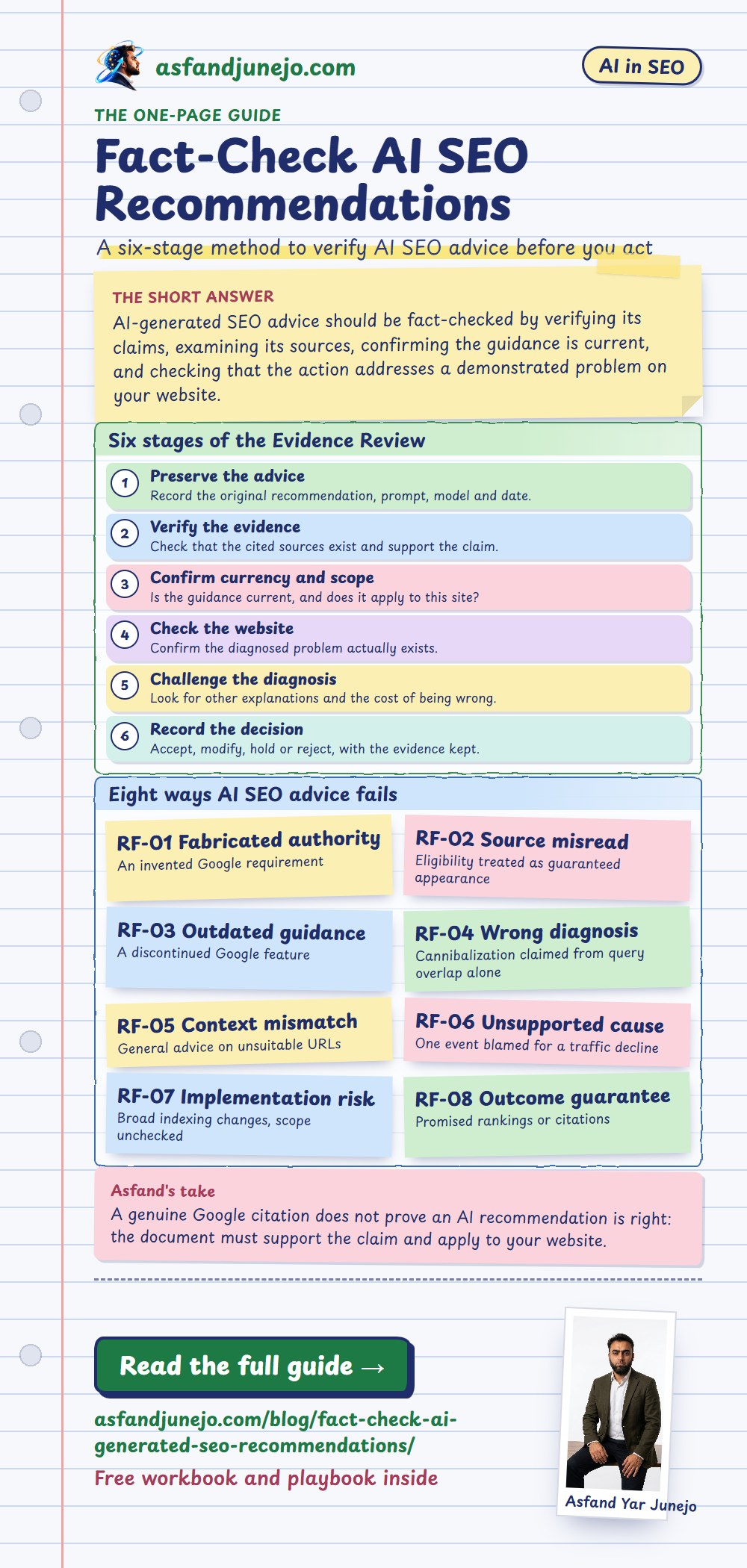
AI-generated SEO recommendations should be fact-checked by verifying their claims, examining the sources supporting them, confirming that the cited guidance remains current, and determining whether the proposed action addresses a demonstrated problem on the affected website. A recommendation can be technically correct yet unsuitable, supported by a genuine citation that has been misinterpreted, or implemented successfully without producing the expected search outcome.
Published · Sources checked · By Asfand Yar Junejo, publisher asfandjunejo.com
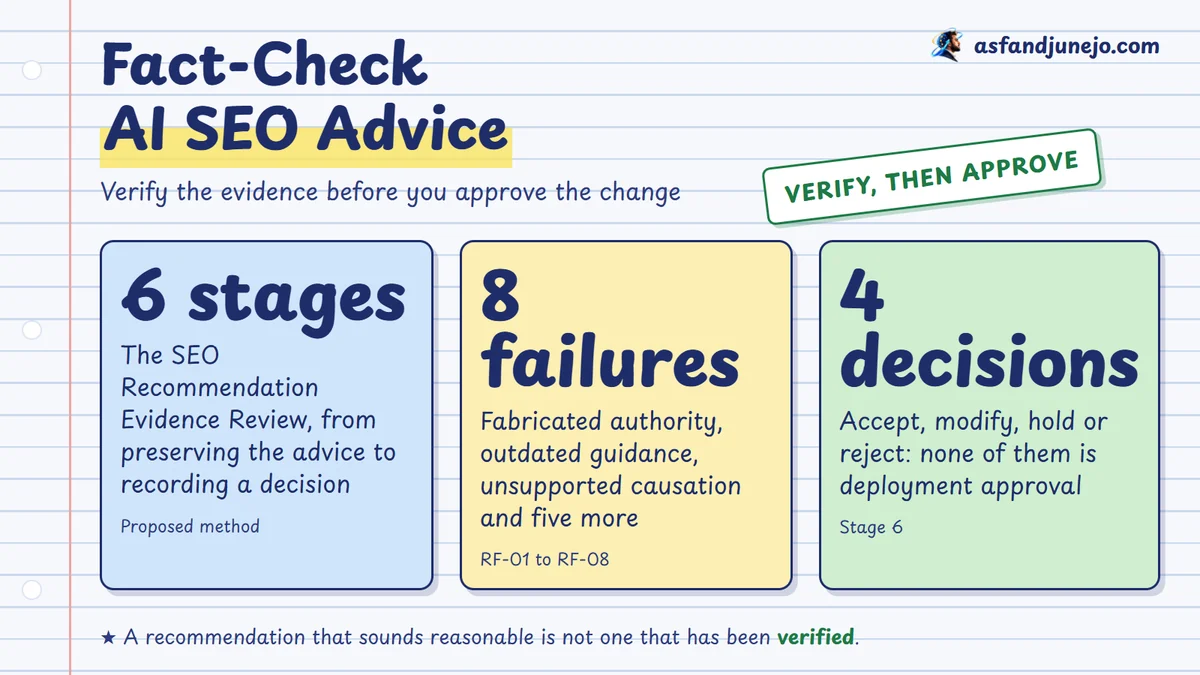
The essential distinction is between a recommendation that sounds reasonable and a recommendation that has been adequately verified.
An AI assistant might suggest consolidating pages, changing canonical URLs, implementing structured data, rewriting metadata, modifying crawler directives, or investigating a decline in organic traffic.
These suggestions can be valuable starting points.
However, their usefulness depends on evidence that may not be present in the generated response.
A recommendation to consolidate pages requires more than observing overlapping keywords. A recommendation to remove indexing restrictions requires understanding why those restrictions exist. Recommending structured data requires checking whether the intended Search feature is supported and whether the markup accurately represents the page.
An AI-generated performance diagnosis introduces another problem.
The model may observe that clicks declined after a Google update and conclude that the update caused the decline. Yet the recorded decline and its proposed explanation are different claims.
Search Console may support the first.
The second requires additional investigation.
Google’s own guidance provides a useful foundation for separating these conditions.
On October 1, 2026, Google updated its documentation concerning generative AI content, explicitly emphasizing manual fact-checking before publication. The clarification applies to generated content and metadata, including titles, descriptions, structured data, and image alternative text.
Earlier, on June 5, Google published dedicated guidance concerning third-party SEO tools, services, and advice. That document encourages website owners to evaluate recommendations against Google’s official guidance rather than relying on unsupported claims about ranking systems, AI search, or supposed Google approval.
Google’s May 2026 guidance on generative AI Search further clarifies which foundational SEO practices remain relevant and which purported AI optimization shortcuts are unnecessary.
These publications address related but distinct responsibilities.
The October update concerns the accuracy of AI-generated information published on websites.
The June guidance concerns the evaluation of external SEO advice.
The May guide describes Google’s recommendations for its generative Search features.
None of these documents establishes that Google certifies individual AI-generated SEO recommendations or guarantees the outcomes of their implementation.
That responsibility remains with the website owner and the specialists evaluating the recommendation.
This article introduces the SEO Recommendation Evidence Review, a proposed six-stage methodology for evaluating AI-generated SEO advice before it is approved as a website change.
The method separates the recommendation’s factual claims, cited authorities, source interpretations, website-specific evidence, contradictory findings, implementation risks, and final decision.
It also demonstrates the approach using documented Google Search changes and an archived AI-assisted sitemap deliverable from asfandjunejo.com.
The underlying principle is straightforward:
An AI-generated SEO recommendation should be approved only when its supporting evidence is valid, its interpretation is defensible, its application is appropriate, and its consequences have been evaluated.
The workbook, evidence review playbook and quick reference behind this method are free for Search Signals subscribers.
What are the key takeaways?
A genuine Google citation does not establish that an AI recommendation is correct. The cited document must actually support the claim, and its guidance must apply to the relevant website condition.
Google’s October 2026 documentation update emphasizes factual review of AI-generated content. It should not be described as a new blanket ranking penalty against AI-assisted websites.
Google’s June 2026 third-party SEO guidance directly supports the independent verification of outside recommendations. It does not endorse a particular AI SEO tool or verification framework.
Technical validity, website suitability, implementation approval, and search performance are different conditions. Passing one does not automatically establish the others.
AI-generated recommendations can fail due to fabricated authority, outdated guidance, incorrect diagnoses, unsuitable generalizations, unsupported causal claims, implementation risks, or exaggerated promises of outcomes.
The most reliable review process preserves the original recommendation, independently verifies its sources, investigates the actual website, examines alternative explanations, and records an accountable decision.
What does it mean to fact-check an AI-generated SEO recommendation?
Fact-checking an AI-generated SEO recommendation means verifying the claims that justify the proposed action and determining whether those claims support the recommendation in the context of the affected website. The process evaluates factual accuracy, source reliability, interpretation, technical applicability, and material consequences before deciding whether to accept, modify, hold, or reject the advice.
This is different from proofreading AI-generated text.
A content editor may verify whether a generated product description accurately states the product’s material, dimensions, availability, and intended use.
An SEO specialist evaluating a recommendation must answer additional questions.
Does the identified problem exist?
Does the supporting documentation apply?
Would the proposed change correct the problem?
Could it create a different problem?
What evidence would establish that the intervention worked?
These questions concern the validity of a decision, not merely the accuracy of individual sentences.
An observation is not automatically a diagnosis
Consider a hypothetical AI-generated report identifying two related pages that receive impressions for overlapping queries.
The query overlap may be a legitimate observation.
However, the assistant might interpret it as harmful keyword cannibalization and recommend consolidating the pages.
That diagnosis requires additional evidence.
The pages may serve distinct user needs, purchasing stages, locations, or commercial purposes.
Their shared visibility for broad queries does not, by itself, establish that one page is harming the other’s performance.
Even if further investigation identifies a genuine problem, consolidation is not automatically the appropriate solution.
The website may benefit from clearer content differentiation, more relevant internal links, or adjustments to page targeting.
The important distinction is between three statements.
Observation: Two pages receive impressions for some of the same queries.
Hypothesis: The overlap may indicate harmful competition.
Recommendation: Consolidate the pages into one URL.
The first can be established through suitable reporting evidence.
The second requires interpretation and further testing.
The third requires an evaluation of available solutions and their consequences.
The recommendation must not inherit the certainty of the original observation.
Factual correctness and decision validity
A recommendation can accurately describe Google’s technical behavior while remaining inappropriate for a particular website.
For example, Google supports canonicalization as a method for communicating preferred representative URLs among duplicate or substantially similar pages.
That is a documented technical principle.
However, it does not establish that every pair of pages discussing related subjects should share one canonical URL.
The applicability of the recommendation must be demonstrated separately.
This creates two essential verification questions:
Is the underlying technical statement correct?
Does that statement justify the proposed action on this website?
A complete review must answer both.
Verification should not guarantee an SEO outcome
Even when a recommendation is technically justified, its future impact may remain uncertain.
Correcting a broken internal link can establish that visitors and crawlers now reach the intended destination.
It cannot automatically establish that the correction will increase organic traffic by a particular percentage.
Fixing structured data can establish that the markup satisfies certain technical requirements.
It does not guarantee that Google will display an enhanced search appearance.
Therefore, recommendation verification should distinguish the expected technical result from any later search performance objective.
That separation makes the eventual outcome easier to evaluate without overstating what the evidence supports.
What did Google change about AI content fact-checking in October 2026?
On October 1, 2026, Google updated its guidance on generative AI content to emphasize manual fact-checking and review before publication. The updated wording explicitly connects that review to content accuracy and trustworthiness, including generated metadata. It was a clarification of documentation, not an announcement of a new universal ranking penalty for AI-generated content.
Confirmed Google's documentation page on generative AI content shows an update date of October 1, 2026 and says to manually fact-check AI-generated content, including titles, meta descriptions, structured data and image alt text (checked November 1, 2026)
Google’s current guidance explains that generative AI can help organize original information and support content research.
However, generated outputs can contain inaccurate claims.
The updated guidance stresses that material intended for publication should be examined for factual reliability.
Importantly, the instruction applies beyond the main body of a webpage.
Generated titles, meta descriptions, structured data, and image alternative text also require appropriate review.
What was actually new?
The October update made the expectation for manual fact-checking more explicit.
It also clarified that the review process applies to metadata.
Metadata accuracy was not an entirely new concern introduced that day.
The change strengthened the wording and more directly connected the review requirement to information that may appear in Google Search.
Google recorded the update as an effort to align its public documentation with material used during developer presentations.
This distinction matters because coverage of Search documentation changes sometimes treats every revised sentence as evidence of a newly introduced ranking mechanism.
A documentation change can clarify existing advice without establishing that a ranking system changed.
Does Google prohibit AI-generated content?
No.
Google does not establish a blanket prohibition on using AI to assist with website content.
Its Search policies focus on the quality, purpose, and behavior of the resulting material.
Google’s scaled content abuse policy concerns the production of large amounts of content primarily to manipulate rankings rather than to provide meaningful value to users.
That concern is not limited to one production method.
The relevant distinction is between useful content developed with appropriate editorial controls and content produced primarily to manipulate search systems.
Why the October guidance matters for SEO recommendations
The guidance directly concerns generated content.
An AI-generated SEO recommendation is a different type of output because it proposes a future action.
Nevertheless, the underlying expectation of factual accuracy is relevant.
If an AI assistant recommends adding misleading structured data, its recommendation must be challenged.
If it generates metadata containing unsupported service claims, that information should be corrected before publication.
If it attributes an invented requirement to Google, the claimed authority should be independently verified.
This is a professional application of Google’s accuracy principles, not a separate Google certification program.
Google’s June guidance provides the stronger foundation for recommendation verification
On June 5, 2026, Google introduced specific guidance for evaluating third-party SEO advice.
That publication addresses conventional SEO alongside recommendations concerning AI Search, AEO, and GEO.
Google encourages website owners to compare outside advice with official Search documentation and make informed decisions rather than automatically following third-party tools.
It also cautions against services that claim access to internal ranking information or promise guaranteed results.
The document is particularly relevant to AI-generated SEO recommendations because it addresses the reliability of outside advice rather than the production of website copy.
The practical implication is that an AI assistant’s confidence is not a substitute for evidence.
Its recommendation should be evaluated according to the documented behavior of the system it claims to optimize.
Why can AI-generated SEO recommendations be wrong?
AI-generated SEO recommendations can fail because of fabricated sources, inaccurate interpretations, outdated guidance, unsupported diagnoses, unsuitable assumptions, implementation risks, or unjustified performance predictions. Each failure requires a different response, so a reliable review should identify the specific problem rather than classify every questionable recommendation as an AI hallucination.
A recommendation may be wrong even when its individual technical terms are used correctly.
An AI assistant could identify an existing Google API but misunderstand which pages are eligible to use it.
It could accurately describe canonical tags but recommend them for pages that should remain independent.
It could correctly identify a drop in organic clicks but invent the explanation.
These situations share a common characteristic: the proposed action exceeds the supporting evidence.
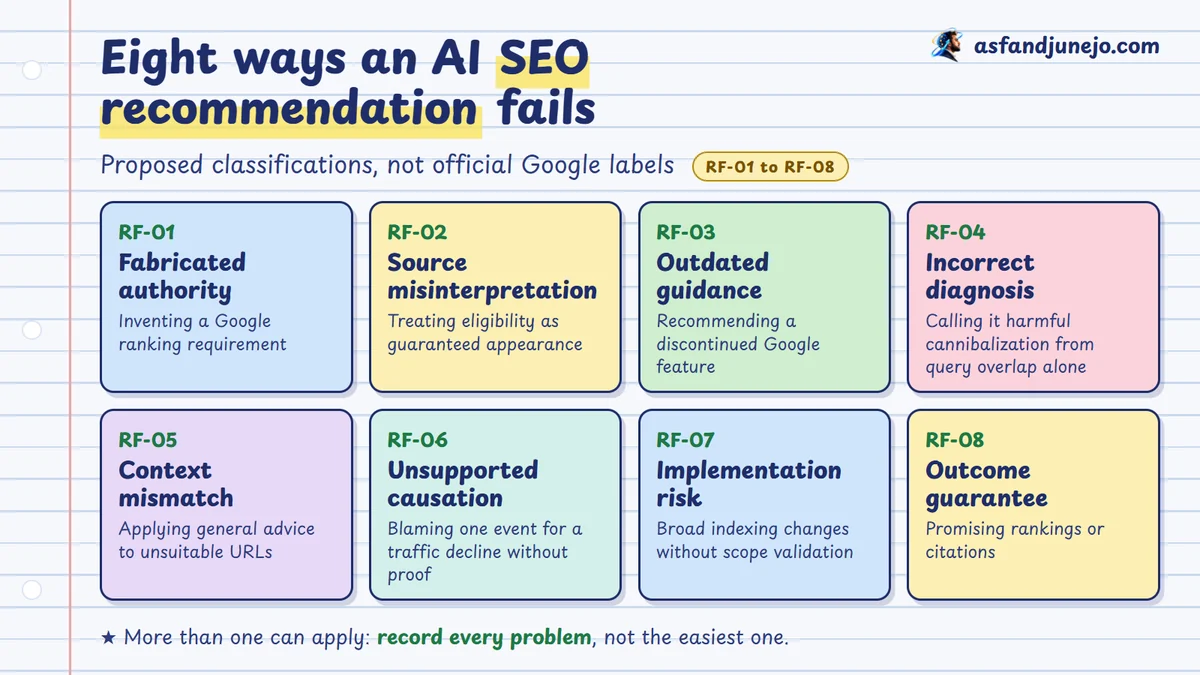
Eight recurring recommendation failures
| Code | Failure type | Example |
|---|---|---|
| RF-01 | Fabricated authority | Inventing a Google ranking requirement |
| RF-02 | Source misinterpretation | Treating eligibility as guaranteed search appearance |
| RF-03 | Outdated guidance | Recommending a discontinued Google feature |
| RF-04 | Incorrect diagnosis | Declaring harmful cannibalization from query overlap alone |
| RF-05 | Context mismatch | Applying general advice to unsuitable URLs |
| RF-06 | Unsupported causation | Attributing a traffic decline to one event without sufficient evidence |
| RF-07 | Implementation risk | Proposing broad indexing changes without scope validation |
| RF-08 | Outcome guarantee | Promising ranking or citation increases without adequate support |
These are proposed analytical classifications, not official Google labels.
More than one can apply to the same recommendation.
For example, advice concerning a discontinued Search feature may also contain an unsupported ranking guarantee.
The reviewer should record both problems rather than select whichever appears easiest to explain.
Fabricated authority versus genuine-source misuse
A fabricated-source problem occurs when the cited authority cannot be verified.
A different problem occurs when the source exists but does not support the recommendation.
Suppose a model cites Google’s structured data documentation while claiming that implementing a particular schema type guarantees improved rankings.
The source may exist and accurately describe technical requirements.
However, the promised ranking effect is a separate claim.
The source’s authority does not automatically extend to every conclusion attached to it.
This is why checking whether a URL loads is insufficient.
The reviewer must inspect whether the cited passage supports the specific proposition.
Outdated advice versus an incorrect principle
A previously supported Search feature may be discontinued later.
An AI assistant relying on older information could recommend a technically recognizable implementation for an outcome that is no longer available.
The recommendation may have been reasonable historically.
It may not be suitable today.
This calls for a source-freshness review rather than a blanket conclusion that the underlying technology is inherently invalid.
Incorrect diagnosis versus unsuitable solution
The wrong solution may accompany a real website problem.
For example, a crawl might correctly identify broken internal links.
An AI assistant could then recommend redirecting every affected destination to the homepage.
The underlying problem is genuine.
However, a blanket redirect may create irrelevant destinations and fail to restore the intended user journey.
The appropriate decision could be to accept the diagnosis but modify the proposed intervention.
This distinction is valuable because useful observations should not be discarded merely because the suggested solution is weak.
Outcome predictions require separate evidence
A recommendation may also contain a numerical forecast.
An AI assistant might claim that a technical fix will increase organic traffic by 25%.
That percentage does not become reliable simply because the technical issue exists.
A credible forecast would require a defined model, relevant historical evidence, documented assumptions, and an appropriate level of uncertainty.
Google explicitly cautions that third-party SEO services do not have access to its internal ranking data and cannot guarantee performance.
A technically justified intervention can be approved without attaching an unsupported prediction to it.
How do you verify AI SEO advice against Google’s guidelines?
AI-generated SEO advice should be checked by isolating the exact Google-specific claim, locating the appropriate official documentation, verifying that the source supports the claim, and determining whether the guidance remains applicable to the relevant product and website condition. The review must distinguish mandatory requirements, technical explanations, recommendations, and professional interpretations.
This begins with language.
Expressions such as Google requires, Google penalizes, Google recommends, and Google guarantees attribute authority to Google.
They deserve careful verification.
Verify the exact proposition
Consider the statement:
Google recommends structured data.
That statement is too broad to determine whether a specific implementation should be approved.
The reviewer must identify the relevant feature, markup type, page content, and claimed benefit.
Google may document structured data for particular Search features.
However, that does not establish that every schema type improves rankings or that every valid implementation produces a rich result.
The exact claim must be evaluated against the appropriate documentation.
Distinguish authority from evidentiary sufficiency
Google Search Central is an authoritative source for Google’s published Search requirements.
However, its documentation does not establish the technical condition of an individual website.
For example, Google’s canonicalization guidance explains how canonical preferences work.
It cannot independently establish whether a particular service page should be canonicalized to another page.
That requires website-specific evidence.
The distinction is important:
Source authority determines whether the source is appropriate for the claim.
Evidentiary sufficiency determines whether the available evidence actually establishes the claim.
A recommendation can cite the right source while lacking sufficient evidence for the proposed action.
Check the document’s current scope
Search features, product eligibility, and technical guidance can change.
The reviewer should examine the current documentation and relevant updates before approving a time-sensitive recommendation.
A secondary article may accurately describe a historical feature while being unsuitable as a source for current implementation.
Google maintains a public record of material Search documentation changes, including feature deprecations, new guidance, and clarifications.
However, recency alone does not determine whether a document is applicable.
An official technical guide may remain more authoritative than a newer opinion article on the same topic.
Do not generalize Google’s statements to every AI platform
Google’s generative AI Search guidance concerns Google’s systems.
Its statements about llms.txt, structured data, and content chunking should not automatically be treated as technical documentation for unrelated AI assistants.
A recommendation concerning another platform requires evidence appropriate to that platform.
The reviewer should identify the actual system the advice claims to influence.
Otherwise, a narrow product-specific fact can become an unsupported universal statement.
Preserve uncertainty where Google has not disclosed the answer
Google does not disclose all of its internal ranking mechanisms.
An AI assistant may nevertheless claim that a particular content structure, entity signal, or formatting technique produces a guaranteed ranking effect.
When the relevant mechanism is not established through available evidence, the claim should remain qualified.
A professional recommendation may still be made using relevant observations and experience.
It should be labeled accordingly rather than presented as an official Google requirement.
The SEO Recommendation Evidence Review: A practical verification framework
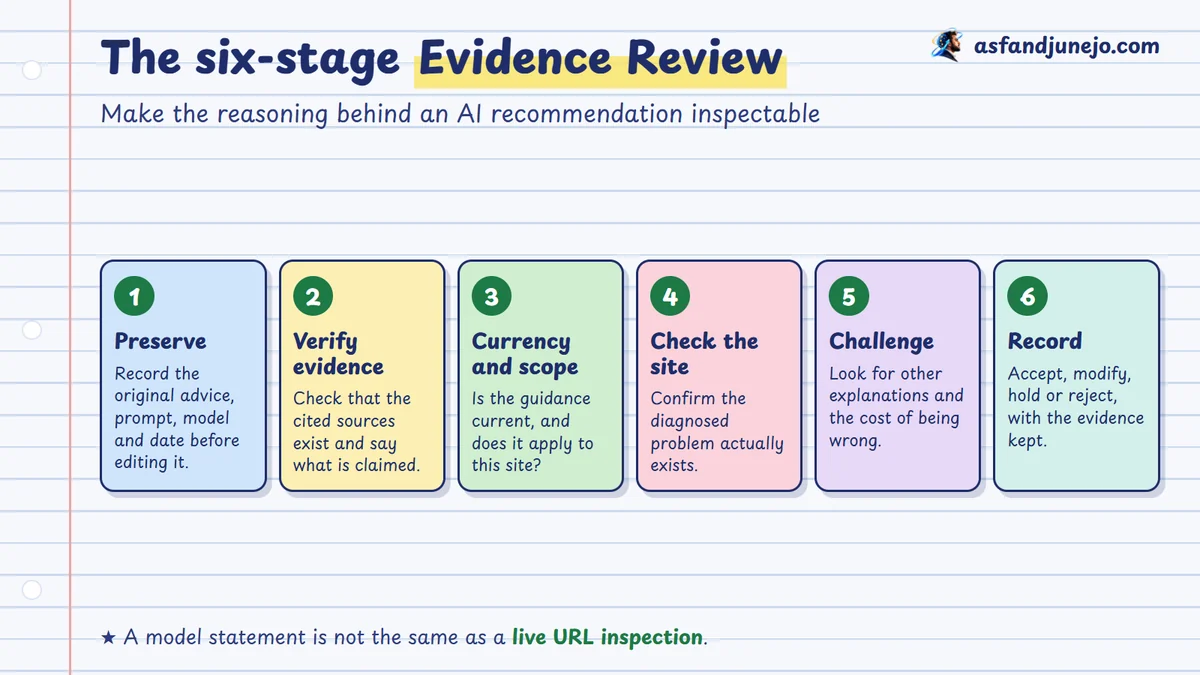
The SEO Recommendation Evidence Review is a proposed six-stage method for assessing whether an AI-generated recommendation has sufficient factual, technical, and contextual support to justify further action. It separates verification from implementation authorization and preserves the evidence behind the final decision.
Hypothesis A proposed method from this article, not an official Google framework or certification
The framework’s purpose is not to certify every recommendation through a universal numerical score.
It is to make the reasoning inspectable.
Stage 1: Preserve and isolate the recommendation
Record the original recommendation before rewriting or correcting it.
Identify its separate factual claims, diagnosis, proposed intervention, and expected outcome.
Preserve the original prompt, model or tool when known, date, relevant settings, and the information supplied to the model.
This prevents later editing from concealing what the AI originally recommended.
Stage 2: Verify the supporting evidence
Check that the cited sources exist and are relevant.
Inspect the actual passages supporting material claims.
Where the recommendation depends on website data, verify the underlying observations rather than relying on the model’s summary.
For example, if an AI assistant flags a page as blocked from indexing, the reviewer should examine the relevant technical signals and supporting evidence in Search Console.
A model-generated statement is not equivalent to a live URL inspection.
Stage 3: Confirm source currency and scope
Determine whether the guidance remains current.
Identify the relevant search product, feature, page type, and eligibility conditions.
A recommendation based on discontinued rich-result documentation should not pass merely because its implementation syntax remains recognizable.
The reviewer should also check whether the source applies to the affected website.
Stage 4: Establish the website’s actual condition
Investigate whether the diagnosed problem exists.
The required evidence depends on the recommendation.
A canonicalization recommendation may require inspecting URL relationships and Google’s selected canonical.
A redirect recommendation may require examining response codes, destinations, and internal links.
A content recommendation may require verifying facts, page purpose, and user needs.
A traffic diagnosis may require checking reporting periods, query groups, landing pages, and known data anomalies.
Stage 5: Challenge the diagnosis and assess consequences
Look for evidence that could make the recommendation inappropriate.
Determine whether other explanations fit the observation.
Consider how the proposed change might affect important pages, navigation, indexing, conversions, or dependent systems.
Risk should be evaluated according to the consequences of failure, not merely the apparent simplicity of the change.
Stage 6: Record the verification decision
Assign one of four dispositions.
Accept: The recommendation is supported and appropriate within the verified scope.
Modify: The underlying issue is established, but the proposed solution requires changes.
Hold: Material evidence remains missing or conflicting.
Reject: The recommendation conflicts with verified evidence, applicable requirements, or legitimate website objectives.
These decisions concern recommendation validity.
They do not automatically authorize implementation.
Verification status is not deployment approval
This distinction should remain explicit in the final evidence register.
A recommendation may be verified but still await development review.
A technically justified migration may require staging, redirect mapping, dependency checks, and a tested recovery procedure.
A recommendation should therefore have separate fields for:
Evidence-review disposition: Accept, Modify, Hold, or Reject.
Implementation authorization: Approved, pending, denied, or not applicable.
Deployment state: Not started, implemented, failed, or reverted.
Validation state: Passed, failed, unresolved, or not tested.
This avoids using one ambiguous approval status to represent several different decisions.
How do you detect fabricated, outdated, or misused SEO citations?
A reliable citation audit verifies the existence of the source, its authority for the relevant claim, its current applicability, and the exact proposition supported by its content. A genuine source can still be quoted inaccurately or interpreted too broadly.
A citation should therefore be evaluated as evidence, not decoration.
Source existence is only the first check
An AI assistant may provide a convincing Google documentation title or URL.
The reviewer should locate the relevant document independently.
If the reference cannot be verified, the recommendation should not retain its confirmed Google authority status.
However, a missing URL does not automatically prove that the document never existed.
It may have moved or been replaced.
The reviewer should investigate the current documentation before drawing that conclusion.
A relevant document may not support the recommendation
Suppose an AI assistant cites Google’s structured data guidelines while promising that the recommended markup will produce a rich result.
The cited document is real and relevant.
However, Google explicitly states that valid markup does not guarantee rich-result appearance.
The error is not necessarily a fabricated source.
It is an unsupported inference.
The correct review should identify the narrower statement that the document actually establishes.
Quotation accuracy and interpretation accuracy are different
A quotation can be exact while its interpretation is wrong.
For example, a document may state that a condition is required for eligibility.
An AI assistant may transform that into a claim that satisfying the condition guarantees a particular search appearance.
The quotation may be correct.
The conclusion is not established.
The reviewer must examine the surrounding qualifications and limitations.
A second AI answer is not independent verification
Asking the same assistant to reconsider its advice may help reveal inconsistencies.
Another model may also identify alternative explanations.
However, neither generated response should automatically be treated as authoritative evidence.
The source material and website condition must still be checked independently.
This is particularly important when several models rely on similar public summaries or share the same misunderstanding.
Treat retrieved content as untrusted data
An additional risk emerges when AI agents can browse websites, read files, or interact with connected tools.
A retrieved page may contain instructions intended to influence the assistant rather than provide legitimate SEO evidence.
For example, a webpage under review could contain text instructing an automated agent to disregard previous requirements, retrieve unrelated private information, or modify a connected system.
Those instructions are not authorized simply because they appear in a retrieved document.
OWASP identifies indirect prompt injection as a risk when models process externally supplied content that attempts to alter their behavior.
An SEO verification workflow should therefore separate evidence from instructions.
Retrieved HTML, documents, comments, and audit outputs should be treated as material to examine, not as commands that override the authorized task.
The surrounding systems should enforce access restrictions and approval controls.
A warning inside a prompt is not an adequate substitute for technical permission boundaries.
How do you fact-check technical SEO recommendations?
Technical SEO recommendations require two forms of verification: the proposed behavior must be consistent with applicable technical guidance, and the website must exhibit a condition that justifies the intervention.
A technically valid mechanism should not be applied indiscriminately.
Canonicalization
Google uses canonicalization to select representative URLs among duplicate or very similar pages.
Website owners can communicate preferences through canonical annotations, redirects, and other signals.
However, Google may select a different canonical URL from the one declared.
Consequently, an AI recommendation to canonicalize two pages requires examining their content relationship, intended search purposes, internal links, existing signals, and relevant evidence.
Overlapping keywords alone are not sufficient justification.
Robots.txt and noindex
An AI assistant may recommend blocking a page via robots.txt while applying the noindex directive.
That combination may undermine the intended outcome if Googlebot cannot access the page to process the indexing instruction.
Google documents the distinction between preventing crawling and preventing indexing.
The reviewer must establish the actual objective.
Preventing crawling, excluding a public page from search results, and protecting confidential information are distinct requirements.
Private information requires appropriate security controls rather than relying solely on search directives.
The Indexing API
Google’s Indexing API is restricted to supported job posting and livestreaming pages with the relevant markup.
It should not be recommended as a general-purpose indexing shortcut for ordinary articles.
The existence of a real Google API does not establish that every URL is eligible to use it.
Redirects and site migrations
A recommendation to redirect old URLs must consider whether appropriate replacement pages exist.
A redirect can function technically while sending visitors to irrelevant destinations.
The review should evaluate the original page’s purpose, the replacement’s relevance, the redirect chain, internal links, and the impact on critical user journeys.
A successful redirect response does not establish that the migration decision was appropriate.
JavaScript rendering
Google can render JavaScript and use rendered content in Search.
Therefore, an AI recommendation claiming that every client-side-rendered website is inherently unindexable is inaccurate.
However, JavaScript applications can still encounter problems with inaccessible resources, incorrect routing, rendering failures, or missing content.
The correct investigation compares actual page responses, rendering behavior, and relevant Search Console evidence.
The implementation should be evaluated rather than judged solely by its framework.
Sampling and sitewide recommendations
A technical audit may inspect a small number of URLs and recommend a change affecting an entire website.
That creates an evidence-scope problem.
Finding a defect on three URLs does not independently establish that every page using a similar template has the same defect.
The reviewer should determine whether the observed pattern is representative and whether the proposed implementation scope is supported.
A limited sample may justify further investigation.
It should not automatically justify a sitewide change.
How should AI-generated content, metadata, and structured data advice be verified?
AI-generated content and metadata recommendations should be evaluated against the underlying business information, the page’s visible content, relevant accessibility requirements, and applicable Google Search policies. Passing a syntax check does not establish factual accuracy or guarantee search performance.
This applies to visible content and machine-readable information.
Titles and meta descriptions
An AI assistant may recommend adding commercially attractive claims to improve the presentation of search results.
However, those claims must be accurate.
A generated title describing a company as the largest supplier in a market requires evidence to support that claim.
A description promising nationwide next-day installation must reflect the business’s actual capabilities.
Google recommends descriptive title text and explains that it may generate search-result title links from multiple sources.
The website owner does not fully control every title or snippet displayed.
A recommendation should therefore focus on accurate representation rather than guaranteeing a particular search presentation.
Image alternative text
Alternative text should communicate the relevant meaning or function of an image.
Keyword repetition is not a substitute for useful description.
A generated alternative that simply repeats commercial search phrases may fail to communicate the actual image content.
The reviewer should consider the image’s purpose, the surrounding information, and relevant accessibility requirements.
Decorative images may require different treatment from informative images.
Structured data
A model may generate syntactically valid JSON-LD containing unsupported business details, nonexistent reviews, or inaccurate credentials.
A passing validator result does not establish that those claims are true.
Google’s structured data guidelines distinguish technical requirements, content requirements, and eligibility for particular search features.
They also explain that technically valid markup does not guarantee rich results.
Misleading structured data may raise policy concerns.
A technical eligibility failure and a policy violation should not automatically be described as the same problem or the same kind of ranking penalty.
Product claims, credentials, and testimonials
AI-generated descriptions can introduce unsupported product specifications, service commitments, statistics, or professional qualifications.
The correct evidence may come from approved product records, business documentation, issuer records, or authentic customer experiences.
A claim should not be published merely because it sounds credible.
A testimonial should not be invented to strengthen perceived authority.
Likewise, distinct credential types should not be collapsed into a more impressive but inaccurate count.
Originality and useful content
An AI-detection score does not establish whether content is factually accurate, original, or helpful.
The relevant editorial investigation should examine what the page contributes to its intended audience.
Google’s people-first content guidance emphasizes useful information, substantial analysis, trustworthy sourcing, and content that offers genuine value.
Automated production can support that objective, but does not establish it on its own.
Which AEO and GEO recommendations conflict with Google’s guidance?
AI Search recommendations should be checked against Google’s official documentation when they claim to influence Google AI Overviews or AI Mode. Google does not require a special AI-only schema, llms.txt, or artificial content chunking to participate in its generative Search features.
The underlying issue is platform-specific evidence.
A tactic described as AEO or GEO does not become a documented Google requirement merely because it is associated with AI search.
llms.txt
Google’s June 15, 2026 clarification states that llms.txt is unnecessary for Google Search and does not independently improve or harm Google rankings.
Maintaining the file for another system may still be reasonable.
Therefore, the statement that Google requires llms.txt for AI Overview visibility should be rejected.
However, the separate question of whether another application uses the file requires its own evidence.
Special AI schema
Google does not require a special schema.org type solely for generative AI Search.
Structured data remains useful for its documented purposes, including eligibility for supported conventional Search features.
An AI recommendation introducing unsupported markup as a guaranteed citation mechanism should not be accepted.
Artificial content chunking
Google’s generative AI guidance explains that pages do not need to be divided into tiny fragments for its systems to understand them.
Clear headings, concise explanations, and logical structure may improve usability.
However, that editorial value is different from a claim that a specified paragraph length guarantees AI citations.
There is no basis for treating arbitrary chunk size as a mandatory Google optimization rule.
Manufactured brand mentions
An AI tool may recommend generating large numbers of artificial discussions, endorsements, or mentions to increase an entity’s visibility.
That advice deserves scrutiny.
Google cautions against inauthentic mentions and continues to apply its broader spam policies to generative Search experiences.
Legitimate independent references should not be confused with manufactured endorsements intended to manipulate search systems.
Guaranteed AI citations
Google does not provide third-party services with access to its internal ranking systems.
A tool may help monitor supported observations or identify opportunities for optimization.
It cannot reliably guarantee that Google will cite a particular website in future generated answers.
A forecast should remain a qualified estimate rather than a promise.
How do you verify AI-generated SEO performance diagnoses?
AI-generated explanations of changes in search performance should be verified by examining the original measurements, reporting periods, affected URLs, query patterns, technical changes, and plausible alternative causes. A recorded decline establishes that the measured activity changed, not why it changed.
This distinction is especially important when the model generates a confident causal explanation.
A traffic decline is not a complete diagnosis
Suppose organic clicks decline after a Google Search update.
An AI assistant may conclude that the update penalized the website and recommend rewriting the affected content.
The timing may justify investigation.
However, it does not establish causation.
Google’s guidance on investigating search traffic declines identifies multiple potential explanations, including technical problems, changes in search demand, algorithmic developments, security issues, and reporting conditions.
The analyst should examine which pages and queries were affected before selecting a cause.
Verify the measurement first
The source property, date range, search type, filters, and reporting freshness should be checked.
An analytics configuration change or source reporting anomaly can create a misleading trend.
Search Console clicks and GA4 sessions also use different collection and attribution methods.
A difference between them should not automatically be classified as lost traffic.
Where source limitations materially affect a conclusion, they should be disclosed.
Distinguish correlation from causation
A decline in ranking following a deployment may justify checking the deployment.
It does not automatically prove the deployment caused the decline.
The reviewer should examine what changed, which URLs were affected, and whether the observed pattern is consistent with the proposed explanation.
Where several interventions occurred together, assigning the result to one may remain uncertain.
Separate technical outcomes from commercial outcomes
Correcting a broken canonical configuration may resolve an observable technical inconsistency.
That is one outcome.
Improved search visibility is another.
Qualified leads and revenue are further outcomes.
Each requires its own evidence.
The fact that a correction was technically successful does not establish its eventual commercial effect.
Original evidence case: Reviewing an AI-assisted XML sitemap deliverable
A real recommendation or deliverable provides stronger evidence of verification when its original request, preserved output, intended purpose, and supporting technical documentation can be inspected. An archived AI-assisted sitemap created for asfandjunejo.com illustrates the difference between a technically valid file and a sufficiently verified deliverable.
The original task
On October 9, 2026, an AI assistant was asked to create an XML sitemap for asfandjunejo.com to support submission through Google Search Console.
The associated conversation included advice to verify that the live WordPress sitemap endpoint is working before submitting it.
The assistant also generated a separate XML sitemap artifact.
The original task and assistant guidance are identifiable from the conversation record, although the complete historical assistant response has not been independently reproduced for this article.
The archived generated file is available for inspection.
What the preserved artifact contains
The recovered file is named asfandjunejo-sitemap.xml.
It was created on October 9, 2026, and is 168 bytes in size.
The XML contains a standard sitemap URL set with one listed location:
https://asfandjunejo.com/
No additional URLs appear in that archived file.
This is an observed property of the preserved artifact, not a hypothetical result.
Was the XML technically invalid?
No technical syntax defect was established from the inspected content.
Google supports XML sitemaps that list URLs, including simple files with a single URL.
The presence of only one URL does not make an XML sitemap inherently invalid.
Google’s sitemap documentation also explains that content management systems such as WordPress may already generate sitemaps automatically.
The issue concerns the relationship between the generated deliverable and the user’s intended purpose.
A file containing only the homepage cannot independently establish that a complete inventory of intended public URLs was supplied.
What would the verification process require?
A reviewer should first establish which canonical public URLs existed when the sitemap was generated.
The reviewer should then determine whether the website already had an appropriate CMS-generated sitemap or sitemap index.
The live endpoint should be fetched and its contents examined.
Only after those checks could the analyst decide whether the generated file was sufficient, redundant, or incomplete for the intended submission.
The archived file alone does not establish which other pages existed on October 9.
It also does not prove which sitemap, if any, was eventually submitted to Search Console.
A current sitemap cannot reliably reconstruct the complete historical site inventory without additional records.
These limitations matter because they prevent an incomplete artifact from being mistaken for an exaggerated claim about a historical indexing failure.
Applying the SEO Recommendation Evidence Review
Original objective: Create an XML sitemap suitable for the website’s submission workflow.
Preserved evidence: An AI-assisted XML artifact containing only the homepage URL.
Google requirement: A sitemap should contain the appropriate preferred URLs the site owner wants Google to discover. Submission is a discovery signal, not an indexing guarantee.
Verified condition: The archived file contains one URL.
Unresolved questions: Whether additional URLs should have been included on the creation date, whether a separate CMS sitemap existed, and which endpoint was submitted.
Review disposition: Modify or hold, pending URL inventory verification.
Recommended correction: Identify the authoritative sitemap source, verify its coverage and live availability, then submit the appropriate sitemap or sitemap index through the intended workflow.
Implementation status: Not established from the archived file.
Indexing outcome: Not established.
What this case demonstrates
The case does not prove that the AI assistant invented Google’s sitemap requirements.
It does not establish that Google failed to index pages because of the generated file.
It also does not establish that the XML file violated Google’s technical sitemap specification.
Its value lies in a more precise observation.
An AI-generated artifact can be syntactically valid while its completeness for the intended task remains unverified.
A review should therefore examine the intended deliverable, not simply whether the generated file opens or passes a format check.
Provenance and limitations
This is an inspection of a preserved first-party AI-assisted deliverable, not a controlled experiment comparing different AI models.
The file establishes what was generated.
It does not independently reproduce every sentence of the historical AI response, prove that the file was deployed, or measure any resulting Google Search performance.
Those distinctions are part of the evidence.
Four documented Google examples that expose outdated or unsupported recommendations
The following examples apply the verification method to specific requirements in Google Search. The recommendations are illustrative, but the product behavior is grounded in Google’s official documentation.
Example A: FAQ schema guarantees FAQ rich results
Illustrative recommendation: Add structured FAQ data to achieve Google’s FAQ rich-results appearance.
Google’s documentation history confirms that FAQ rich results stopped appearing beginning May 7, 2026.
The related documentation was removed in June.
The recommendation therefore relies on a discontinued search appearance.
Decision: Reject the stated rich-result objective.
Useful FAQ content may remain appropriate for visitors.
Example B: Use the Indexing API for every article
Illustrative recommendation: Submit all ordinary blog posts through Google’s Indexing API.
Google documents the API for eligible job posting and livestreaming content.
Decision: Reject blanket use for ordinary articles.
The site should instead rely on appropriate discovery and indexing practices.
Example C: Passing structured data validation guarantees enhanced results
Illustrative recommendation: Fix the JSON-LD syntax and Google will display a rich result.
Correcting genuine markup errors can be appropriate.
However, Google does not guarantee the appearance of rich results merely because the markup is valid.
Decision: Modify the recommendation.
Preserve the technical correction, but remove the unsupported guarantee.
Example D: Google requires llms.txt for AI Overviews
Illustrative recommendation: Create an llms.txt file because Google requires it for AI Overview rankings.
Google explicitly states that the file is unnecessary for its Search systems.
Decision: Reject the claimed Google requirement.
Other potential uses must be evaluated separately.
A first-party distinction from the AI Visibility Audit Example
The publicly documented October 18, 2026 AI Visibility Audit Example on asfandjunejo.com recorded an llms.txt consistency issue.
At that time, the file did not list the site’s certifications page.
The audit recommended keeping the file aligned with the intended website inventory while explicitly acknowledging that llms.txt is not a Google AI ranking requirement.
That recommendation should be evaluated according to its maintenance objective, not an invented ranking promise.
This demonstrates why the same technical action may be appropriate for one objective and unsupported for another.
A recommendation’s intended benefit is part of what must be fact-checked.
When should an AI SEO recommendation be accepted, modified, held, or rejected?
The final recommendation decision should reflect the quality of its evidence, its applicability to the website, and the consequences of implementation. A recommendation can be verified without being authorized for deployment, and a deployed change can succeed technically without producing the expected SEO result.
Accept
Accept a recommendation when the supporting facts are established, and the intervention is appropriate within the verified scope.
For example, an unintended indexing directive on an important public page may justify correction once the intended page behavior has been confirmed.
Acceptance does not guarantee indexing or ranking improvements.
Modify
Modify advice when the underlying issue is real but the proposed solution is unsuitable.
For instance, a recommendation to fix broken internal links may be valid while a blanket homepage redirect is inappropriate.
The diagnosis can be retained while the intervention changes.
Hold
Hold a recommendation when material evidence is missing.
This may involve unclear page intent, unverified crawl observations, incomplete reporting, or conflicting implementation requirements.
The decision should identify what must be investigated before approval.
Reject
Reject a recommendation when it conflicts with verified evidence or legitimate website requirements.
Examples include fabricated Google policies, unsupported API use, and claims that discontinued Search features can still be obtained through their former markup.
Evaluate implementation risk separately
A verified recommendation may involve significant operational consequences.
Risk should consider the importance of affected pages, scale of deployment, reversibility, data sensitivity, technical dependencies, and confidence in the diagnosis.
A single shared-template change may affect thousands of URLs.
A redirect rule may disrupt critical landing pages.
An indexing change may alter the discoverability of commercially important content.
The approval process should reflect those consequences.
Validate rollback procedures
A documented rollback plan does not establish that recovery will succeed.
Higher-risk changes may require testing the restoration procedure in an appropriate environment.
Database changes, dependent systems, cache behavior, and deployment configuration can make recovery more complex than simply reverting a code commit.
The organization should avoid claiming that a change is safely reversible without supporting evidence.
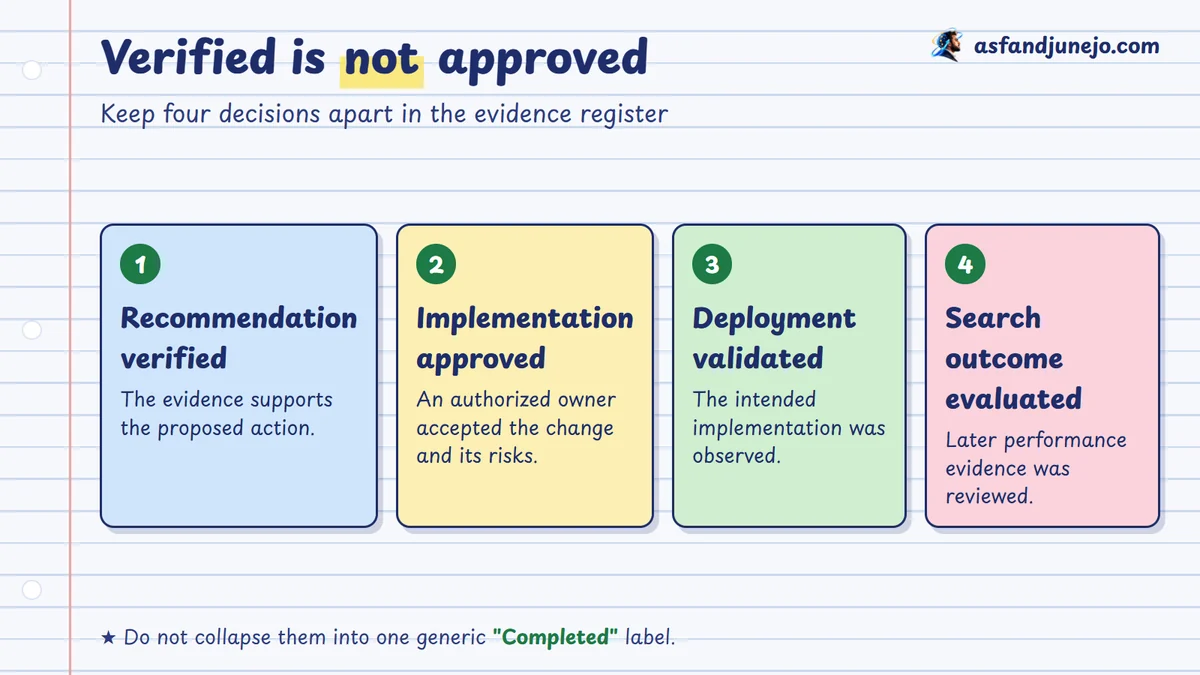
Separate four decisions
The final register should distinguish:
Recommendation verified: The evidence supports the proposed action.
Implementation approved: An authorized owner has accepted the change and its risks.
Technical deployment validated: The intended implementation has been observed.
Search outcome evaluated: Relevant later performance evidence has been reviewed.
These states should not be collapsed into one generic Completed label.
How do you build a repeatable AI SEO fact-checking workflow?
A repeatable fact-checking workflow preserves the original recommendation, verifies source authority and website conditions, documents contradictions, assigns accountability for the decision, and records post-implementation evidence. The process should enable another qualified reviewer to understand why the recommendation was accepted, modified, held, or rejected.
The workflow begins with evidence capture.
A recommendation should receive an identifier and retain its original wording, prompt context, model or tool where known, date, proposed action, and affected URLs.
Next, the reviewer checks its factual claims against relevant primary sources.
A source record should identify the document, the relevant passage, the review date, and the interpretation it supports.
The reviewer then examines the website.
The evidence may include URL responses, canonical declarations, indexing directives, internal links, structured data, or appropriate performance records.
The review should preserve the observation date and, where available, the website release or version being assessed.
Website evidence can become stale
A recommendation justified by an October 10 crawl may become unnecessary after an October 15 deployment.
The original evidence may remain historically accurate.
It does not automatically describe the website’s current state.
Before implementing an older recommendation, confirm that the diagnosed issue still exists.
For significant changes, record the exact environment, page template, URL set, and release version used during verification.
Record contradictory evidence
A good review should actively investigate reasons the recommendation might be wrong.
If an AI assistant identifies duplicate content, examine whether the pages have distinct purposes.
If it attributes traffic loss to an algorithm update, check for technical changes and reporting anomalies.
If it recommends a sitewide change from a sample, verify whether the sample supports generalization.
Contradictory evidence should remain visible even when it complicates the decision.
Establish testable acceptance criteria
An approved change should have a defined technical objective.
For example:
Canonical correction: The approved canonical annotation appears on the intended URLs, and no conflicting template-level declaration remains.
Redirect correction: The source URL returns the intended redirect, reaches the relevant destination, and does not introduce unwanted chains or loops.
Structured data correction: The markup validates where applicable and accurately represents the visible content.
Internal-link correction: The affected links lead to the approved destinations.
These criteria evaluate implementation behavior.
They should not be rewritten as guaranteed ranking outcomes.
Preserve the final evidence record
A practical recommendation register should contain the following fields:
| Field | Purpose |
|---|---|
| Recommendation ID | Unique reference |
| Original recommendation | Preserve the unmodified advice |
| Prompt and model information | Establish generation context where available |
| Affected URLs | Define scope |
| Claimed authority | Identify attributed Google or third-party requirements |
| Verified source | Preserve independently examined documentation |
| Source review date | Establish currency |
| Website evidence | Document the observed condition |
| Evidence timestamp or release | Prevent stale findings from being treated as current |
| Contradictory evidence | Record alternative interpretations |
| Risk assessment | Identify operational consequences |
| Evidence-review disposition | Accept, Modify, Hold, or Reject |
| Implementation authorization | Record the separate approval decision |
| Deployment reference | Connect the approved change to its release |
| Validation evidence | Record the observed technical result |
| Performance assessment | Keep later search outcomes separate |
| Remaining uncertainty | Prevent unsupported closure |
The register should preserve revision history.
A changed recommendation should not erase the original evidence or decision.
A complete reporting conclusion
A strong verification report should be able to state:
What the AI recommended.
What evidence supported or contradicted the recommendation.
Which website condition was verified.
Whether the guidance was current and applicable.
What implementation risks were identified.
Who approved or rejected the proposed action.
What was actually deployed.
Which outcomes were observed afterward.
Where uncertainty remains.
That is more informative than reporting that an AI audit generated 150 suggestions and 120 were implemented.
A high implementation count does not establish that the recommendations were correct or valuable.
Where can you get the AI SEO fact-check kit?
Join Search Signals with your email and three files unlock on this page straight away: the AI SEO Fact-Check Kit (ZIP), the recommendation verification workbook (Excel) and the evidence review playbook (PDF).
The workbook has nine tabs: start here, recommendations, source verification, technical evidence, contradictions, risk and decisions, implementation QA, policy watch and an evidence manifest. The four-page playbook walks through the six stages, and a two-page quick reference sits in the ZIP.
- AI SEO Fact-Check Kit (ZIP)Workbook, playbook, quick reference, read-me and checksums
- Recommendation Verification WorkbookExcel workbook, 9 tabs
- Evidence Review PlaybookPDF, 4 pages
Directional Verification templates with fictional sample values, not legal advice or a guarantee of any SEO outcome
Frequently asked questions
Can AI-generated SEO recommendations be trusted?
They can be useful, but consequential recommendations should be independently verified. The reviewer should check factual claims, source interpretation, website applicability, and implementation consequences.
Does Google penalize websites for using AI-generated SEO advice?
Google does not establish a blanket penalty for obtaining SEO advice through AI. However, resulting implementations may create problems if they violate applicable Search policies or technical requirements.
What did Google change on October 1, 2026?
Google strengthened the explicit manual fact-checking guidance for AI-generated website content and clarified that the review applies to generated metadata. It did not announce a universal AI-content ranking penalty.
Does Google endorse AI SEO tools?
Google says it does not evaluate or approve third-party SEO services, contrary to what some vendors imply. Website owners should compare outside advice against official guidance.
Can a genuine Google citation support an incorrect recommendation?
Yes. The document may be real while the AI assistant misinterprets it or extends its claims beyond what the source establishes.
How do I identify outdated SEO advice?
Check the current official documentation, the relevant update history, the supported features, and the applicable eligibility requirements.
Does Google require llms.txt?
No. Google states that llms.txt is not required for its Search systems and does not independently affect Google Search visibility or rankings.
Does FAQ schema still produce Google’s former FAQ rich result?
No. Google discontinued that Search appearance in May 2026. Useful FAQ content may still serve readers.
Can Google’s Indexing API be used for ordinary blog posts?
Google documents the API for eligible job posting and livestreaming content, not as a general-purpose article submission mechanism.
Does valid structured data guarantee rich results?
No. Valid markup may satisfy relevant technical requirements, but Google does not guarantee an enhanced search appearance.
How should AI-generated canonical recommendations be checked?
Examine actual page similarity, intended search purpose, existing canonical signals, redirects, internal links, and relevant Google-selected canonical evidence.
Can an AI assistant prove why organic traffic declined?
Not from timing or correlation alone. The diagnosis requires checking the relevant reporting evidence and investigating alternative explanations.
Can an AI assistant verify its own SEO advice?
It can assist with review, but another generated answer is not independent evidence. The relevant documentation and website observations must still be checked.
Should every AI recommendation be implemented?
No. Recommendations may be accepted, modified, held, or rejected according to the supporting evidence and intended consequences.
Does approval guarantee better rankings?
No. Technical correctness, successful deployment, and later search performance are separate outcomes.
What if a recommendation was valid when it was generated, but the website has changed?
Recheck the diagnosed condition against the current website. Historical evidence does not automatically justify a current implementation.
Final perspective: Verified evidence should govern AI SEO decisions
AI systems can generate SEO recommendations quickly.
They can help identify patterns, summarize documentation, organize audit findings, and suggest possible interventions.
Those capabilities are valuable.
However, the speed of recommendation generation does not eliminate the need to establish whether the recommendation is correct.
A legitimate Google citation can be misinterpreted.
A technically valid implementation can be inappropriate for the affected page.
An unsupported causal explanation can accompany a real performance decline.
And a generated deliverable can satisfy basic syntax requirements without establishing that it fulfills the intended task.
The SEO Recommendation Evidence Review is designed to examine those distinctions systematically.
Its six stages connect the original claim, source verification, policy currency, website-specific evidence, contradictory findings, and an accountable decision.
The method also separates recommendation validity from implementation authority.
This matters because a verified recommendation may still require staging, approval, deployment controls, and recovery testing.
A successful deployment does not guarantee an improved search outcome.
The first-party sitemap example illustrates the broader principle.
The archived AI-assisted XML file was structurally plausible and contained a valid homepage location.
However, its contents alone did not establish that it represented the intended public URL inventory or that the appropriate sitemap had been submitted to Search Console.
The correct response was not to invent an indexing failure.
It was to identify what the artifact established, what remained unknown, and what additional verification the original task required.
The documented Google cases reinforce the same conclusion.
A discontinued rich-result feature cannot be restored through outdated advice.
A restricted API should not be treated as universally available.
Valid structured data cannot guarantee a search appearance.
And a file that Google does not require should not be promoted as a mandatory AI ranking mechanism.
The objective is not to categorically reject AI-generated SEO advice.
It is to ensure that recommendations receive the scrutiny appropriate to their claims and consequences.
AI can generate an SEO recommendation in seconds. Trusting it requires verified sources, website-specific evidence, contradiction testing, and accountable judgment.
Apply the SEO Recommendation Evidence Review
Select one consequential AI-generated recommendation currently under consideration.
Preserve the original wording.
Verify the supporting sources.
Examine the actual website condition.
Identify evidence that could contradict the recommendation.
Evaluate the implementation consequences.
Record an Accept, Modify, Hold, or Reject decision.
If the change is authorized, test the implementation against clearly defined criteria and evaluate later search outcomes separately.
For organizations that require a scoped investigation into technical search visibility or AI-generated answer evidence, explore AI Visibility Audit services.
Research methodology and limitations
Research review date: October 31, 2026.
This article combines official Google Search documentation, a proposed recommendation-verification methodology, illustrative technical scenarios, and selected first-party evidence.
Source authority
Google-specific technical claims were checked against relevant Search Central documentation concerning generative AI content, third-party SEO advice, canonicalization, indexing directives, structured data, the Indexing API, sitemaps, and traffic-decline investigation.
These sources establish Google’s published guidance within their respective scopes.
They do not independently establish the condition of every website or guarantee the results of a proposed intervention.
Framework status
The SEO Recommendation Evidence Review and recommendation failure taxonomy are proposed analytical methods.
They are not official Google standards.
They have not been evaluated through controlled research demonstrating specific improvements in rankings, diagnostic accuracy, or commercial performance.
Archived sitemap case
The October 9, 2026 case uses a preserved AI-assisted XML file from the author’s project archive.
The file contains one homepage URL and was inspected for this revision.
The full historical model response and contemporaneous production sitemap state were not independently reproduced.
The example therefore supports a conclusion about artifact contents and verification requirements, not a claim about a confirmed indexing failure or the complete historical behavior of the AI system.
First-party AI visibility example
The llms.txt case refers to the author’s public October 18, 2026 AI Visibility Audit Example.
The findings are dated first-party observations.
They are not an independent external audit, and the article does not assume that those conditions remain unchanged.
Illustrative recommendations
The FAQ schema, Indexing API, structured data, canonicalization, robots.txt, and other examples are constructed for instruction unless specifically identified as documented historical outputs.
They are not presented as genuine responses collected from a named model.
Limits of performance interpretation
The article does not claim access to Google’s internal ranking systems.
It does not guarantee search positions, AI citations, increases in organic traffic, or commercial outcomes from specific recommendations.
Technical validation and performance assessment are treated as separate forms of evidence.
Primary technical sources
- Google Search Central: Guidance on Third-Party SEO Tools and Advice (opens in a new tab)
- Google Search Central: Guidance on Using Generative AI Content (opens in a new tab)
- Google Search Central: Generative AI Search Optimization Guide (opens in a new tab)
- Google Search Central: Documentation Update History (opens in a new tab)
- Google Search Central: Structured Data Guidelines (opens in a new tab)
- Google Search Central: Canonicalization Guidance (opens in a new tab)
- Google Search Central: Noindex Documentation (opens in a new tab)
- Google Search Central: Indexing API Eligibility and Usage (opens in a new tab)
- Google Search Central: Sitemap Creation and Submission (opens in a new tab)
- Google Search Central: Investigating Search Traffic Declines (opens in a new tab)
- OWASP: LLM Prompt Injection Risks (opens in a new tab)
- First-party research: AI Visibility Audit Example