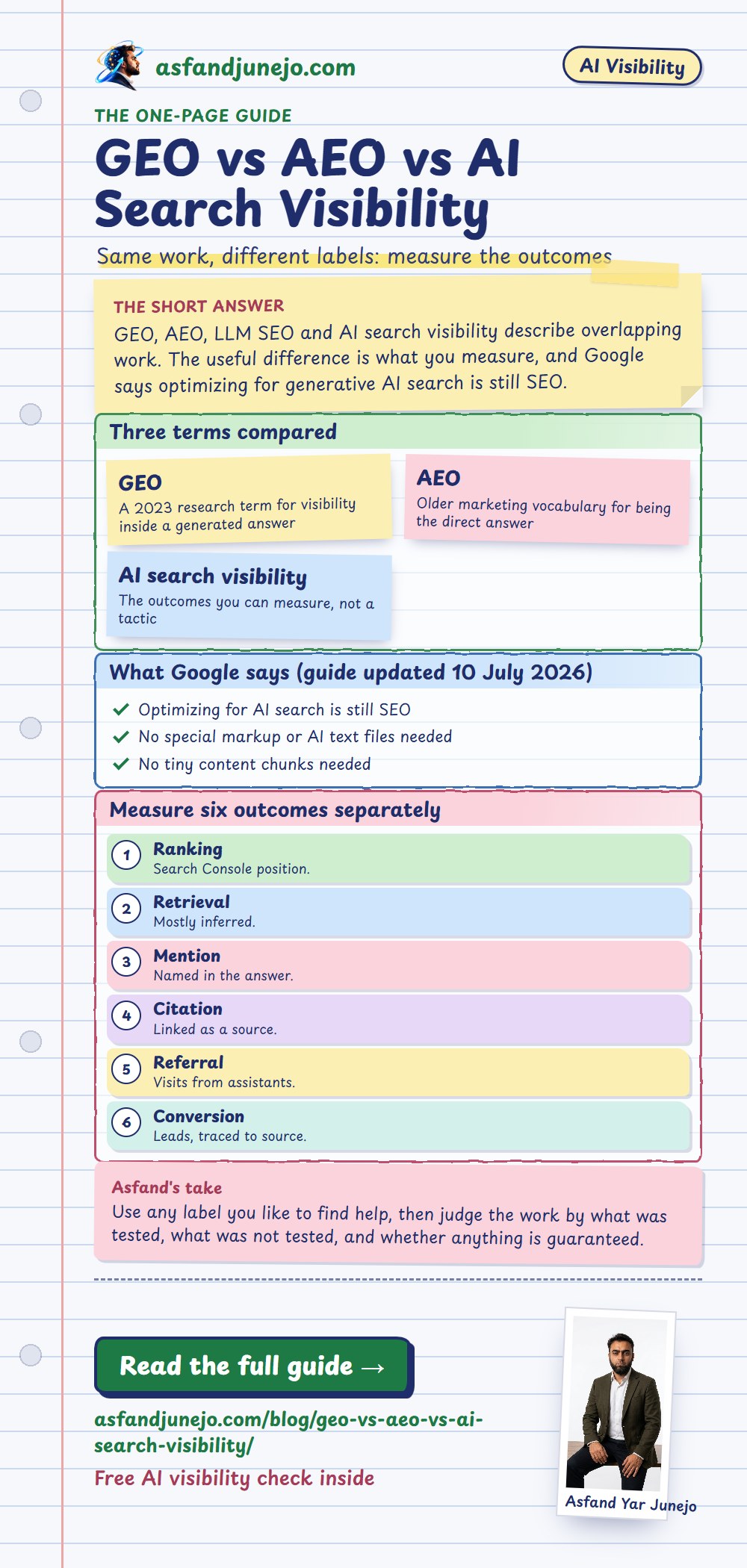
GEO, AEO, LLM SEO and AI search visibility describe overlapping work, and the useful difference between them is what you measure, not what you do. Google's own guidance says that optimizing for generative AI search is still SEO and that no special markup, AI text file or content chunking is required. The term that matters most for a business is AI search visibility: the set of outcomes, from ranking to conversion, that tell you whether AI answers find, use and send people to your content.
Published · Sources checked · By Asfand Yar Junejo, publisher asfandjunejo.com
What do GEO, AEO and AI search visibility mean?
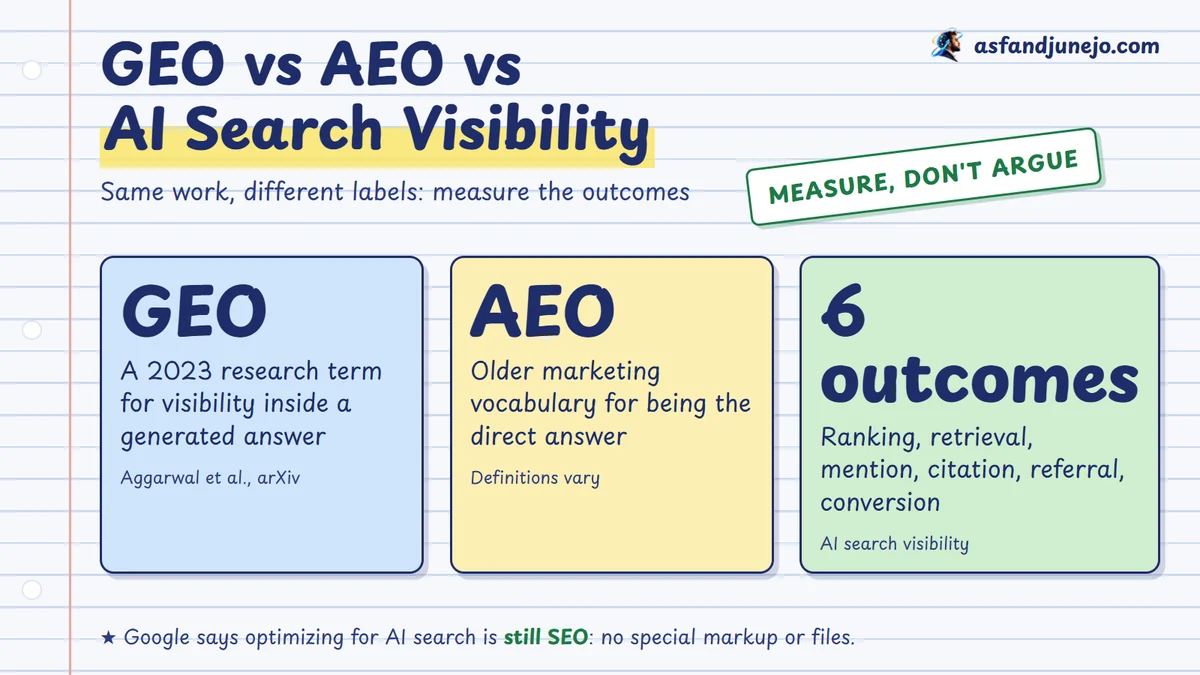
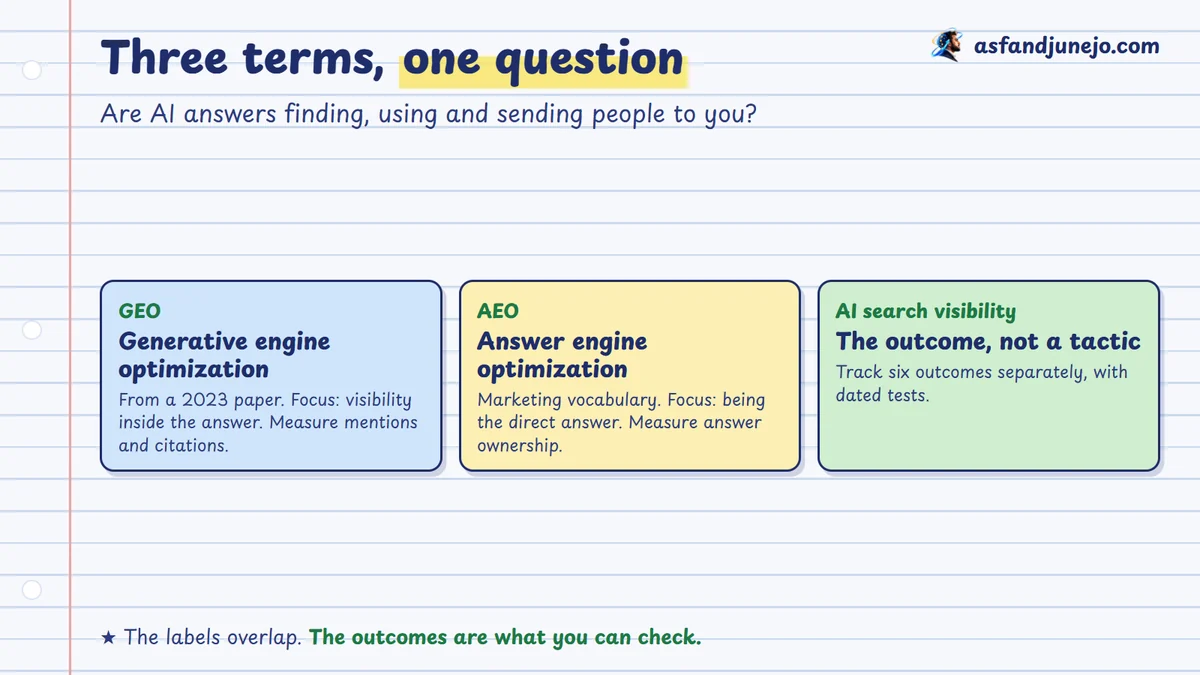
GEO is a research term for improving how visible a source is inside a generated answer, AEO is older marketing vocabulary for being the direct answer, and AI search visibility is the measurable result of both.
| Term | Where it comes from | Main focus | What to measure |
|---|---|---|---|
| GEO (generative engine optimization) | A 2023 research paper by Aggarwal and colleagues, later published at KDD 2024 | Making a source more visible inside the answer a generative engine writes | Mentions, citations and share of an answer |
| AEO (answer engine optimization) | Marketing vocabulary that grew out of featured snippets and voice answers | Being the single, extractable answer to a question | Answer or snippet ownership, citations |
| AI search visibility | A descriptive term for the outcome, not a tactic | Whether AI answers find, use, name and send people to you | Ranking, retrieval, mention, citation, referral and conversion, kept separate |
The GEO paper, "GEO: Generative Engine Optimization" by Pranjal Aggarwal, Vishvak Murahari, Tanmay Rajpurohit, Ashwin Kalyan, Karthik Narasimhan and Ameet Deshpande, first appeared on arXiv on November 16, 2023. It describes generative engines as search systems that gather and condense information to answer a question, and it introduces visibility metrics for sources inside those answers.
Confirmed Title, authors and first submission date checked on the paper's arXiv page on November 1, 2026
AEO has no single authoritative definition. Industry sources use it for work aimed at direct answers, and some treat it as the same practice as GEO under a different name. Where this guide says AEO is older marketing vocabulary, that is an observation about how the term is used, not a formal standard.
Directional Definitions of AEO vary between vendors and agencies, so treat any single definition as one view
What does Google say about optimizing for AI search?
Google says generative AI search is still search, so the best practices of SEO continue to apply, and it says you do not need special markup, AI text files or tiny content chunks to appear in it.
Google's guide on optimizing for generative AI features on Search, last updated on July 10, 2026, makes four points that matter when you read GEO and AEO advice:
- No separate discipline. Optimizing for generative AI search is optimizing for the search experience, and so it is still SEO.
- No special files. You do not need to create new machine-readable files, AI text files, markup or Markdown to appear in Google Search. That includes llms.txt, which Google Search does not use.
- No special schema. Structured data is not required for generative AI search, and there is no special schema.org markup to add. Regular structured data still helps with rich results.
- No tiny pieces. There is no requirement to break content into small fragments for AI to understand it.
Confirmed Google Search Central, "Guide to optimizing for generative AI features on Google Search", read on November 1, 2026
That guidance covers Google's features. It does not say what other assistants such as ChatGPT, Claude or Perplexity use. For those, there is no equivalent published rulebook, which is why testing and logging your own results matters more than any acronym. Google also warns, in its guidance on third-party SEO advice, that tools and services have no access to its internal ranking data and cannot guarantee performance, and it names promises of improvements for AI experiences as something to scrutinize.
Which other terms mean the same thing?
Most of the other labels you will see are names for the same work seen from a different angle, and a few are misleading because they imply a ranking list that AI assistants do not publish.
| Term you may see | What it usually means | Watch out for |
|---|---|---|
| AI SEO | SEO work aimed at AI search features and assistants | Often a rebrand of ordinary SEO, which is fine if it says so |
| LLM SEO | Getting content retrieved or cited by large language model products | Different products behave differently, so one tactic rarely fits all |
| ChatGPT ranking | Appearing in ChatGPT answers | An answer is not a ranked list, so measure mentions and citations over repeated tests |
| AI Overviews optimization | Appearing in Google's AI Overviews | Google says ordinary SEO fundamentals apply |
| GEO / AEO audit | A review of crawler access, content, entities and answer testing | Check that the audit lists what was not tested |
| Entity SEO | Making the brand, person or product clearly and consistently identifiable | Needs independent corroboration, not only your own pages |
What should you measure instead of arguing about the label?
Measure six separate outcomes (ranking, retrieval, mention, citation, referral and conversion) and never fold them into one score, because one outcome does not guarantee the next.
- Check eligibility first: can the relevant crawlers reach the page, and is it indexable and readable? The technical eligibility checklist covers this.
- Test the answers: run repeated, logged prompts and record mentions, citations and recommendations in separate columns, as in ranking vs retrieval vs citation.
- Measure arrivals and outcomes: use GA4 and your CRM, as described in AI visibility tracking.
- Date everything: platforms change without notice, so an undated result is not evidence.
You can run a first pass on your own site with the free AI visibility check and the robots.txt checker for AI crawlers, which run in your browser.
Where can you actually see each of the six outcomes?
Two of them have a first-party report (ranking and, for some Google and Microsoft features, citation and impressions), two can only be observed by testing (mention and citation in other assistants), one is mostly inferred (retrieval), and conversion is yours to measure.
| Outcome | What it means | Where you can see it | Certainty |
|---|---|---|---|
| Ranking | Your page appears at a position in a list of results | Search Console's Performance report, or a rank tracker | Measured |
| Retrieval | A system pulled your page into the material it used to write an answer | Rarely exposed. You can infer it from crawler access, server logs and how often your page is cited | Inferred |
| Mention | The answer names your brand, with or without a link | Repeated, logged prompt tests in each assistant | Observed |
| Citation | The answer links your page as a source | Prompt tests, plus Bing Webmaster Tools' AI Performance report for citations in Microsoft's AI answers | Observed, and measured for Bing |
| Referral | A person arrives from an AI answer | GA4's AI Assistant channel for recognized assistants; Google's AI Overviews and AI Mode traffic is classed as Organic Search | Partly measured |
| Conversion | The visitor does something that matters to the business | GA4 key events and your CRM | Measured |
Search Console also has dedicated Generative AI performance reports, launched in June 2026, which show impressions for supported AI Overviews and AI Mode appearances. Each report counts a different unit (impressions, citations, sessions), so never add them together. Why your AI SEO report is missing data explains what each source can and cannot show.
Strongly supported Reporting features as described in that article, checked against Google and Microsoft documentation on November 1, 2026. The certainty column is this article's own scale
What does a reading of the six outcomes look like in practice?
It looks like a short table of separate results with the weakest link marked, not a single score. The example below is fictional and its numbers are invented to show how to read the outcomes.
Imagine Northwind Signs, a made-up supplier of retail signage that wants to be recommended for "multi-location signage rollout". Over four weeks it runs the same twelve buyer prompts weekly in three assistants, logs each answer, and reads its reports.
| Outcome | What the fictional brand recorded | How to read it |
|---|---|---|
| Ranking | Top 10 in Google for 3 of 5 target queries | Solid on three queries; two need page work |
| Retrieval | Not observable | Check crawler access and treat as unknown |
| Mention | Named in 5 of 12 prompts across the three assistants | Visible in under half the tests |
| Citation | Linked as a source in 2 of those 5 | The weak link: named often, linked rarely |
| Referral | 4 sessions in the AI Assistant channel | Small, and not the whole picture |
| Conversion | 1 enquiry, from an assistant session | Too few to judge a rate |
The reading is not "visibility is 42%". It is that the brand is named more often than it is linked, so the next step is to find out why: which pages the assistants cite instead, and whether Northwind's own page answers the question directly. That is exactly the question the label debate hides.
Hypothesis Fictional figures, written for this article to demonstrate the method. They are not results from any real site
What should you do in the next 30 days?
Spend week one on access, week two on a fixed set of prompts, week three on measurement, and week four on a written decision about what to change.
- Week 1, check eligibility. Run your robots.txt through the robots.txt checker, which tests 28 AI and search crawler names, and confirm the pages you want cited are indexable and readable. If you keep an llms.txt, check its format with the llms.txt validator, remembering that Google does not use it.
- Week 2, fix the prompts. Build twelve buyer prompts with the AI visibility check, run each in the assistants your buyers use, and record the date, engine, location and whether you were named and linked.
- Week 3, set up measurement. Read Search Console's Generative AI reports where they appear, check GA4's AI Assistant channel, and add Bing Webmaster Tools if you do not already use it. Write down what each report counts.
- Week 4, decide. Compare the prompt log with the reports, mark the weakest of the six outcomes, and choose one change to test, such as making a key page answer the question in its first paragraph. Repeat the same prompts a month later.
If you would rather have an outside record, an AI visibility audit does the first three weeks' work to an agreed scope and ends in a ranked plan.
Which claims about GEO and AEO should you read with care?
Treat any claim that turns one experiment, one platform or one label into a rule as unproven, and check what was measured before you act on it.
- "A 40% boost" applies to a benchmark. The GEO paper reports visibility gains of up to 40% on GEO-bench, a benchmark of queries and web sources built by its authors. It also says efficacy varies across domains, so a headline figure from a benchmark is not a forecast for your site.
- "Do this one thing and AI will cite you." Platforms control their answers and publish no ranking rules, and the same question can return different answers from one run to the next. Advice that promises a result is a reason to ask what was tested.
- "AEO and GEO need different content." The labels describe overlapping aims, being the direct answer and being visible inside a generated answer. A page that answers a question clearly, can be crawled and carries accurate information serves both.
- "You need a special file or markup." Google says you do not, for its generative AI features. Other services may read other files, and no source cited here shows that they do.
- "One score summarizes it." A blended score hides which outcome failed. A page that ranks but is never cited needs different work from a page that is cited but never ranked.
- "Last month's answer is today's answer." An undated observation is not evidence, so record the date, engine, location and signed-in state with every test.
Confirmed The paper's abstract and Google's guide, read on November 1, 2026. The advice on reading claims is this article's own judgment
Which term should you use when you hire or search for help?
Use whichever label you like to find people, then judge them by the evidence they show: what they tested, what they did not test, and whether they promise results nobody can guarantee.
Searching for "GEO consultant", "AEO services" or "AI search visibility" will return overlapping results, because the labels overlap. The label tells you little about quality. A promise of guaranteed citations or special access to AI systems is a warning sign under the standard Google applies to ranking claims. A verification rubric for exactly this decision is in how to vet an AI search expert.
If you want an example of a fixed-scope offer that states its limits, see the AI visibility audit, and the public audit example showing what the work looks like with dated evidence.
Frequently asked questions
Is GEO different from SEO?
The GEO paper treats it as a way to improve visibility inside generated answers, while Google says optimizing for generative AI search is still SEO. In practice the fundamentals overlap, and what differs is how you test and measure the results.
What is the difference between AEO and GEO?
AEO is older marketing vocabulary for being the direct answer, and GEO is a research term for visibility inside a generated answer. Many practitioners use them interchangeably, so check what a provider actually measures.
Do I need llms.txt for AI search?
Not for Google Search, which says it does not use such files and that you do not need them to appear. Keeping one for other services that read it is harmless, but it is not a ranking requirement.
Do I need special schema markup for AI search?
Google says there is no special schema.org markup for generative AI search and that structured data is not required for it. Regular structured data is still useful for rich results and for describing your entities.
Can anyone guarantee that ChatGPT or Google will cite my site?
No. Google states that third-party tools cannot access its internal ranking data and cannot guarantee performance, and AI assistants publish no ranking rules at all. A forecast should be presented as a qualified estimate, not a promise.
How many prompts do I need to test?
There is no universal number. Enough to cover the questions your buyers actually ask at each stage, from discovery to comparison to choice; twelve is a practical start, and the free AI visibility check builds that set. Keep the set fixed so results are comparable from week to week.
Does the GEO paper prove these methods work in ChatGPT or Google?
No. The paper reports gains on GEO-bench, a benchmark its authors built, and says efficacy varies across domains. It is evidence that content changes can affect visibility in a test setting, not a guarantee for a live assistant.
Should I stop doing traditional SEO to focus on GEO?
No. Google says optimizing for generative AI search is still SEO, and pages that cannot be crawled, indexed or understood are unlikely to be used by any answer system. Treat the new work as extra testing and measurement on top of sound fundamentals.
Is a high mention rate the goal?
Not on its own. A mention without a link may send no one, and a mention in an irrelevant answer helps no one. Read mention, citation, referral and conversion together and ask which one is weakest.
What is AI search visibility?
It is the set of outcomes that show whether AI answers find, use, name and send people to your content: ranking, retrieval, mention, citation, referral and conversion, each measured on its own.
Sources
- Google Search Central, Guide to optimizing for generative AI features on Google Search (opens in a new tab), last updated July 10, 2026.
- Google Search Central, Guidance on using third-party SEO tools, services, and advice (opens in a new tab), last updated June 5, 2026.
- Aggarwal, P., Murahari, V., Rajpurohit, T., Kalyan, A., Narasimhan, K. and Deshpande, A. GEO: Generative Engine Optimization (opens in a new tab). arXiv:2311.09735, first submitted November 16, 2023.