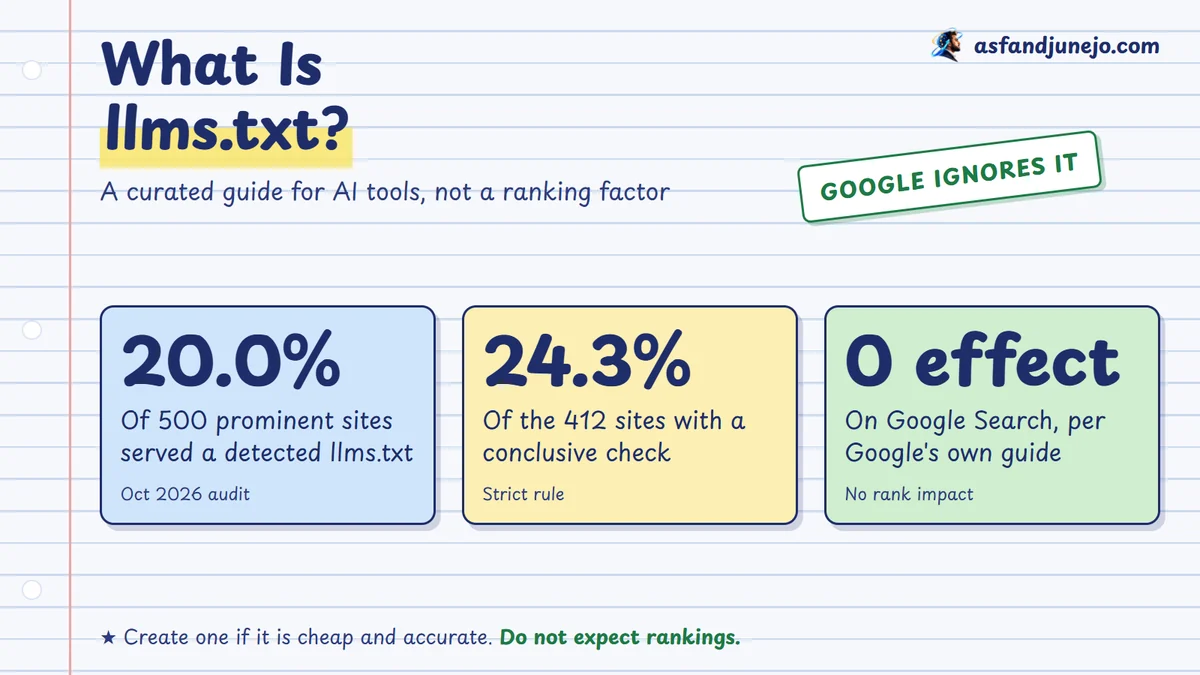
llms.txt is a proposed Markdown file that gives AI tools a short, curated guide to a website, and it does nothing for your Google rankings. Google says Google Search does not use it. In a sample of 500 prominent websites, 20.0% published one, led by software and marketing companies. This guide explains what it is, who uses it, what real files look like, and whether it is worth your time.
Published · Sources checked · By Asfand Yar Junejo, publisher asfandjunejo.com
What is llms.txt?
llms.txt is a proposed plain-text Markdown file at the root of a website (/llms.txt) that gives AI tools a short, curated guide to the site's most useful pages.
The proposal is published at llmstxt.org and is currently at version 2. The file has one required part, an H1 heading with the name of the site or project. It can then add a short summary in a blockquote, plain paragraphs, and H2 sections that hold lists of Markdown links, each with an optional note. A section named Optional marks links an AI tool can skip when it has little room.
A sitemap lists every page you want search engines to find. An llms.txt is meant to list only the pages that best explain the site, written in a form a language model can read quickly. That difference, a curated guide rather than a full inventory, is the whole idea.
Confirmed Format, required H1 and the Optional section are described on llmstxt.org (checked November 2, 2026). It calls itself a proposal, not a standard issued by a standards body.
Does Google use llms.txt, and does it help SEO?
No: Google says Google Search does not use llms.txt, so adding one will not change how your pages rank or appear in Google, and it will not harm them either.
Google's guide to optimizing for generative AI features in Search says you do not need to create AI text files, new markup or special files to appear in those features, and that Google Search itself doesn't use them. It adds that creating them for other services is fine and does not affect your Search visibility. So the honest SEO answer is that llms.txt is not a ranking factor in Google.
That leaves a narrower question: do any AI tools or developer workflows read the file? Some documentation platforms and coding tools do, and the AI labs publish their own for developer documentation. Whether a given assistant uses yours when it answers a customer question is not documented, and nobody outside those companies can prove it. Treat any claim that llms.txt gets you cited by ChatGPT or other assistants as unproven.
Confirmed Google's statement is in its generative AI optimization guide, last updated July 10, 2026.
Hypothesis Some AI tools may read a curated manifest; no major assistant has published a commitment to use llms.txt for ranking or citing ordinary websites.
How many websites publish an llms.txt?
In a purposive sample of 500 prominent websites checked in October 2026, 100 (20.0%) served a detected llms.txt file, and 24.3% of the 412 sites whose check was conclusive did.
These figures come from the AI-Crawler Access Audit 2026, which fetched /llms.txt from the same 500 websites it checked for robots.txt policy. The strict rule required a Markdown-like file served without an HTML content type. One more Markdown file was served with the wrong content type, 311 checks found nothing, and 88 could not be determined.
| Result | Websites | Share of 500 |
|---|---|---|
| Detected llms.txt (strict rule) | 100 | 20.0% |
| Markdown file served with a wrong content type | 1 | 0.2% |
| Absent or not a manifest | 311 | 62.2% |
| Inconclusive (bot walls, errors, timeouts) | 88 | 17.6% |
Because 88 checks were inconclusive, the audit reports bounds rather than a single number: 20.0% if none of them had a file, and 37.6% if all of them did. Those are missing-data bounds, not confidence intervals.
Directional A purposive sample of prominent sites, not the web. The audit measured whether a file exists, not whether any AI product reads it.
Which industries publish llms.txt?
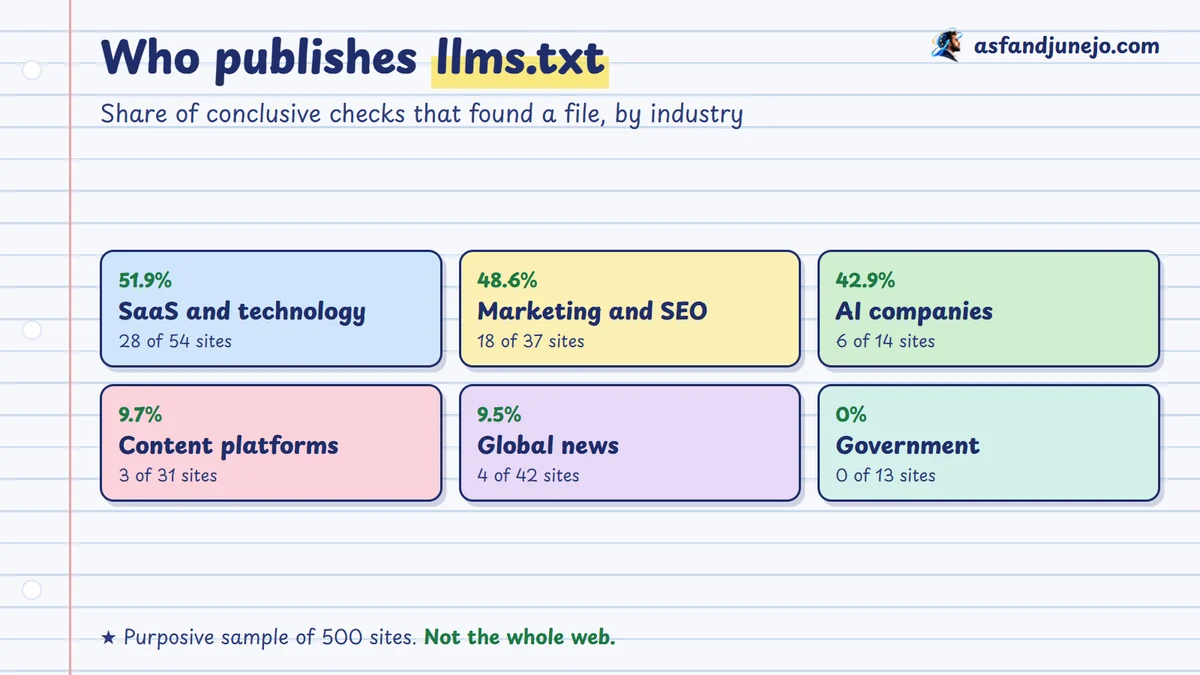
Software, marketing and AI companies lead, and news, government and content platforms trail, among the sites whose llms.txt check was conclusive.
| Industry bucket | Sites with a file | Conclusive checks | Share |
|---|---|---|---|
| SaaS and technology platforms | 28 | 54 | 51.9% |
| Marketing, SEO and media industry | 18 | 37 | 48.6% |
| AI companies | 6 | 14 | 42.9% |
| Finance, banking and insurance | 8 | 32 | 25.0% |
| E-commerce and retail | 9 | 37 | 24.3% |
| Travel, hospitality and airlines | 4 | 18 | 22.2% |
| Education and research | 4 | 26 | 15.4% |
| Healthcare and pharma | 3 | 24 | 12.5% |
| Content platforms and communities | 3 | 31 | 9.7% |
| Global news and media | 4 | 42 | 9.5% |
| Government and public sector | 0 | 13 | 0.0% |
Two regional samples were checked separately because they mix industries: Gulf and MENA sites had a file on 7 of 22 conclusive checks (31.8%) and Pakistan's top sites on 6 of 51 (11.8%). Small groups swing widely, so read these as descriptions of the sample, not of whole countries.
The pattern fits how the format is used. llmstxt.org notes that documentation platforms can generate the file automatically, and it is most useful where an AI tool or coding agent needs a clean map of developer documentation. News publishers, who block AI crawlers most often in the same audit, rarely publish one.
Directional Small buckets: in a group of 14 sites, one extra site moves the percentage by about 7 points.
What do real llms.txt files look like?
Most are tidy documents with an H1, a summary and a handful of link sections, but nearly half contain list items that are not links and the largest is a sitemap in all but name.
To learn from real files, this site's llms.txt validator was run over 92 files collected on October 21 and 22, 2026, from the same 500 websites. These are files that passed a basic structural test: readable text, and an H1 or at least one Markdown link.
| Finding | Files | Share of 92 |
|---|---|---|
| Starts with an H1, as the proposal requires | 87 | 94.6% |
| Has a blockquote summary right after the H1 | 73 | 79.3% |
| Has at least one H2 section of links | 85 | 92.4% |
| Has a list item that is not a Markdown link | 42 | 45.7% |
| Lists the same address more than once | 19 | 20.7% |
| Has at least one empty H2 section | 22 | 23.9% |
| Has more than one H1 | 10 | 10.9% |
The typical file is 8,581 bytes long, with 34 links under its H2 sections and 8 sections (medians). The spread is wide: six files list more than 1,000 links, and the largest lists 12,432, which is a sitemap wearing an llms.txt's clothes. That defeats the purpose of a curated guide.
Directional Counts follow this validator's rules, which are stricter than the audit's own structural test, so they do not match the audit's 100-file headline. The saved files are not yet published on this site.
Should you create an llms.txt?
Create one only if it is cheap and you can keep it accurate: it will not help your Google rankings, and its value elsewhere is unproven.
Think of it as optional machine-readable documentation for your own site, not as an SEO tactic. It makes the most sense when you run documentation or a product that developers and AI coding tools consult, when your platform generates the file for you, or when you want a stable page list that you can point other tools to.
It makes little sense as a substitute for the basics. Accessible canonical HTML pages, accurate navigation, a working sitemap and valid structured data come first, and they are what Google tells site owners to rely on. If your pages are blocked, slow or thin, a curated list of them will not fix that. The GEO vs AEO guide covers what to measure instead of chasing a file.
- Yes, consider it if your platform generates it automatically, or you maintain developer documentation
- Maybe if you can keep a short, accurate list of key pages current
- Skip it for now if you expect it to move Google rankings or guarantee AI citations; neither is supported
How do you write and publish an llms.txt?
Write a short Markdown file with one H1, a one-sentence summary, and a few H2 sections of described links, then serve it as plain text at your root.
- Name the site on the first line with a single H1 (
# Example Co). - Add one sentence in a blockquote saying what the site is and who it is for.
- Group your best pages under H2 headings such as Services, Evidence or Guides, one link per line in the form
[Name](https://example.com/page/): what it helps with. - Put lower-priority links under an H2 named Optional.
- Keep it short. Link the pages a newcomer needs, and leave the rest to your sitemap.
- Publish it at
/llms.txtand make sure it returns a text or Markdown file, not your homepage's HTML. - Validate it with the free llms.txt validator and check the saved file after every site redesign.
This site publishes its own llms.txt at asfandjunejo.com/llms.txt.
What are the common llms.txt mistakes?
Serving an HTML page instead of a file, listing thousands of links, leaving non-link bullets and empty sections, and expecting it to change rankings.
- An HTML page at the address. Many sites answer every unknown path with a web page. A request for
/llms.txtshould return a real file or a clean 404. Counting any 200 response as adoption inflates studies, which is why the audit applied a strict content-type rule. - A sitemap in disguise. Thousands of links is a list of every page, not a guide.
- List items that are not links. Plain bullets give a reader nothing to follow.
- Empty sections and repeated addresses make a file look unfinished.
- Stale links. A file that points to redirected or deleted pages is worse than none.
- Believing the hype. No document shows that an llms.txt raises citations, traffic or rankings.
Frequently asked questions
What is llms.txt?
llms.txt is a proposed Markdown file at a website's root that gives AI tools a short, curated guide to the site's most useful pages. It needs one H1 with the site name and can add a summary and H2 sections of links.
Does llms.txt help SEO?
No. Google says Google Search does not use llms.txt, so it does not help or harm your rankings in Google. Any value comes from other tools that choose to read it, which is not documented for ordinary websites.
Is llms.txt a standard?
No. It is a community proposal published at llmstxt.org, currently at version 2. It is not issued by a standards body, and no major AI provider has published a commitment to honour it for ranking or citing sites.
How many websites have an llms.txt?
In a purposive sample of 500 prominent websites checked in October 2026, 100 (20.0%) had a detected file, and 24.3% of the 412 conclusive checks did. The sample is not the whole web.
Which industries use llms.txt most?
In the same sample, SaaS and technology platforms (51.9% of conclusive checks), the marketing and SEO industry (48.6%) and AI companies (42.9%) lead. Global news (9.5%) and government (0 of 13) trail.
Where do I put the llms.txt file?
At the root of your domain so it loads at /llms.txt, served as plain text or Markdown. A request to that address should return the file, not an HTML page.
How long should an llms.txt be?
Short enough to be a guide. Among 92 real files the median was 8,581 bytes with 34 links under its sections. A file with thousands of links is a sitemap, not a curated guide.
How do I check my llms.txt?
Open yourdomain.com/llms.txt and confirm it shows a Markdown file, not your homepage. Then paste it into the free llms.txt validator on this site to check the H1, links, sections and duplicates.
Sources
- Google Search Central, Guide to optimizing for generative AI features on Google Search (opens in a new tab), last updated July 10, 2026.
- llmstxt.org, The /llms.txt file: a proposal to standardise on using an /llms.txt file (opens in a new tab) (version 2), checked November 2, 2026.
- Asfand Yar Junejo, AI-Crawler Access Audit 2026: What 500 Websites Reveal (opens in a new tab), version 3.1, published November 1, 2026.
- Asfand Yar Junejo, Free llms.txt validator, with an analysis of 92 real files (opens in a new tab), files collected October 21 and 22, 2026.