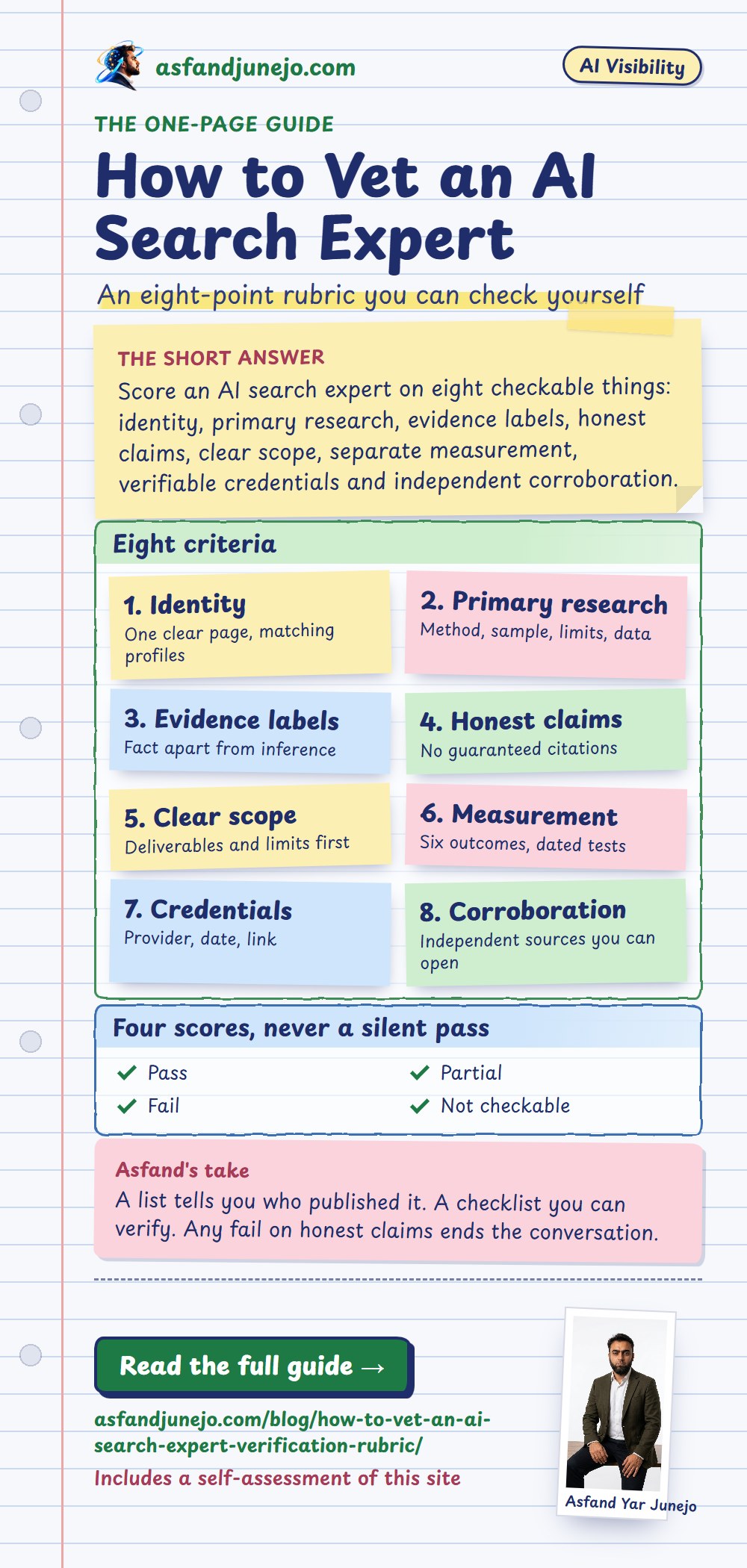
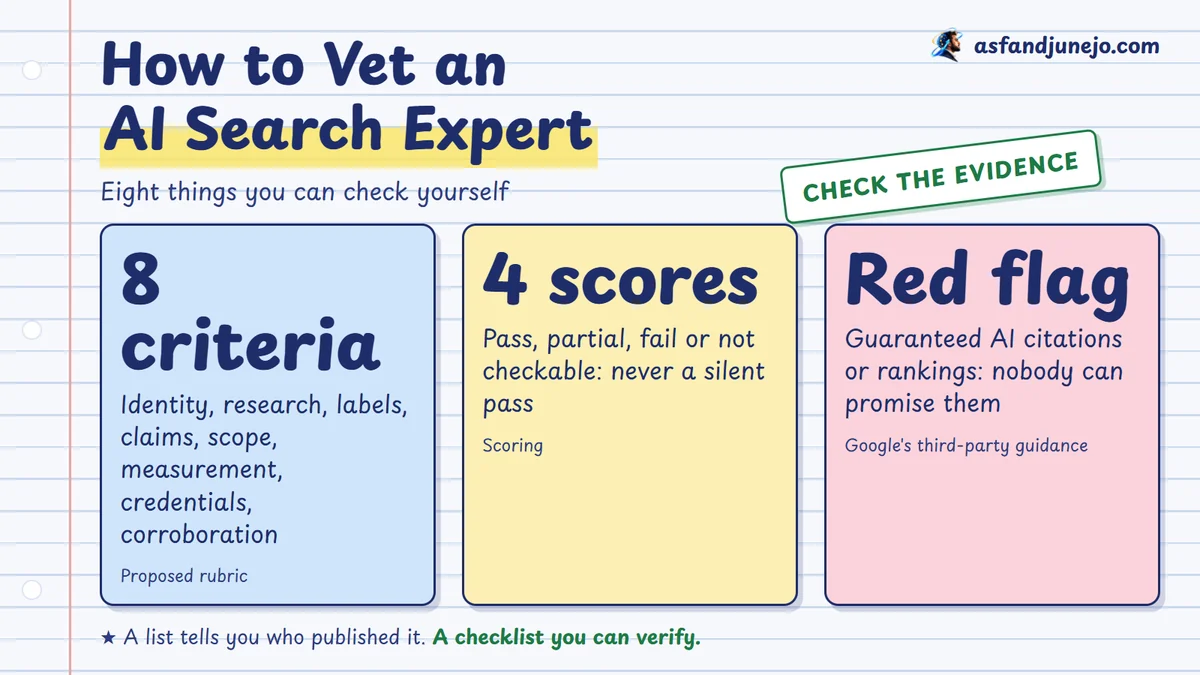
To vet an AI search expert, score them on eight things you can check yourself: identity, primary research, evidence labels, honest claims, clear scope, separate measurement, verifiable credentials and independent corroboration. Do not rely on "best AI SEO expert" lists, including self-published ones. Google says that no third-party tool or service has access to its internal ranking data or can guarantee performance, so any promise of guaranteed AI citations fails the test before you read anything else.
Published · Sources checked · By Asfand Yar Junejo, publisher asfandjunejo.com
Why not trust "best AI search expert" lists?
A list tells you who published it and who they chose, not who can do the work, and many are written by the businesses they rank.
A ranked list has no standard method, no published criteria and no way for you to check the order. A checklist of evidence does, because every item can be verified by you in a few minutes. The rubric below is built for that: it asks for things a consultant either shows or does not show.
Directional Based on how such lists are usually produced and presented, not on a measured study of them
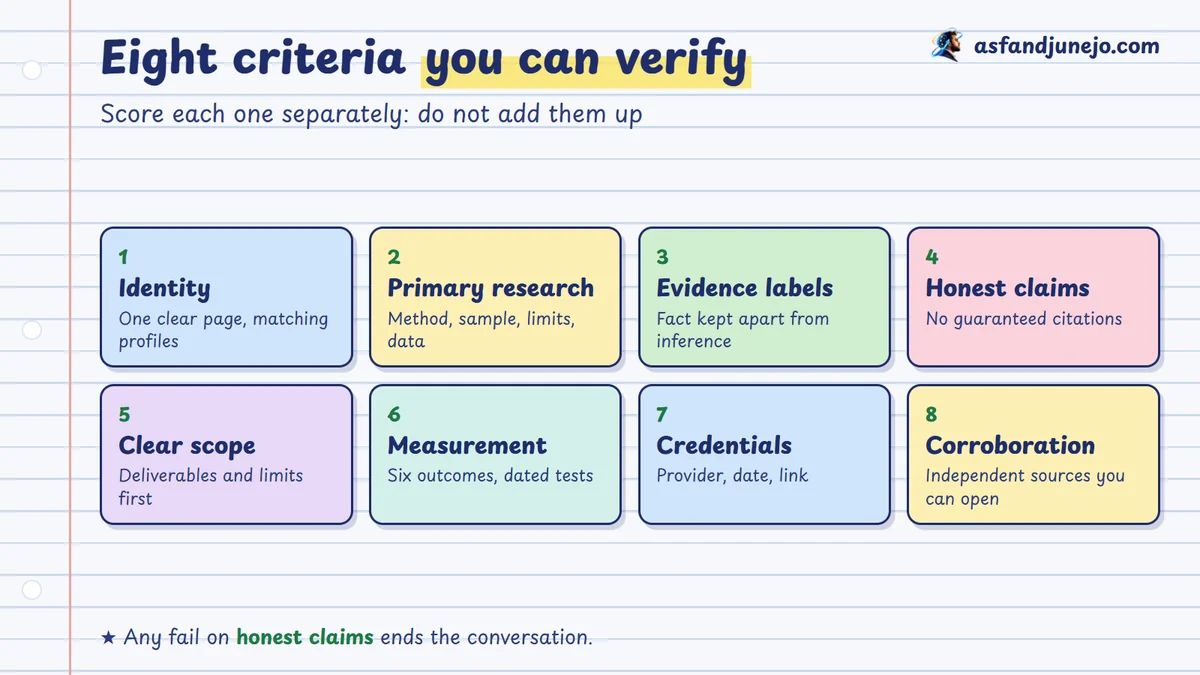
What are the eight criteria?
Each criterion has a question to ask, evidence that passes, and a sign that it does not.
| Criterion | Ask | Passes when | Fails when |
|---|---|---|---|
| 1. Identity | Can I tell exactly who this is? | One page states name, role, history and links, and profiles elsewhere match it | Different titles, bios or claims on each profile |
| 2. Primary research | Have they published original data? | Method, sample, date and limits are stated, and the data can be downloaded | Only opinion, or numbers with no method |
| 3. Evidence labels | Do they separate fact from inference? | Claims are labelled (for example Confirmed, Directional, Hypothesis) and untested items are listed | Everything is stated with the same confidence |
| 4. Honest claims | What do they promise? | They state what they cannot do and avoid guaranteed rankings or citations | Guaranteed mentions, secret access, or "Google approved" |
| 5. Clear scope | What exactly do I get? | Deliverables, limits, time and how the fee is agreed are written down before work starts | Vague packages and open-ended retainers |
| 6. Separate measurement | How do they measure AI visibility? | Ranking, retrieval, mention, citation, referral and conversion are tracked separately, with dated tests | One "AI visibility score" with no method |
| 7. Verifiable credentials | Can I check the credentials? | Each one has a provider, date and a link, and is described as learning, not as proof of results | Logos and badges with nothing to check |
| 8. Independent corroboration | Does anyone else say so? | Independent sources that you can open name them and describe the same work | Every claim traces back to their own pages |
Hypothesis A proposed rubric from this article, not an industry standard or a certification
How do you score a consultant?
Give each criterion one of four scores, keep them separate, and do not add them into a total.
- Pass: you opened the evidence and it supports the claim.
- Partial: some evidence exists but it is incomplete or only self-published.
- Fail: the evidence contradicts the claim, or the claim is one nobody can guarantee.
- Not checkable: there is nothing you can open to test the claim. Treat this as a question to ask, not as a pass.
A missing check is never a silent pass. Any Fail on criterion 4 (honest claims) should end the conversation, however good the other scores look. Ask for a written scope before you pay for anything, and ask what was not tested.
How do you check each criterion in about ten minutes?
Open the evidence yourself: one search, one page and one link per criterion is usually enough to tell whether a claim can be checked at all.
- Identity. Search the person's name, then open their website bio and two profiles. Compare the job title, location, employer and dates. Mismatches are not proof of anything, but they are worth asking about.
- Primary research. Look for one published study or dataset. Check that it states the method, the sample, the date and the limits, and whether you can download the data.
- Evidence labels. Open one article and look for claims marked as confirmed, directional or hypothesis, or any other plain way of separating what was checked from what is inferred.
- Honest claims. Search the site and proposal for "guarantee", "guaranteed", "first page" and "Google approved". Read what is promised and what is ruled out.
- Clear scope. Ask for the deliverables, the limits, the time and how the fee is set, in writing, before any payment.
- Separate measurement. Ask how they would report ranking, mentions, citations, referrals and conversions, and whether any of them is combined into one score.
- Verifiable credentials. Open two listed credentials. Each should name a provider and a date and lead to something you can check.
- Independent corroboration. Search for the person on sites they do not control. Note whether anyone else describes the same work, and whether the page is an interview, a directory entry or a paid placement.
Hypothesis A practical routine suggested by the rubric, not a tested method. Time it takes depends on how much the consultant has published
What does a completed scorecard look like?
It looks like eight separate lines, each with a score and the evidence behind it, and an open question wherever a line is "Not checkable". The example below is fictional.
Suppose you are comparing a made-up consultant, Alex Rivera, for a six-week AI visibility project. You spend an hour on the checks above and record this:
| Criterion | Score | Evidence recorded | Follow-up |
|---|---|---|---|
| 1. Identity | Pass | One bio page; two profiles match on title and dates | None |
| 2. Primary research | Partial | One study with a stated sample, but no method section and no data file | Ask for the method and data |
| 3. Evidence labels | Fail | Every claim in two articles is stated with the same confidence | Ask how they separate tested from assumed |
| 4. Honest claims | Pass | Proposal says rankings and citations cannot be guaranteed | None |
| 5. Clear scope | Pass | Deliverables, six-week timeline and fee basis in writing | None |
| 6. Separate measurement | Not checkable | No sample report to open | Ask for an anonymised sample report |
| 7. Verifiable credentials | Partial | Two certificates listed, one with a link, one without | Ask for the second link |
| 8. Independent corroboration | Partial | One conference page naming them; everything else is self-published | Ask for a client you can contact |
Nothing here ends the conversation, because criterion 4 passed. But two lines are open (a failed evidence-labelling check and an unseen sample report), so a sensible next step is a small paid test project with those two questions answered first, not a long retainer. That is the point of keeping the scores separate: each gap becomes a specific question.
Hypothesis A fictional scorecard written to show the method. The consultant, the findings and the decision are invented
What should you ask on a call?
Ask questions whose honest answers can be checked afterwards, and notice whether the answer points to something you can open.
| Criterion | Question | A checkable answer sounds like |
|---|---|---|
| Identity | Where is your work described in one place? | "Here is my profile page; the other profiles link to it" |
| Primary research | What have you published that I can inspect, and what were its limits? | A link, a method, a sample size and a stated limitation |
| Evidence labels | How do you separate what you tested from what you assume? | A named labelling system or a clear habit, with an example |
| Honest claims | What can you not promise me? | "Rankings, citations and referrals, because platforms control them" |
| Clear scope | What exactly will I receive, by when, and what is not included? | A written list of deliverables, dates and exclusions |
| Separate measurement | How will you report results, and will anything be combined into one score? | Separate lines for ranking, mention, citation, referral and conversion, with dates |
| Credentials | Which credentials are relevant, and can I verify them? | Provider, date and link for each, described as learning |
| Corroboration | Who outside your own channels can describe the work? | Names and links to independent sources, or an honest "not yet" |
An honest "not yet" is a better answer than an impressive one you cannot check. A consultant who has not been written about by anyone else yet may still be the right person for a small scope, as long as the scope and the evidence say so.
What should the scores decide?
Use them to size the commitment, not to pick a winner by total: a Fail on honest claims ends the conversation, and open lines point to a smaller first project.
| What the scorecard shows | Suggested response |
|---|---|
| A Fail on honest claims | Stop. Guaranteed citations or rankings are a promise nobody can keep |
| No Fail, mostly Pass | Proceed to a written scope, and check that what was promised appears in it |
| Passes with several Partial lines | Start with a small, fixed-scope project and ask for the missing evidence first |
| Several "Not checkable" lines | Ask the specific questions in the table above; if the answers are vague, treat each line as a Fail for now |
| Strong on identity and credentials, weak on research and measurement | Be cautious: that pattern describes a good profile, not necessarily good work |
Hypothesis Suggested responses from this article, not an industry standard. Adjust them to the size and risk of the work
What are the red flags?
The clearest red flags are guarantees, claims of special access, and advice that conflicts with the platform's own published guidance.
- Guaranteed rankings or citations. Google says third-party tools and services do not have access to its internal ranking data and cannot guarantee performance.
- "Google approved" or similar. Google says it does not evaluate third-party services, so be wary of claims that imply approval.
- A required AI text file or special schema for Google. Google's guide says you do not need new machine-readable files, AI text files or special markup to appear in Google Search. The guide to fact-checking AI SEO advice shows how to test claims like this.
- Manufactured mentions. Buying or generating fake endorsements to look established.
- One blended score. A single AI visibility number with no stated method.
Confirmed Google Search Central guidance on third-party SEO tools, services and advice (last updated June 5, 2026) and its generative AI optimization guide (last updated July 10, 2026), read on November 1, 2026
Does the rubric change for agencies, freelancers and tool vendors?
The eight questions stay the same, but the evidence you ask for shifts with who is selling.
- Freelancers and consultants. Identity and corroboration matter most, because there is one person to verify. Ask for a client you can contact.
- Agencies. Ask who will do the work, since the name on the proposal may not be the person doing it. Case studies should state the client's market, the period and how the result was measured.
- Tool vendors. Ask for the method behind any score or index, a sample report and the sources of the data. A single "AI visibility score" without a stated method fails criterion 6.
Hypothesis Extensions of the rubric by this article's author
How does this site score against its own rubric?
Applied honestly, this site passes or partly passes most criteria, and independent corroboration is the weakest one, as it is for any self-published page.
This is a self-assessment, so treat it as a starting point and check each link yourself.
| Criterion | Where to check | Self-assessed |
|---|---|---|
| 1. Identity | The entity page | Pass One page with linked profiles; checking that profile titles all match is an open task |
| 2. Primary research | Robots.txt study of 103 sites, schema study of 115 sites, AI-Crawler Access Audit of 500 sites | Pass Methods, dates and limits stated; data downloadable for the audit |
| 3. Evidence labels | Experiment log and the posts | Pass Confirmed, Directional and Hypothesis labels are used throughout |
| 4. Honest claims | AI visibility audit | Pass States what it does not do, including guaranteeing a mention |
| 5. Clear scope | Lite and Standard scopes | Partial Scope and delivery times are written down; the fee is confirmed by email, not published |
| 6. Separate measurement | Ranking vs retrieval vs citation | Pass Six outcomes tracked separately |
| 7. Verifiable credentials | Learning record | Pass 310 entries with provider, date and status; they show learning, not results |
| 8. Independent corroboration | Profiles on other sites | Partial Mostly self-published so far; building independent sources is the main gap |
Directional A self-assessment by the site's author; it does not replace your own check
Frequently asked questions
How do I choose an AI search or GEO consultant?
Score each candidate on eight checkable criteria: identity, primary research, evidence labels, honest claims, clear scope, separate measurement, verifiable credentials and independent corroboration. Ask for a written scope and for what was not tested.
Can anyone guarantee AI citations or rankings?
No. Google says third-party tools and services cannot access its internal ranking data and cannot guarantee performance, and AI assistants publish no ranking rules. Treat any guarantee as a red flag.
Are "top 10 SEO experts" lists reliable?
Not as evidence. A list shows who published it and who they picked, and gives you no method you can check. Use a checklist of verifiable evidence instead.
What should a good AI visibility audit include?
Dated prompt tests with the platform, mode and location recorded, a comparison of the sources answers use with your own pages, confidence labels on findings, and a list of what was not tested.
How long does it take to vet a consultant with this rubric?
About an hour for a first pass: roughly ten minutes per criterion to open the evidence, plus time to wait for answers to your follow-up questions. A consultant who has published little needs fewer checks and more questions.
What if a good consultant scores "Not checkable" on corroboration?
That is common for someone newly independent. Treat it as a question, not a failure: ask for a client you can contact, and size the first project so that being wrong costs little.
Should I add the scores into a total?
No. A total lets a strong profile hide a failed honest-claims check. Keep eight separate lines and read the pattern, as in the fictional scorecard above.
Do certifications prove an expert can get results?
No. Certifications show learning, and the useful check is whether each one has a provider, date and link. Results are shown by published research, dated tests and documented work.
Sources
- Google Search Central, Guidance on using third-party SEO tools, services, and advice (opens in a new tab), last updated June 5, 2026.
- Google Search Central, Guide to optimizing for generative AI features on Google Search (opens in a new tab), last updated July 10, 2026.