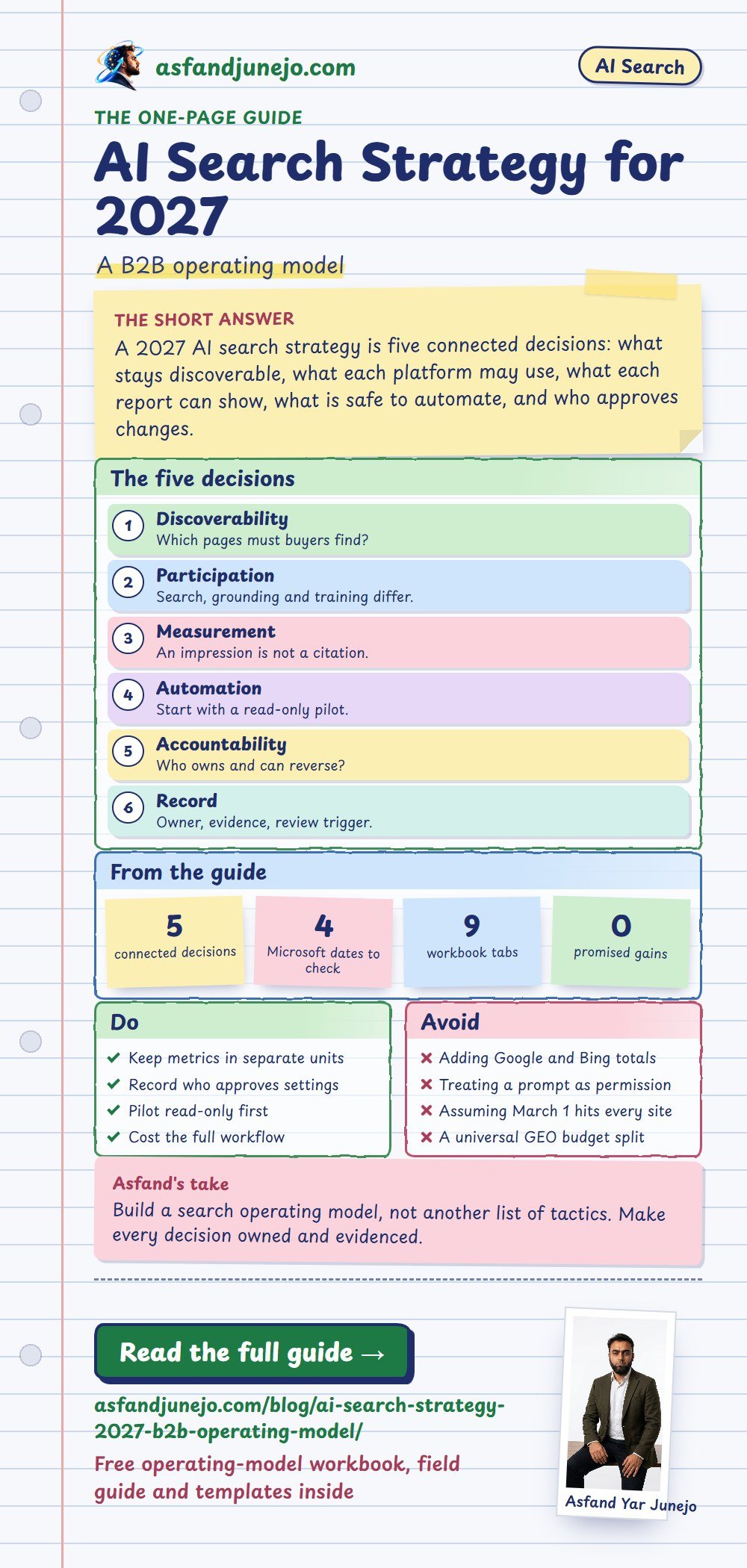
An effective AI search strategy for 2027 requires B2B organizations to coordinate traditional search engine optimization, generative search visibility, publisher participation controls, reliable measurement, and accountable automation. The objective is not simply to appear more frequently in AI-generated answers. It is to establish a search operating model that helps the business become discoverable through relevant platforms, provide accurate information to potential buyers, measure observable outcomes, and make justified decisions about technology, resources, and commercial priorities.
Published · Sources checked · By Asfand Yar Junejo, publisher asfandjunejo.com
This distinction matters because AI search is increasingly discussed as though it were one platform, one optimization discipline, or a replacement for traditional SEO. It is none of those things. Google Search, Bing, ChatGPT, and other AI-assisted discovery systems expose different capabilities, use different information-processing methods, and provide different levels of visibility into their results. A website can be indexed by Google without appearing in a particular AI Overview. An AI assistant can mention a business without linking to its website. A cited source can receive no measurable referral traffic. A referral can produce a commercial inquiry without proving that a particular AI-generated answer caused the conversion.
During 2026, several developments made these differences more important. Google introduced generative AI performance reporting (opens in a new tab) and a Search generative AI participation control (opens in a new tab). Microsoft expanded AI citation reporting (opens in a new tab) and announced new preferences separating AI grounding from model training (opens in a new tab). OpenAI introduced Businesses in ChatGPT (opens in a new tab) in beta, allowing eligible organizations to manage business information and access available engagement insights.
Meanwhile, AI agents connected to analytics platforms, technical crawlers, content management systems, and business applications created new opportunities to automate repetitive marketing work. These developments introduce operational decisions that conventional SEO planning does not fully address. A marketing leader preparing for 2027 must determine which discovery environments matter to the business, which content-use permissions are appropriate, what available metrics establish, and which responsibilities can safely be delegated. The organization must also decide whether those capabilities should be maintained internally, supported through external specialists, or delivered through governed automation.
The central challenge for 2027 is therefore not choosing between SEO, AEO, and GEO. It is building a search operating model in which visibility, evidence, technology, and accountability reinforce one another.
This guide distinguishes documented capabilities from predictions, separates technical eligibility from observed search performance, and explains how B2B organizations can evaluate automation and delivery-model investments without relying on unsupported promises. A continuous hypothetical enterprise software example demonstrates the decisions. The scenario is illustrative; it does not represent an observed client engagement or measured gains in rankings, AI citations, or revenue.
The operating-model workbook, executive field guide and decision templates behind this guide are free for Search Signals subscribers.
What are the key takeaways?
Build one accountable search operating model for 2027 instead of choosing between SEO, AEO and GEO: decide what must be discoverable, what each platform may use, what each report can and cannot show, what can be automated safely, and who approves changes.
- Keep Google AI impressions, Bing citations, ChatGPT mentions, referrals and qualified leads as separate events. Never add unlike metrics into one total.
- Search participation, AI grounding, model training and business identity are different controls, so keep a register with an owner for each.
- Microsoft's March 1, 2027 deadline is conditional on legacy NoArchive or NoCache use. It does not apply to every site.
- Start automation with a read-only, bounded pilot. A prompt that asks for approval is not a permission system.
- Choose in-house, agency, managed automation or hybrid on full operating cost and accountability, not on a universal budget split.
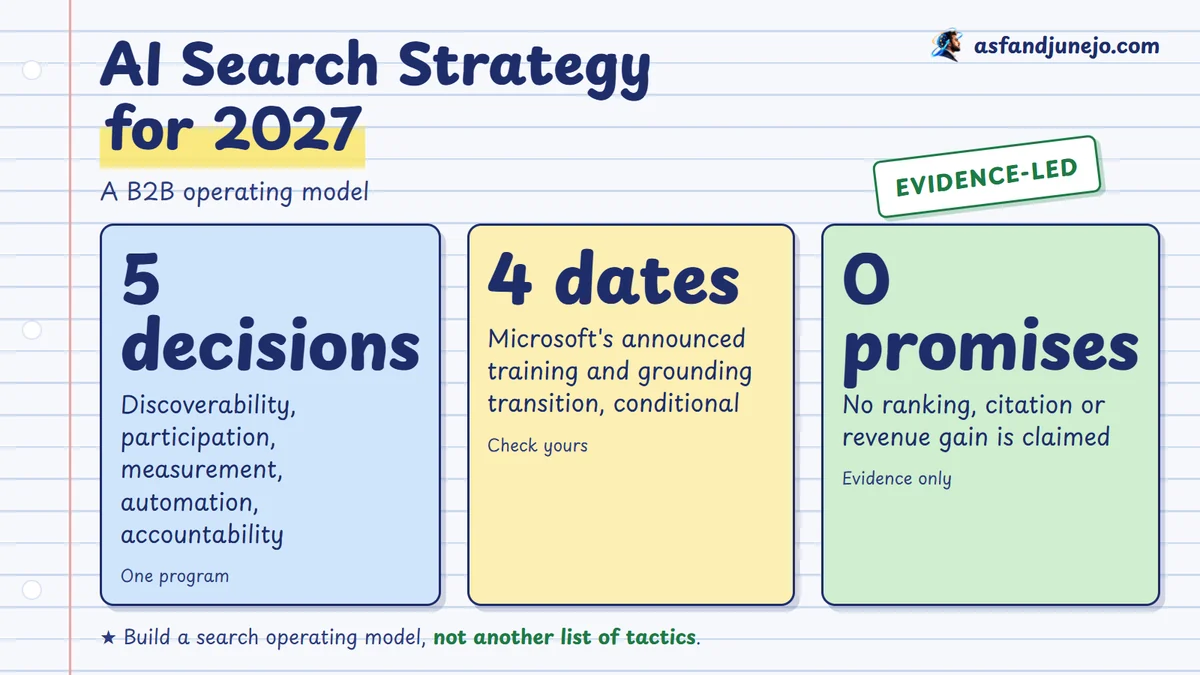
- The enterprise software company is fictional. No ranking, citation or revenue gain is claimed.
What are the five decisions behind a 2027 AI search strategy?
| Strategic decision | Question | Required evidence or output |
|---|---|---|
| Discoverability | Where should buyers find and evaluate the business? | Search-surface and priority-content inventory |
| Participation | Which search, grounding, and training settings fit business requirements? | Publisher-control decision register |
| Measurement | What can each platform observe, and what remains unknown? | Multi-platform measurement contract |
| Automation | Which recurring tasks can be delegated at acceptable risk? | Bounded automation assessment |
| Accountability | Who owns, executes, approves, and maintains each capability? | Search operating-model and ownership matrix |
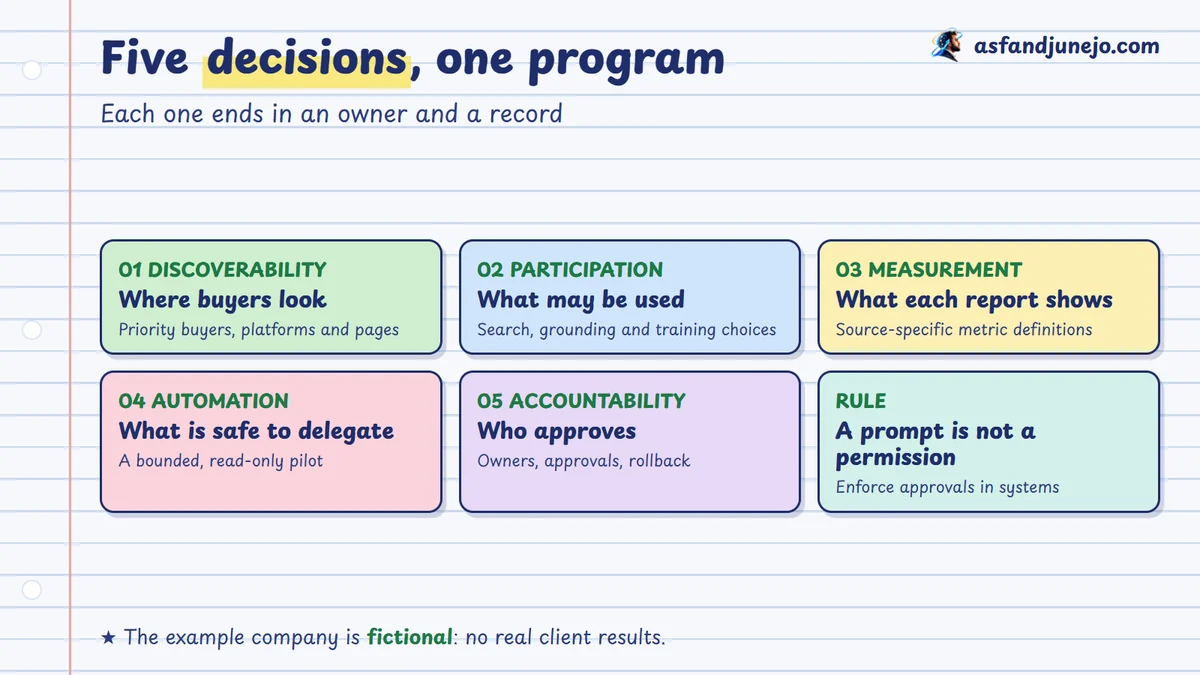
These decisions are connected but should not be collapsed into a universal AI readiness score. A company may have strong technical SEO while lacking reliable AI citation reporting. Another may have extensive monitoring but no validated connection between search interactions and qualified pipeline. A third may automate reporting efficiently while relying on unverified explanations. Each requires a different response: identify the constraint and authorize the work most likely to resolve it.
What is established about AI search entering 2027?
AI search strategy entering 2027 should be based on documented platform capabilities, established search fundamentals, and clearly labeled forecasts. New generative search features do not establish that traditional search will disappear or that AI assistants follow one universal retrieval architecture.
Annual SEO forecasts often combine released capabilities, announced future changes, and predictions about adoption or advertising. Those categories require different levels of confidence. A reporting feature can be verified through its current documentation. An announced transition can inform conditional implementation planning. A prediction that an interface will replace conventional search cannot be treated as an established outcome.
The important developments from 2026
| Platform | Documented development | Strategic implication |
|---|---|---|
| Dedicated Generative AI Performance reporting in Search Console | Evaluate supported AI Search exposure distinctly from conventional performance measures | |
| Search generative AI participation control | Assign responsibility for publisher participation decisions | |
| Bing | AI Performance reporting and thematic insights | Monitor supported AI citation and grounding-related observations |
| Microsoft | Separate AI training and grounding preferences | Review content-use decisions and applicable 2027 transition requirements |
| OpenAI | Businesses in ChatGPT | Evaluate business information, identity ownership, and engagement reporting |
| MCP ecosystem | July 2026 protocol updates | Reassess integration architecture, authorization, and operational controls |
These developments do not establish that every business must adopt every available capability. They do show that search planning includes platform participation, information governance, and evidence collection beyond conventional ranking reports.
Traditional search remains relevant
AI-powered interfaces can change discovery without eliminating the importance of search infrastructure. Google continues to use established search systems to support its AI Search experiences. Microsoft's supported AI experiences can use web information through grounding. Other applications may use external search services, direct retrieval, connected business data, or previously learned information. These mechanisms are not identical, and their implementation may change.
Therefore, appearing prominently in conventional search does not guarantee inclusion in every generated answer. A citation likewise does not establish a particular conventional ranking position. For planning, separate discovery, access, indexing, selection, citation or representation, referral, and commercial outcome. These stages are analytical distinctions, not a mandatory sequence followed by every AI system.
The related article Ranking, Retrieval, and Citation: Why Measure Them Separately? examines those measurement boundaries in detail. This guide addresses the organizational decisions they create.
SEO, AEO, and GEO overlap
SEO generally concerns content accessibility, usefulness, relevance, and visibility in search engines. Answer Engine Optimization (AEO) commonly emphasizes representation in answer-oriented experiences. Generative Engine Optimization (GEO) frequently refers to visibility in generative search and AI-assisted discovery. These are practical working definitions, not universally standardized categories.
A B2B company should avoid building three disconnected teams that repeatedly investigate the same technical and content issues. For example, accurate product documentation may support both traditional search and relevant AI retrieval, but neither benefit is guaranteed. Google's guidance for AI features in Search (opens in a new tab) continues to emphasize established SEO practices and says special AI-specific schema is not required to appear in covered generative Search experiences. See also Schema Markup for AI Search: What It Can and Cannot Do.
Confirmed Google's AI features page says there are no additional requirements to appear in AI Overviews or AI Mode, and that no special schema.org markup, new machine-readable files or AI text files are needed (checked November 21, 2026)
What remains uncertain about 2027?
There is no verified date on which conversational AI will replace traditional search. Platforms have not disclosed complete formulas for whether every brand will be cited or recommended. No universal SEO-versus-GEO budget allocation is defensible across every B2B organization. Agency automation economics and future AI advertising features likewise remain conditional.
| Evidence category | Meaning | Planning treatment |
|---|---|---|
| Established | Supported by released product or current official documentation | Include in operating plans with a source and date |
| Announced or emerging | Documented but subject to future rollout, eligibility, or implementation limits | Prepare conditionally; recheck before deployment |
| Directional | Plausible but unconfirmed future development | Monitor without building critical dependencies on it |
A resilient strategy should remain useful even when a forecast does not materialize.
Which search capabilities should B2B organizations preserve?
B2B AI search programs should preserve technical accessibility, accurate information, useful content architecture, credible third-party representation, and clear ownership of digital assets. These capabilities support multiple discovery environments without guaranteeing citations or recommendations.
The risk of adopting AI optimization workflows is that organizations may divert resources from unresolved foundational problems. A company can invest in citation monitoring while important documentation is blocked from indexing, publish comparisons while product specifications remain inaccurate, or purchase analytics without defining the business decisions they support.
Technical eligibility is necessary, not sufficient
Important resources should be evaluated for intended discovery environments. For an enterprise software provider, these may be product pages, API documentation, integration guides, security details, and service resources. Technical verification should distinguish crawler access, HTTP responses, rendered content, indexing directives, canonical relationships, and platform-specific participation settings. Successful access does not demonstrate that a source was selected or cited.
The detailed implementation method belongs in AI Search Visibility Audit: Technical Eligibility Checklist. The executive decision here is which content deserves priority verification because it supports important buyer tasks.
Information quality matters beyond extractability
An accessible product page may fail to explain supported integrations, prerequisites, limitations, or deployment conditions. A technical guide may be accurate but omit relevant versions or scope. Important B2B claims should be supported by approved product documentation or other appropriate evidence. A support claim requires a different evidentiary basis than a subjective claim of category leadership.
Clarity helps buyers and reduces the chance that important information is misunderstood when summarized outside the original page. However, the goal is accurate and useful content, not manipulating a hypothetical passage-extraction formula. For buyer-question mapping and content production, see B2B AI search content strategy. This guide stays at the executive operating-model level.
Third-party corroboration is a credibility task
B2B buyers may consult partners, reviews, product directories, technical communities, and independent publications. If the vendor says an integration is generally available while a partner says it is beta-only, the contradiction deserves investigation. Correcting it improves factual reliability for people and potentially for retrieval systems, but does not prove a particular weighting in an undisclosed AI recommendation algorithm. The objective is credible representation, not fabricated consensus.
The AI-Crawler Access Audit 2026 on this site reports original research on crawler policies across a purposive set of websites. Because that sample was not random, its findings should not be generalized into population-wide prevalence estimates. Its relevance here is to demonstrate why site policies must be inspected rather than assumed.
Assign ownership to foundational capabilities
| Capability | Primary responsibility | Required evidence |
|---|---|---|
| Technical eligibility | SEO and engineering | Verified URL and configuration records |
| Product information | Product marketing | Approved specifications and documentation |
| Third-party consistency | Brand and communications | Investigated material discrepancies |
| Publisher controls | Marketing leadership with governance stakeholders | Approved participation choices |
| Measurement | Analytics and marketing operations | Defined metrics and data-quality checks |
| Production changes | Engineering or authorized publishing owner | Change approval and deployment verification |
Role titles may differ, but no consequential setting or claim should become unowned because multiple departments depend on it.
How should publishers manage AI search participation, grounding, and training?
Publisher governance in 2027 should distinguish conventional indexing, generative search participation, AI grounding, model training, and business-profile management. These uses are not interchangeable and are not controlled universally by one directive.
Google's generative AI participation control
Google provides a Search generative AI control (opens in a new tab) for eligible property owners to manage inclusion in specified AI Search features, including covered AI Overviews, AI Mode, and relevant Discover experiences. The control is distinct from Google-Extended, which relates to specified AI training uses. Changing one should not be represented as automatically changing the other or improving conventional rankings.
A B2B company's decision should reflect commercial objectives, content rights, and applicable governance requirements. Record the approved choice, relevant Search Console property, owner, implementation state, and verification. Treat unchanged settings as reviewed decisions when appropriate.
Microsoft's 2027 training and grounding transition
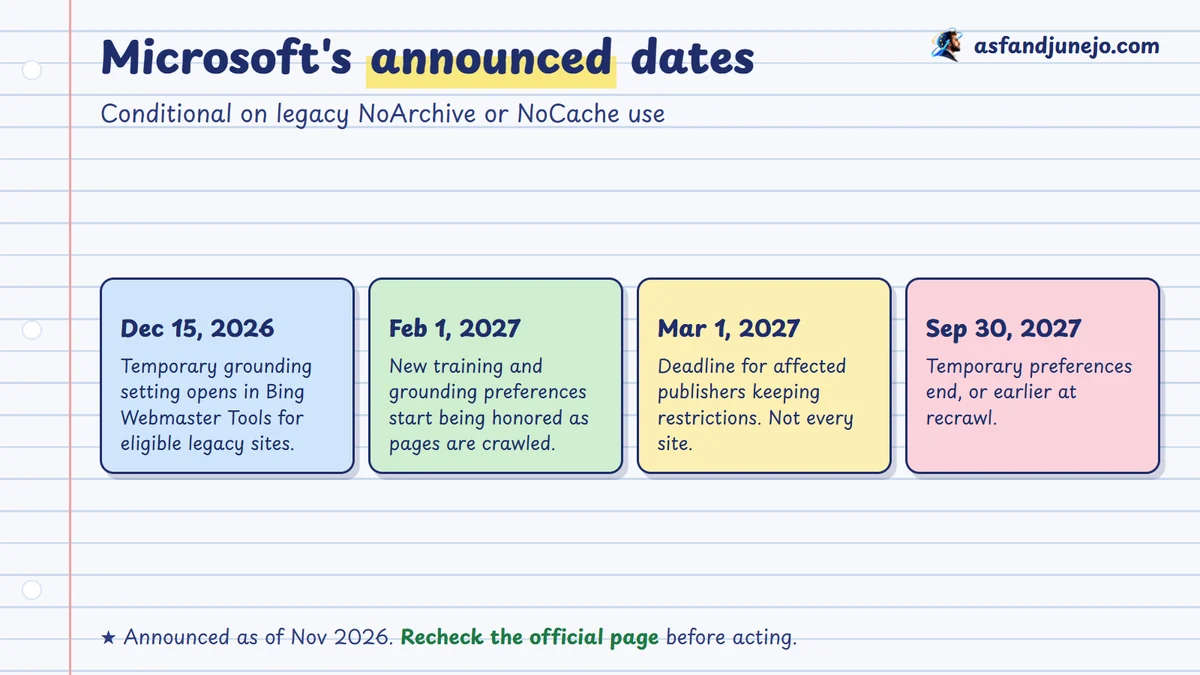
On October 30, 2026, Microsoft announced separate preferences for AI training and AI grounding (opens in a new tab). Training and grounding are different uses: one concerns development of models; the other concerns retrieval of current content to support generated responses. The announced transition has special conditions for publishers using legacy NoArchive or NoCache directives.
| Date | Announced milestone | Applicability |
|---|---|---|
| December 15, 2026 | Temporary grounding-transition setting becomes available | Sites matching specified legacy conditions |
| February 1, 2027 | Microsoft begins honoring new training/grounding preferences as pages are crawled | Publishers implementing the relevant preferences |
| March 1, 2027 | Deadline for affected publishers maintaining specified restrictions | Relevant legacy NoArchive/NoCache configurations |
| September 30, 2027 | Remaining temporary grounding preferences expire, subject to earlier recrawl | Sites relying on that temporary arrangement |
The March 1 deadline does not apply indiscriminately to every website. Affected publishers must check the precise required combination of page-level preferences and temporary Bing Webmaster Tools settings, and confirm recrawl expectations. Implementation note: These are announced dates as checked in November 2026, not proof of future processing. Verify the current official documentation before deployment.
Confirmed Microsoft's October 30, 2026 announcement says the new training and grounding preferences are honored from February 1, 2027; that publishers using NoArchive or NoCache should act by March 1, 2027; that temporary grounding preferences open in Bing Webmaster Tools on December 15, 2026 for sites using those directives as of that date; and that they last until recrawl or September 30, 2027, whichever is earlier (checked November 21, 2026)
Businesses in ChatGPT introduces identity governance
Businesses in ChatGPT (opens in a new tab), introduced in beta on November 10, 2026, lets eligible organizations claim and manage business information in Business Hub and view applicable engagement insights. It is a managed platform identity, not a robots directive. Setup introduces responsibilities for verification, authorization, delegated access, recovery, and information accuracy. Agencies can assist, but clients should retain appropriate control over their business identities.
Claiming a business is not a guarantee of favorable recommendations. Refer to OpenAI's setup guidance (opens in a new tab) for eligibility and currently available functionality.
Confirmed OpenAI's November 10, 2026 announcement describes Businesses in ChatGPT as a beta and says insights such as mentions, website clicks and discovery topics are aggregated, appear only when thresholds are met, and do not share users' conversations (checked November 21, 2026)
Use a publisher-control register
| Field | Record to preserve |
|---|---|
| Platform and property | The relevant provider, domain, property, or business identity |
| Control purpose | Search participation, grounding, training, or profile management |
| Current condition | Observed setting with date and source |
| Approved preference | Business decision and rationale |
| Authority | Person or team authorized to approve |
| Verification | Deployment evidence and any observable processing |
| Review trigger | Policy, contract, product, or organizational change |
A permissive configuration does not guarantee citations. A training restriction does not necessarily restrict conventional indexing. A platform-specific grounding preference does not govern unrelated systems. The required outcome is a documented understanding of what the business permits and what can actually be observed.
Confirmed Google's help pages say the Generative AI performance report covers AI Overviews and AI Mode, is built around impressions and includes data from the Web search type; and that the Search generative AI control does not affect AI training (Google-Extended does) and is not a ranking or inclusion signal for other parts of Search. Both were rolled out to all websites worldwide as of August 31, 2026 (checked November 21, 2026)
How should B2B teams measure AI search performance?
AI search measurement should preserve the distinctions between indexing, impressions, citations, brand mentions, website referrals, qualified leads, and revenue. These are different events and should not be combined into an undefined "AI visibility" number.
Google Search Console: generative AI impressions
Google's Generative AI Performance report (opens in a new tab) provides supported generative Search impressions, including covered AI Overviews and AI Mode. An impression does not establish a visit, recommendation, or purchase. The dedicated data relates to activity included in broader Search reporting, so analysts must avoid double counting. Preserve property, date range, dimensions, filters, aggregation, and data completeness.
Bing Webmaster Tools: citations and grounding themes
Microsoft's AI Performance report (opens in a new tab) describes supported publisher citation activity across specified Microsoft experiences. The Topics Portfolio beta (opens in a new tab) groups grounding-related queries thematically; its approximate and AI-generated classifications should not be presented as complete demand measurements. Citation observations do not independently establish referral traffic or qualified pipeline.
Businesses in ChatGPT: aggregate engagement
OpenAI's business setup documentation (opens in a new tab) describes applicable aggregate reporting such as mentions, website clicks, and discovery topics, with product-specific definitions and availability conditions. A brand name appearing in an answer may not meet the reporting definition of a website-linked mention. Topic summaries are not individual customer prompt transcripts. Empty or missing metrics may reflect product thresholds or availability rather than proof of zero activity.
Analytics and CRM: commercial outcomes
Website analytics may record visits from identifiable AI referrals, but referrer handling, tracking, and channel classification limit completeness. CRM records may show inquiries, qualified opportunities, and revenue without establishing that a particular unseen AI answer caused a purchase. B2B journeys often involve many stakeholders and channels. Recorded attribution is not automatically experimental proof of incrementality.
A multi-platform measurement contract
| Source | Observable evidence | Limitation | Useful decision |
|---|---|---|---|
| Google Search Console | Search performance and supported generative AI impressions | Exposure does not equal a click or conversion | Investigate reach and change |
| Bing Webmaster Tools | Supported AI citation and grounding observations | Scope and estimates depend on platform methodology | Evaluate thematic presence |
| ChatGPT Business Hub | Available aggregate mentions, clicks, topics | No individual prompt-level transcript visibility | Review business representation and engagement |
| GA4 or equivalent | Recorded sessions and website events | Untracked interactions remain invisible | Evaluate on-site behavior |
| CRM | Qualified leads, opportunities, revenue | Attribution needs an explicit method | Examine commercial outcomes |
| Controlled prompt observations | Specific responses and visible references | Small or selected prompts may be nonrepresentative | Investigate answer accuracy and variability |
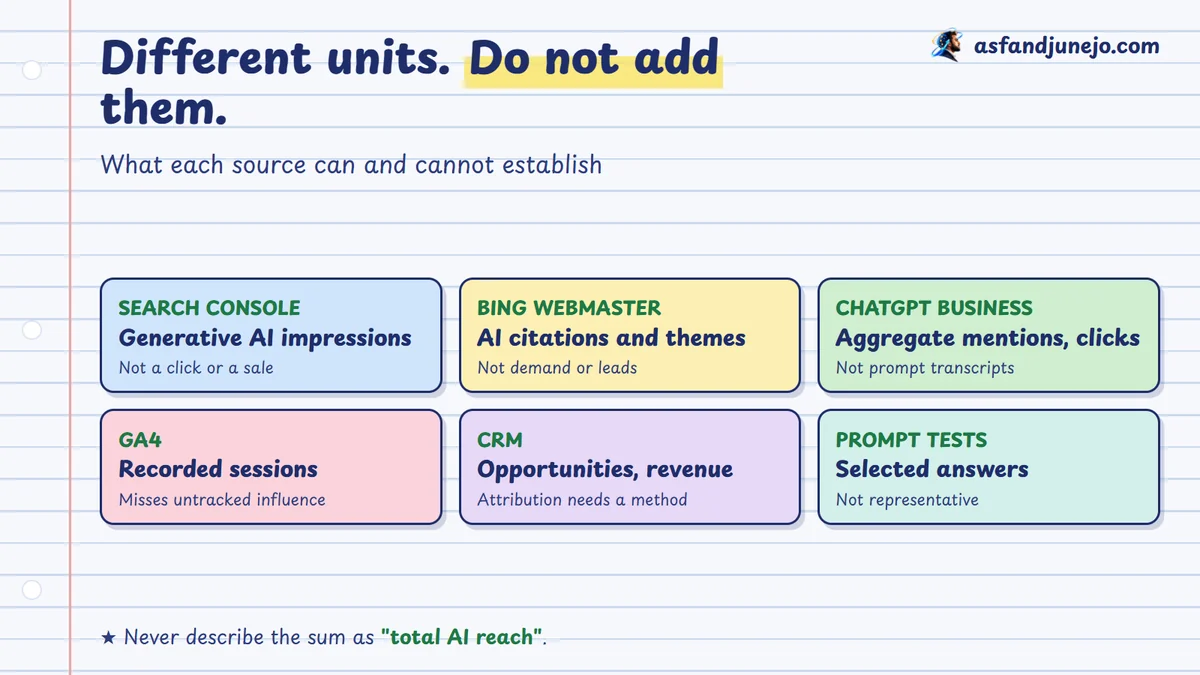
The contract should include metric owner, extraction method, relevant property, date range, denominator, missingness, and the strongest claim the data supports. For example, do not add Bing citations to Google impressions and describe the sum as "total AI reach." Do not assume every AI referral becomes qualified pipeline.
Paid search remains a separate workstream
Paid AI-powered search placements, ordinary organic links, AI citations, and independent recommendations have different commercial relationships and reporting rules. A paid test may be justified where supported and measurable, but advertising expenditure does not prove improved organic citation likelihood. Marketing leaders should evaluate paid activity using its own platform controls, costs, and conversion evidence.
The practical outcome is an answer to a decision: Are priority pages accessible? Does a platform report relevant exposure? Are product facts represented accurately? Are identifiable visitors reaching commercially useful content? Are inquiries qualified? Where evidence is missing, state the limitation rather than filling it with an assumed explanation.
Where can MCP-connected agents improve search operations?
MCP-connected agents can support repeatable SEO analysis when tasks are defined, sources are authorized, and consequential decisions remain governed. Protocol compatibility does not establish tool safety, accuracy, or production suitability.
The Model Context Protocol (opens in a new tab) standardizes aspects of connecting compatible AI applications with external tools and information. For SEO, those may include analytics, technical crawlers, project systems, and CMS services. MCP is one option; existing APIs, scheduled scripts, and platform-native integrations may be more appropriate in particular environments.
Confirmed The MCP project's July 28, 2026 release post announces the 2026-07-28 specification, including a stateless protocol core, header-based routing, cacheable list results and authorization hardening (checked November 21, 2026)
Choose tasks by their operating risk
| Workflow | Appropriate automation role | Required review |
|---|---|---|
| Search data collection | Retrieve approved reports and preserve settings | Verify scope and completeness |
| Indexing anomaly detection | Flag unexpected conditions | Confirm affected URLs and alternatives |
| Technical ticket preparation | Assemble evidence and possible actions | Validate diagnosis and recommendation |
| Content inventory maintenance | Identify missing owners, versions, or references | Confirm against approved records |
| Reporting drafts | Summarize verified observations | Approve material explanations |
| Production changes | Execute specifically authorized modifications | Enforced release and recovery controls |
A system producing more tickets is not automatically more effective. It must reduce meaningful work or improve reliability after correction and review costs are included.
Start with bounded evidence collection
The hypothetical software company selects weekly search health reporting as its first candidate. An agent may retrieve specified, read-only data; compare approved periods and URL populations; and prepare evidence packets containing source, date, filters, observed condition, and open questions. It cannot publish content or change crawler directives. A reduction in clicks should be recorded as an observation, not automatically as evidence of an algorithm update or faulty content.
Predefine pilot success
Evaluate data retrieval accuracy, source scope, false alerts, missed important cases, reviewer correction effort, tool failures, and complete operating cost. An unavailable API must be reported as an error, not zero activity. An incomplete export must not be treated as complete. The pilot should conclude with an explicit decision to continue, revise, or stop. The first goal is dependable assistance within an enforceable boundary, not maximal autonomy.
The internal guide Connect Claude to GA4 and Search Console: A Secure, Read-Only SEO Workflow covers a specific implementation. This article remains at the operating-model level.
What security and approval controls do AI search agents require?
Agentic search workflows need enforceable access restrictions, trusted integration governance, validation procedures, accountable approvals, and recovery mechanisms. An instruction to ask for human approval does not replace technical controls.
Connected agents may read webpages, tool responses, repositories, and internal documents with different trust levels. Some inputs may be incorrect or contain hostile instructions. External information should be treated as evidence to inspect rather than operational authority. OWASP's MCP Security Cheat Sheet (opens in a new tab) recommends application-enforced authorization and tool-call validation independent of model interpretation.
Separate permission levels
| Permission class | Appropriate activity | Essential restriction |
|---|---|---|
| Read-only | Retrieve authorized information | No production modification |
| Analysis | Prepare findings and change proposals | No authority to approve own changes |
| Staging | Execute approved tests in a controlled environment | No automatic production promotion |
| Production | Perform specifically authorized changes | Scoped authorization, validation, audit, and recovery |
These are editorial operating classes, not standardized MCP permission levels. Actual enforcement belongs in identities, API scopes, tool policy, and deployment systems. A data-collection agent should not receive broad CMS write access because another workflow needs to publish content.
Prompt injection, tool poisoning, and changing dependencies
A retrieved document or tool response can attempt to redirect an agent toward data disclosure or unauthorized action. Connector metadata or behavior may also change after initial approval. Maintain an inventory of approved integrations, verify their identity, review consequential changes, and prohibit untrusted content from authorizing privileged tool use. Limit sensitive information and credentials, keep logs proportionate, and define behavior for stale data, failed APIs, and partial execution.
Enforce the release gate
Observe → Recommend → Validate → Approve → Execute is a useful operational sequence only when enforcement exists outside the prompt. The final action should be bound to the specific approved scope, affected resources, responsible owner, and validation evidence. A model's confidence is not approval. A staging test is not a production authorization.
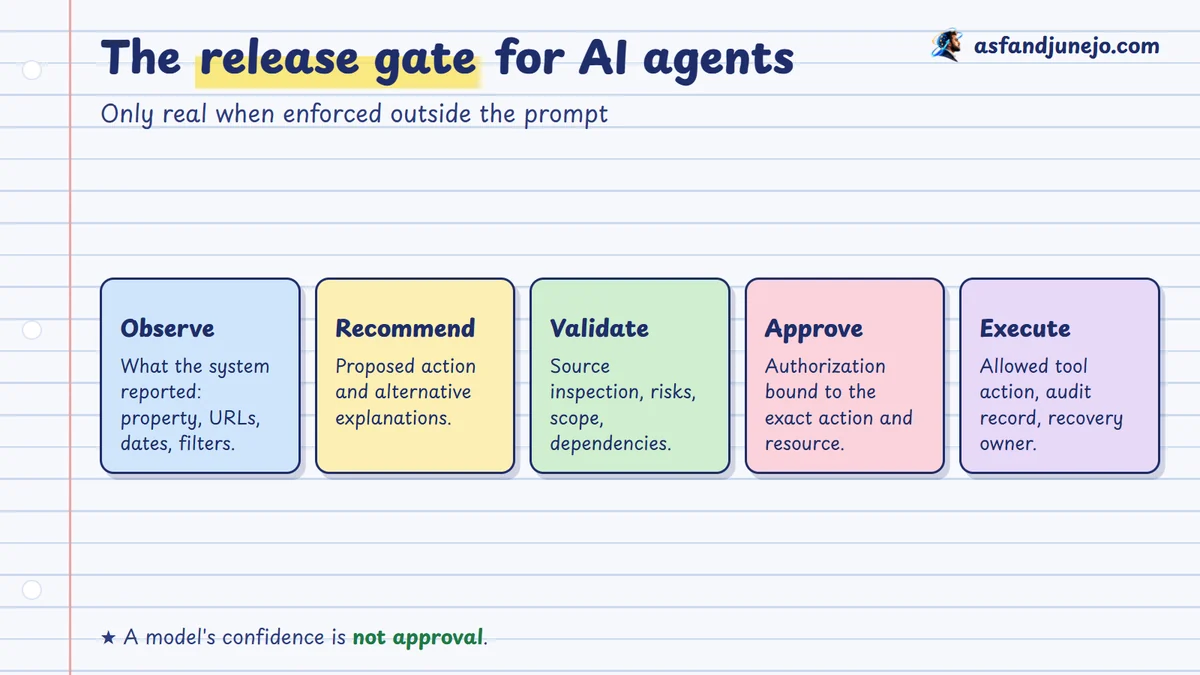
Audit records should capture action, affected property, requesting identity, approval, tool, result, and relevant evidence without unnecessarily storing tokens or confidential data. Define access revocation, connector suspension, rollback, and incident review before enabling production writes. See AI in SEO: What to Automate, What to Verify, and What to Keep Human for the detailed delegation and validation workflow.
What should stay in-house, move to an agency, or become a shared capability?
The suitable AI search delivery model depends on internal expertise, recurring work, business importance, full operating cost, and accountability. In-house teams, agencies, managed automation, and advisory arrangements are alternatives, not a universal maturity ladder.
A B2B company may own its analytics properties while an agency interprets results. External specialists may recommend technical changes while engineering controls deployment. An agent may prepare reports without determining commercial priorities. Ownership, execution, authorization, and maintenance should be documented separately.
| Delivery model | Best-fitting situation | Main limitation | Essential control |
|---|---|---|---|
| In-house | Stable recurring work with capable staff | Hiring, training, maintenance | Clear ownership and specialist escalation |
| Specialist agency | Complex or intermittent expertise | Coordination and dependency | Scope, evidence, access, handoff |
| Managed automation | Repeatable defined tasks | Provider reliance and reliability | Auditability, access, exit arrangements |
| Done-with-you advisory | Client seeks internal capability | Requires capable internal operators | Training and ownership transfer |
| Hybrid | Recurring operations plus specialist needs | Coordination complexity | Explicit responsibility boundaries |
It is plausible that automation will reduce the distinctiveness of some repetitive agency deliverables. However, universal predictions about generalist agency replacement or inevitable movement to advisory models remain unsupported. Technical interpretation, evidence verification, architecture design, and accountable implementation still require capability.
Compare full workflow economics
A realistic comparison includes internal labor, integration, recurring software, infrastructure, security review, maintenance, QA, exception handling, and recovery. Replacing a manual report with an automated report is not a savings claim unless the complete preparation and correction effort is measured.
For the hypothetical software company, a hybrid approach is reasonable: internal marketing retains priorities, engineering owns production changes, automation supports read-only evidence collection, and an external specialist handles defined investigations. This is a proposed arrangement, not an observed economic result.
How should B2B organizations prioritize AI search investment?
AI search investment should follow verified business constraints, expected value, evidence quality, implementation effort, operating cost, and the consequences of failure. A universal SEO-versus-GEO budget percentage is not defensible across all organizations.
An indexing problem, inconsistent product facts, and broken lead qualification call for different solutions. The company should first establish which problem prevents progress. It should then distinguish corrections, foundational capabilities, experiments, and expansions.
| Investment type | Purpose | Approval basis |
|---|---|---|
| Required correction | Resolve a confirmed material defect | Verified condition and authorized fix |
| Foundational capability | Establish dependable access, ownership, or measurement | Documented operating gap |
| Bounded experiment | Evaluate uncertain benefit | Hypothesis, method, decision rules |
| Strategic expansion | Introduce a new program or delivery model | Business case, resources, evidence, risks |
Evaluate business importance, evidence confidence, potential benefit, implementation effort, recurring cost, risk/reversibility, and measurement feasibility separately. An arbitrary composite score can conceal critical tradeoffs. A material publisher-control issue should not be ignored merely because a speculative content opportunity earns more points.
Total operating cost and staged investment
A simple model is: Implementation + Integrations + Recurring services + Infrastructure + Human review + Maintenance + Security + Expected recovery effort, taking care not to double count expenses. Compare the complete current and proposed workflows under consistent assumptions.
For the fictional company, staged priorities are: verify important content and controls; reconcile measurement; pilot one read-only workflow; review internal versus external ownership; and expand only when acceptance criteria are satisfied. Initiatives can be approved, revised, deferred, or stopped. A decision to stop an unsuitable pilot may preserve resources, even without producing a new ranking result.
What does a complete 2027 B2B AI search operating model look like?
An evidence-governed operating model connects platform participation, measurement, automation permissions, ownership, and investment decisions through one accountable process. Its effectiveness should be tested through operational records rather than invented visibility or revenue gains.
The following company is fictional. It sells enterprise subscription software and maintains product pages, technical documentation, integration guides, and commercial resources. Marketing uses Search Console and analytics; sales uses a CRM. It has no unified publisher-control register, inconsistent definitions for AI visibility, and no approved operating model for connected agents. Leadership requests a 2027 strategy to improve AI discovery.
Illustrative The enterprise software company, its pilot and every decision in this scenario are constructed teaching examples. No client, ranking result, AI citation gain or revenue effect is claimed
Decision 1: Define discoverability priorities
Identify the public resources most important to integration evaluation, vendor comparison, procurement, and implementation. Verify relevant technical eligibility before launching low-priority content expansion. Decision: Establish a priority URL inventory and investigate confirmed exclusions.
Decision 2: Establish publisher-control ownership
Marketing leadership identifies relevant governance stakeholders; engineering reviews current settings; the company checks whether Microsoft's legacy transition applies. Decision: Maintain approved participation choices, owners, and verification records.
Decision 3: Define multi-platform measurement
Analytics keeps Google impressions, Bing citations, ChatGPT business engagement, website referrals, and CRM outcomes separately defined. Missing attribution is noted. Decision: Approve a metric dictionary and reconcile permissible comparisons.
Decision 4: Pilot bounded automation
The SEO team proposes weekly read-only evidence collection. The system may prepare review packets but cannot publish or modify indexing rules. Decision: Authorize a limited pilot, not production execution privileges.
Decision 5: Select the delivery model
Internal marketing owns priorities and analytics interpretation; engineering owns production; security reviews integrations; external specialists support unusual technical work. Decision: Adopt a hybrid responsibility model for the proposed pilot.
Consolidated operating decision record
| Capability | Planned approach | Owner | Evidence required |
|---|---|---|---|
| Search eligibility | Priority URL verification | SEO + Engineering | Technical findings |
| Publisher controls | Authorized platform decisions | Marketing + Governance | Settings and approvals |
| AI reporting | Separate platform-specific measures | Analytics | Sources, definitions, limitations |
| Commercial measurement | Website + CRM records | Marketing Operations | Valid events and qualification definitions |
| Automation | Read-only evidence collection | SEO Operations | Accuracy, failures, correction effort |
| Production changes | Existing release process | Engineering | Authorization and verification |
| Specialist support | Bounded review | Marketing Leadership | Scope and findings |
| Expansion | Conditional | Cross-functional owner | Pilot, cost, and risk assessment |
This is a completed planning decision record, not a report of executed changes. The company has not yet run the pilot, and no empirical success result can be assigned.
What must the pilot establish?
It should demonstrate correct retrieval, property and date filters, complete URL populations, explicit failure behavior, appropriate alerts, reviewer correction effort, and acceptable operating cost. An API outage must not become a report of zero activity; a plausible recommendation must not become an authorized change; an unauthorized write must be blocked through system permissions.
Possible future decisions are expand, revise, or stop, each based on observed performance, governance, and economics. Until the evaluation occurs, broad production authority should remain withheld.
The operating model is valuable because it makes search decisions more reliable and accountable before larger investments are authorized.
Where can you get the 2027 AI search operating-model toolkit?
Join Search Signals with your email and the toolkit unlocks on this page straight away: a nine-tab workbook with publisher controls, measurement definitions, an agent pilot QA gate, an ownership matrix, investment scenarios and an executive readiness checklist, plus a six-page field guide and editable decision templates.
The examples inside are illustrative and do not authorize production changes. Fill in your own authorized records.
- AI Search 2027 Operating Model WorkbookExcel workbook, 9 tabs, illustrative examples labeled
- AI Search 2027 Executive Field GuidePDF, 6 pages
- 2027 B2B AI Search Decision TemplatesPDF, printable, plus an editable text copy
- Full kitZIP: workbook, field guide, templates, read-me and checksums
Directional Planning templates. Nothing here predicts a ranking, citation or financial result or authorizes a platform change
Frequently asked questions about AI search strategy for 2027
Will AI search replace traditional SEO in 2027?
There is no verified basis for concluding that traditional SEO will be irrelevant in 2027. Technical accessibility, useful information, and conventional search visibility remain important. Organizations should broaden participation and measurement without assuming every AI system follows identical retrieval paths.
What is the difference between SEO, AEO, and GEO?
SEO generally concerns traditional search optimization. AEO emphasizes answer-oriented representation, and GEO commonly describes visibility in generative search experiences. The terms overlap and are not universally standardized. Organize work by actual platform and business requirements rather than acronyms alone.
How much should B2B companies spend on GEO?
There is no universally appropriate percentage. Investment depends on technical conditions, buyer behavior, commercial objectives, available measurement, and resources. A business with severe indexing problems may have different priorities from one with strong foundations but limited AI visibility reporting.
Does Google indexing guarantee AI citations?
No. Indexing and citation are distinct outcomes. A system may select information for a particular generated answer under conditions that cannot be fully predicted by the website owner.
Should every business claim its profile in ChatGPT?
Eligible companies should evaluate whether claiming their business helps manage accurate information and available insights. Verification, permissions, and ownership matter. Claiming a business does not guarantee favorable independent recommendations.
Does every SEO automation workflow require MCP?
No. MCP is one integration approach. APIs, scripts, native automations, and custom systems may also fit. Evaluate requirements, cost, security, reliability, and maintenance.
Can AI agents manage SEO without human approval?
Agents can perform narrowly authorized work, but consequential decisions and production changes need appropriate governance. A prompt requiring approval is insufficient if permissions still allow unauthorized execution.
How should AI citations be connected to revenue?
Measure citations using their platform definitions, then examine identifiable referrals and commercial events using analytics and CRM records. Do not claim complete causal attribution without suitable evidence.
Is in-house AI search always cheaper than using an agency?
No. Include staff, training, software, integration, security, QA, maintenance, and occasional specialist work. Compare complete delivery arrangements with consistent assumptions.
What is the executive decision checklist for 2027?
| Area | Required question |
|---|---|
| Business objective | Which buyer or commercial problem is the program intended to address? |
| Search assets | Which public resources matter to buyer research? |
| Technical eligibility | Are those resources accessible through approved pathways? |
| Publisher controls | Have applicable participation, training, and grounding preferences been reviewed? |
| Account ownership | Does the business retain appropriate control of its identities and properties? |
| Information quality | Are important claims accurate and verifiable? |
| Measurement | Are platform metrics defined separately and sourced? |
| Commercial attribution | Are leads and revenue interpreted within the available evidence? |
| Automation | Which tasks have stable inputs and acceptable risk? |
| Permissions | Can connected agents access only authorized tools and resources? |
| Quality assurance | Can unreliable outputs and unapproved releases be blocked? |
| Recovery | Can failures be investigated and changes reversed where appropriate? |
| Delivery model | Which capabilities stay internal or receive specialist support? |
| Operating cost | Are maintenance, review, and security costs included? |
| Investment approval | Does each initiative have an owner and justified purpose? |
Completing this checklist does not demonstrate a specified ranking, citation, or financial result. It makes the decisions and remaining evidence gaps explicit.
Conclusion: build a search operating model, not another collection of tactics
A resilient AI search strategy for 2027 starts with a clear understanding of search capabilities, information assets, and commercial objectives. Traditional SEO remains important. Generative search adds participation controls, measurement surfaces, and new forms of information representation. Automation can reduce repetitive work but creates responsibilities involving access, security, verification, and recovery.
Organizations need to know where their important information can be discovered, which content uses are permitted, what available evidence measures, and who can approve consequential actions. Some capabilities belong internally because they require continuous product knowledge and business accountability. Some tasks may justify governed automation. Others benefit from specialist agencies or advisory arrangements. No delivery model is universally superior.
For B2B leaders, the useful 2027 strategy is not a list of predictions about which interface will dominate. It is a plan that separates established capabilities from uncertain developments, connects reporting to decisions, and expands automation only when sufficient evidence and controls exist.
The strongest AI search strategy is defined by how reliably an organization turns discoverability, evidence, and technology into accountable business decisions, not by the volume of automated work or the number of citations reported.
What evidence supports this guide, and what does it not show?
This article distinguishes documented platform capabilities, announced changes, professional recommendations, and forward-looking interpretations. Google documentation supports the discussions of generative Search reporting, participation controls, and SEO foundations. Microsoft documents AI Performance reporting and the announced grounding/training transition. OpenAI documents Businesses in ChatGPT. The MCP release information and OWASP guidance support the discussion of integration and security controls.
The decision maps, capability registers, metric contracts, and ownership models are editorial planning tools, not official platform frameworks or independently validated predictors of performance. The enterprise software company is fictional. Its decisions illustrate a possible approach without representing actual client data or measured improvements. Platform controls and product capabilities may change after November 2026. Recheck current primary documentation before modifying production settings or acting on announced future deadlines.
Further reading and implementation resources
- B2B AI search content strategy - buyer questions and evidence-backed pages.
- AI Search Visibility Audit: Technical Eligibility Checklist - crawler, HTTP, and indexing investigation.
- Ranking, Retrieval, and Citation: Why Measure Them Separately? - visibility measurement definitions.
- AI in SEO: What to Automate, What to Verify, and What to Keep Human - task-level verification and governance.
- AI-Crawler Access Audit 2026 - original crawler-policy research and its sampling limitations.
- Free SEO & AI Visibility Tools - practical diagnostic starting points.
Need an evidence-led review for your own search program? Review the SEO & AI Visibility Services or request a scoped assessment.
Primary sources and references
Opened and read on November 21, 2026: Google's two Search Console help pages and AI features page, Microsoft's training and grounding announcement, OpenAI's Businesses in ChatGPT announcement and help page, and the MCP 2026-07-28 release post. Platform features and announced dates may change after November 2026, so recheck the primary page before acting. The enterprise software company and every scenario decision are constructed examples with no outside source.
- Google Search Central: AI features and your website (opens in a new tab)
- Search Console Help: Search generative AI control (opens in a new tab)
- Microsoft Bing Blog: Your content, your choice, clearer preferences for training and grounding (opens in a new tab)
- OpenAI: Introducing Businesses in ChatGPT (opens in a new tab)
- OpenAI Help: Setting up your business on ChatGPT (opens in a new tab)
- Search Console Help: Generative AI performance report (Search) (opens in a new tab)
- Microsoft Bing Blog: Introducing AI Performance in Bing Webmaster Tools (Public Preview) (opens in a new tab)
- Microsoft Bing Blog: Introducing Topics Portfolio (beta) in AI Performance (opens in a new tab)
- Model Context Protocol blog: The 2026-07-28 Specification (opens in a new tab)
- OWASP: MCP Security Cheat Sheet (opens in a new tab)