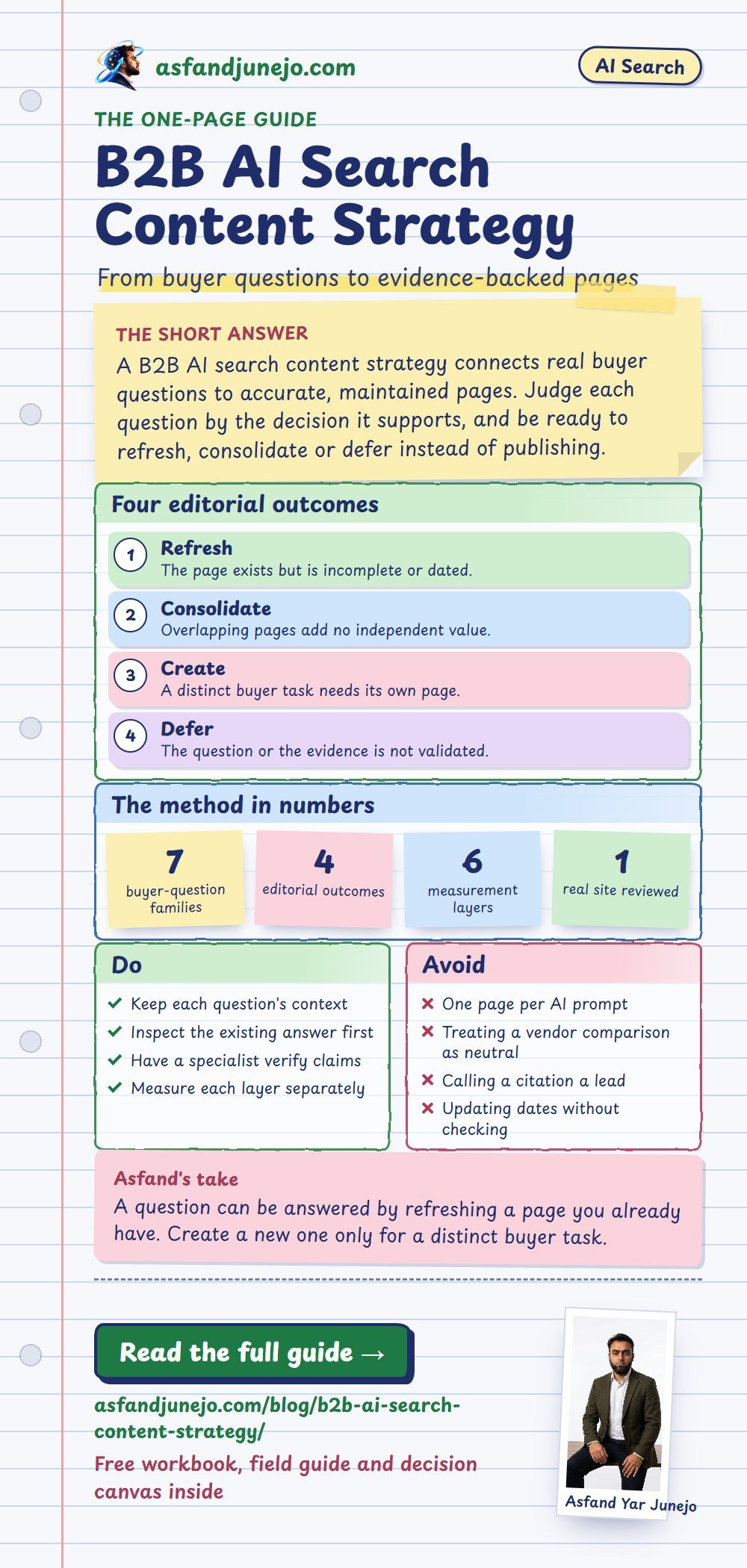
A B2B AI search content strategy is a structured approach to identifying the questions business buyers need answered, verifying the information required to answer them, and publishing that information on the pages most appropriate to their decisions. Rather than creating hundreds of articles about generative AI prompts, an effective strategy connects real purchasing requirements to product capabilities, technical documentation, credible comparisons, and measurable customer outcomes.
Published · Sources checked (GitLab claims re-read ) · By Asfand Yar Junejo, publisher asfandjunejo.com
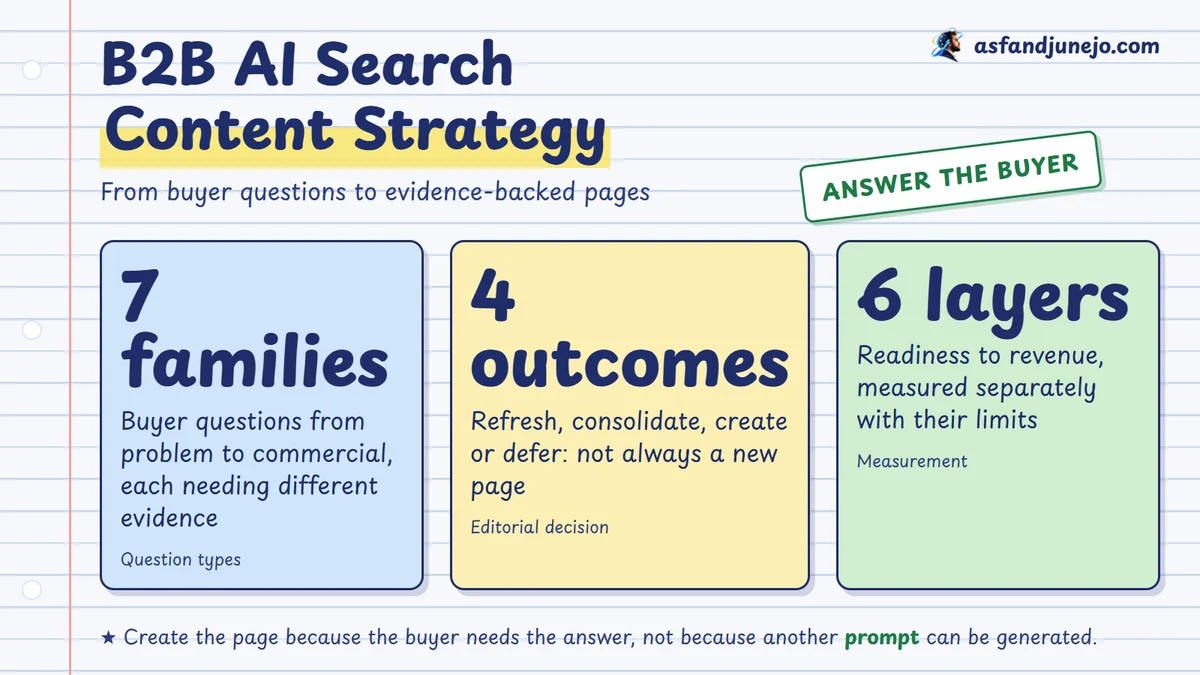
The objective is not to manufacture content that appears optimized for an AI assistant.
It is to make the organization’s most important information accurate, accessible, understandable, and useful wherever prospective customers encounter it.
Consider a business buyer evaluating a software platform. An initial question might concern which solutions offer a particular capability. A later question may involve technical compatibility, implementation requirements, security controls, pricing conditions, or the differences between competing vendors.
These questions may involve the same product category, but they do not require identical answers.
A general product overview cannot substitute for documentation explaining whether a specific access-control requirement is enforceable. A promotional comparison cannot replace current technical specifications. An article targeting a broadly relevant keyword may attract visitors while leaving the organization’s most commercially significant questions unresolved.
The problem is therefore not necessarily a shortage of content.
It is often a shortage of decision-ready information.
This distinction has become increasingly important as business buyers incorporate AI assistants into their research.
In its 2026 AI Search Insight Report (opens in a new tab), G2 surveyed 1,076 B2B software purchasing decision-makers and influencers. Among respondents, 51% reported beginning their software research with an AI chatbot more often than with Google, while 71% said they used AI chatbots at some point in the research process.
Confirmed G2's report says it surveyed 1,076 B2B decision makers in March 2026, that 51% start software research with an AI chatbot more often than with Google, and that 71% use AI chatbots somewhere in the research process. The page shows no publication date (checked November 3, 2026)
These findings describe the surveyed population’s reported behavior. They do not establish that all B2B buyers use the same channels, that AI has replaced conventional search, or that appearing in an AI-generated answer guarantees consideration or purchase.
Nevertheless, they demonstrate why content teams should examine how buyers investigate products across several information environments.
The commercial significance extends beyond initial discovery.
Forrester’s State of Business Buying 2026 (opens in a new tab) describes purchasing processes involving multiple stakeholders, greater scrutiny of business value, and the validation of AI-assisted research through other sources. Its analysis draws on the 2025 Buyers’ Journey Survey and emphasizes that buyers seek evidence that reduces uncertainty.
Confirmed Forrester's blog post (Barbara Winters, January 21, 2026) draws on its 2025 Buyers' Journey Survey of nearly 18,000 global business buyers, reports buying groups averaging about 13 internal stakeholders and nine external participants, and says buyers check AI output against trusted sources. The full report is for Forrester clients only (checked November 3, 2026)
For a B2B organization, these findings suggest an important editorial responsibility.
The website must support more than the person who discovers the product. It must also serve the technical reviewer evaluating compatibility, the procurement professional examining conditions, the operational stakeholder considering implementation, and the executive assessing business relevance.
Those people may ask different questions, consult different sources, and reach the website through different paths.
A successful content architecture should help them find the information they need without forcing every requirement into one promotional article.
The 10-sheet buyer question workbook, field guide and one-page decision canvas behind this method are free for Search Signals subscribers.
What are the key takeaways?
A B2B AI search content strategy connects real buyer questions to accurate, maintained pages. Judge each question by the decision it supports and the evidence it needs, and be ready to conclude that the right action is to refresh, consolidate or defer, not to publish another article.
- Treat AI-generated prompts as hypotheses, not publishing instructions: Google's guidance discourages a separate page for every query variation.
- Collect real buyer questions with their context: the role, environment, decision, source and date.
- Inspect the existing answer before creating a page, then refresh, consolidate, create or defer, and record why.
- When evidence is missing, mark a claim unverified rather than unsupported, and have a specialist review security and compliance claims.
- Measure six layers separately, because attribution is not incrementality and a citation is not a lead.
What does a real B2B website reveal?
GitLab provides a useful public example.
Its website separates broad platform positioning, commercial pricing, vendor comparisons, technical integrations, and detailed authentication documentation into distinct resources.
The GitLab platform page (opens in a new tab) explains the overall offering. Its pricing page (opens in a new tab) describes the available subscription plans and commercial terms. The GitLab versus GitHub page (opens in a new tab) presents a vendor-authored comparison.
Meanwhile, GitLab’s technical documentation (opens in a new tab) provides implementation and administrative guidance, including detailed instructions for SAML single sign-on.
These resources have different responsibilities.
A buyer asking whether GitLab supports SAML SSO needs a different answer from someone asking whether SSO enforcement applies to every access method.
The distinction is not theoretical.
GitLab’s published documentation explains that SSO enforcement depends on configuration and activity type. Its SAML group documentation distinguishes among web authentication, Git activity, API requests, and specific exceptions.
That documentation demonstrates why a broad feature claim cannot always answer a precise enterprise requirement.
The case study throughout this article examines these publicly accessible pages and their information architecture.
It does not claim that GitLab adopted a particular content strategy to improve AI citations, that specific pages caused customer conversions, or that its internal editorial decisions are known.
The purpose is to understand what the documented website structure can teach other B2B organizations about how to answer complex questions accurately.
The resulting approach is straightforward:
Start with the buyer’s decision. Identify the evidence it requires. Inspect the existing answer. Choose the right page. Verify the claims. Publish and evaluate the outcome.
What Is a B2B AI Search Content Strategy?
A B2B AI search content strategy connects customer information needs with accurate, maintained resources that can support conventional search, AI-assisted discovery, and purchasing evaluation. It uses buyer research, semantic analysis, evidence from the existing website, and editorial governance to determine what information should be published and where it belongs.
The strategy differs from a conventional keyword calendar in the way it defines a content opportunity.
Keyword research can reveal how people describe problems, products, and categories. Search volume and ranking information can help evaluate potential discoverability.
However, those observations do not independently establish whether a particular question matters to a prospective customer or whether a new page is required.
A buyer-question approach begins with a more fundamental consideration:
What does the customer need to determine before making the next decision?
A person searching for a software category may need an explanation of the available approaches.
A procurement stakeholder comparing named vendors may need verifiable information about product scope, commercial terms, and support arrangements.
A security reviewer may need confirmation of a specific technical control.
All three questions may belong to the same general topic, but they require different information.
The content strategy should preserve those differences.
AI prompts are useful research inputs, not automatic publishing instructions
An AI assistant can generate a substantial collection of plausible questions about almost any product category.
A content team may ask for 200 questions about enterprise DevSecOps platforms and receive variations concerning features, integrations, pricing, security, and competitors.
That list may provide useful starting hypotheses.
It does not prove that real customers ask every question, that the questions represent distinct decisions, or that the organization should create 200 URLs.
Several prompts may express the same information need.
For example:
- What is the best DevSecOps platform for enterprise teams?
- Which enterprise DevSecOps tools should we compare?
- What are the leading platforms for enterprise software delivery?
These questions may require similar information on category and vendor evaluation.
A single well-scoped resource may address them more effectively than several near-identical pages.
But consider a more specific question:
Does GitLab SAML SSO enforcement apply to API requests and Git operations?
This requires technical information about authentication, authorization, configuration, and access methods.
It cannot be answered adequately by another general category comparison.
The important distinction is not the number of words in the prompt.
It is whether the question introduces a materially different decision or evidence requirement.
Google’s official guidance on optimizing for generative AI features (opens in a new tab) explicitly advises against creating separate content for every conceivable query variation. It also explains that Google does not require artificial content chunking or an ideal page length to participate in its generative search experiences.
Confirmed Google's guide to optimizing for generative AI features discourages separate pages for every query variation (calling it an ineffective long-term strategy that can fall under its scaled content abuse policy), says content does not need splitting into small pieces and says there is no ideal page length (checked November 3, 2026)
The appropriate editorial response is therefore not to multiply pages until every possible prompt has a matching URL.
It is to make the necessary information available in a coherent, useful architecture.
AI search visibility contains different observable outcomes
A page can be technically eligible for Google Search without appearing for a particular query.
It may appear in conventional search results without being included as a supporting link in an AI-generated answer.
A company may be mentioned without its website being cited.
A cited page may receive no measurable referral traffic.
A referral may occur without becoming a qualified inquiry.
These events should not be treated as interchangeable.
The detailed distinction between ranking, retrieval, mentions, and citations is examined in Ranking, Retrieval, and Citation: Why Measure Them Separately?.
For B2B content strategy, the practical implication is that visibility observations should inform investigation rather than dictate publication.
A competitor appearing in an AI-generated answer may indicate that its information is relevant to a particular question under the observed conditions.
It does not establish that copying the competitor’s content format will produce the same result.
Nor does a missing citation establish that the company needs another article.
The team must first investigate whether its existing website answers the customer’s underlying question.
Conventional SEO remains the technical foundation
Google’s AI features documentation (opens in a new tab) states that established SEO practices remain relevant to AI Overviews and AI Mode.
For a page to be eligible as a supporting link in these experiences, it must satisfy applicable Google Search indexing and snippet eligibility requirements.
There is no separate requirement to publish special AI schema, create a particular text file, or follow a proprietary writing structure.
Eligibility does not guarantee inclusion.
Technical accessibility matters, but it is only part of the content problem.
A technically accessible page may still be unhelpful if its claims are vague, its evidence is outdated, or it fails to answer the relevant question.
Similarly, a technically sophisticated website cannot establish product capabilities through structured data alone.
The information must be accurate.
The strongest strategy therefore combines search fundamentals with the work of understanding customer needs and maintaining reliable answers.
What Questions Do B2B Buyers Ask Before Choosing a Solution?
B2B buyers ask questions about business problems, solution categories, use cases, competing vendors, technical validation, implementation, and commercial terms. These questions do not necessarily follow a fixed sequence because different stakeholders evaluate different risks and requirements throughout the purchasing process.
A developer researching software delivery tools may prioritize workflow compatibility.
An engineering leader may evaluate team coordination and the complexity of implementation.
A security specialist may assess authentication, access management, and data controls.
Procurement may need to understand contractual obligations, subscription structures, and supplier suitability.
An executive may seek evidence of organizational value and the risks associated with changing platforms.
These stakeholders can examine the same product without needing the same information.
A content strategy organized around one generic buyer persona may fail to accommodate those differences.
Seven buyer-question families
A practical research taxonomy can organize questions into seven groups.
| Question family | Example question | Appropriate evidence |
|---|---|---|
| Problem | Why are software delivery workflows fragmented? | Process analysis and relevant alternatives |
| Solution category | When is an integrated DevSecOps platform appropriate? | Category definitions and selection criteria |
| Use case | Will the platform support our team’s development workflow? | Verified functionality and implementation context |
| Comparison | How do GitLab and GitHub differ in terms of our requirements? | Current product information and fair criteria |
| Validation | Does SSO enforcement cover our required access methods? | Technical documentation and applicable conditions |
| Implementation | What must be configured before rollout? | Prerequisites, procedures, and limitations |
| Commercial | Which subscription and deployment options fit our requirements? | Current pricing structure, plan conditions, and contractual information |
These categories are editorial planning aids, not an assertion that every buyer follows seven sequential stages.

Problem questions require diagnosis before product promotion
A buyer may recognize that an existing software delivery process is fragmented, but not know whether purchasing a new platform is the appropriate response.
A useful problem guide should explain the relevant causes and alternatives.
Those alternatives might include improving existing workflows, changing internal responsibilities, integrating current tools, or adopting a different platform.
The answer should not assume that every problem requires the publisher’s product.
This matters because a persuasive page can still be commercially misleading if it presents purchasing as the only reasonable option.
A credible problem article helps readers understand the conditions under which a particular solution category becomes appropriate.
Solution-category questions require meaningful distinctions
Category questions help buyers understand the approaches available.
For example, a buyer comparing an integrated DevSecOps platform with a collection of specialized tools may need to understand potential trade-offs involving integration responsibilities, operational flexibility, security requirements, pricing, and organizational complexity.
A category guide should explain the criteria rather than declare one approach universally superior.
The company can discuss the advantages of its own model, but its recommendations should remain tied to the conditions where those advantages apply.
Use-case questions require evidence of suitability
A use-case question adds customer context.
A large software organization operating multiple development teams may have different requirements from a small company managing a limited number of repositories and deployment pipelines.
Relevant content may need to address team structure, existing systems, access management, deployment environment, and ongoing administration.
An industry or use-case page should not consist of a general product description with a different industry name inserted into the heading.
It should explain which requirements matter in that context and how the offering addresses them.
Comparison questions require credible alternatives
A comparison question asks the buyer to evaluate options.
GitLab’s public page comparing (opens in a new tab)GitLab and GitHub (opens in a new tab)demonstrates how a vendor can organize a competitive comparison around topics such as platform consolidation, AI capabilities, security, and governance.
The page is useful for examining GitLab’s competitive positioning.
However, it is a vendor-authored resource, not an independent product evaluation.
Statements about GitHub should be verified against appropriate GitHub documentation before being presented as independent facts.
The comparison criteria themselves should also be assessed.
A buyer primarily concerned with a specific integration or deployment requirement may need a more focused analysis than a broad platform comparison.
Validation questions require exact technical evidence
Validation questions are often more consequential than general feature questions.
GitLab’s SAML documentation illustrates this clearly.
Asking whether a product supports SAML SSO is not equivalent to asking whether SSO is enforced for every access method.
The relevant answer depends on the offering, authentication method, configuration, and activity being evaluated.
GitLab’s documentation for SAML SSO on GitLab.com (opens in a new tab)explicitly distinguishes group access, web activity, Git activity, API requests, and other conditions.
A broad claim of SSO support would not be sufficient to explain all of these distinctions.
The content must meet the requirement with the precision the customer needs.
Implementation questions require operational detail
A buyer considering deployment may need to understand prerequisites, configuration procedures, likely dependencies, testing, and potential complications.
GitLab’s SAML setup tutorial (opens in a new tab) provides step-by-step instructions for configuring SSO with an identity provider.
This serves a different purpose than a marketing page explaining the feature’s existence.
The technical resource is useful because it describes how the capability is configured and verified.
A company should not assume that every customer will achieve the same implementation outcome. The relevant environment, permissions, configuration, and external dependencies matter.
Commercial questions require clear conditions
A buyer may need to understand subscription tiers, deployment types, paid features, usage allowances, and the circumstances requiring a custom quotation.
GitLab’s pricing page (opens in a new tab) distinguishes among GitLab.com, Self-Managed, and Dedicated offerings and presents relevant subscription information.
These distinctions matter because the same product family may provide different commercial and operational arrangements.
A pricing resource should make those conditions understandable.
Where pricing is not public or depends on an individual engagement, the organization can explain the applicable variables without inventing a figure.
A complete content strategy should address commercial uncertainty as carefully as technical uncertainty.
Buyers do not necessarily follow a linear funnel
A buyer may begin with a named vendor, investigate a technical requirement, compare alternatives, and then return to a broad category question.
Another may arrive through a professional recommendation and begin with pricing.
The website should support these different paths.
That means product pages should link to relevant technical resources, comparisons should refer to authoritative specifications, and implementation documentation should provide sufficient context for readers who access it directly.
A coherent content architecture does not require the buyer to follow the publisher’s preferred journey.
It makes the necessary information accessible wherever the evaluation begins.
How Do You Collect and Validate Buyer Questions?
Collect B2B buyer questions from actual customer interactions, sales records, support requests, product feedback, implementation discussions, search behavior, and relevant public sources. Preserve the context in which each question arises, then verify whether it represents a meaningful decision before assigning editorial resources.
A generated question is not the same as an observed customer requirement.
A content strategist may reasonably hypothesize that enterprise software buyers care about administrator authentication, but that hypothesis should not be presented as a verified finding from customer interviews.
Likewise, a competitor’s FAQ demonstrates what the competitor chose to publish, not necessarily what customers ask most frequently.
The research process should preserve these differences.
First-party evidence provides valuable context
Sales conversations can reveal recurring objections, purchasing criteria, and questions that delay the evaluation process.
Support tickets can expose confusion around implementation or feature behavior.
Product teams can identify technical limitations that customers frequently misunderstand.
CRM records may show documented reasons why opportunities did not progress.
Implementation specialists may identify prerequisites that should have been communicated before purchase.
Each source has limitations.
Sales representatives may remember unusual cases more readily than routine interactions. CRM categories may be inconsistent. Support issues may overrepresent customers experiencing difficulties.
Search queries reveal expressed information needs but do not necessarily establish purchasing intent.
The strongest research process involves comparing relevant sources and evaluating their reliability.
Preserve the original question and its context
Suppose a prospective customer asks:
Can we enforce SSO across every access method?
The wording alone may be insufficient.
Does the customer mean browser authentication, Git operations, API requests, service accounts, or a combination of these?
Are they evaluating GitLab.com or a self-managed deployment?
Which subscription tier and configuration are relevant?
Is the question based on a mandatory internal security policy or a general preference?
These details affect the answer.
A content team that simplifies the question to “Does the platform support SSO?” may remove the constraint that makes it commercially important.
An effective research record should therefore capture the wording, audience, decision, relevant environment, source, date, existing answer, and verification responsibility.
A practical buyer-question register
| Field | Purpose |
|---|---|
| Question | Preserve the actual wording or an accurate privacy-safe paraphrase |
| Source | Identify the conversation, document, search observation, or research input |
| Context | Record buyer role, use case, environment, and relevant constraints |
| Decision | Explain what the person needs to determine |
| Existing resource | Identify the page or document currently addressing it |
| Evidence requirement | Define what must be verified |
| Responsible owner | Identify who is qualified to validate the answer |
| Confidence | Distinguish confirmed observations from hypotheses |
| Editorial action | Investigate, refresh, consolidate, create, or defer |
The register should support decision-making, not become another large database maintained for its own sake.
A useful record contains enough information to determine why the question matters and what remains unresolved.
Cluster questions by decision, not wording alone
Several questions may share terminology while requiring different evidence.
- Does GitLab support SAML SSO?
- Can SAML SSO be enforced for group members?
- Does SSO enforcement apply to API requests?
- Can SSO requirements be applied to Git operations?
These questions belong to the same broad authentication subject.
They should not be treated as interchangeable.
The first concerns availability.
The second concerns configuration and enforcement.
The third introduces the API access boundary.
The fourth concerns Git activity and the conditions under which enforcement applies.
A single well-maintained documentation section may address all four, but the distinctions must remain visible.
AI-assisted clustering can help identify related questions. A subject-matter reviewer should confirm whether the proposed grouping preserves important differences.
Prioritize questions according to decision importance
Search volume can support prioritization, but it should not be the only consideration.
A specialized enterprise security question may have limited observable search demand yet remain essential for purchasing approval.
A broad educational question may attract a large audience but offer little connection to the organization’s actual capabilities.
A useful editorial prioritization should examine buyer relevance, importance to the purchasing decision, availability of evidence, existing coverage, maintenance requirements, and commercial fit.
These considerations should remain transparent.
An elaborate scoring model is not necessary if the organization cannot explain why the scores were assigned.
A priority assessment should help the team choose what to investigate or improve, not manufacture statistical certainty.
Protect customer information during research
Customer conversations and support records can contain confidential operational details, personal information, or commercially sensitive requirements.
The content team should not indiscriminately transfer those records to AI tools or publish examples without appropriate authorization.
Where an example can be explained through a privacy-safe paraphrase, that may be sufficient.
Where a named customer case is necessary, the organization should establish the relevant permissions and factual basis.
Information should be used only within authorized purposes, with appropriate access and retention controls.
The research process must not create a new privacy problem while attempting to improve marketing content.
How Do Semantic SEO and Content-Gap Analysis Identify a Real Opportunity?
Semantic SEO helps identify the entities, attributes, and relationships necessary to explain a subject. Content gap analysis determines whether existing resources answer relevant buyer questions accurately and completely. The objective is to identify unresolved information needs, not merely keywords that competitors use and the company does not.
A page can contain many relevant terms while failing to answer the customer’s question.
An enterprise software page might mention security, authentication, integration, and compliance without explaining the controls available under particular configurations.
The terminology is present.
The decision-ready information is not.
A useful semantic analysis, therefore, examines the relationships among the customer, product, capability, configuration, condition, and evidence.
Map meaningful entities and relationships
Consider the GitLab authentication example.
The relevant subject includes several connected entities and attributes:
- GitLab.com and Self-Managed offerings.
- Subscription tier.
- SAML identity provider.
- Group and instance configuration.
- SSO enforcement settings.
- Web, Git, and API activities.
- User identities, service accounts, and access exceptions.
These terms should not be inserted into a page simply to increase semantic coverage.
They matter because they determine the accuracy of the answer.
For example, documentation describing SAML SSO for GitLab.com groups should not automatically be treated as equivalent to documentation for a self-managed instance.
Similarly, an enforcement rule that applies to one activity type should not be generalized to all access methods.
The relationships are part of the technical truth.
Four useful content coverage states
An editorial audit can classify an existing answer as follows.
- Strong coverage: The answer directly addresses the question, identifies relevant conditions, and provides sufficient evidence.
- Partial coverage: Some relevant information exists, but the reader still lacks essential scope, implementation detail, or a clear conclusion.
- Missing coverage: The information need is relevant but has no adequate answer in the appropriate resource.
- Weak or unsafe coverage: The answer is misleading, outdated, unsupported, or expressed more broadly than the evidence permits.
These categories are analytical judgments, not official Google quality labels.
Their purpose is to help a team explain why an editorial intervention is necessary.
Inspect the actual content, not only search snippets
A competitive review should examine representative sources in sufficient depth to determine what they provide.
For a technical B2B requirement, these may include product documentation, vendor comparisons, implementation guides, and relevant independent references.
A search snippet cannot reliably establish whether a page contains an important limitation further down.
Nor does the absence of a phrase from a snippet prove that the subject is missing.
The analysis should record the question, intended audience, sources inspected, relevant scope, evidence, and date.
It should also recognize source interests.
A vendor’s product documentation may be authoritative for its current documented capabilities.
A vendor’s comparison page may be useful evidence of its marketing position without being independent verification of competitor weaknesses.
A professional commentary article can provide useful ideas without establishing a representative market-wide finding.
A documented content architecture review: GitLab
A targeted review of GitLab’s public website on November 3, 2026 identifies several distinct resources.
| Buyer information need | Public resource | Information responsibility |
|---|---|---|
| Understand the overall platform | GitLab Platform | Product positioning and general capabilities |
| Evaluate subscriptions and deployment | GitLab Pricing | Commercial structure and relevant conditions |
| Compare GitLab with GitHub | GitLab vs. GitHub | Vendor-authored competitive positioning |
| Understand SAML SSO | SAML SSO for GitLab.com groups | Technical scope and enforcement conditions |
| Configure SSO | SAML setup tutorial | Step-by-step implementation |
| Understand SCIM provisioning | GitLab.com SCIM documentation | User provisioning behavior and limitations |
This review establishes the existence and distinct purposes of the pages.
It does not establish that the architecture was designed specifically for AI search, that the company selected these pages from a particular keyword model, or that the resources generated measurable commercial results.
Those would require internal evidence or suitable performance data.
Confirmed GitLab's pricing page separates GitLab.com, Self Managed and Dedicated; its platform page presents one control plane; the SAML tutorial walks through group SSO on GitLab.com with an identity provider; and the SCIM page covers GitLab.com groups on Premium and Ultimate, with documented limits such as no user updates and tested support for Okta and Microsoft Entra ID only (checked November 3, 2026)
The actual information gap is often smaller than expected
Suppose a content strategist identifies the question:
Does GitLab enforce SSO for all API access?
A superficial analysis might conclude that an article is needed because the question is technically specific and commercially relevant.
However, GitLab’s existing SAML SSO documentation (opens in a new tab) already provides an important answer.
It states that general SSO enforcement does not apply to API requests, while explaining additional conditions for Git-related activity when relevant enforcement settings are enabled.
The documentation also describes exceptions involving access mechanisms and other activity types.
The buyer’s question is therefore not necessarily missing from the website.
The better editorial decision may be to maintain the existing technical documentation and ensure that related product or commercial pages direct readers to it when appropriate.
This is a more useful outcome than creating another general article about SSO.
What a meaningful gap must establish
Before approving new content, the team should determine whether the question is relevant, whether existing resources answer it, and what additional evidence the organization can contribute.
A competitor’s omission is not automatically an opportunity.
A keyword variation is not automatically a new intent.
A technical distinction is not automatically a separate URL.
A genuinely valuable gap exists when an identifiable reader need remains unresolved, and the organization can provide a reliable answer.
That answer may require updating a product page, expanding documentation, creating a comparison, or clarifying an important limitation.
Content-gap analysis becomes more effective when it can justify not creating another page.
How Do You Map Buyer Questions to the Right Website Pages?
Map each question to the page that can answer it most completely and credibly. A product page, technical guide, comparison, pricing resource, or educational article may be appropriate depending on the reader’s decision. The correct response is not automatically a new blog post.
Website architecture should reflect information responsibilities.
A product overview introduces the offering.
Technical documentation explains how a capability works.
A comparison evaluates alternatives.
A pricing page clarifies purchasing conditions.
An implementation resource explains deployment requirements.
These functions can be connected via internal links without being compressed into a single oversized article.
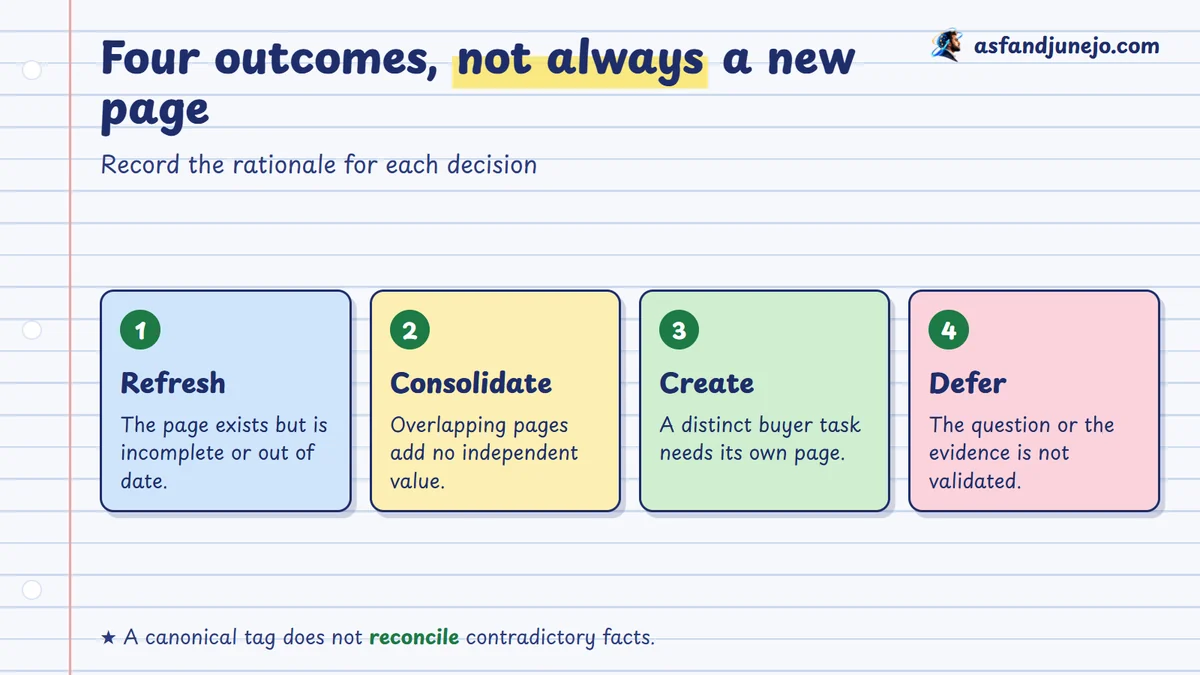
Four editorial outcomes
- Refresh an existing page when it serves its intended purpose but needs more accurate, complete, or up-to-date information.
- Consolidate overlapping pages when several resources address substantially the same question without offering meaningful independent value.
- Create a distinct page when the reader’s decision requires substantial information that cannot be served appropriately within existing resources.
- Defer publication when the question is insufficiently validated, the evidence is unavailable, or the proposed content would not justify its maintenance.
These decisions should be recorded with their rationale.
A real page-selection example
For the GitLab SSO question, a content strategist could evaluate four possible destinations.
The general platform page is appropriate for introducing high-level capabilities but not for documenting detailed authentication exceptions.
The pricing page may help identify relevant subscription terms, but it should not serve as the primary technical specification.
The vendor comparison may mention security differences when adequately supported, but it should not independently define GitLab’s authentication behavior.
The existing SAML documentation is the most appropriate authoritative technical resource.
This leads to a clear editorial recommendation:
Retain the technical answer in GitLab’s existing documentation and connect related pages to it when necessary.
That is an analytical recommendation based on the inspected public architecture, not a claim about GitLab’s actual internal editorial decision.
When should a new URL be justified?
A new page should serve a meaningfully different information task.
For example, a comprehensive implementation tutorial may warrant a separate resource because it contains prerequisites, configuration steps, troubleshooting, and validation procedures.
GitLab’s SAML tutorial illustrates this distinction.
The general SAML documentation explains feature behavior and configuration concepts.
The tutorial walks users through implementation.
The difference is the task.
A buyer seeking to understand whether a capability is supported does not necessarily need the full setup procedure. An administrator implementing the feature requires details that would overwhelm a brief product description.
These resources can coexist because they serve distinct purposes.
Internal links should help the buyer progress
Links should connect related information based on the customer’s most likely next question.
A platform page may lead to pricing and relevant feature documentation.
A pricing page may lead to plan-specific capability information.
A comparison may cite the authoritative product documentation that supports an important claim.
A setup guide may link to troubleshooting and authentication prerequisites.
The anchor text should communicate the destination’s purpose.
Links inserted only to satisfy a target number do not necessarily improve the reader’s experience.
An effective internal-link system clarifies relationships between information resources.
Consolidation requires more than a canonical tag
Two overlapping articles may cause maintenance problems even if the publisher declares a single canonical URL.
A canonical signal can help search engines understand preferred versions of duplicate or near-duplicate content.
It does not reconcile contradictory product information.
If several pages contain inconsistent explanations of a feature, the organization must resolve the underlying factual differences.
Before consolidation, identify useful material worth preserving, unique reader purposes, existing links, and technical handling.
A permanent redirect may be appropriate when a page is retired, and its content moves to another URL.
However, a page should not be removed solely because it has low traffic.
Specialized documentation can remain commercially valuable to a small number of important readers.
The decision should reflect the usefulness of the information, not only search metrics.
How Do You Create Fair Comparisons and Evidence-Backed Validation Pages?
A reliable B2B comparison identifies the products and conditions being evaluated, uses criteria relevant to the buyer’s needs, distinguishes documented facts from judgments, and makes important limitations visible. Its purpose is to support an informed decision, not to manufacture a universal winner.
Comparison content can influence financially significant purchases.
That makes evidence quality particularly important.
Vendor comparisons are useful, but not independent by default
GitLab’s GitLab versus GitHub page (opens in a new tab) presents differences across several product and commercial dimensions.
The page helps readers understand GitLab’s preferred competitive positioning.
However, it is published by one of the competing vendors.
Its claims concerning GitHub should not be automatically treated as independently verified.
A complete competitive assessment should examine relevant GitHub documentation as well as GitLab’s claims, particularly when technical features, subscription conditions, or product availability may have changed.
This does not make the vendor-authored comparison inherently unusable.
It means its authorship and evidentiary limitations matter.
A reader should be able to distinguish the company’s commercial argument from independent facts.
Confirmed The comparison page is hosted on GitLab's own site and promotes GitLab. It covers platform consolidation, AI, vendor independence, security and governance, CI/CD and migration, and its statements about GitHub are GitLab's own characterizations (checked November 3, 2026)
Define the exact comparison before recommending a product
A meaningful comparison should identify the intended buyer and use case.
It should also specify the relevant product versions, editions, deployment conditions, and review date.
Comparing two enterprise software platforms without specifying which plans and configurations were examined may lead to misleading conclusions.
A feature available through an add-on, partner integration, or higher subscription tier is not necessarily equivalent to a feature included in the base offering.
Similarly, a capability available in a cloud-hosted version may not be available under identical conditions in a self-managed deployment.
The content should retain these distinctions.
Three types of statements require separate treatment
Relevant product documentation, policies, pricing information, or other appropriate sources support documented facts.
Observed findings describe the results of actual tests or evaluations conducted under stated conditions.
Editorial judgments interpret the available evidence in light of specific buyer requirements.
A vendor may document support for an integration.
A reviewer may test that integration in a particular environment.
An analyst may then conclude that the product is appropriate for a defined use case.
These are related but different claims.
A successful test does not establish compatibility with every configuration.
A vendor description does not establish an independent performance advantage.
A recommendation should explain the conditions under which it applies.
What GitLab’s SSO documentation teaches about technical accuracy
A particularly useful example concerns SSO enforcement.
GitLab’s public documentation states that SSO enforcement for GitLab.com groups depends on identity and configuration conditions.
It also states that general SSO enforcement does not apply to API requests.
However, GitLab documents separate enforcement behavior for Git activity and relevant Git-related API endpoints when additional settings are enabled.
The documentation identifies exceptions involving service accounts, access tokens, and other mechanisms.
This creates an important editorial distinction.
A statement such as “GitLab supports SSO” is broadly descriptive.
A statement such as “GitLab enforces SSO on every API request and access mechanism” would not be supported by the documentation reviewed.
The accurate answer needs the relevant scope and exceptions.
This is what evidence-backed B2B content should accomplish.
It should prevent technically broad marketing language from being mistaken for a precise operational guarantee.
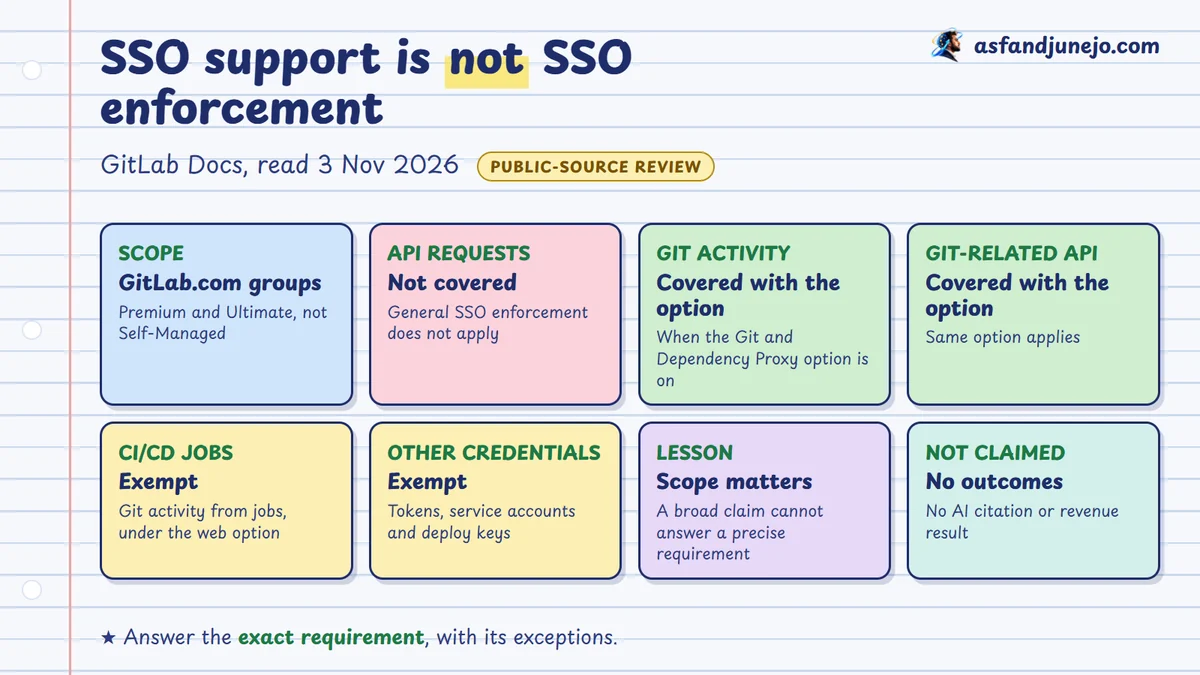
Confirmed GitLab's SAML SSO page covers GitLab.com groups on Premium and Ultimate, not Self-Managed. It says SSO enforcement does not apply to API requests; that with the Git and Dependency Proxy option on, Git over SSH or HTTPS and Git-related API endpoints fall under enforcement; and that CI/CD Git activity and credentials not tied to regular users (project and group access tokens, service accounts, deploy keys) are exempt under the web activity option. Documentation changes, so recheck before reuse (checked November 3, 2026)
Security and compliance claims require specialist review
A security certification does not automatically establish that every product feature or deployment configuration satisfies every buyer requirement.
A technical claim should identify the relevant control, product scope, conditions, and authoritative evidence.
Where appropriate, product security, engineering, or compliance specialists should review the exact published wording.
A general security overview may be useful context without answering a particular requirement.
If a capability is unknown, mark it as unverified.
Do not label it unsupported merely because the evidence was not found.
Likewise, do not label it supported because a broad marketing page uses related terminology.
Recommendations should be conditional
A product may be a strong choice for a particular workflow but less appropriate for another.
A useful recommendation identifies the buyer’s priorities, the evidence supporting the conclusion, and the limitations that could change the result.
For example, a company prioritizing a particular deployment model may evaluate alternatives differently from an organization focused on integration simplicity.
There is no need to declare every product equal.
There is a need to explain the reasoning.
A credible comparison should also acknowledge legitimate competitor strengths and disclose the publisher’s commercial interest.
Maintain comparison pages as products evolve
Software features, pricing, integrations, and licensing conditions can change.
A comparison should record when its claims were checked and what sources support them.
Material product changes should trigger reassessment.
A document reviewed in November 2026 may become outdated as new releases appear.
Updating the visible date without verifying the content is not a meaningful freshness procedure.
The organization should maintain a source record, responsible owner, and review trigger.
This is especially important for content involving security, integrations, pricing, and competitive claims.
How Should B2B Teams Write, Publish, and Distribute Content for AI-Assisted Discovery?
Publish the clearest verified answer in the resource best suited to the reader’s task, then distribute useful adaptations through relevant channels. Maintain an authoritative source for important product facts so that marketing pages, documentation, comparisons, and external communication do not drift into contradictory claims.
The purpose of content structure is to support comprehension.
A technical reader should be able to quickly identify the applicable requirements.
A commercial buyer should understand the relevant purchasing conditions.
An executive should be able to evaluate the value proposition without having to navigate unrelated documentation.
Use answer-first writing without oversimplifying
A strong section begins with the relevant answer and explains the necessary conditions.
For example:
Does GitLab SAML SSO enforcement apply to every API request?
A useful response should answer the scope directly, then explain the distinctions documented for GitLab.com groups and relevant activity types.
The answer should not begin with several paragraphs about why security matters to modern businesses.
However, it should not stop at an oversimplified yes-or-no if the correct interpretation depends on configuration.
Directness and completeness are complementary.
The goal is to reduce uncertainty without removing essential context.
Do not write solely for AI extraction
Google states that its generative AI features do not require publishers to divide content into artificially small chunks or use a specific writing style.
Well-structured headings and clear paragraphs can help readers navigate information.
They do not create a guaranteed citation mechanism.
A detailed technical answer may require several paragraphs, configuration examples, or a table.
A narrow factual question may require only a short explanation.
The appropriate depth follows the question.
Content should not be lengthened simply to match an assumed SEO threshold or shortened to satisfy an invented AI answer format.
Establish an authoritative home for product facts
GitLab’s public documentation provides a useful example of maintained product information.
Its documentation contribution guide (opens in a new tab) describes the documentation as the source of truth for configuring, using, and troubleshooting the product.
The guide also describes a contribution process involving source files, commits, merge requests, and review.
This gives technical information an identifiable maintenance mechanism.
The presence of a version-controlled documentation workflow does not guarantee that every page is error-free.
It does create a way to inspect and revise content.
B2B organizations should establish a similarly clear ownership model for consequential facts.
A product manager may own feature availability.
Engineering may verify integration behavior.
Security specialists may review access-control claims.
Commercial leadership may approve pricing descriptions.
Marketing can then communicate verified information without becoming the sole authority over every underlying product detail.
Confirmed GitLab's contribution guide calls the documentation the single source of truth for configuring, using and troubleshooting GitLab, and describes changes going through merge requests (checked November 3, 2026)
Distribute information without creating inconsistent versions
The company website is generally a useful primary location for authoritative product descriptions, technical documentation, and commercial information.
External publications, professional communities, review platforms, and partner resources may serve different information needs.
However, no publicly established rule guarantees that all AI assistants prefer company websites over independent sources.
A content strategy should not claim otherwise.
The company can contribute useful explanations to third-party environments without manufacturing endorsements or presenting promotional content as independent opinion.
Repurposing should also preserve accuracy.
A detailed integration guide may support a shorter professional discussion, but the shorter version should not remove conditions that materially affect the claim.
When an underlying product fact changes, dependent marketing materials should be reviewed.
Technical eligibility remains necessary
For Google Search, technical foundations include appropriate indexing eligibility, crawl access, snippet eligibility, and a coherent website structure.
Important content should be available in a form that can be accessed and understood.
Internal links should connect relevant pages.
Canonical handling should be appropriate.
Structured data should accurately represent visible content and applicable supported features.
Google does not require special AI-specific structured data to appear in AI Overviews or AI Mode.
The distinction between structured data and AI citation claims is explored in Schema Markup for AI Search: What It Can and Cannot Do.
Technical readiness creates the conditions for eligible discovery.
It does not guarantee that an AI system will cite a page.
Versioned documentation provides a model for ongoing improvement
GitLab’s documentation is particularly useful because the source files and contribution processes are public.
Its documentation workflow allows contributors to propose changes through version-controlled files and merge requests.
Readers can inspect documented product behavior, while contributors have an established mechanism for correction.
This demonstrates one form of a maintained information system.
It does not establish that GitLab autonomously updates its content, or that a particular documentation change improved rankings or conversions.
For another B2B website, the lesson is operational.
Important content should have an owner, an evidence source, a revision process, and a trigger for review.
Where the information changes frequently, the system should make those changes manageable.
A smaller collection of maintained resources may be more valuable than a larger library of disconnected articles.
How Do You Measure Whether B2B AI Search Content Helped?
Evaluate B2B AI search content through separately defined observations of search visibility, AI-generated answer appearances, referrals, customer interactions, qualified inquiries, and commercial outcomes. These signals can inform decisions, but no single metric establishes the entire influence of content on purchasing behavior.
An organization may improve the completeness of its technical documentation without producing an immediate measurable increase in traffic.
A comparison page may influence a purchase discussion without resulting in a final recorded conversion.
A cited page may receive no referral.
These possibilities make it important to define what success means before changing the content.
Establish the baseline before editing
For an existing page, record the URL, current content, intended audience, relevant question, and known measurement conditions.
Document the proposed intervention.
Is the team correcting a factual error?
Adding missing technical information?
Improving navigation?
Consolidating overlapping content?
Creating a new resource?
These activities should not be treated as identical changes.
The evaluation must correspond to the original objective.
A technical accuracy correction can be successful even when direct revenue attribution remains unavailable.
What Google Search Console reports in 2026
On June 3, 2026, Google announced dedicated generative AI performance reporting in Search Console. Google stated that the rollout had reached websites worldwide by August 31, 2026.
The Generative AI performance report for Search (opens in a new tab) provides impression data for supported generative features, including AI Overviews and AI Mode.
The report allows website owners to examine eligible impressions by page, date, country, and device, subject to its definitions and reporting limitations.
These are impressions of links shown within supported Google generative search experiences.
They are not a complete record of every AI-generated answer involving a brand.
The report also does not independently establish qualified leads or revenue caused by those impressions.
Google states that generative AI impression data is already included in the overall Search performance reporting scope.
It should not be added to the broader totals as though it represents an entirely separate audience.
The report may also be unavailable for properties without sufficient qualifying impressions.
A responsible dashboard must preserve these conditions.
Directional Search results show Google's launch post (opens in a new tab) dated June 3, 2026, describing impression-only reports for AI Overviews and AI Mode, with clicks still in the standard Performance report. Google's help page, read November 2, 2026, says the rollout reached all sites worldwide by August 31, 2026. The launch post itself was not opened
Track AI citations as documented observations
When examining AI-generated answers, the organization should record the platform, relevant mode, prompt, date, language or geographic conditions where known, cited sources, and observed brand mentions.
Repeated checks can provide additional context.
However, one sampled response is not evidence of stable visibility for every user.
Different systems may produce different answers to similar questions.
A fixed prompt set also does not capture a representative share of all possible buyer interactions.
The observation method should be documented and its limitations made clear.
Referrals and buyer-reported discovery require different labels
Website analytics can record certain referrals when the necessary information is available.
However, a buyer may encounter a brand in an AI assistant, later search for it through a conventional engine, and eventually visit the website directly.
The measurable session may not reveal the earlier influence.
A customer discovery question can provide useful qualitative context, but the response depends on recall and interpretation.
The reporting should therefore distinguish technical referrals from buyer-reported discovery.
Neither should be treated as proof that a specific content page caused the purchase.
Qualified opportunities require CRM evidence
A form submission is not automatically a qualified B2B inquiry.
The business should define the conditions that establish customer relevance, product fit, and commercial opportunity.
CRM records may then help evaluate whether content interactions are associated with qualified leads or later pipeline stages.
However, incomplete attribution can prevent a reliable connection.
The team should not fill that gap with invented certainty.
When evidence is partial, it should be reported as partial.
Attribution is not incrementality
Attribution assigns credit to observed interactions according to a defined model.
Incrementality attempts to determine what additional outcome occurred because the intervention existed.
Those are different questions.
A buyer may have purchased without encountering a particular article. Another may have relied on information that analytics did not capture.
A causal conclusion requires an appropriate experimental or analytical design.
Without that evidence, the responsible statement may be that a resource was encountered during an observed journey, not that it independently generated the resulting revenue.
A practical measurement record
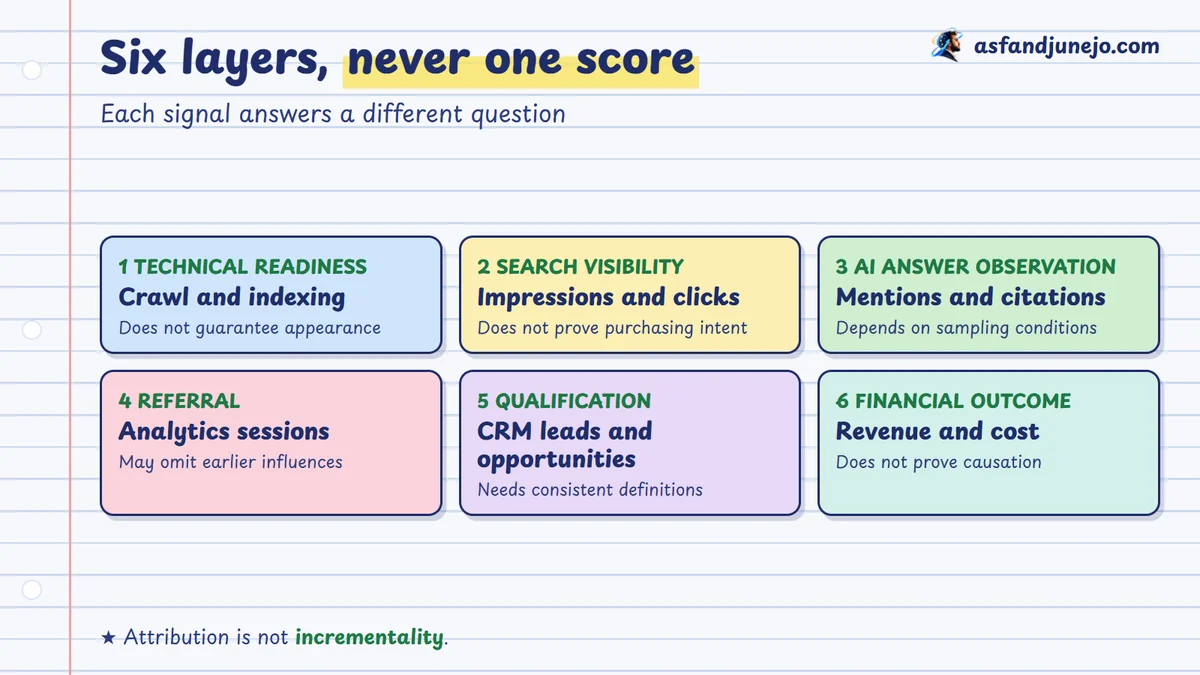
A content team can maintain six distinct observation layers.
| Layer | Evidence | Important limitation |
|---|---|---|
| Technical readiness | Crawl and indexing evidence | Does not guarantee appearance |
| Search visibility | Search Console impressions and clicks | Does not prove purchasing intent |
| AI answer observation | Documented mentions and citations | Depends on sampling conditions |
| Referral | Analytics source and session records | May omit earlier influences |
| Commercial qualification | Valid CRM lead and opportunity records | Requires consistent definitions |
| Financial outcome | Relevant revenue and cost records | Does not independently establish causation |
This measurement approach avoids compressing unrelated signals into a proprietary score.
It also helps teams decide what additional evidence is required.
What can be concluded about GitLab’s AI search performance?
The public pages reviewed demonstrate an information architecture with separate product, commercial, comparison, and technical resources.
They do not provide sufficient evidence to establish the incremental AI search traffic or revenue generated by that architecture.
The case study therefore does not claim that GitLab’s documentation structure caused higher AI citation frequency, increased qualified inquiries, or improved conversion rates.
Such conclusions would require appropriate performance data and a defensible analytical design.
The case demonstrates content organization and evidence specificity, not measured acquisition success.
That boundary is part of the methodology.
Case Study: How GitLab’s Website Connects Buyer Questions to Evidence-Backed Resources
GitLab provides a publicly inspectable example of how a complex B2B software website can separate product explanations, pricing, competitive positioning, and technical documentation. Its authentication resources demonstrate why a seemingly simple buyer question may require several precise distinctions before an accurate answer can be provided.
Case-study method: Public website and documentation review conducted November 3, 2026.
Scope: GitLab platform, pricing, vendor comparison, SAML SSO, SCIM, implementation tutorial, and documentation maintenance guidance.
Evidence boundary: This is an independent editorial analysis of publicly available resources. It is not a GitLab-endorsed case study, an internal customer research report, or a test of its AI search performance.
Step 1: Define the buyer’s actual decision
Consider an enterprise security reviewer evaluating GitLab for a development organization.
The relevant question is:
Does GitLab enforce single sign-on across every access method, including web activity, Git operations, and API requests?
This is a constructed buyer scenario, not a verified quotation from a GitLab customer.
It provides a realistic technical information task because authentication and enforcement are explicitly covered in GitLab’s documentation.
The question contains several requirements.
The buyer needs to understand whether SSO is supported, where enforcement applies, which settings are required, and whether exceptions exist.
A statement that the platform supports SAML SSO would not resolve the complete decision.
Step 2: Identify the available public resources
The platform page (opens in a new tab) explains GitLab’s overall offering.
The pricing page (opens in a new tab) distinguishes subscription and deployment arrangements.
The comparison page (opens in a new tab) presents GitLab’s competitive positioning.
The SAML SSO documentation (opens in a new tab) explains group authentication and enforcement.
The SSO configuration tutorial (opens in a new tab) provides implementation steps.
The SCIM documentation (opens in a new tab) explains relevant user provisioning behavior.
These pages serve different reader tasks.
A commercial page can introduce the offering, while technical documentation provides the precision needed for a security evaluation.
Step 3: Identify the important technical distinctions
GitLab’s documentation distinguishes GitLab.com group SAML SSO from relevant self-managed configurations.
It identifies subscription requirements for the documented features.
It also distinguishes web authentication, Git activity, and API-related behavior.
In the reviewed documentation, general SSO enforcement does not apply to API requests.
However, the documentation describes additional enforcement of Git activity, including relevant Git-related API operations under specified conditions.
It also identifies exceptions involving certain credentials and access mechanisms.
This means the buyer’s original question cannot be answered accurately through an unrestricted statement that all access methods are covered.
The documentation requires the reader to understand the exact scope of enforcement.
This is the central evidence lesson.
Broad product capability is not necessarily a guarantee.
Step 4: Evaluate existing coverage
The relevant documentation already addresses much of the buyer’s question.
It identifies the general capability, applicable conditions, and important limitations.
The information is more specific than the statement that SSO is available.
On the evidence inspected, the technical documentation provides substantial coverage of the question.
A remaining editorial opportunity, if identified through user feedback or navigation analysis, might involve clearer cross-links or a concise decision summary.
However, the reviewed pages do not establish that GitLab customers currently struggle to find the answer.
Therefore, it would be inappropriate to describe that as a verified content gap.
Step 5: Choose the appropriate editorial action
The evidence does not justify automatically creating another article about GitLab SSO enforcement.
The existing documentation is an appropriate place for the detailed answer.
An independent content recommendation would be to preserve authoritative technical information there, ensure that related explanations do not contradict it, and connect relevant product or evaluation content to the documentation where helpful.
This is an analytical recommendation, not a claim that GitLab has approved or implemented it.
A new page would need a distinct reader task and enough additional value to justify separate maintenance.
For example, a detailed administrative troubleshooting resource may serve a different purpose from the general SAML guide.
The distinction should be demonstrated rather than assumed.
Step 6: Examine comparison integrity
GitLab’s vendor comparison page provides useful information about its claimed differentiation.
But it is commercially interested content.
If an independent comparison were being prepared for a buyer, the analyst would need to verify material claims about GitHub using GitHub’s current documentation and, where available, appropriate independent evidence.
The presence of a comparison table does not itself establish objectivity.
A fair evaluation requires relevant criteria, up-to-date product information, clear scope limitations, and a clear distinction between facts and judgments.
This applies equally to any B2B vendor publishing comparisons.
Step 7: Examine the maintenance process
GitLab’s documentation contribution guide (opens in a new tab) explains how documentation changes can be proposed through source files and merge requests.
This public workflow provides a mechanism to maintain and correct technical information.
Individual source files can also be inspected through GitLab’s repository history.
The relevant evidence demonstrates a documented approach to collaborative maintenance of documentation.
It does not independently establish the outcome of any particular content change or prove that all technical claims remain continuously accurate.
The lesson for other B2B organizations is to maintain important information through an accountable process rather than treat publication as a one-time event.
Step 8: Separate demonstrated findings from unknown outcomes
The reviewed evidence establishes that GitLab publishes distinct resources for platform positioning, commercial conditions, vendor comparisons, authentication behavior, implementation, and documentation maintenance.
It also establishes that important SSO limitations and exceptions are described in the technical documentation.
The review does not establish GitLab’s internal customer-question research, its editorial prioritization model, or the commercial effect of those pages.
No AI citation uplift, customer acquisition improvement, or revenue result is claimed.
This separation matters because a case study should not become less credible in the attempt to make its results appear more impressive.
What other B2B teams can learn
The transferable lesson is not that every software company should copy GitLab’s navigation or create identical page types.
The lesson is that different buyer decisions often require different information resources.
A broad product proposition needs a clear explanation.
A comparison needs defensible criteria.
A purchasing decision needs transparent commercial conditions.
A technical requirement needs precise documentation.
An implementation task needs usable procedures.
And every consequential claim needs a way to remain accurate as the product changes.
The strongest content systems connect these responsibilities without repeating the same answer across numerous unnecessary pages.
Where can you get the B2B AI search content kit?
Join Search Signals with your email and three files unlock on this page straight away: the B2B AI Search Content Kit (ZIP), the buyer question and content gap workbook (Excel) and the implementation field guide (PDF).
The ZIP holds the 10-sheet workbook (buyer questions, entity map, coverage audit, evidence register, URL decisions, brief builder, publication QA, observation log and sources), the six-page field guide and a one-page printable decision canvas.
- B2B AI Search Content Kit (ZIP)Workbook, field guide, decision canvas, read-me and checksums
- Buyer Question and Content Gap WorkbookExcel workbook, 10 sheets
- Implementation Field GuidePDF, 6 pages
Directional Templates with a public-source example, not legal advice and not a guarantee of any ranking, citation, referral or revenue outcome
Frequently Asked Questions About B2B AI Search Content Strategy
Should a B2B company create one article for every AI prompt?
No. Several prompt variations may express the same information need. Group questions according to the buyer’s decision and required evidence. Create a separate page only when the audience, task, or information requirements justify a distinct resource.
Are AI-generated prompts useful for content research?
Yes, as exploratory hypotheses. They can suggest possible buyer questions and reveal areas worth investigating. However, a generated prompt is not proof that customers ask the question or that it deserves a new URL.
How is semantic SEO different from keyword stuffing?
Semantic SEO involves explaining topics, entities, attributes, and relationships that matter to the reader’s question. Keyword stuffing repeats phrases without improving the answer. Relevant terminology should clarify meaning rather than satisfy a repetition target.
Are comparison pages more important than educational content?
Their usefulness depends on the buyer’s task. Comparisons support alternative evaluation, while educational guides, product pages, security documentation, and implementation resources answer different questions. No single content format serves every decision.
Should B2B brands publish on their own website or third-party platforms?
Important product facts and documentation generally benefit from being maintained in an authoritative home on the company’s website. Third-party channels can provide independent perspectives and reach relevant audiences. The appropriate distribution strategy depends on the purpose of the information and the platform.
Does answer-first writing guarantee AI citations?
No. A clear opening answer can improve usability, but no evidence establishes a universal guarantee of AI citation from that format. Google’s published guidance does not require a special AI writing structure.
Does schema markup make a B2B website appear in AI Overviews?
No special AI-specific schema is required for Google AI Overviews or AI Mode. Accurate structured data may support relevant search features, but it does not guarantee inclusion in AI-generated results.
How long should a B2B AI search article be?
Long enough to answer the question with appropriate context, evidence, and limitations. There is no Google-mandated word count for generative AI search visibility.
Can an AI referral be credited with the entire contract value?
Not automatically. A recorded referral may be a single observed interaction within a larger purchasing process. Attribution depends on the measurement model, while establishing incremental commercial impact requires separate causal evidence.
When should a company consolidate existing content?
Consolidation is appropriate when several pages serve substantially the same information task without contributing meaningful independent value. Technical, commercial, and specialized resources should not be merged merely because they share terminology.
What should a team do when a technical product claim cannot be verified?
Identify the responsible specialist, request the necessary evidence, and withhold the unsupported affirmative claim. If the requirement remains unresolved, document that limitation rather than invent a capability or describe it as confirmed.
What is the best first step for a small B2B content team?
Select one commercially relevant audience, collect a manageable set of actual buyer questions, inspect the existing answers, and identify one improvement that can be supported with reliable evidence. The goal is to establish a repeatable decision process before expanding publication volume.
Publish Answers That Help Buyers Make Defensible Decisions
B2B content strategy should not be measured by how many prompt variations a company can target or how quickly it can generate additional webpages.
Its real purpose is to reduce the uncertainty customers encounter when evaluating problems, solutions, vendors, implementation requirements, and commercial commitments.
AI-assisted search has changed how many buyers collect and synthesize information.
It has not removed the need for accurate product facts, meaningful comparisons, technical documentation, and independent judgment.
The GitLab case illustrates why these distinctions matter.
A broad marketing statement about SSO support cannot replace documentation explaining exactly how enforcement applies across different conditions and access methods.
A vendor comparison cannot automatically be treated as independent verification.
A pricing page cannot substitute for implementation guidance.
Each resource should fulfill the responsibility associated with the buyer’s question.
For content teams, the operational process begins by collecting relevant questions and preserving their context.
The existing website should then be examined before proposing another page.
Missing evidence must be verified.
New content should be created only when it provides a distinct, useful answer.
Published resources should remain connected and maintainable as products and customer requirements change.
Performance should be measured through appropriately defined observations rather than unsupported guarantees about AI citations or revenue.
The goal is not to build the largest content library. It is to build the most defensible information system for the customers the business intends to serve.
Organizations seeking to evaluate their AI-assisted discovery, buyer-question coverage, technical eligibility, or evidence gaps can begin with a focused review of the questions their customers need answered and the resources currently available to them.
Explore a scoped AI visibility audit to understand how evidence-led assessment can inform that work.
Create the page because the buyer needs the answer, not because another AI prompt can be generated.
Research Methodology and Source Limitations
This article combines official search-engine documentation, published B2B buyer research, and an independent editorial review of a real software company’s public information architecture.
The GitLab case study was reviewed on November 3, 2026. It examined publicly accessible resources for product, pricing, comparison, authentication, implementation, and documentation maintenance.
The analysis identifies observable page functions and documented technical distinctions. It does not include private GitLab analytics, customer interviews, internal content decisions, controlled AI citation tests, or verified incremental revenue measurements.
G2’s 2026 findings are reported within the scope of its surveyed B2B software respondents. Forrester’s buyer research is used to contextualize complex purchasing decisions, not to establish the performance of any particular content format.
Recommendations about question prioritization, page architecture, and editorial verification are practical interpretations of the available evidence, not official Google ranking requirements.
Primary sources and references
Opened and read on November 3, 2026: the G2 report, the Forrester post, Google's guide to optimizing for generative AI features, and GitLab's pricing, platform, comparison, SAML SSO, SAML tutorial, SCIM and documentation contribution pages. Not re-read that day: Google's AI features page and its helpful-content guidance (read November 2, 2026 for another guide), the Search Console launch post and the GitLab documentation home page. GitLab's pages change, and the case study describes them as of November 3, 2026.
- G2: 2026 AI Search Insight Report (opens in a new tab)
- Forrester: The State of Business Buying, 2026 (Barbara Winters, January 21, 2026) (opens in a new tab)
- GitLab: Platform (opens in a new tab)
- GitLab: Pricing (opens in a new tab)
- GitLab: GitLab vs. GitHub (opens in a new tab)
- GitLab Docs (opens in a new tab)
- Google Search Central: Optimizing for generative AI features (opens in a new tab)
- Google Search Central: AI features and your website (opens in a new tab)
- GitLab Docs: SAML SSO for GitLab.com groups (opens in a new tab)
- GitLab Docs: SAML SSO tutorial for GitLab.com (opens in a new tab)
- GitLab Docs: Contribute to documentation (opens in a new tab)
- Google Search Console Help: Generative AI performance report (opens in a new tab)
- Google Search Central Blog: Search Generative AI performance reports in Search Console (June 3, 2026) (opens in a new tab)
- GitLab Docs: Configure SCIM for GitLab.com groups (opens in a new tab)