Multilingual SEO is the process of making a website’s content accessible, relevant, and discoverable in more than one language. For global brands, however, effective multilingual SEO requires more than translating existing pages. It involves understanding local search intent, verifying whether products and services are available in each market, adapting information as needed, and implementing technical signals to help search engines identify appropriate language and regional versions.
Published · Sources checked · By Asfand Yar Junejo, publisher asfandjunejo.com
The central decision is not how many pages a business can translate. It is which audiences need localized information, what evidence supports that need, and whether the resulting pages can be maintained accurately.
A company can translate hundreds of pages without answering the questions that matter to its intended customers.
Its translated terminology may be correct but uncommon in the target market. Its product descriptions may contain capabilities that are unavailable under local commercial conditions. Its regional pages may use conflicting canonical and hreflang signals. Visitors may also encounter a fully translated landing page only to discover that the checkout, support process, or advertised service is unavailable to them.
These problems are often treated as separate responsibilities. SEO teams conduct keyword research, translators adapt language, regional teams review market information, Product Marketing manages claims, and developers implement localized URLs.
Each function may complete its assigned tasks, yet the resulting page still fails to meet a meaningful requirement for its audience.
A more reliable strategy begins by connecting these responsibilities to a common decision: What information does this audience need, and what is the minimum appropriate intervention?
That intervention may be a reviewed translation, a regional content adaptation, a new localized page, a correction to existing technical signals, or a decision not to publish until the necessary evidence exists.
Consider an international ecommerce software company expanding into Spanish-speaking markets.
The company already has an English page explaining how businesses can create an online store. It wants to reach audiences in Mexico and Spain.
The two markets share a language, but this alone does not establish that their search behavior, commercial requirements, product availability, or purchasing conditions are identical. Nor does it prove that they need completely separate versions of every page.
The company must investigate which information is shared, which requirements differ, and whether those differences justify additional URLs.
This guide develops an evidence-led multilingual SEO approach that connects market selection, local search research, content decisions, technical implementation, and measurement.
It also examines Shopify’s publicly accessible language and regional pages, including an independent analysis of their canonical and alternate-language declarations.
The objective is to help global brands create useful localized information without confusing translation volume with international search relevance.
The 14-sheet market-intent audit workbook and printable checklists behind this guide are free for Search Signals subscribers.
What are the key takeaways?
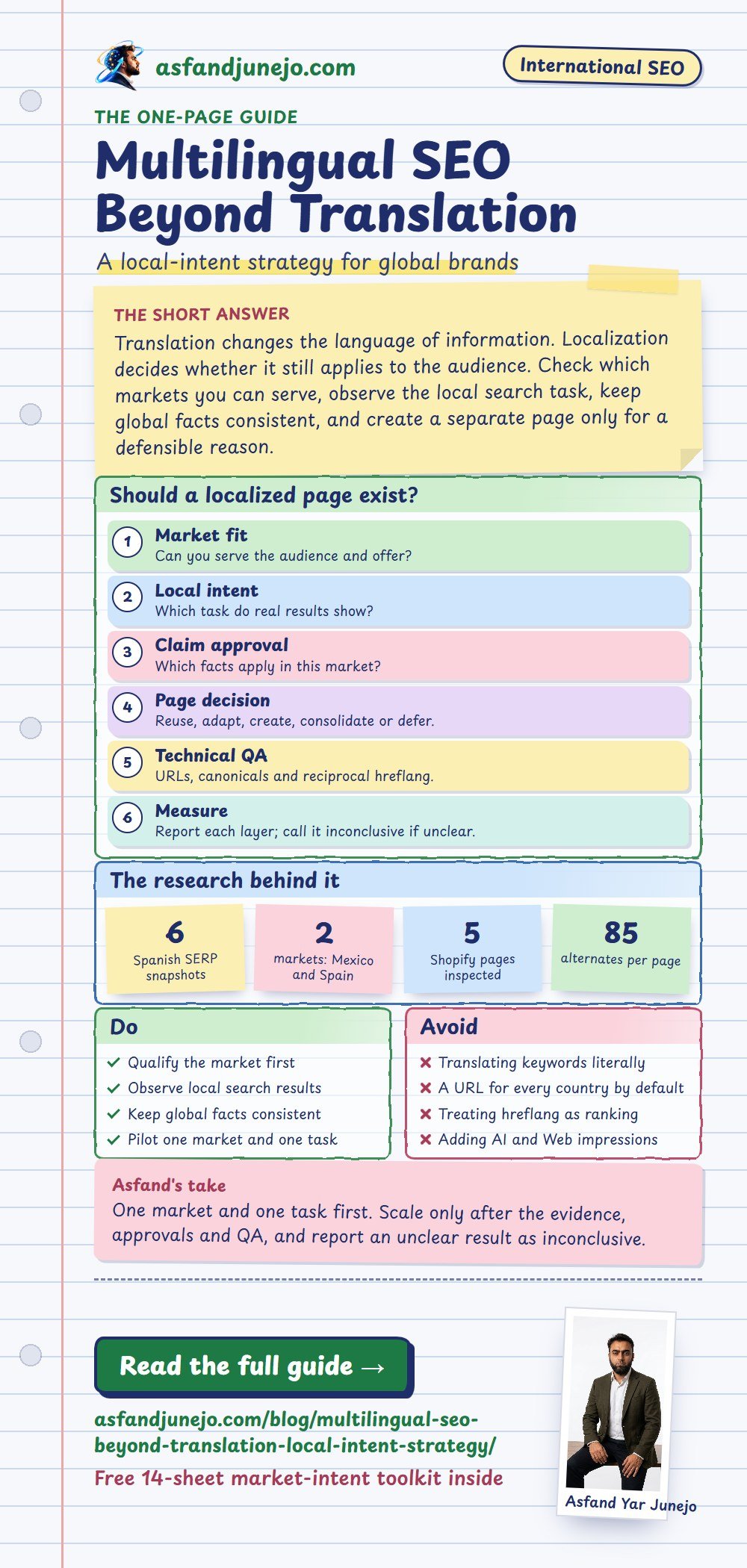
Translation changes the language of information. Localization decides whether that information still applies to the audience. Decide which markets you can serve, observe the local search task, keep global facts consistent, create a separate page only for a defensible reason, and verify URLs, hreflang and canonicals as separate signals.
- Market eligibility comes before translation: demand does not prove you can fulfil the offer.
- Shared language does not mean identical needs, and different countries do not automatically need different pages.
- In six sampled Spanish-language SERPs, Mexico and Spain showed overlapping search tasks with some local framing. That is an observation, not a survey.
- Hreflang labels alternate versions. Canonicals are signals about a preferred URL. Neither guarantees indexing or rankings.
- Pilot one market and one task first, measure each layer separately, and call an unclear result inconclusive.
What Is Multilingual SEO Beyond Translation?
Multilingual SEO makes website information discoverable and usable across languages. Its broader international application may also require market-specific content, commercial validation, technical localization, and ongoing maintenance. Translation changes the language of information, while localization determines whether that information remains appropriate for the intended audience.
These responsibilities are connected but not interchangeable.
Translation communicates existing information in another language
Translation changes how information is expressed while preserving its intended meaning.
An English page describing the process of creating an online store may be translated into Spanish, German, French, Arabic, or another language.
The translation may accurately communicate the source explanation.
However, linguistic accuracy does not establish that the translated terminology matches the words people use in the intended market.
Nor does it establish that the product, pricing, support, and commercial conditions described on the original page are applicable internationally.
For example, a software vendor may describe an integration available under a particular product plan. Translating that statement does not establish that the integration is offered under every regional plan.
The claim must remain accurate for the intended audience.
Translation therefore answers a limited question: How should the existing information be communicated in another language?
Multilingual SEO must also establish whether the existing information is suitable for the target market.
Localization adapts information to an audience and locale
Localization concerns the language, cultural, technical, and commercial requirements of a particular audience.
The World Wide Web Consortium’s guidance on localization and internationalization (opens in a new tab) explains that localization can involve date formats, currencies, addresses, legal requirements, images, interface conventions, and script-specific presentation.
For a commercial website, localization may also require reviewing product availability, delivery coverage, payment arrangements, support capabilities, and market-specific claims.
A company should not assume that every market requires entirely different content.
Some product facts may remain valid across all supported regions. Others may require qualification or replacement.
The degree of adaptation should follow the audience’s actual needs and the evidence available.
Internationalization prepares systems for localization
Internationalization concerns the design and development work that allows websites and applications to support different languages and regional requirements.
A content management system may need to handle multiple character sets, configurable number formats, bidirectional text, localized URLs, and relationships between source and translated content.
A website designed only for English may require substantial changes before it can reliably support Arabic, Urdu, Japanese, or other language environments.
The challenge is not merely whether the system can store translated text.
It must also display the content correctly, preserve user interactions, support appropriate navigation, and maintain accurate relationships among language versions.
Internationalization is therefore an enabling technical discipline rather than another term for translation.
Multilingual and multiregional targeting are different
Google distinguishes multilingual websites from multiregional websites in its international SEO documentation (opens in a new tab).
A multilingual website offers content in multiple languages.
A multiregional website explicitly targets audiences in different geographic markets.
A website may be both.
For example, a Canadian business may provide English and French versions intended for customers in Canada.
An international retailer may use English-language pages for the United States, United Kingdom, and Australia while providing different pricing, fulfillment, or support information in each market.
The second example involves regional targeting despite the shared language.
This distinction has important implications for content architecture.
One language does not necessarily require one URL.
One country does not necessarily require a separate domain.
And a language-specific URL should not automatically be interpreted as targeting a particular country.
A Spanish-language page may serve international Spanish-speaking audiences, while another page may specifically address customers in Mexico.
Language, region, and locale must remain distinct
A language describes how information is communicated.
A region identifies a geographic context.
A locale combines relevant language and regional conventions where applicable.
These distinctions matter because audiences sharing a language do not necessarily share identical commercial requirements.
Spanish-speaking customers in Mexico and Spain may encounter different payment arrangements, support conditions, or product availability.
English-speaking customers in several countries may also require different commercial information.
However, regional differences should not be assumed solely because countries have different names.
The business must establish which differences are material to the user’s task.
A multilingual SEO strategy should therefore be organized around the relationship between audience, language, market, search intent, and the applicable product or service.
That relationship provides the foundation for deciding which localized pages should exist.
Which Languages and Markets Should a Brand Prioritize?
Global brands should prioritize markets where they can identify meaningful audience demand, provide the advertised product or service, support customers appropriately, and maintain accurate localized information. Keyword volume can contribute to market research, but it should not override commercial eligibility or operational readiness.
A market may appear attractive because relevant keywords receive substantial estimated search demand.
That does not establish that the business is ready to serve customers there.
A company may lack regional service coverage, appropriate contractual arrangements, supported payment methods, or necessary product capabilities.
Publishing localized commercial pages before resolving those conditions may attract inquiries the organization cannot satisfy.
Market qualification should therefore precede large-scale translation.
Start with observable customer demand
Existing customer relationships often provide more actionable evidence than broad market-size estimates.
A company may already receive inquiries from a market it has not formally targeted.
Sales teams may encounter recurring questions from customers using a particular language.
Support records may reveal requests for translated documentation or clarification of regional service conditions.
Search Console may show impressions for relevant queries originating from a target country.
These observations provide starting points.
They do not independently establish commercial viability.
Search impressions from a country do not prove that the searchers can purchase the product or that the existing page should be translated.
Likewise, low estimated search volume does not necessarily indicate weak demand for a specialized B2B service.
A narrow technical requirement may be commercially important even when keyword tools show limited search volume.
The relevant question is whether the business can identify an audience whose needs align with what it can provide.
Verify the offer before preparing localized content
Product availability should be checked at the same level of specificity as the proposed page.
For an ecommerce company, this may involve shipping locations, fulfillment restrictions, product availability, returns, and payment methods.
For a SaaS platform, the relevant conditions may include supported plans, integrations, hosting arrangements, service availability, and technical support.
For a professional services business, market eligibility may depend on actual delivery capacity, relevant expertise, language support, and commercial arrangements.
The appropriate functional owners should confirm these conditions.
The existence of search demand cannot establish that a product is available.
Nor can a translation tool authorize a commercial claim.
If a product is unavailable or a mandatory condition cannot be satisfied, the business may need to defer the affected commercial content.
Evaluate the complete customer experience
A localized landing page is only one part of the visitor’s journey.
A person may understand the page but encounter an unsupported country field in the inquiry form.
A translated product explanation may link to a checkout that does not support the intended market.
A technical guide may direct readers to support documentation that is unavailable in the relevant language.
These inconsistencies can undermine the usefulness of localization.
The organization should verify whether the intended audience can complete the relevant task.
Not every business must provide every service in every language. However, limitations should be communicated accurately.
Consider maintenance capacity before expansion
Localized pages require ongoing updates.
Product specifications change. Commercial terms are revised. Integrations are added or withdrawn. Support conditions evolve.
A claim that appears across several language versions can become outdated when its source changes.
The business should identify which localized pages depend on consequential source information and who is responsible for reviewing them.
A company that can translate 100 pages immediately may not have the capacity to maintain those pages reliably.
Initial publishing capacity and long-term content governance are different requirements.
Market eligibility matrix
A useful market assessment should record evidence rather than produce an arbitrary market attractiveness score.
| Evaluation area | Evidence required | Decision |
|---|---|---|
| Audience demand | Customer inquiries, market research, relevant search observations | Is there a meaningful information need? |
| Product availability | Approved product and service information | Can the business fulfill the offer? |
| Commercial readiness | Pricing, payment, contractual, and delivery conditions | Can customers complete the intended transaction? |
| Language capability | Qualified reviewers and relevant support arrangements | Can accurate information be produced and maintained? |
| Technical readiness | CMS, localization workflow, URL architecture, and QA capability | Can the website support the intended versions? |
| Maintenance ownership | Reviewers, source dependencies, and update procedures | Can the content remain accurate? |
The result should be an explicit decision to proceed, investigate, limit scope, or defer.
A market with relevant search demand but an unsupported product offering should not automatically receive a commercial landing page.
The appropriate intervention depends on what the organization can substantiate.
How Do You Research Local Search Intent Without Translating Keywords Literally?
Local search-intent research begins by understanding the task a person wants to complete and then investigating how that task is expressed in the intended market. Literal keyword translation provides possible terminology, but it does not establish which queries are common, which pages search engines display, or which information users need.
A single commercial concept can support several search intents.
Someone searching for an online store platform may want to learn how e-commerce works, compare software providers, estimate costs, or begin implementation.
Those tasks may require different pages even when the queries contain overlapping terminology.
The first step is to define the underlying information need.
Begin with the task, not the translated keyword
Consider the English topic: create an online store.
A business preparing Spanish-language content might investigate phrases such as crear tienda online, cómo crear tienda online, and plataformas de ecommerce.
These are reasonable research candidates.
They should not automatically be assigned to the same page.
The first phrase may have broad informational and commercial interpretations.
The second more explicitly describes a process.
The third suggests a category or platform comparison.
Actual search-result evidence can help determine how these distinctions appear under specific market conditions.
Original research: Mexico versus Spain
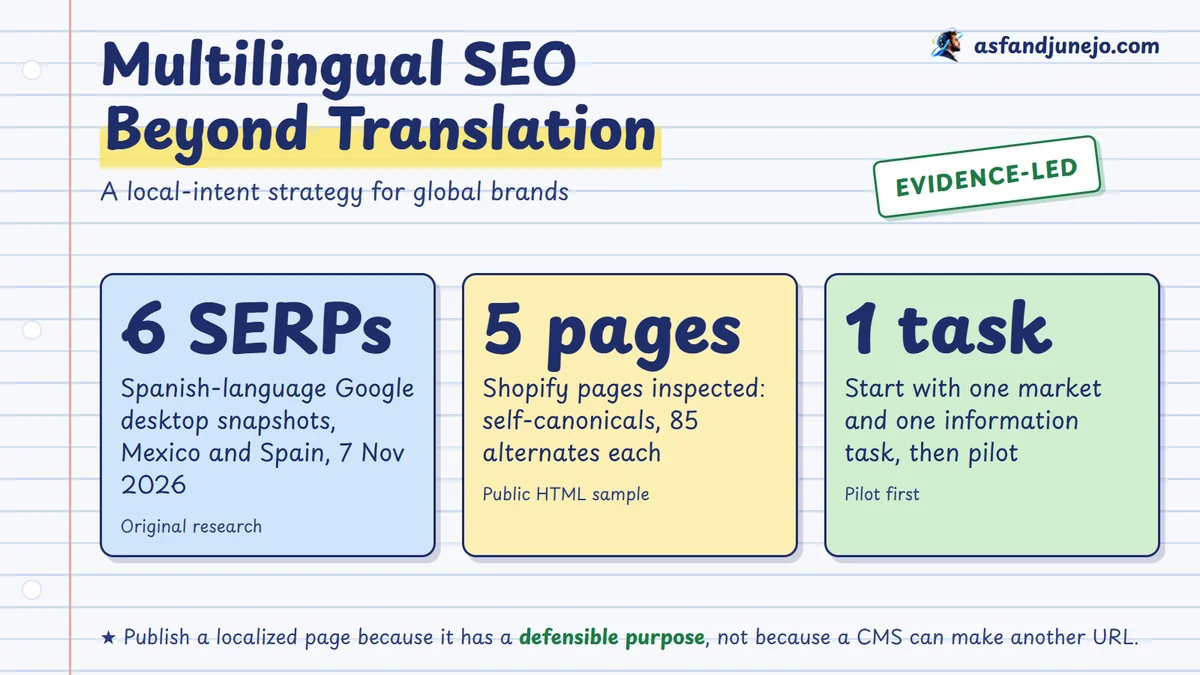
To investigate this article’s local-intent question, six Google SERP observations were collected on November 7, 2026.
The study used three Spanish-language query formulations across two search locations: Mexico and Spain.
The requests used country-specific Google search-location configurations, Spanish as the search language, and desktop results.
The observations were collected between approximately 12:11 and 12:12 UTC on November 7, 2026.
The investigation examined the visible result types and first-page organic results for each query.
It was designed to identify how the search results presented the underlying tasks, not to estimate keyword volumes or measure actual user preferences.
What the local search results showed
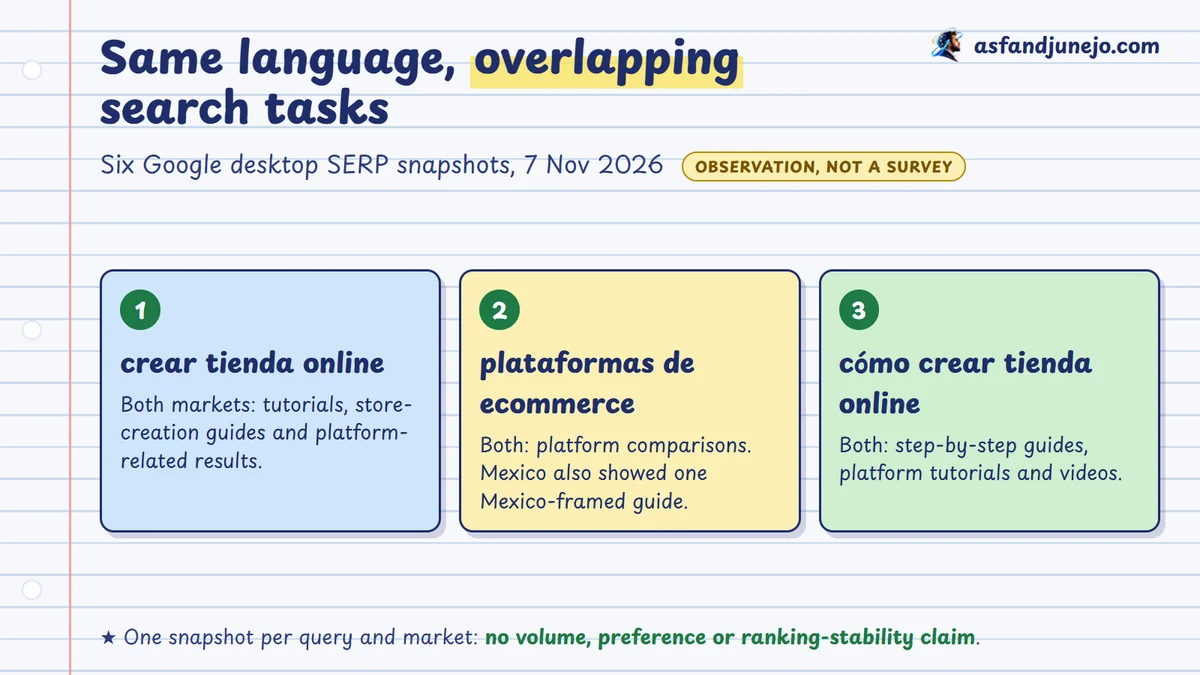
| Query | Mexico observation | Spain observation | Supported interpretation |
|---|---|---|---|
| crear tienda online | Tutorials, online-store creation guides, video content, and platform-related results | Tutorials, business setup guides, and online-store creation resources | Both markets display substantial how-to intent |
| plataformas de ecommerce | Platform comparisons, ecommerce software guides, and a result explicitly addressing platforms for selling in Mexico | Platform comparisons, software selection guides, and ecommerce platform lists | Both markets show comparison intent, with some region-specific framing |
| cómo crear tienda online | Step-by-step guides, platform tutorials, and video resources | Step-by-step guides, platform tutorials, and video resources | The procedural task is strongly represented in both samples |
These are observations from six individual result sets, not a longitudinal study of rankings or search behavior.
The findings are useful because they challenge a common assumption about localization.
Different countries do not necessarily require different content strategies for the same search task.
In the sampled results, instructional searches yielded broadly comparable content categories in both Mexico and Spain.
The platform-comparison query also produced similar types of resources.
However, some results included region-specific framing.
For example, the Mexico results for plataformas de ecommerce included a page titled “10 mejores plataformas para vender en línea en México.”
The Spain sample included resources such as “Cómo elegir entre diferentes plataformas de e-commerce” and comparisons discussing multiple e-commerce platforms.
This suggests that a general platform-selection task can coexist with content that addresses regional market conditions.
It does not establish that Mexican searchers universally prefer one platform, terminology variant, or purchasing model.
Why the overlap matters
The result-set comparison provides an important decision signal.
If a global brand finds that two markets share the same underlying search task, it may be able to preserve much of the same core explanation across localized pages.
The business should then investigate whether the surrounding product information, examples, commercial terms, or support arrangements need regional adaptation.
For example, an explanation of how ecommerce platforms manage product catalogs may remain valid across markets.
A comparison of supported payment providers or market-specific service availability may require separate verification.
This distinction can prevent unnecessary duplication.
It also avoids the opposite mistake of assuming one generic translation is appropriate for every market.
The correct content decision follows the evidence.
What the SERP investigation does not establish
The observations do not provide verified differences in search volume between Mexico and Spain.
They do not establish the preferred terminology of all Spanish-speaking users.
They do not prove that the observed rankings will remain stable.
They do not show which results receive the most clicks or generate qualified customers.
The study also does not include mobile results, historical SERP comparisons, or statistically representative user research.
One captured result set per query and market is insufficient to support claims about long-term market behavior.
Directional These are the author's six SERP captures from November 7, 2026. Search results change, so I could not independently reproduce them; treat them as a point-in-time observation, as the article itself says
For a consequential international expansion decision, the company should combine localized SERP sampling with customer research, relevant Search Console observations, and product or commercial evidence.
The article’s finding is therefore deliberately narrow:
The sampled markets showed substantial overlap in broad search tasks, while some results presented locally framed information. Further evidence is needed to determine which differences justify separate content.
Translate the research into a content decision
The company should now determine which resource best serves each task.
A beginner-focused query may justify an educational guide.
A platform-comparison query may require a comparison that accurately addresses capabilities and limitations.
A query concerning local payments, shipping, or other market conditions may need specific regional evidence.
The source-language website should be examined before creating another page.
If an existing resource already addresses the task and its facts apply to the target market, translation with appropriate review may be sufficient.
If important regional conditions differ, the content should be adapted accordingly.
If the search task itself differs materially, a separate resource may be justified.
If the organization cannot substantiate the relevant offer or claim, publication should be deferred.
Combine SERP observations with first-party evidence
Search results explain what the search engine displayed under the captured conditions.
Customer interviews, support inquiries, on-site search, and Sales feedback can provide additional evidence about actual customer requirements.
Search Console can reveal which queries and pages already receive Google Search exposure.
However, Google withholds some query data for privacy, and country-level reporting identifies the origin of searches rather than the searcher’s preferred language.
The company should not treat any one of these sources as a complete account of local demand.
A reliable local-intent brief should preserve the query, target market, observed results, customer requirement, applicable product facts, and proposed intervention.
This creates a more defensible basis for localization than translating a keyword spreadsheet without examining the search environment.
Which Content Elements Should Stay Global, and Which Need Localization?
Globally valid product facts should remain consistent across localized pages. Information should change when the relevant market, audience, product configuration, commercial terms, or user requirements differ. The objective is to preserve factual consistency while adapting the information necessary for local relevance.
Unnecessary variation can introduce errors.
A translator may unintentionally strengthen a technical claim.
A regional page may describe a feature unavailable under the corresponding plan.
A customer testimonial may be presented as proof of outcomes outside its documented conditions.
These are not merely writing problems. They concern evidence and applicability.
Preserve facts that genuinely apply across markets
Core product specifications, verified capabilities, and documented limitations should remain consistent across all intended audiences.
A manufacturer should not change a product’s technical specifications simply to make a localized page appear unique.
A SaaS vendor should not expand a feature’s availability through translation.
A professional service provider should not claim market-specific expertise without evidence.
The approved source information should remain identifiable.
If a source claim changes, dependent localized pages should be reviewed.
Localize information that affects the user’s decision
Commercial and operational conditions may differ by market.
A pricing page may need an applicable currency and billing arrangement.
An ecommerce page may require local shipping and returns information.
A SaaS page may need to explain which integrations or services are available in the market.
A technical guide may require different examples when the target audience uses a different operating environment.
These changes should be based on verified applicability.
The content team should not assume regional differences simply because a country has different cultural conventions.
Global versus local content decisions
| Content element | Recommended approach | Approval responsibility |
|---|---|---|
| Core product capabilities | Preserve verified facts unless availability differs | Product or Engineering |
| Pricing and commercial terms | Verify applicable market conditions | Finance or Commercial Operations |
| Technical integrations | Validate product version and regional availability | Product or Engineering |
| Regulatory statements | Review applicable scope and wording | Legal or Compliance |
| Customer testimonials | Preserve permission and evidence context | Customer Marketing |
| Search terminology | Investigate local usage and intent | SEO and qualified language reviewer |
| Dates, currency, and measurements | Adapt relevant presentation conventions | Localization and UX |
| Forms and conversion paths | Confirm the intended customer can complete the task | Marketing and Operations |
| Support information | State actual language and service availability | Customer Support |
The table is an operational review model, not a requirement to create different values for every market.
Some fields may remain unchanged.
Others may need material adaptation.
The decision should be documented at the claim or information level.
Localization includes the conversion path
A useful localized page can still fail the customer if the next step is unsuitable.
A translated product page may link to an unsupported checkout.
A regional service page may direct users to an inquiry form that does not accept their country.
A technical document may link to instructions for a different product version.
These issues should be tested as part of the complete task.
The content owner should verify that relevant calls to action, forms, confirmation messages, pricing information, and support destinations remain appropriate for the intended audience.
This is a broader requirement than keyword optimization.
Shared evidence needs local approval boundaries
A company may maintain one authoritative product record while allowing specific regional exceptions.
Each material exception should identify the relevant market, the source of evidence, the responsible approver, and the review trigger.
For example, a product integration may be supported globally except in a specific deployment environment.
The localized content should retain that condition rather than presenting an unconditional capability.
A fact can also be internally verified without being authorized for public disclosure.
Customer-specific technical information, private contracts, and restricted security details require appropriate handling.
The goal is to make localized content accurate and maintainable, not merely linguistically consistent.
When Does a Market Need a Separate Localized Page?
A separate localized page is justified when it serves a distinct language requirement, audience task, market-specific information need, or deliberate regional targeting purpose that the organization can maintain. A different country name or translated keyword alone does not establish that another URL is necessary.
The page-creation decision should follow market and content research.
Automatically creating regional pages can lead to unnecessary duplication and maintenance work.
Using one generic page for every market can also conceal important commercial differences.
A defensible strategy must distinguish these situations.
Different languages, equivalent information
Suppose a software company offers the same supported product and commercial conditions to English- and German-speaking audiences.
The principal need may be linguistic accessibility.
A translated German page, reviewed for terminology and factual accuracy, may be sufficient.
The page does not necessarily need a completely different product narrative.
Its technical implementation should establish the appropriate relationship with the English version.
The same language across several countries
A business may serve the United States, United Kingdom, and Australia through English-language content.
Some information may apply across all three markets.
Other details may differ, including pricing, shipping, or service availability.
The company should not assume that every technical guide requires three separate versions.
A shared guide may be appropriate when its information remains accurate.
Regional pricing or support pages may require distinct treatment.
The page structure should follow the information need.
Several languages within one country
A business may serve customers in Canada through English and French pages.
The underlying product may remain the same.
Separate language URLs can be justified by the audience’s language requirements even when the commercial information is largely shared.
The company should maintain the relevant alternate-language relationships without inventing unnecessary market differences.
One language, materially different regional requirements
The Mexico-versus-Spain example illustrates a more complex situation.
Both markets may include audiences researching how to create online stores.
The core product explanation can remain substantially similar.
However, the customer may also need information about applicable plans, commercial arrangements, payment integrations, or support.
A regional page can be justified when those differences matter to the audience or when the company maintains a coherent regional targeting strategy.
The business should verify the differences rather than assume they exist.
When the correct decision is not to publish
A market may show relevant search activity while the business lacks a supported offer.
The required local reviewer may be unavailable.
The CMS may not reliably manage localized versions.
Important commercial claims may remain unresolved.
In these situations, creating another page may be premature.
The appropriate decision may be to improve the existing website, resolve the evidence gap, or defer localization.
The minimum sufficient content intervention
The decision should follow this sequence:
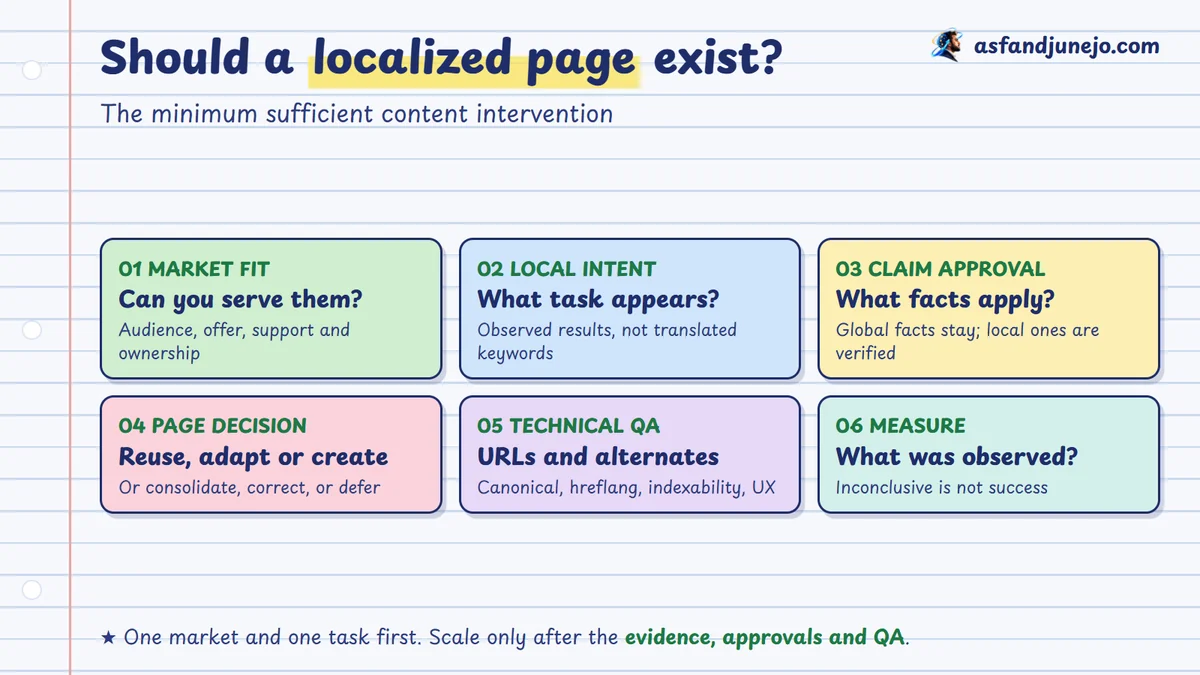
Market eligibility → Local search task → Existing information → Material differences → Content intervention → Technical implementation.
The intervention can take several forms.
A company may translate an existing page, adapt particular fields, create a distinct regional version, consolidate unnecessary duplicates, correct the language-selection experience, or defer publication.
The preferred option is the one that adequately addresses the identified requirement without introducing unnecessary complexity.
A localized page should exist because it has a defensible purpose, not because the content management system can generate another URL.
Once the page decision is made, the next challenge is implementing the technical relationships correctly.
How Should Multilingual URLs, Hreflang, and Canonicals Work Together?
Localized URLs, hreflang, and canonicalization serve different purposes. URLs provide stable addresses for content. Hreflang identifies alternate language or regional versions. Canonicalization helps Google select a representative URL among duplicate or substantially similar pages. A coherent implementation should reflect the actual content relationships without assuming that technical annotations guarantee indexing or rankings.
Google recommends using separate URLs for different language versions (opens in a new tab).
The appropriate URL architecture depends on the website’s infrastructure and business requirements.
A company may use country-code domains, subdomains, or subdirectories.
None is universally superior.
The more important requirements are accessibility, technical consistency, and maintainability.
What hreflang communicates
The hreflang attribute identifies an alternate version intended for a language or regional audience.
Examples include en-US, en-GB, es-MX, es-ES, and de.
The language component comes first, followed by an optional regional component.
The distinction matters because es identifies Spanish without specifying Spain, while es-ES identifies Spanish for Spain.
Google does not use hreflang to determine a page’s language. It primarily analyzes visible content.
Confirmed Google's localized-versions documentation says Google doesn't use hreflang or the HTML lang attribute to detect a page's language, that the HTML, HTTP header and sitemap methods are equivalent, and that pages that don't point to each other have their annotations ignored. Google's multi-regional documentation recommends a separate URL for each language version and warns against automatic redirects based on assumed language (checked November 11, 2026)
The annotation instead communicates the relationship among alternate versions.
Choose one maintainable implementation method
Google supports three methods for declaring localized alternatives: HTML annotations, HTTP headers, and XML sitemaps.
Its localized-version guidance (opens in a new tab) explains that these methods are equivalent from Google’s perspective.
Implementing all three does not provide additional Search benefit.
For ordinary HTML pages, annotations can be placed in the document’s <head>.
HTTP headers may be useful for non-HTML resources such as PDFs.
XML sitemap annotations can be appropriate when the website’s infrastructure makes centralized mapping easier.
The organization should choose a method it can maintain consistently.
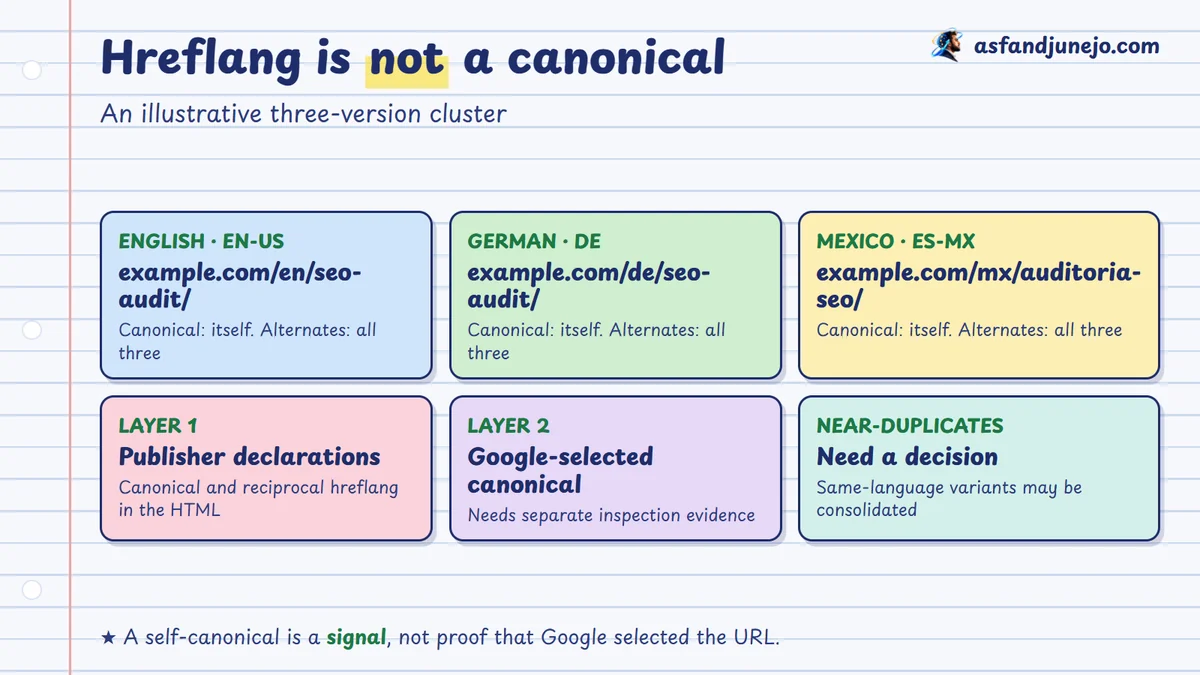
Example: Three localized service pages
Consider a hypothetical website with English, German, and Mexican Spanish versions of a service page.
The following markup identifies the alternate URLs:
<link rel="alternate" hreflang="en-US" href="https://example.com/en/seo-audit/">
<link rel="alternate" hreflang="de" href="https://example.com/de/seo-audit/">
<link rel="alternate" hreflang="es-MX" href="https://example.com/mx/auditoria-seo/">
<link rel="alternate" hreflang="x-default" href="https://example.com/language/">This is an illustrative configuration.
The x-default destination represents a hypothetical language-selection page.
The same applicable alternate mapping should appear on the three localized pages.
Each page should include its own URL in the mapping, and the relationships should be reciprocal.
Google can ignore nonreciprocal relationships.
Canonicals are declared separately
For pages intended to remain independently canonical, the corresponding declarations might be:
| Version | Declared canonical |
|---|---|
| English | https://example.com/en/seo-audit/ |
| German | https://example.com/de/seo-audit/ |
| Mexican Spanish | https://example.com/mx/auditoria-seo/ |
The German page would contain:
<link rel="canonical" href="https://example.com/de/seo-audit/">This example assumes the localized pages contain appropriate language versions and are intended to remain eligible search destinations.
It is not a universal rule that requires every regional page to canonicalize to itself, regardless of duplication.
Distinguish hreflang from canonicalization
Hreflang helps Google understand which pages are intended for different audiences.
Canonicalization determines which URL Google treats as representative when pages are duplicate or substantially similar.
These decisions interact.
A substantially translated German page normally serves a distinct language audience and should not automatically canonicalize to its English source.
Same-language regional variants require more judgment.
For example, two English-language regional pages may contain similar product descriptions but different commercial terms.
If the business intends both to remain distinct search destinations, its content strategy and canonical declarations should support that objective.
If the pages are effectively duplicate versions without a meaningful distinction, consolidation or another canonical strategy may be more appropriate.
Google’s canonicalization documentation (opens in a new tab) explains that publisher-declared canonicals are signals, not commands.
Google may select another URL as canonical.
A self-referencing declaration therefore does not prove that the page has been independently selected or indexed.
Avoid conflicting technical signals
A multilingual technical audit should investigate conflicting canonical declarations, redirected alternate URLs, missing reciprocal references, unsupported locale codes, noindex directives, and inaccessible localized pages.
Canonicalization should not be managed through robots.txt.
A page blocked from crawling may prevent Google from inspecting the information needed to interpret its content and technical relationships.
Likewise, a localized URL should not be expected to appear in Search if it is explicitly excluded from indexing.
The technical reviewer should inspect the actual page response, source HTML, rendered HTML, robots directives, canonical declaration, and relevant sitemap information.
The goal is to verify the intended implementation, not merely count tags.
What Technical and UX Errors Can Undermine Multilingual Search?
Multilingual websites can become difficult to discover or use when localized URLs are inaccessible, language redirects interfere with navigation, canonical and alternate-language signals conflict, or important parts of the interface remain untranslated. These issues should be diagnosed according to their actual mechanism rather than described as universal ranking penalties.
Technical accessibility and user experience are related but distinct.
A localized page may be crawlable while providing a poor language experience.
Another may contain excellent localized content but expose conflicting indexing signals.
Both require investigation.
Avoid automatic redirects that restrict access
Some websites redirect visitors based on their IP addresses or browser languages.
This can create problems when the inferred location or preference is incorrect.
A visitor may be researching another country.
A user may prefer a different language.
Google also warns that automatic routing can prevent crawlers from discovering localized versions.
The website should maintain stable, accessible URLs and provide a practical way to switch languages or regions.
A language suggestion can be useful, but the user should not be trapped in an automatically selected version.
Preserve the visitor’s task when switching languages
A visitor reading a technical guide should ideally reach the equivalent localized guide when changing language.
Redirecting every language-switching action to another homepage may interrupt the task.
Where no equivalent translation exists, the website should provide an appropriate fallback or explain the limitation.
The experience should not imply that an unrelated homepage is an equivalent replacement.
HTML language attributes support accessibility
Google determines a page’s language primarily from visible content rather than relying on the HTML lang attribute.
However, the attribute remains important for accessibility and language-aware technologies.
A Spanish-language page should use an appropriate language declaration, such as:
<html lang="es">A regional variant may use:
<html lang="es-MX">These declarations should accurately describe the content.
They do not replace hreflang relationships.
Right-to-left languages need directional support
Arabic, Urdu, Sindhi, Hebrew, and other languages using right-to-left scripts require appropriate directionality.
For an Urdu-language page:
<html lang="ur" dir="rtl">The language and direction attributes serve different purposes.
Mixed-language content may also require bidirectional isolation.
For user-generated text whose direction is not known in advance, dir="auto" and suitable isolation markup can be useful.
The W3C’s right-to-left HTML guidance (opens in a new tab) explains these requirements in detail.
A translation workflow should not assume that mirroring the interface visually is sufficient.
Forms, punctuation, URLs, numbers, menus, and mixed-script content should be tested.
Diagnose issues with evidence
A technical review should identify the observed issue, the affected URLs, supporting evidence, the responsible owner, and the recommended correction.
For example, if the Spanish version redirects unexpectedly to English, the reviewer should capture the request conditions and final destination.
If a canonical points to another region, the reviewer should inspect whether the pages are genuine duplicates or whether the implementation conflicts with the intended targeting strategy.
If the language selector fails on mobile, the issue should be documented through the rendered experience.
These findings should not be combined into an arbitrary SEO health score that implies a direct relationship with rankings.
The appropriate correction depends on the actual problem.
How Should AI Translation and Human Review Be Governed?
AI-assisted translation can support multilingual content production, but factual accuracy, terminology, market applicability, and disclosure permissions still require appropriate review. A reliable workflow separates language quality from domain approval and maintains a traceable relationship between source information and localized pages.
The central risk is that fluent language can reproduce or conceal an inaccurate statement.
An AI translation may preserve a source claim that is already outdated.
It may omit an important limitation.
It may combine terminology from different product versions.
It may also produce regionally inappropriate wording while remaining grammatically correct.
These risks should be managed according to the type of information involved.
Begin with approved source facts
The organization should identify the authoritative source for consequential product claims.
If a feature is supported only under specific conditions, those conditions must remain attached to the translated statement.
The localization team should not infer missing capabilities or commercial terms.
A source claim that cannot be verified should be corrected or appropriately qualified before translation.
Maintain terminology consistency
A terminology register can record approved product names, technical expressions, regional equivalents, and relevant usage conditions.
However, terminology governance should not prevent legitimate regional variation.
A proprietary product name may remain unchanged, while a generic service category may require a different expression for the intended audience.
The correct wording should follow evidence and qualified review.
Separate linguistic review from factual approval
A native or highly proficient language reviewer may evaluate clarity, terminology, and natural expression.
That expertise does not automatically authorize approval of technical, financial, security, or regulatory claims.
The relevant domain specialist should approve factual scope.
The language reviewer should confirm that the localized statement preserves the approved meaning.
Both reviews may be necessary for consequential content.
This distinction is explored further in AI in SEO: What to Automate, What to Verify, and What to Keep Human.
AI translation is not automatically a Google spam violation
Google does not prohibit content merely because AI or automated translation contributed to its creation.
Directional Google's spam policies say automation or generative AI is not prohibited by itself, and its generative AI guidance warns that many AI-made pages without added value may violate the scaled content abuse policy. Neither page mentions translation, so applying this to machine translation is the author's reasoning (checked November 11, 2026)
Its guidance on generative AI content (opens in a new tab) focuses on providing useful information, ensuring quality, and complying with Search policies.
Google’s scaled-content-abuse policy concerns large-scale content production intended primarily to manipulate search rankings rather than help users.
The method of production is not the only consideration.
A substantial multilingual website can be legitimate when its pages serve real audiences and contain useful information.
Conversely, generating numerous low-value regional pages solely to capture keyword variations can create policy and quality risks.
The organization should evaluate the content’s purpose and substance rather than assume automation is inherently compliant or noncompliant.
Maintain source-to-localized-page dependencies
Localized content should remain connected to its authoritative source.
A change to product availability, pricing, integrations, or commercial terms may affect several language versions.
The organization should identify the dependent pages and require appropriate revalidation.
Each material claim should have an identifiable source, applicable scope, responsible approver, and review trigger.
Outdated content should not remain public merely because the translation team has not been notified.
Protect sensitive information
Localization processes may involve customer records, technical documentation, contractual terms, or other restricted material.
The organization should use authorized tools and appropriate access controls.
Information approved for internal analysis is not automatically approved for publication.
An AI system should not receive sensitive material simply because it might produce a more natural translation.
The same disclosure and privacy requirements apply to human and automated localization workflows.
What Can Shopify’s Multilingual Website Teach Us About Locale Targeting?
Shopify’s public website provides an inspectable example of a global platform maintaining multiple language and regional versions of a shared product proposition. Its sampled online-store pages demonstrate distinct regional URL paths, localized titles and language attributes, self-referencing canonical declarations, and coordinated hreflang mappings.
These observations describe Shopify’s publicly accessible implementation. They do not establish its rankings, conversion performance, or the commercial impact of localization.
Scope of the independent case study
The page-level inspection was conducted on November 7, 2026.
Five public Shopify URLs were examined:
| Page context | URL | Observed HTML language |
|---|---|---|
| English | https://www.shopify.com/online | en |
| International Spanish | https://www.shopify.com/es/online | es |
| Mexico Spanish | https://www.shopify.com/mx/online | es-MX |
| Spain Spanish | https://www.shopify.com/es-es/online | es-ES |
| German | https://www.shopify.com/de/onlineshop-erstellen | de |
All five sampled pages returned successful HTTP responses during the inspection.
Confirmed I re-fetched all five pages on November 11, 2026: each returned HTTP 200 with the stated HTML lang, a self-referencing canonical and 85 alternate-language entries, and all five carried identical mappings (en-US, es, es-MX, es-ES, de and x-default). Shopify's pages can change, and none of this shows Google-selected canonicals or performance
Each declared its own URL as canonical.
The inspection also examined titles, H1 headings, and alternate-language annotations.
Different regional URLs can share a product proposition
The Mexico and Spain pages provide Spanish-language explanations of Shopify’s online store creation capabilities.
Their core messaging is substantially similar.
The page titles identify the relevant regional contexts, including Shopify México and Shopify España.
The international Spanish version uses a separate URL without the same country-specific path.
This supports an important conclusion.
A business can maintain regional variants while preserving globally valid product information.
The existence of regional pages does not prove that the fundamental product category or search task differs across regions.
Separate versions may serve broader localization, commercial, or targeting requirements.
Those requirements must be verified rather than inferred from URL paths alone.
The sampled canonical declarations
The inspected pages declared the following canonical URLs:
| Page | Canonical declaration |
|---|---|
| English | /online |
| International Spanish | /es/online |
| Mexico | /mx/online |
| Spain | /es-es/online |
| German | /de/onlineshop-erstellen |
Each declaration pointed to the corresponding page.
These findings establish publisher-declared canonical preferences.
They do not establish that Google selected every URL as canonical.
That would require appropriate indexing evidence.
The sampled hreflang relationships
The HTML inspection identified 85 alternate-language annotations on each of the five sampled online-store pages.
The observed mappings included:
- en-US pointing to the English page.
- es pointing to the international Spanish page.
- es-MX pointing to the Mexico page.
- es-ES pointing to the Spain page.
- de pointing to the German page.
- x-default pointing to the English fallback.
The five inspected pages included applicable self-referencing, alternate entries, and reciprocal relationships among the sampled versions.
This is evidence of a coordinated alternate-language mapping in the inspected HTML.
It is not proof that every one of the 85 referenced destinations is valid or independently indexed.
The inspection did not establish the Google-selected canonical for each page.
It also did not measure Shopify’s traffic, rankings, conversion rates, or AI citations.
What the German page adds
The German online-store page uses a localized URL slug:
/de/onlineshop-erstellen
Its title and main heading convey the online store creation proposition in German.
This demonstrates that localized URLs can reflect the relevant language and topic terminology rather than simply retain an English slug.
However, the observation does not establish that the chosen German phrase has a particular advantage in search volume or conversion.
Those conclusions require separate evidence of query and performance.
What Shopify does not prove
The case does not show that Shopify’s localization architecture caused increased revenue.
It does not establish the preferred terminology of all Mexican, Spanish, or German audiences.
It does not prove that a smaller business should reproduce Shopify’s extensive language network.
It also does not establish that all emitted alternate annotations are accepted or interpreted exactly as intended by Google.
The evidence supports a narrower and more useful lesson.
A multilingual website can preserve shared product information while maintaining distinct language and regional destinations through a coordinated technical architecture.
What smaller brands should adopt
Smaller businesses should adopt the underlying discipline rather than the number of localized URLs.
Each page should have a defined audience and information purpose.
Product claims should remain accurate.
Regional differences should be supported by evidence.
Technical relationships should reflect the actual content versions.
The business should also have enough operational capacity to maintain the resulting pages.
A smaller set of well-supported localized resources may be more appropriate than a large network of automatically generated regional variants.
How Should You Measure Multilingual SEO Performance?
Multilingual SEO performance should be measured through distinct views of technical eligibility, search visibility, audience engagement, and business outcomes. Search Console provides useful country, page, and query information, but its reports do not independently establish user language preferences or the causal effect of localization.
The correct reporting design depends on the purpose of the localized pages.
An informational resource may serve a different task from a regional product or pricing page.
A technical guide may support customer evaluation without directly producing a lead.
These outcomes should not be combined into one arbitrary multilingual SEO score.
Establish a defined page and market cohort
Before evaluating an intervention, record the relevant URLs, intended audiences, publication dates, and measurement periods.
A German-language product guide and a Mexican Spanish pricing page should not automatically be evaluated against identical engagement expectations.
The reporting should also identify major concurrent changes.
Paid advertising, product updates, pricing revisions, seasonality, and measurement changes may influence observed results.
Use Search Console data with its limitations
Search Console can report Search performance by query, page, country, device, and date.
The country dimension identifies where the search originated.
It does not independently identify the searcher’s preferred language.
Some query data is anonymized, and reporting methods may limit the number of visible rows.
Google also commonly attributes page-level Search performance to the canonical URL.
This matters when the intended regional URL is not the Google-selected canonical URL.
The team should therefore inspect both the declared canonical and available evidence of Google’s canonical selection.
The Search Console performance documentation (opens in a new tab) provides the relevant reporting definitions.
Google’s 2026 generative-AI report adds another measurement layer
Google completed the worldwide rollout of its dedicated Generative AI performance report for Search (opens in a new tab) on August 31, 2026.
Confirmed Google's Search Console help page says the report covers AI Overviews and AI Mode, shows impressions only, assigns pages to canonical URLs, includes data from the Web search type in the main performance report, may not appear if a site has too few impressions, and was rolled out to all websites worldwide as of August 31, 2026 (checked November 11, 2026)
The report provides impressions associated with supported Google Search AI features, including AI Overviews and AI Mode.
It supports analysis by dimensions such as page, country, device, and date.
The report is focused on impressions.
It does not provide a separate AI-specific query-and-click report equivalent to conventional Search performance reporting.
Its data is also included within the broader Web Search reporting environment.
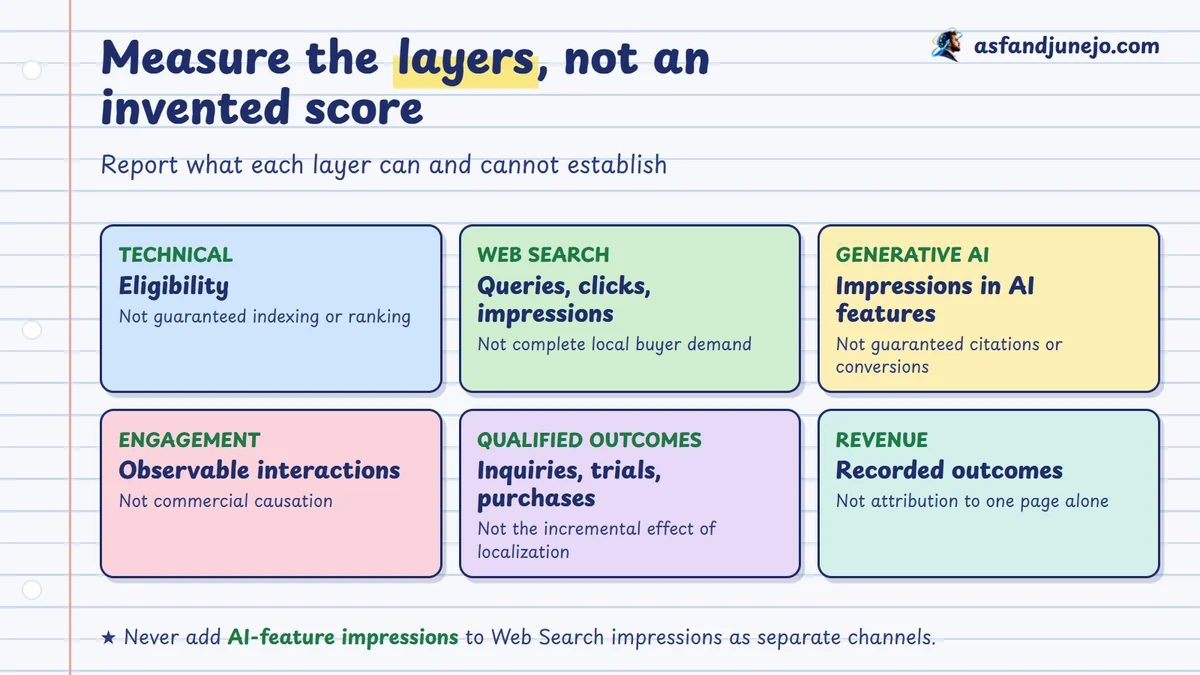
The two impression totals should not be added together as if they were independent channels.
A website with insufficient AI-feature impressions may not see the dedicated report.
For multilingual SEO, the report can help identify whether particular pages receive recorded AI-feature exposure.
However, a country-level AI impression does not establish which language the searcher preferred, whether the localization caused its appearance, or whether the impression resulted in a qualified visit.
Manual AI-response observations should be maintained separately from Search Console and commercial reporting.
Market-level measurement hierarchy
| Measurement layer | What it establishes | What it does not establish |
|---|---|---|
| Technical eligibility | Whether intended URLs and signals are accessible | Guaranteed indexing or ranking |
| Conventional Search | Reported impressions, clicks, and relevant queries | Complete local buyer demand |
| Generative AI | Supported Google AI-feature impressions | Guaranteed citations or conversions |
| Website engagement | Observable visitor interactions | Commercial causation |
| Qualified outcomes | Defined inquiries, trials, or purchases | Incremental effect of localization |
| Revenue | Recorded commercial outcomes | Attribution to one page without additional evidence |
The organization should report these observations according to their actual definitions.
Avoid attributing every improvement to localization
Suppose a company publishes a German-language product page and later observes more qualified inquiries from Germany.
The result is relevant.
However, it does not establish that localization alone caused the increase.
Other factors may have changed.
A paid campaign may have begun.
Brand awareness may have increased.
Pricing may have changed.
A competitor may have reduced its activity.
The analysis should preserve those possibilities.
Where appropriate, the business may use experiments or comparison designs to investigate incremental effects.
Where causal evidence is unavailable, it should describe the observed association without overstating certainty.
For a related explanation of these distinctions, see Ranking, Retrieval, and Citation: Measuring AI Visibility.
How Can a Brand Run a Multilingual SEO Pilot Before Scaling?
A multilingual SEO pilot should test a defined market, a consequential search task, and a manageable group of pages before the business expands localization across its website. The pilot should evaluate market readiness, content relevance, technical implementation, and available evidence of performance without assuming that every positive observation justifies scaling.
The purpose is to reduce uncertainty.
A pilot may reveal that the market needs different information.
It may show that an existing page can be adapted without creating another URL.
It may expose problems with the CMS, localization workflow, or regional commercial information.
These findings can be useful even when the project does not produce measurable growth.
Define the pilot’s scope
Begin with one eligible market and one meaningful audience task.
Document the relevant source page, intended language, applicable product conditions, and current technical state.
Assign responsibility for search research, factual verification, linguistic review, technical implementation, and measurement.
A small team may perform several functions, but the authority to approve consequential claims should remain clear.
Establish the baseline
Record the existing page’s available Search performance and relevant business observations.
Identify the current canonical and indexing status.
Document known information gaps and technical issues.
If reliable historical data is unavailable, state that limitation.
Do not manufacture baseline figures.
Conduct local-intent research
Investigate relevant terms and actual search results in the target market.
Record the search conditions and observations.
Compare the findings with the existing content.
The research should determine whether translation, adaptation, or a distinct resource is justified.
Verify the applicable offer
Confirm that the product or service is available under the conditions described on the localized page.
Obtain the appropriate approvals for material claims.
Do not allow the localization process to introduce unsupported capabilities, pricing, or service promises.
Implement the smallest useful intervention
The business may translate a page, adapt market-specific information, create a regional variant, correct technical annotations, improve the language-switching experience, or consolidate unnecessary duplicates.
The intervention should be selected according to the identified problem.
Validate the implementation
The technical review should examine the localized URL, HTTP response, indexability, canonical declaration, hreflang mapping, relevant sitemap, and rendered content.
The UX review should inspect navigation, forms, calls to action, mobile presentation, and language switching.
Where applicable, right-to-left behavior and mixed-script content should also be tested.
Evaluate the available results
Collect the agreed Search, AI-feature, engagement, and commercial observations.
Record relevant concurrent changes.
If the data is insufficient to support a meaningful conclusion, classify the outcome as inconclusive.
An inconclusive result should not automatically be described as failure or success.
Make an explicit expansion decision
The pilot can lead to improvement, expansion, consolidation, deferral, or discontinuation.
Expansion should depend on demonstrated usefulness, remaining uncertainty, commercial readiness, and maintenance capacity.
The business should not replicate localized pages across additional markets simply because the initial pages were published successfully.
The objective is not to scale translation as quickly as possible. It is to establish a repeatable process for delivering accurate and relevant information to audiences the business can actually serve.
Where can you get the multilingual SEO market-intent toolkit?
Join Search Signals with your email and the toolkit unlocks on this page straight away: a 14-sheet audit workbook, a field guide, a one-page decision canvas, a hreflang and canonical QA checklist and the evidence files behind the research.
The workbook covers market eligibility, local query research, page decisions, claims, URL and hreflang mapping, canonical QA, approvals, a change register, measurement and publication QA, plus the six sample SERPs and five Shopify HTML observations kept apart from your own entries.
- International SEO Market-Intent Audit WorkbookExcel workbook, 14 sheets
- Market-Intent Field GuidePDF, 4 pages
- Market-Intent Decision CanvasPDF, 1 page, printable
- Hreflang and Canonical Publication QA ChecklistPDF, 1 page, printable
- Full kit with evidence CSV and code exampleZIP: all files, SERP evidence CSV, hreflang example, read-me and checksums
Directional Planning and evidence-review templates. The sample SERPs are single snapshots. Nothing here proves market demand, authorizes a release, or guarantees indexing, rankings, citations or revenue
Frequently Asked Questions About Multilingual SEO
What is multilingual SEO?
Multilingual SEO makes website information accessible and discoverable in multiple languages. It includes language-specific content, technical implementation, and consideration of the intended audience’s information needs. Translation is one component, but accurate language alone does not establish local search relevance.
How is multilingual SEO different from international SEO?
Multilingual SEO focuses on serving audiences in different languages. International SEO is broader and may include country targeting, regional content, commercial conditions, and multilingual implementation. A website can target multiple countries using a single language, or support multiple languages within a single country.
Why is translation alone insufficient for international SEO?
Translation preserves the meaning of source content, but it does not establish that the source information applies to every market. Product availability, search terminology, commercial conditions, and customer requirements may differ. Those differences must be investigated before deciding whether the translated page is suitable.
Should keyword research be conducted separately for each market?
Yes, when the business intends to serve distinct markets. Local research helps determine how the intended audience expresses a task and which information search results present. However, different markets may share substantial search intent. Research should identify actual differences rather than assume them.
Does every country need a separate domain or website?
No. Country-code domains, subdomains, and subdirectories are possible approaches, but a separate domain is not required for every country. The correct architecture depends on content needs, business requirements, technical capabilities, and maintenance considerations.
When should businesses create regional pages in the same language?
Separate same-language regional pages can be justified when the intended audiences require different information, commercial conditions, or a deliberately maintained regional experience. Pages with little meaningful difference require careful consideration of duplication, canonicalization, and whether consolidation would be more appropriate.
How do hreflang and canonical tags work together?
Hreflang identifies alternate language or regional versions. Canonicalization helps Google select a representative URL among duplicate or substantially similar pages. The signals should reflect the actual content relationships. A self-referencing canonical does not guarantee that Google will independently select the URL.
Does Google use hreflang to identify a page’s language?
No. Google primarily determines a page’s language from visible content. Hreflang helps identify alternate versions intended for different audiences. The HTML lang attribute remains useful for accessibility and other language-aware technologies.
Is machine translation sufficient for multilingual SEO?
Machine translation may be a useful production aid, but consequential claims, terminology, commercial applicability, and language quality still require appropriate review. Linguistic accuracy and factual approval are separate responsibilities.
Can translated or regional pages create duplicate-content problems?
Legitimate multilingual or regional content is not automatically a spam violation. Google may select a canonical URL among substantially similar pages, especially same-language regional variants. The business should ensure that its content architecture and technical signals reflect the intended audience relationships.
How should multilingual SEO success be measured?
Measure technical eligibility, Search performance, relevant engagement, and defined business outcomes separately. Search Console country data does not establish language preference, and increased visibility does not independently prove commercial impact.
Does multilingual SEO automatically improve AI search visibility?
No. Relevant localized content may create additional opportunities for discovery, but Google does not guarantee inclusion in AI Overviews or AI Mode. Standard Search eligibility requirements apply, and observed AI impressions, referrals, and commercial outcomes should be evaluated separately.
Multilingual SEO Begins With Market Evidence
Multilingual SEO becomes more useful when international expansion is informed by evidence about the audience, the market, and the information the business can provide accurately.
Translation makes information understandable in another language.
Localization addresses differences that matter to the intended audience.
Internationalization enables the technical system to support those differences.
Search optimization helps relevant users and search engines discover the resulting pages.
These responsibilities should operate together, but they should not be confused.
A company can implement technically correct hreflang annotations while publishing irrelevant information.
It can create fluent translations that describe unsupported products.
It can also prepare valuable regional content that remains difficult to discover because its technical relationships are inconsistent.
The strongest strategy begins before publication.
The business determines which markets it can serve.
It identifies the search tasks that matter.
It verifies which product and commercial information applies.
It decides whether to translate, adapt, create, consolidate, or defer.
It then implements the technical relationships and measures what can actually be observed.
The Mexico-versus-Spain search investigation demonstrates why market differences should be researched rather than assumed.
Both markets showed substantial overlap across the sampled search tasks, while certain results reflected regional context.
The Shopify case demonstrates how a global website can maintain shared product information across multiple language and regional destinations through an extensive alternate-language architecture.
Neither observation establishes that every business should reproduce the same content structure.
A successful multilingual SEO strategy does not maximize the number of translated pages. It establishes which audiences need distinct information, what evidence supports that information, and how the website can deliver it accurately and reliably.
For businesses evaluating multilingual architecture, localized content, canonicalization, and international search accessibility, an evidence-led technical assessment can help identify the gaps that matter before creating additional pages.
Explore the SEO and AI Visibility Services available through Asfand Yar Junejo, or review the broader approach to evidence-led search strategy.
Research Methodology and Evidence Boundaries
This article combines official Google Search Central documentation, W3C internationalization guidance, independently collected Google SERP observations, and public Shopify webpage inspection.
Research date: November 7, 2026.
Local search investigation
Six Google search-result sets were collected using a SERP API.
The investigation used three queries across Mexico and Spain, with Spanish selected as the search language and desktop results requested.
The queries were:
crear tienda online
plataformas de ecommerce
cómo crear tienda online
The observations were collected between approximately 12:11 and 12:12 UTC.
The study compared visible result types and first-page organic results.
It did not measure search volumes, user preferences, click behavior, historical ranking stability, or commercial performance.
One result-set capture per query and market limits the conclusions that can be drawn.
Shopify implementation study
Five publicly accessible Shopify pages were inspected using a crawler API.
The inspection examined HTTP responses, titles, H1 headings, HTML language attributes, canonical declarations, and alternate-language annotations.
The five pages returned successful responses and declared self-referencing canonical URLs.
Each sampled page exposed 85 alternate-language entries.
The relevant relationships among the five sampled URLs were reciprocal.
The study did not validate all 85 referenced URLs as a complete network.
It did not establish Google-selected canonicals, indexing status, search rankings, traffic, or commercial outcomes.
Evidence classification
Technical requirements are documented in the official platform documentation.
Public website observations are identified as observations.
Market interpretations are limited to the evidence collected.
Recommendations describe proposed implementation practices rather than guaranteed performance outcomes.
No causal effects of localization on rankings, AI visibility, or revenue were measured.
Primary sources and references
Opened and read on November 11, 2026: Google's localized-versions, multi-regional and generative AI content documentation, and the Search Console generative AI performance report help page. The five Shopify pages were re-fetched the same day. The other links were confirmed to load but were not re-read in full. The Mexico and Spain SERP snapshots are the author's own captures from November 7, 2026.
- W3C Internationalization: Localization vs. internationalization (opens in a new tab)
- Google Search Central: Managing multi-regional and multilingual sites (opens in a new tab)
- Google Search Central: Localized versions of your pages (hreflang) (opens in a new tab)
- Google Search Central: How to specify a canonical with rel="canonical" and other methods (opens in a new tab)
- W3C Internationalization: Structural markup and right-to-left text in HTML (opens in a new tab)
- Google Search Central: Guidance on generative AI content on your website (opens in a new tab)
- Search Console Help: Performance report (Search results), dimensions and data groupings (opens in a new tab)
- Search Console Help: Generative AI performance report (Search) (opens in a new tab)
- Google Search Central: Spam policies for Google web search (opens in a new tab)
- Shopify: Build your online store (English) (opens in a new tab)
- Shopify: Crea tu tienda online (international Spanish) (opens in a new tab)
- Shopify: Crea tu tienda online (Mexico) (opens in a new tab)
- Shopify: Crea tu tienda online (Spain) (opens in a new tab)
- Shopify: Onlineshop erstellen (Germany) (opens in a new tab)