Growing an SEO agency sustainably means attracting clients whose problems the agency can responsibly solve, proving its expertise through credible evidence, establishing commercially viable engagements, and maintaining relationships that produce useful decisions for both parties.
Published · Sources checked · By Asfand Yar Junejo, publisher asfandjunejo.com

Acquiring more clients is one part of that process. It is not the complete definition of agency growth.
An independent SEO consultant may secure several new retainers while becoming less profitable, as each engagement requires additional unpaid work. A small agency may generate qualified inquiries but struggle to convert them into sustainable projects because prospects lack implementation resources, reliable analytics, or realistic expectations. Another consultancy may complete a technically valuable engagement yet lose the relationship because the client never understood which problems were solved or which decisions remained outstanding.
These situations reveal a fundamental distinction between winning SEO clients and building an SEO consulting business that can consistently deliver value.
Search marketing presents particular challenges because the consultancy does not control every factor influencing performance. Search engines determine how content is discovered and presented. Competitive conditions and audience demand change. Technical improvements may depend on engineering teams outside the agency. A client’s lead qualification, sales follow-up, and product offering can affect commercial outcomes even when relevant organic visitors reach the website.
Consequently, effective SEO consulting requires more than technical knowledge or persuasive business development. The agency must determine which client problems deserve investigation, what evidence can establish the starting condition, which responsibilities it can accept, and how completed work will be evaluated.
Professional relationships support this process by creating opportunities grounded in relevant expertise rather than personal familiarity alone. Referrals can introduce suitable buyers, credible case studies can reduce uncertainty, qualification can identify delivery constraints, and carefully scoped proposals can establish realistic expectations before work begins. However, none of these activities independently guarantees higher revenue, longer retention, improved rankings, or additional AI search citations.
This guide develops a practical operating approach for independent SEO consultants and small specialist agencies. It connects business positioning, referrals, client acquisition, qualification, and evidence-backed proposals with accountable delivery and long-term relationship management. A single hypothetical B2B software engagement runs throughout the article to demonstrate how these decisions work together. The scenario, its records, and its commercial assumptions are constructed instructional examples, not documented client results.
Illustrative The B2B software company, the marketing director, the reporting error and the $4,000 revenue, $2,400 cost and 40% margin are constructed teaching examples. No client, audit, ranking result or retention effect is claimed
The underlying principle is that sustainable growth for an SEO agency comes from becoming demonstrably useful to the right clients, not from making those clients dependent on the agency.
The client-fit workbook, six-page field guide and communication templates behind this guide are free for Search Signals subscribers.
What are the key takeaways?
Grow by taking on clients whose problems you can responsibly solve, proving your expertise with evidence a buyer can inspect, agreeing a scope that is commercially viable, and reviewing each engagement with a decision. More clients is not the same as growth.
- Every prospect ends in one of five decisions: accept, narrow, defer, refer or decline, with a reason and an owner.
- A referral gives context, not proof that an engagement is viable. Qualify every channel to the same standard.
- Proof must be inspectable: the problem, work, evidence, period and limits, with permission to publish.
- Keep verified, needs-investigation, not-tested, recommended and implemented as different states in every report.
- Project contribution is revenue minus defined direct costs. It is not business profit, and the $4,000 example is hypothetical.
- Test the process for 30 days. It can show clearer decisions, not proof of revenue growth.
What Does Healthy Growth Look Like for an SEO Consultancy?
Healthy SEO agency growth occurs when a consultancy increases its ability to serve appropriate clients profitably and reliably, without compromising the quality of its work. Revenue, client count, and retention can contribute to that assessment, but each requires context to become a meaningful indicator of business health.
A consultancy can increase monthly revenue even as margins decline, delivery capacity is insufficient, or dependence on a small number of clients grows. Conversely, a specialist may maintain a relatively small client portfolio while improving profitability, producing stronger deliverables, and creating the capacity to accept suitable opportunities. The distinction depends on the economics and quality of the work, not simply the number of contracts signed.

Why acquiring more SEO clients is not always growth
Consider an independent consultant who specializes in technical SEO. The consultant initially serves three clients through clearly defined diagnostic engagements. Each project has an agreed-upon scope, access to relevant data, and a defined delivery process. After expanding marketing activity, the consultant accepts several additional retainers. Revenue increases, but the new agreements include broad commitments to content production, technical implementation, reporting, and ongoing strategic support.
Some clients require frequent investigations beyond the original scope. Others lack internal resources to implement recommendations. The consultant also spends substantially more time on proposals, account administration, and responding to unplanned requests. The business has more clients, but its operating conditions may have deteriorated. The consultant must examine actual costs, available working hours, and the sustainability of those commitments before describing the expansion as successful.
This is why an agency needs to distinguish commercial activity from commercial contribution. A signed contract establishes an agreement. It does not establish the margin that will remain after delivery or whether the agency has sufficient resources to fulfill the commitment.
Which measures describe healthy agency growth?
For a small SEO consultancy, a useful financial and operational review includes the following dimensions.
| Dimension | What it measures | What it cannot establish alone |
|---|---|---|
| Revenue | Income recognized under the chosen accounting method | Profitability or cash availability |
| Cash collection | Money actually received from clients | Whether engagements are profitable |
| Direct delivery costs | Labor, subcontracting, and other costs attributable to delivery | Total operating expenses |
| Project contribution | Revenue remaining after defined direct costs | Overall business profit |
| Client acquisition effort | Time and money spent winning engagements | Future client value |
| Delivery capacity | Resources available for approved work | Quality of the work produced |
| Client value | Whether the engagement addresses its agreed objective | Whether renewal is necessary |
| Client concentration | Dependence on individual accounts | Whether a large client is inherently unsuitable |
These measures should be reviewed together. For example, an agency may report a favorable project contribution while excluding the founder’s substantial unpaid sales and administrative time. That does not invalidate the contribution calculation, provided the definition is clear. It does mean the figure should not be taken as a complete measure of business profitability. Similarly, recurring revenue may improve cash-flow predictability without guaranteeing that each retainer remains commercially appropriate.
The agency must understand what is included in its cost calculations and which expenses remain outside them.
Client acquisition has an economic cost
Small SEO agencies frequently underestimate the time required to acquire work. A founder may spend hours reviewing a prospect’s website, preparing recommendations, attending discovery meetings, and developing a proposal. If those activities are not recorded, the business may treat client acquisition as effectively free. That makes it difficult to determine whether a particular acquisition channel or service offering is commercially sustainable.
A basic acquisition review should capture relevant marketing expenditure, sales effort, proposal preparation, and the number of clients acquired within a defined period. These records can help the agency compare approaches, although the results require careful interpretation. A single large engagement may distort the apparent value of a channel. A referral may require little direct marketing expenditure but depend on years of professional relationship development. Neither should be described as universally more efficient without comparable evidence.
Delivery capacity should constrain growth decisions
An agency’s ability to accept new work depends on more than the number of available hours. The team must possess the necessary technical expertise, review capacity, tools, permissions, and access to client-side decision-makers. A consultancy specializing in technical SEO should not automatically accept responsibility for paid media, application development, content production, or AI search monitoring simply because those services are commercially adjacent.
Offering additional services may be justified when the required capabilities and delivery arrangements are in place. Otherwise, expansion can create commitments that the organization is not equipped to fulfill. A narrower service portfolio may make the agency easier to understand, recommend, and manage. However, specialization should follow observed client problems and demonstrated capabilities rather than the assumption that every narrowly positioned agency will achieve better financial results.
Does healthy growth require long-term retainers?
No. A successful SEO engagement may end because its original purpose has been achieved. A website migration assessment, technical investigation, or search visibility diagnostic can provide valuable information without requiring an indefinite retainer. The correct commercial decision depends on whether additional work would address a legitimate need.
An agency should not manufacture ongoing services merely to preserve recurring revenue. Equally, a long-term engagement can be valuable when the work requires continuous analysis, maintenance, implementation, and review. Healthy growth means the consultancy can explain why an engagement should begin, what makes it economically viable, and whether continued work remains useful.
What Makes an SEO Consultancy Relevant and Worth Referring?
An SEO consultancy becomes easier to recommend when prospective clients and professional partners can recognize the problems it solves, understand the limits of its services, and examine credible evidence of its capabilities. Effective positioning makes expertise understandable rather than relying on broad claims of authority.
This matters particularly for independent consultants and small agencies because their reputations often depend on a relatively limited number of professional relationships. A useful referral requires more than the referrer knowing that someone provides SEO services. The referrer must understand when those services are appropriate.
Position the agency around a recognizable business problem
Consider two descriptions of an SEO consultancy. The first says that the company provides comprehensive SEO services designed to maximize visibility, rankings, traffic, and business growth. The second explains that the consultancy investigates why important B2B product and documentation pages are not performing as expected in organic search, then develops evidence-ranked recommendations for the teams responsible for implementation. The first statement describes desirable outcomes.
The second identifies a recognizable problem, relevant expertise, and a concrete work product. That distinction helps a potential client determine whether the service matches an existing need. It also helps referral partners recognize appropriate situations without having to interpret a long catalog of marketing capabilities. A useful positioning statement should clarify the intended customer, the problem being addressed, the type of work provided, and the boundaries of the service.
It should not claim to produce every business outcome associated with organic search.
Find the agency’s position through evidence
Positioning should begin with the consultancy’s actual work and client interactions. Review completed engagements, recent inquiries, proposal outcomes, and projects that became difficult to deliver. Look for recurring questions. Which client problems repeatedly required the same expertise? Which engagements produced useful and verifiable findings? Which proposals were straightforward to scope? Which services generated unexpected costs or depended heavily on resources the agency did not control?
These observations may suggest a defensible specialization. However, a handful of projects cannot establish what an entire market wants. The consultancy should treat early patterns as hypotheses and investigate them through conversations with potential buyers and professional partners. Instead of asking whether a proposed service sounds attractive, ask about a recent problem the buyer attempted to solve.
What triggered the investigation? Who was responsible for the outcome? Which information was missing? What made the problem commercially important? What prevented the organization from resolving it internally? Specific past behavior provides a stronger basis for understanding demand than generic expressions of interest.
What evidence makes an SEO consultancy credible?
SEO expertise can be supported through professional experience, documented methods, authorized case studies, relevant credentials, technical demonstrations, and original research. These forms of evidence serve different purposes. A certification may substantiate completion of a defined course or assessment. A technical demonstration may show that a consultant understands a particular diagnostic process.
A published methodology may reveal how evidence is collected, interpreted, and reviewed. An authorized case study may describe what happened during a specific engagement. None should be used to claim more than it can establish. For example, a consultant who can demonstrate why a canonical configuration is intentional rather than erroneous provides more meaningful technical evidence than someone who reproduces an automated tool’s warning without validation.
The distinction matters because SEO tools can accurately detect conditions without establishing whether those conditions represent business problems. A consultancy’s credibility should rest partly on how well it interprets evidence, including its willingness to identify false positives and unresolved questions.
Make the proof inspectable
A credible case study should explain the original problem, the work performed, the evidence used, the observation period, and the limits of the findings. If search clicks increased after an intervention, the case study should identify the source and reporting period. It should not automatically attribute the entire increase to the consultancy when concurrent changes, search demand, or other factors may have contributed. If the case study contains confidential information, the consultancy should obtain appropriate permission before sharing it.
Where client-specific results cannot be disclosed, a clearly labeled demonstration of the work process can still help prospective buyers evaluate the agency. For an example of how search findings, methods, and reported results can be presented with explicit evidence limitations, see the SEO case studies and portfolio on asfandjunejo.com.
Those portfolio examples demonstrate technical work and reported search outcomes. They should not be interpreted as proof of client acquisition methods, engagement pricing, referrals, or retention without additional records.
Make expertise understandable to nontechnical buyers
A founder or marketing director may not understand the significance of canonical relationships, rendering behavior, entity resolution, or search query classification. The consultancy should explain the business decision those technical findings support. Instead of leading with technical terminology, begin with the consequence being investigated. For example, a consultant might explain that the organization needs to determine whether priority product pages can be discovered and interpreted correctly before investing in additional content production.
The technical investigation then becomes relevant because it informs a recognizable business decision. This does not require oversimplifying the work. It requires connecting the technical explanation to the client’s question. The same principle applies when explaining the consultancy’s methodology.
A process becomes easier to evaluate when it shows how evidence is collected, how uncertainties are handled, and what makes a recommendation actionable. The approach and methodology page provides an example of communicating search work through defined questions and decisions rather than a list of tools.
Referability is an outcome of specificity
Consider a web development agency whose client is preparing a significant website migration. The developer understands implementation but requires specialist support to assess redirect coverage, indexing risks, and search-related technical dependencies. An SEO consultancy known for migration assessments is easier to recommend than one whose primary description is simply full-service digital marketing. The referral has a clear purpose.
The parties can also understand where the SEO consultancy’s responsibilities begin and end. That is the practical advantage of effective positioning. The goal is not to convince every prospective client that the consultancy can solve every search problem. It is to make the agency’s relevance unmistakable when the right problem appears.
How Do Professional Relationships Generate Qualified SEO Opportunities?
Professional relationships generate qualified SEO opportunities when trusted contacts recognize a relevant client problem, understand the consultancy’s expertise, and make an informed introduction. Referrals can provide context for an initial conversation, but they do not eliminate the need to verify the buyer’s requirements, budget, authority, or implementation readiness.
Relationship-led acquisition should therefore be understood as a method of creating relevant opportunities, not a guarantee that those opportunities will become clients.
Build relationships around complementary expertise
For a specialist SEO consultancy, useful professional relationships may include web developers, analytics specialists, content strategists, conversion consultants, fractional marketing executives, and agencies delivering adjacent services. These professionals often encounter client problems that extend beyond their own responsibilities. A development partner may identify search migration risks. An analytics consultant may discover that a company cannot reliably distinguish organic inquiries from those originating in other channels.
A content strategist may encounter technical access problems that prevent otherwise useful material from being discovered. The appropriate referral depends on the underlying problem and the capabilities required to address it. The relationship becomes stronger when each provider understands the other’s boundaries. A technical SEO consultant should not accept a software development engagement merely because it originated through a trusted partner.
Similarly, a development agency should not imply that its SEO partner can guarantee search performance. Useful relationships create informed introductions without requiring either party to exaggerate its expertise.
One continuous example: The B2B software introduction
Consider a hypothetical software company that sells a subscription-based platform to business customers. Its marketing director is concerned that several important product pages are receiving fewer qualified organic visits than expected. A former client of an independent SEO consultant is aware of the concern and offers to introduce the two parties. The consultant specializes in technical SEO and search visibility investigations.
With both parties comfortable proceeding, the former client makes the introduction and provides a brief description of the reported problem. At this stage, only a limited set of facts has been established. The software company has expressed a concern about search performance. The marketing director is willing to discuss it.
The consultant has relevant investigative expertise. The introduction does not establish that the website contains technical SEO errors. It also does not establish that the company has an approved budget, that engineering resources are available, or that organic search is responsible for weak commercial performance. Those questions remain open.
A responsible response is to acknowledge the introduction and arrange a discovery conversation focused on understanding the problem. The consultant should not begin by asserting that the website requires a complete redesign, extensive content production, or a long-term SEO retainer.
What does research establish about referrals?
Promethean Research published a 2026 client-retention study (opens in a new tab) based on a survey of 165 digital agency leaders. The research reports that clients acquired through referrals and word of mouth remained with the company approximately 1.9 times longer than those acquired through events, networking, or outbound methods in its surveyed context. The finding is useful, but its interpretation requires care.
The reported difference is an association within the research population. It does not demonstrate that the acquisition of referrals independently caused longer relationships. Client characteristics, service requirements, prior familiarity, and engagement type may contribute to differences in tenure. The result should therefore encourage agencies to examine the quality of their own referral relationships rather than adopt the reported ratio as a forecast.
Directional Promethean Research's retention page (dated July 3, 2026) says that in its survey of 165 digital agency leaders, clients won through referrals and word of mouth stayed about 1.9 times longer than clients won through events, networking or outbound. It is self-reported survey data, so the figure supports an association in that sample only (checked November 15, 2026)
Referrals should complement other acquisition channels
Relationship-led growth does not require an agency to depend exclusively on referrals. An independent SEO consultancy may also generate relevant opportunities through educational content, organic search visibility, professional publishing, industry participation, complementary partnerships, and carefully targeted outreach. Each channel creates a different form of discovery. A prospective client may find a technical SEO article through Google, review the author’s published research, and initiate a conversation.
Another may encounter the consultancy through a professional community. A third may receive a direct introduction from a trusted advisor. The source of the acquisition is important for understanding how the relationship began. However, the source of an opportunity does not determine whether the engagement should be accepted.
A referral may produce a poor-fit prospect. An appropriate outreach conversation may lead to a well-scoped and commercially sustainable project. An organic search inquiry may demonstrate clear buyer intent but still require investigation before an offer can be prepared. The qualification standard should remain consistent across channels.
For small consultancies, diversification also reduces dependence on one referral partner or acquisition source. That does not mean every channel deserves equal investment. The agency should prioritize approaches that produce relevant conversations within its available resources and professional obligations.
A referral should preserve consent and context
An introduction does not provide unrestricted permission to contact the prospect indefinitely. The consultancy should respect the referred person’s choice about further communication and avoid placing contacts into unrelated marketing sequences without an appropriate basis. It should also preserve confidentiality. The person making an introduction does not automatically become entitled to updates about the prospect’s budget, business concerns, or eventual engagement.
If referral compensation is involved, applicable disclosure, contractual, and professional requirements should be considered. The arrangement should not compromise the quality of the recommendation or create a misleading impression of independence.
How should a consultancy evaluate referral quality?
A useful referral process records enough information to understand whether introductions are relevant. For the hypothetical B2B software inquiry, the initial record might contain:
| Field | Recorded information |
|---|---|
| Opportunity source | Introduction from a former client |
| Prospect situation | B2B software company reporting weaker product-page organic performance |
| Initial contact | Marketing director |
| Known problem | Search performance concern requiring investigation |
| Evidence availability | Not yet verified |
| Commercial readiness | Not yet established |
| Next action | Authorized discovery conversation |
This is not a completed qualification record. It is an opportunity record that distinguishes known conditions from unanswered questions. That distinction prevents the consultant from confusing a promising introduction with an approved commercial engagement. A consultancy should review referral quality through the relevance of introductions, qualification outcomes, and eventual delivery experience.
Referral count alone does not establish commercial success. Professional relationships become an acquisition advantage when they connect recognizable problems with relevant expertise while preserving the right to decline unsuitable work.
How Should an SEO Consultancy Qualify a Prospect Before Accepting Work?
An SEO consultancy should qualify a prospect by verifying the problem, identifying the evidence available to investigate it, confirming commercial and decision-making readiness, and assessing whether the required work can be delivered within the proposed scope. The outcome should be a documented decision to accept, narrow, defer, refer, or decline.
Qualification is not a judgment about whether a prospective client is inherently desirable. It is an assessment of whether the consultancy can responsibly fulfill a particular engagement under the conditions available. A recognizable brand, substantial website, or attractive budget does not automatically establish suitability. Likewise, a smaller organization may be an excellent client when its problem is clear, and the work can be delivered reliably.
Continue the B2B software engagement
During discovery, the software company’s marketing director explains that several product pages appear to be attracting fewer qualified organic visitors. The consultant asks which pages are commercially important, how the organization defines a qualified visit or inquiry, and which reporting period prompted concern. The director confirms that Google Search Console and website analytics data are available.
However, the company has not yet established whether the reported decline reflects lower search visibility, changes in query composition, reduced demand, measurement problems, or weaker visitor conversion. The consultant should not select one explanation before examining the evidence. The director also reveals an important operational constraint. The engineering team is committed to another development cycle and cannot allocate implementation resources during the proposed engagement.
This information changes the type of service the consultancy can responsibly offer. A diagnostic may be feasible. A technical remediation project requiring immediate deployment is not feasible under the stated conditions.
Separate the client’s concern from the verified problem
The phrase organic traffic is declining can describe several different situations. A website may receive fewer impressions because search demand has changed. Clicks may decline even when impressions remain relatively stable. A page may lose visibility for a commercially important query while gaining impressions for less relevant searches.
Analytics changes can also affect reported sessions or conversions. For a B2B company, the commercial problem may involve more than search exposure. Relevant visitors may reach the website but fail to complete an inquiry. Inquiries may be recorded but not qualified consistently.
The sales team may receive suitable leads but encounter issues with follow-up or conversion. These possibilities should remain separate until the evidence supports a particular conclusion. SEO can contribute to qualified discovery and relevant website experiences. It does not automatically control the client’s lead qualification, sales process, product-market fit, or eventual purchase decisions.
The consultant should clarify where the reported problem occurs before accepting responsibility for solving it.
What evidence should be examined during qualification?
A discovery assessment should seek enough information to determine whether further investigation is useful and feasible. For the hypothetical software company, relevant information may include the affected URL population, available Search Console data, analytics events, known website changes, target markets, and business definitions of qualified demand. The consultancy should also identify the stakeholders who can explain the underlying business problem.
A marketing director may understand acquisition objectives, while a product manager knows which product pages represent commercially important offerings. An engineer may be needed to confirm technical implementation constraints. However, a prospect should not be required to disclose unnecessary confidential information or grant broad system permissions merely to receive a proposal.
Google’s guidance on hiring an SEO (opens in a new tab) recommends evaluating proposed work, requesting realistic estimates, and initially providing read-only access to Search Console when an audit is being considered. This guidance supports a measured approach to pre-engagement investigation. The consultancy should request additional access only when the engagement and authorization justify it.
Confirmed Google's hiring guidance says no one can guarantee a number-one ranking, that an audit should give realistic estimates of improvement and of the work involved, and that at this stage you should grant read access to Search Console, not write access (checked November 15, 2026)
The completed client qualification decision
The following record demonstrates how the hypothetical opportunity could be evaluated.
| Qualification dimension | Observed condition | Assessment |
|---|---|---|
| Client problem | Reported decline in qualified discovery across priority product pages | Relevant to the consultancy’s expertise |
| Search evidence | Search Console data available, not yet analyzed | Diagnostic investigation feasible |
| Analytics evidence | Website analytics available; event quality unverified | Measurement limitations must be assessed |
| Buyer authority | Marketing director can sponsor the investigation | Commercial approval process to be confirmed |
| Implementation resources | Engineering unavailable during the initial phase | Immediate technical remediation excluded |
| Budget | Prospect indicates funding may be available | Amount and approval remain unconfirmed |
| Required expertise | Technical SEO and search performance investigation | Within the proposed service capability |
| Desired outcome | Understand the problem and determine next actions | Appropriate for a bounded diagnostic |
| Decision | Narrow the engagement | Offer a diagnostic rather than a guaranteed improvement program |
Illustrative record. No actual client was assessed.
This table makes an important distinction between a known fact and a professional judgment. The availability of Search Console data is an observed condition. Whether the consultancy can deliver a useful diagnostic is a judgment based on the problem, evidence, and operational constraints. The decision to narrow the engagement follows from those conditions.
It is not the output of a universal client-fit score.
When should the consultancy accept, narrow, defer, refer, or decline?
Five decisions are available.
- Accept when the work matches the consultancy’s capabilities and the required commercial, evidentiary, and operational conditions are sufficiently established.
- Narrow when part of the requested work is feasible, but the complete engagement would exceed the available budget, expertise, permissions, or delivery capacity.
- Defer when the underlying need is legitimate but essential resources, approvals, or information will not be available during the proposed period.
- Refer when another provider is better suited to the client’s requirements.
- Decline when the engagement would require unsupported promises, unacceptable operating conditions, work outside the consultancy’s competence, or other commitments it cannot responsibly fulfill.
Each decision should have a reason and an accountable owner. The agency should also record any conditions that would justify revisiting the opportunity. For example, a deferred implementation project may become feasible when the client’s engineering capacity changes. This does not guarantee that a future engagement will occur.
It establishes why the original decision may need reconsideration.

Confirm commercial readiness without overselling
A prospect’s willingness to discuss a problem does not establish that a project is funded. The consultancy should determine who can approve the work, which procurement or contractual requirements apply, and whether the available budget can support the proposed deliverables. These conversations should occur before substantial custom proposal work. If the budget is insufficient for the requested investigation, the consultancy can explain the limitation and consider a smaller scope.
It should not quietly reduce the deliverable’s quality while retaining the original promise. Similarly, when the client requests immediate ranking improvements, the consultancy must explain which work it can perform and which outcomes remain influenced by external search systems and market conditions. Google explicitly warns against SEO providers guaranteeing a number-one ranking (opens in a new tab). The appropriate response is to define a realistic investigation, the assumptions supporting it, and the evidence that will be reviewed.
Qualification should conclude with a decision
For the hypothetical software company, the recommended outcome is a bounded diagnostic. The consultancy can investigate the reported problem, establish relevant findings, and prepare implementation recommendations. The company can then determine which actions to authorize when internal resources become available. This creates a legitimate commercial opportunity without pretending that the consultant can deliver improvements requiring work outside its current control.
A qualified SEO opportunity is not simply a prospect with budget and interest. It is a problem the consultancy can address through an agreement that both parties understand and can realistically support.
How Does Evidence Become a Credible SEO Proposal?
An evidence-backed SEO proposal translates a qualified client problem into a defined investigation or implementation agreement, identifies what can be verified, establishes the deliverables and exclusions, and explains how the client will evaluate completion. Its purpose is to enable an informed commercial decision rather than make a technical service appear more certain than it is.
A proposal should follow the qualification decision. When the consultancy has not established what problem needs investigation, which information is available, or who can implement the recommendations, a detailed SEO growth proposal may be premature. This is especially relevant when an agency sells technical audits, semantic content strategies, search visibility assessments, or AI search consulting. Such work may produce valuable recommendations without guaranteeing a particular search outcome.
Turn the client’s original request into a feasible engagement
Return to the hypothetical B2B software company. The marketing director initially wants the consultancy to identify why product-page search performance is weak and improve qualified organic acquisition. That is an understandable business objective. However, discovery establishes that the cause remains uncertain and engineering implementation is unavailable during the proposed engagement.
A proposal offering immediate technical optimization and guaranteed traffic improvement would therefore create expectations the consultancy cannot responsibly meet. The more appropriate proposal is a defined diagnostic. The difference can be documented explicitly.
| Original request | Approved proposal direction |
|---|---|
| Identify why product-page organic performance has declined | Investigate agreed product pages and relevant performance evidence |
| Fix technical SEO problems | Document confirmed findings and implementation recommendations |
| Improve rankings and qualified traffic | Establish a baseline and identify justified next actions |
| Review all potential SEO issues | Assess the agreed properties, page types, and technical conditions |
| Provide immediate implementation | Exclude production changes during the diagnostic phase |
| Demonstrate commercial improvement | Deliver an evidence-supported diagnosis and decision-ready recommendations |
Constructed example based on the hypothetical engagement.
This comparison is a practical form of expectation management. It preserves the client’s underlying business concern while converting the requested work into something the consultancy can actually deliver. The client remains free to decide that the narrower service does not meet its immediate needs. That decision should be made before the agreement, rather than after delivery.
What evidence should support the proposed work?
A credible proposal should identify the evidence needed to investigate the client’s question. For the software company, the consultancy might rely on Search Console performance records, approved URL inventories, relevant analytics data, and technical observations collected during the engagement. However, the availability of a source does not automatically establish its reliability. Search Console and analytics measure different events.
A crawl observation may identify a technical condition without establishing that it is harmful. A change in clicks may reflect several explanations. The proposal should make these distinctions visible so the client understands what the investigation can and cannot establish. The following example shows how evidence can be translated into a proposed work product.
| Evidence category | Verification requirement | Proposed deliverable |
|---|---|---|
| Search Console | Confirm property, dates, filters, queries, and page population | Search performance baseline |
| Website analytics | Review event definitions and relevant tracking limitations | Measurement reliability assessment |
| Product-page inventory | Confirm agreed URLs and business relevance | Reviewed page population |
| Technical observations | Validate consequential findings against intended behavior | Evidence-backed findings register |
| Historical changes | Document relevant deployments and known marketing activities | Context for competing explanations |
| Implementation constraints | Confirm client-side dependencies and ownership | Prioritized decision and handoff plan |
The proposal does not need to specify every technical test before investigation begins. It should define the assessment boundaries, intended outputs, and conditions that may require additional work. For a detailed example of technical audit scope, quality assurance, and acceptance criteria, see Productize an SEO Audit: Scope, Deliverables, QA, and Recurring Monitoring.
The present article addresses the commercial decision that precedes that technical workflow, rather than reproducing the full audit methodology.
Distinguish demonstrated expertise from promised results
A consultancy should support material capability claims with appropriate evidence. An authorized case study may show how a comparable problem was investigated. A sample findings register may demonstrate analytical discipline. A published research resource may establish familiarity with the relevant technical subject.
However, evidence that a consultant performed similar work does not guarantee that another website has the same problem or will achieve the same result. The proposal should explain why the experience is relevant without overstating its predictive value. Suppose the consultancy previously investigated canonicalization problems on a large B2B website. That experience may support its ability to evaluate canonical relationships on the software company’s product pages.
It does not prove that canonical errors caused the software company’s reported decline. The diagnosis remains open until the appropriate evidence is collected.
Define the commercial agreement precisely
For a bounded diagnostic, the agreement should establish the objective, scope, evidence requirements, deliverables, exclusions, acceptance criteria, and responsibilities. The client should understand which actions are included and which require separate authorization. A concise commercial scope record might look like this:
| Agreement component | Illustrative requirement |
|---|---|
| Objective | Investigate the reported product-page organic performance concern |
| Website scope | Agreed domain, market, and priority product-page population |
| Evidence sources | Authorized search, analytics, technical, and business context records |
| Diagnostic output | Verified findings, limitations, and prioritized recommendations |
| Client responsibilities | Access approvals, relevant context, and decision-maker availability |
| Excluded work | Production implementation, unrestricted investigation, and ongoing monitoring |
| Completion criteria | Delivery of agreed work products under defined quality requirements |
| Commercial terms | Approved fee, payment schedule, review process, and change conditions |
| Responsible parties | Named consultancy owner and authorized client representative |
This is an illustrative agreement structure, not legal advice or a complete contract.
Actual terms should reflect the service, jurisdiction, client requirements, and contractual arrangements. The goal is to remove ambiguity about what the client is purchasing.
How should project economics influence the proposal?
The consultancy must estimate whether the agreed fee can support the work. For a small agency, this includes more than the technical analysis itself. Relevant effort may include discovery, data collection, investigation, evidence verification, independent review, client communication, revisions within scope, and final handoff. The agency should also consider project-specific software costs, subcontractor fees, and reasonably anticipated complications.
Founder sales time and other acquisition expenses should be recorded separately where they are not part of direct delivery costs. This distinction matters when calculating project contribution or evaluating the commercial value of a particular type of engagement. A higher project fee does not automatically produce a healthier margin if the required effort is substantially greater. Likewise, a fixed-fee diagnostic is not commercially predictable when the contract permits unlimited investigation.
The agency should establish clear, manageable scope limits. These may include the assessed properties, priority page groups, markets, data sources, review cycles, and deliverables. Any assumptions that materially influence effort should remain visible.
Manage scope changes before they become disputes
An SEO investigation may reveal additional problems. For example, the hypothetical diagnostic may identify an analytics configuration issue affecting how inquiries are recorded. That discovery could be important to the client’s business question. However, it does not automatically authorize the consultancy to rebuild the analytics implementation or expand the engagement without approval.
A scope-change record should establish the requested addition, the supporting reason, the affected deliverables, the required effort, the commercial consequences, the schedule implications, and the authorized decision-maker. The consultancy should explain whether the additional work is essential to completing the original objective or represents a separate opportunity. If the client declines the expansion, the original deliverables should accurately identify the limitation. The final report should not imply that excluded work was completed.
This approach protects both the consultant’s delivery capacity and the client’s control over expenditure.
Where can AI assist proposal development?
AI can help organize authorized discovery notes, identify missing information in a proposal template, and produce initial drafts from approved service descriptions. It may also help compare proposed deliverables against a documented scope or flag inconsistent terminology. However, AI-generated text should not invent client requirements, technical findings, credentials, case-study results, pricing commitments, or implementation assurances. A responsible consultant must verify the final proposal against the actual discovery record and commercial agreement.
Confidential client information should not be submitted to an AI system without checking the relevant permissions, contractual obligations, and data-handling arrangements. The distinction between suitable automation and accountable human judgment is explored further in AI in SEO: What to Automate, What to Verify, and What to Keep Human. Automation may reduce administrative effort.
It does not transfer responsibility for contractual or technical claims away from the consultancy.
What should the client actually receive?
The proposed diagnostic should conclude with outputs that enable the client to make a defined decision. For the hypothetical software company, that might include a documented search performance baseline, validated technical findings, unresolved measurement questions, and a prioritized implementation plan. The consultancy should distinguish the following conditions:
- Verified: A finding supported by the agreed evidence and appropriate validation.
- Needs investigation: A plausible explanation that cannot yet be confirmed.
- Not tested: A relevant condition outside the available evidence or agreed scope.
- Recommended: An action proposed for client consideration, with supporting reasons and dependencies.
- Implemented: A change actually deployed through the appropriate authorization process.
These labels represent different states. A recommendation should not be reported as implemented merely because it appears in the final deliverable. Likewise, a technical finding should not be presented as proof of a search performance improvement that has not been observed.
The evidence-to-decision handoff
The following hypothetical record demonstrates the intended relationship between findings and client decisions.
| Finding or condition | Evidence status | Consultancy contribution | Client decision |
|---|---|---|---|
| Reported product-page traffic decline | Requires validation against approved page population | Establish a reliable comparison | Accept baseline or request clarification |
| Potential canonical inconsistency | Technical verification required | Investigate intended page relationships | Authorize correction if confirmed |
| Analytics event inconsistency | Additional investigation may be necessary | Explain measurement implications | Approve separate scope or defer |
| Engineering availability | Confirmed operational limitation | Prepare implementation dependencies | Schedule work for a future development cycle |
| Wider organic acquisition performance | Multiple explanations remain possible | Prioritize evidence-supported next steps | Continue, narrow, or complete the engagement |
Illustrative findings-to-decision handoff. No real website analysis or client outcome is represented.
The value of this record is not the number of recommendations. It is that the client can distinguish among the available evidence, the work performed, the remaining uncertainty, and the required decision.
How should the proposal define success?
The acceptance criteria should reflect the service being purchased. For a diagnostic engagement, completion may depend on the delivery of the agreed-upon analysis, validation of consequential findings, documentation of limitations, and a suitable handoff. It should not automatically depend on improved rankings, higher traffic, or additional revenue when the engagement does not include implementation or an appropriate outcome-observation period.
Google’s SEO hiring guidance encourages buyers to examine the provider’s recommendations, understand the work involved, and remain skeptical of guaranteed rankings. The consultancy should therefore describe realistic objectives while remaining transparent about external dependencies. This is also important when the engagement concerns AI search visibility. The consultant may assess available platform observations, content accessibility, and relevant reporting limitations.
It should not promise that a particular AI system will cite the client or recommend its products. The commercial agreement must distinguish authorized work from outcomes determined by external systems.
The proposal should enable a responsible choice
At the end of the qualification and proposal development, the software company’s marketing director has a clear decision to make. The company can authorize the diagnostic to investigate the search performance concern. It can defer the engagement until engineering resources become available. It can request a narrower assessment or decide that internal staff can perform the required investigation.
Each option may be reasonable depending on the organization’s priorities and constraints. The consultancy should provide enough information for the buyer to understand the trade-offs. A strong SEO proposal does not eliminate uncertainty by making unsupported promises. It defines which uncertainty the work will investigate, what evidence will be returned, and how the client can use that evidence to make the next decision.
How Do Delivery, Scope Changes, and Service Recovery Build Client Trust?
An SEO consultancy builds lasting client trust by delivering the agreed work, making progress and limitations clear, addressing problems before they become disputes, and taking responsibility when its own work falls short of the agreed standard. Strong delivery is not simply the completion of technical tasks. It is the ability to demonstrate what was accomplished, explain what remains unresolved, and help the client make an informed decision about the next step.
This distinction becomes particularly important for independent consultants and small SEO agencies, where the same person may be responsible for business development, technical investigation, project management, and client communication. A technically competent consultant can still create a poor client experience when responsibilities are unclear, findings are delivered without business context, or unexpected changes are handled informally.
The goal is not to eliminate every operational problem. It is to establish a delivery process in which important decisions remain visible and accountable.
Translate the approved proposal into a working agreement
Return to the hypothetical B2B software company introduced in the first half. The marketing director has approved a bounded SEO diagnostic designed to investigate the reported decline in qualified organic discovery across selected product pages. The consultancy has not promised immediate improvements in search performance. Engineering implementation remains outside the initial agreement because the company’s development team cannot allocate resources during the diagnostic period.
Before beginning the investigation, the consultant confirms the approved website properties, relevant markets, page population, reporting periods, required data sources, delivery schedule, and review responsibilities. These details should match the commercial agreement rather than introduce new requirements after approval. For example, the consultancy may need permission to examine Search Console performance data and relevant analytics records.
It should not require unrestricted administrative access when the investigation can be completed using appropriately limited permissions. Similarly, access to a client’s systems should be authorized and limited to the data necessary, in accordance with the organization’s applicable security requirements. The consultancy should also identify a decision owner on the client side. A marketing director may approve the engagement, while a product manager or engineer may need to validate the business relevance of particular technical findings.
Without defined responsibilities, an apparently straightforward diagnostic can become delayed by unanswered questions and informal approval processes.
Define what a completed deliverable actually means
A common source of dissatisfaction among SEO clients is the gap between identifying a problem and resolving it. An agency may report that it has addressed a technical issue when it has only documented a recommendation. The distinction should remain visible throughout delivery. Consider a canonicalization concern affecting a group of product pages.
The consultant may first detect a potentially inconsistent canonical signal. That observation requires validation against the intended page structure and relevant technical evidence. If the condition is confirmed as a problem, the consultant may prepare a recommended correction and document the affected pages. However, the correction has not been implemented merely because the recommendation appears in the diagnostic report.
Deployment requires an authorized party to make the change. Verification requires the resulting implementation to be examined after deployment. Those activities represent different delivery states. For a diagnostic-only engagement, the consultancy may fulfill its responsibilities by providing validated findings and sufficiently clear implementation instructions.
The client remains responsible for determining whether and when to authorize the technical changes. This separation protects both parties from confusing professional advice with completed implementation.
How should progress be communicated?
Client communication should answer the questions that matter to the engagement, rather than reproduce every action the consultancy took. A useful update explains which work has been completed, what the evidence currently establishes, which issues require further investigation, and whether any client decisions are needed. For the hypothetical software company, an update might explain that the agreed product-page population has been confirmed and that the available search data is being evaluated against the approved reporting periods.
If unexpected limitations are discovered, they should be identified promptly. For example, the consultant may find that analytics events were renamed during the comparison period. That would not automatically invalidate the investigation. However, it could limit the reliability of year-over-year conversion comparisons.
The client should understand that limitation before the final report is presented as a complete commercial performance assessment. Effective communication reduces uncertainty by making the investigation understandable. It does not require overwhelming the client with technical details that have no bearing on an immediate decision.
When should additional work require separate authorization?
SEO investigations frequently reveal adjacent problems. A diagnostic focused on product-page visibility might identify broken conversion tracking, inconsistent content ownership, or wider information architecture concerns. Some findings may be relevant to the original question but fall outside the approved scope. The consultant should distinguish between documenting an observation and undertaking additional work to resolve it.
Suppose the software company’s analytics implementation requires substantial remediation. The consultancy can explain how the measurement problem affects the conclusions available from the diagnostic. However, rebuilding the analytics system would require appropriate expertise, authorization, and commercial agreement. A scope-change record should identify the requested change, the supporting reason, any additional work, affected deliverables, fee implications, schedule consequences, and the authorized approver.
The record should also preserve the decision if the client declines or defers the additional work. This is not merely an administrative safeguard. It prevents the agency from accepting responsibilities that were not evaluated during qualification and prevents the client from receiving unexpected commercial commitments.
Service recovery: When the consultancy makes an analytical mistake
A credible relationship model must address errors caused by the consultancy itself. Consider a further development in the hypothetical B2B engagement. The consultant prepares a preliminary report describing a decline in organic clicks across the company’s priority product pages. During quality review, the agency discovers that the Search Console export was filtered at the property level rather than restricted to the approved product-page population.
The underlying data may be authentic, but the conclusion does not apply to the population identified in the proposal. This is a material analytical error. It cannot be corrected merely by rewriting the explanation or adding a disclaimer. The affected analysis must be rebuilt.
A responsible recovery record would document the following:
| Recovery element | Required action |
|---|---|
| Error identified | Incorrect URL population used in the preliminary comparison |
| Potential impact | Product-page performance conclusion is not supported |
| Immediate response | Withdraw or suspend reliance on the affected conclusion |
| Correction | Rebuild the comparison using the approved URL inventory and reporting conditions |
| Independent verification | Confirm the revised population, filters, dates, and calculations |
| Client communication | Explain the error and identify any conclusions that changed |
| Prevention | Introduce a documented population and filter validation step |
| Closure | Record reviewer acceptance and communicate the corrected findings |
This is a hypothetical service-recovery example, not a documented client incident.
The timing of the discovery affects the response. If the error is identified internally before the report is delivered, the consultant should correct it before publication and document the quality-control failure. If the incorrect analysis has already influenced a client decision, the consultancy must explain the implications and identify which decisions require reconsideration. A corrected spreadsheet is insufficient when the original conclusion has already influenced a commercial or technical decision.
The consultant should avoid minimizing the error merely because it was unintentional. At the same time, the response should remain proportionate to the actual consequences. The purpose of service recovery is to restore the reliability of the work and make the corrective process inspectable. It is not to manufacture a promotional story about how mistakes inevitably strengthen client relationships.
What does professional offboarding look like?
An SEO engagement can conclude successfully without becoming a recurring retainer. In the hypothetical scenario, the software company may receive the agreed diagnostic, review the findings, and decide to postpone implementation until engineering resources become available. The consultancy should then complete the agreed handoff. That handoff should identify the delivered materials, supporting evidence, approved recommendations, unresolved questions, implementation dependencies, and any relevant monitoring requirements.
The client should retain appropriate access to its own systems and assets. The agreement should determine ownership of commissioned deliverables, any licensed tools or reusable consultancy materials, and the treatment of work created during the engagement. These distinctions matter because a client’s ownership of its accounts and data does not necessarily transfer ownership of every pre-existing method or proprietary tool used by the consultant.
Access permissions should be removed or adjusted when no longer required, and information should be returned, retained, or deleted in accordance with applicable contractual and legal obligations. Confidential client information should not become public merely because the engagement has ended.
Client testimonials require separate permission and evidence
An agency may wish to describe a completed project in its portfolio. However, permission to perform the work is not automatically permission to publish the client’s name, internal analytics, commercial information, or screenshots. The consultancy should establish what the client has authorized for publication. It must also ensure that the underlying evidence supports any public claims.
For US advertising, the Federal Trade Commission’s endorsement guidance (opens in a new tab) addresses truthful testimonials, potentially misleading representations, and, when applicable, the disclosure of material connections. Those advertising requirements are distinct from contractual confidentiality, intellectual-property ownership, privacy obligations, and permission to disclose client information.
International consultants should consider the requirements applicable to their own jurisdiction, clients, and intended advertising markets rather than assuming that one country’s rules govern every engagement. An agency should not invent a client endorsement or imply that a case study was independently audited when it was not. A completed engagement can still demonstrate professional competence through an appropriately anonymized process example when detailed publication permission is unavailable.
Directional The FTC page loads and says the Endorsement Guides were revised in 2023 and covers disclosing material connections between advertisers and endorsers. I did not read the Guides in full, and US advertising rules are not a universal consent or confidentiality rule (checked November 15, 2026)
Client trust is strengthened when the consultancy can account for its work, explain its mistakes, preserve appropriate client control, and conclude the relationship without creating unnecessary dependency.
How Should SEO Agencies Explain Search Performance and AI Visibility Results to Clients?
SEO agencies should explain search performance by distinguishing what was observed, what may have caused the observation, what was verified, and which business decision the evidence supports. Search rankings, organic clicks, qualified inquiries, AI search impressions, citations, and revenue represent different outcomes. Combining them into an undefined visibility or growth score can conceal the very problems the client needs to understand.
For independent consultants, this distinction is commercially important. A client rarely purchases SEO services because it wants additional dashboards. The client usually wants to understand whether relevant audiences are discovering the business, whether important website experiences are working, and whether further investment is justified. Reporting should therefore connect technical and search evidence to the client’s original business question.
Begin with the question the client wants answered
Return to the hypothetical software company. The marketing director initially reported weaker qualified organic discovery across priority product pages. The consultancy has corrected the earlier reporting-population error. The revised investigation must now establish what can legitimately be concluded from the available information.
Search Console may reveal changes in impressions, clicks, queries, countries, or affected pages. Website analytics may provide information about recorded sessions and relevant user actions. CRM records may indicate whether inquiries were accepted as qualified opportunities. These sources observe different stages of the customer journey.
A decline in Search Console clicks does not automatically establish a decline in qualified leads. An increase in organic sessions does not establish that the additional visitors are commercially relevant. Similarly, stable conversion figures do not prove that organic visibility remained unchanged. The consultant should preserve these distinctions rather than select whichever metric creates the most favorable narrative.
Separate evidence from interpretation
A useful performance review should explain which claims can be supported directly and which remain hypotheses. Consider three possible observations. First, Search Console shows that impressions declined for the agreed product-page population during a specified period. Second, analytics records indicate that form submissions remained relatively stable.
Third, the CRM contains incomplete information about whether those submissions became qualified opportunities. These observations would not justify a simple conclusion that SEO had either succeeded or failed. They would establish that search exposure, recorded website actions, and sales qualification require separate examination. The consultant should investigate alternative explanations where the available information permits.
Search demand may have changed. Relevant queries may have shifted. The website may have undergone technical or content modifications. The analytics configuration may have changed.
Competitors may have introduced more relevant material. The consultant should not select a cause merely because it is plausible. A recommendation should follow from the evidence available and clearly identify any uncertainty affecting the decision.
Where does SEO responsibility end and sales responsibility begin?
This is a critical issue for B2B SEO consulting. An agency may help an organization attract relevant visitors while the client’s commercial results depend on events that occur after the initial website interaction. Lead qualification, response times, sales follow-up, pricing, product fit, and buying-committee decisions can influence whether a visitor eventually becomes a customer. Teams outside the SEO consultancy may manage these activities.
Suppose the software company receives relevant organic inquiries, but a substantial proportion remain unreviewed in the CRM. That may represent a commercial process problem requiring attention. However, the consultancy should not automatically conclude that sales follow-up is responsible for weak revenue without examining the relevant records. Nor should it accept responsibility for every downstream sales outcome merely because SEO contributed to the acquisition process.
A responsible engagement defines which outcomes the consultancy can influence directly, which require collaboration, and which remain outside the agreed scope. The consultant may help identify a mismatch between organic acquisition and downstream qualification. Resolving that mismatch may require the client to involve sales operations, analytics, product management, or other specialists. The agency should make those dependencies visible.
A decision-ready SEO performance review
Rather than presenting every available metric as equally important, organize the evidence around the client’s decisions.
| Client question | Relevant evidence | What the evidence does not establish alone |
|---|---|---|
| Are priority pages appearing in Google Search? | Search Console impressions, relevant queries, and page observations | Whether the audience is commercially qualified |
| Are searchers visiting the website? | Search Console clicks and website analytics | Why every click or session changed |
| Are visitors completing relevant actions? | Validated analytics events and backend records | Whether each action is a qualified lead |
| Are inquiries becoming sales opportunities? | CRM qualification records and agreed business definitions | Whether SEO independently caused an opportunity |
| Are important pages technically accessible? | Verified technical observations | Whether fixing a condition will improve rankings |
| Is the company appearing in AI-generated search experiences? | Platform-specific reporting and documented observations | Guaranteed future citations, clicks, or revenue |
| What should happen next? | Evidence, business priorities, implementation effort, and dependencies | A guaranteed commercial outcome |
The table is a reporting framework, not a claim that all listed data sources are available for every client. When data is missing, the report should say so. An absent CRM qualification record should not be converted into an estimated qualified lead merely to complete a presentation. Likewise, an unverified technical observation should not be described as a confirmed cause of lost traffic.
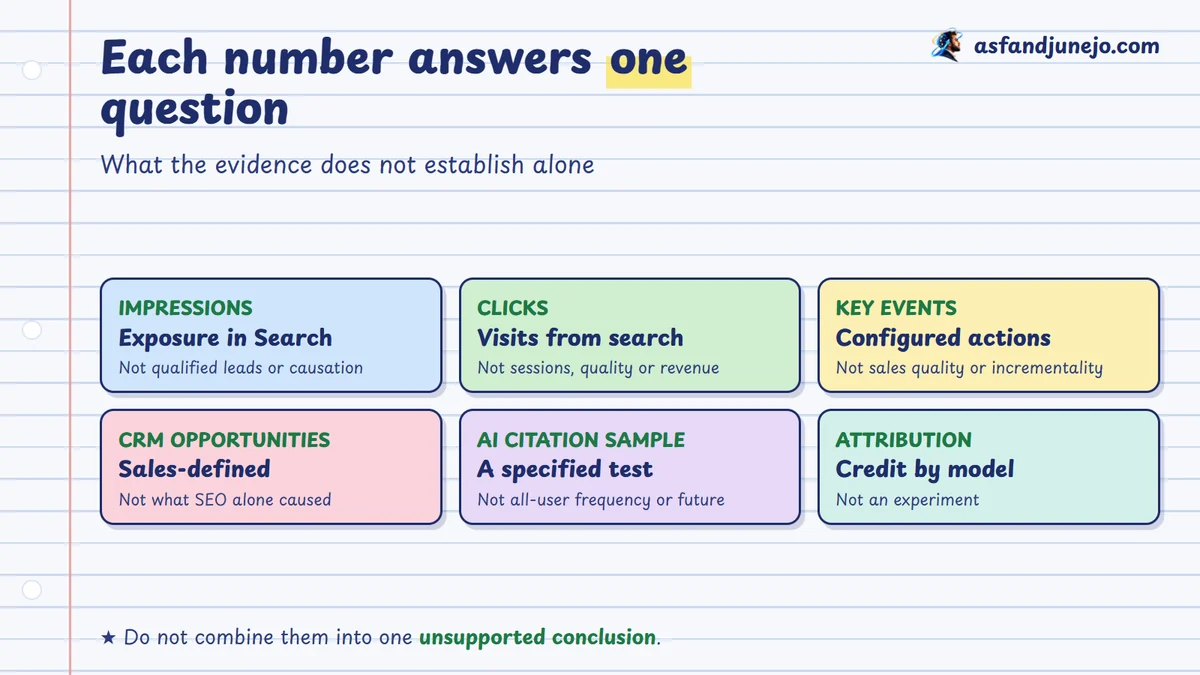
How should AI search visibility be reported?
AI-generated search experiences introduce additional measurement requirements because visibility may occur without a conventional organic visit. However, the term “AI visibility” can refer to several different events. A link may appear in an AI-generated response. A brand may be mentioned without a link.
A source may be cited during a documented prompt test. A user may visit a website through an identifiable AI assistant referral. A commercial interaction may occur after exposure to a search experience that the business cannot directly observe. These outcomes should not be treated as interchangeable.
Google Search Console provides a dedicated Generative AI Performance report (opens in a new tab) for supported Google Search experiences, including AI Overviews and AI Mode. Google states that the report was rolled out worldwide by August 31, 2026. The report focuses on impressions, including which pages receive exposure and the available geographic or device dimensions. It may not appear when a property has insufficient qualifying impressions.
An impression in this report indicates that a link to the website was shown in a supported generative AI search feature, per Google’s reporting methodology. It does not establish that the user clicked the link, read the page, or purchased a product. The dedicated generative AI data also relates to activity included in Google’s broader Search performance reporting. Adding the same activity to ordinary Web impression totals would risk double counting rather than demonstrating additional reach.
Confirmed Google's Search Console help page says the Generative AI performance report covers AI Overviews and AI Mode, is built around impressions, includes data from the Web search type in the main performance report, may not appear when a site has too few impressions, and was rolled out to all websites worldwide as of August 31, 2026 (checked November 15, 2026)
The consultancy should also preserve the report’s aggregation context. Property-level chart totals and page-level table values can differ because the reporting methods differ. Recent data may be preliminary. A responsible analyst should record the property, date range, dimensions, filters, and reporting limitations before concluding.
Can a consultancy measure AI citations across different platforms?
Some AI search experiences expose source references that can be recorded through controlled observations. However, the resulting data requires careful interpretation. A consultant might test a defined group of informational, comparison, and decision-stage questions. The test record should preserve the platform, the exact prompt, the observation date, the relevant region, the available model or search-mode information, and any known personalization conditions.
Brand mentions and source citations should be recorded separately. Repeated observations may help identify variability, but a manually selected set of prompts should not be described as representative of every real user’s experience unless the sampling design supports that conclusion. A citation appearing in one recorded response does not guarantee that the same citation will appear for another user or at a later date. The consultancy should also distinguish observed citations from underlying retrieval behavior.
An AI system may retrieve or otherwise consider information without exposing a complete record of that process to the website owner. Consequently, claims about retrieval should reflect what is genuinely observable. For a more detailed examination of these measurement boundaries, see Ranking, Retrieval, and Citation: Why Measure Them Separately.
Technical eligibility does not establish AI inclusion
A website can be accessible to a relevant crawler and still receive no observed citation in a tested AI search experience. A page may be indexed without appearing in a particular generated answer. Similarly, adding structured data does not guarantee AI-generated visibility. Google’s current guidance (opens in a new tab) states that established SEO fundamentals remain relevant to its generative search features and that special AI-specific schema or machine-readable files are not required to appear in AI Overviews or AI Mode.
Confirmed Google's AI features page says there are no additional requirements to appear in AI Overviews or AI Mode, and that you do not need new machine-readable files, AI text files or markup (checked November 15, 2026)
For technical evaluation, the agency should distinguish whether content can be accessed and processed from whether it is actually surfaced in search experiences. The two questions require different evidence. This distinction is addressed in greater technical detail in AI Search Visibility Audit: Technical Eligibility Checklist. An SEO consultancy should not turn successful accessibility checks into a claim that an AI system will cite or recommend the client’s website.
What does Google Analytics attribution actually establish?
Google Analytics 4 can help organizations examine the paths users take before completing defined key events. Its attribution reporting distributes credit to recorded interactions according to the selected attribution model. That is useful for understanding how observed marketing touchpoints relate to recorded actions. However, attribution credit is not the same as experimentally established causal impact.
Google’s official documentation (opens in a new tab) explains how the Key Event Attribution Paths report represents touchpoints and how different attribution models allocate credit across those paths. For example, a prospect might discover the software company through organic search, return through another marketing channel, and later submit an inquiry. An attribution model may assign credit to one or more of those observed interactions. The model does not establish exactly what would have happened if the original organic interaction had never occurred.
It also cannot account perfectly for every offline conversation, untracked exposure, or decision made by a B2B buying committee. The consultancy should therefore distinguish attributable activity from causal conclusions.
Confirmed Google's Analytics help page for the Key event attribution paths report says attribution models distribute credit across the touchpoints on a path. Saying that credit is not experimental proof of causation is the author's reasoning, not a quote from Google. The page also notes that several older models are no longer available, so check which models your property offers (checked November 15, 2026)
Close the reporting cycle with a decision
For the hypothetical software company, the revised diagnostic might produce several possible findings. Some technical conditions may be confirmed. Others may remain unresolved because the available evidence is incomplete. The investigation may establish that the original reporting period was unsuitable or that changes in query composition explain part of the reported pattern.
The exact conclusion cannot be predetermined. The final report should organize the findings according to their evidentiary strength and business relevance. For each important recommendation, the client should understand the supporting evidence, the affected pages or systems, the expected purpose of the change, the implementation owner, and the conditions for later review.
If engineering resources remain unavailable, the consultancy should identify which recommendations are implementation-dependent rather than suggesting that the client can realize their benefits immediately. The outcome is a decision-ready assessment. The client may authorize additional work, defer implementation, investigate a measurement problem, or conclude that the available evidence does not justify the originally proposed intervention.
An effective SEO report does not merely demonstrate activity. It gives the client a reliable account of what was observed, what remains uncertain, and which decision the evidence can reasonably support.
How Do You Measure Account Economics, Relationship Health, and Client Retention?
An SEO consultancy should evaluate commercial sustainability through project contribution, acquisition effort, delivery capacity, account concentration, and the quality of client relationships. Retention, referrals, and revenue matter, but they should be interpreted alongside the actual costs and conditions of serving each account.
This is especially important for independent consultants, whose financial reports may conceal substantial unpaid founder time. A project can appear profitable because the business records subcontractor payments and software expenses while excluding significant research, proposal development, administration, and review effort. Those omissions may distort commercial decisions even when the accounting records themselves are accurate. A useful management review should therefore distinguish financial accounting measures from operating estimates.
What makes an SEO engagement commercially sustainable?
Consider a hypothetical diagnostic engagement with the following terms:
| Financial component | Illustrative amount |
|---|---|
| Agreed project revenue | $4,000 |
| Directly attributable delivery costs | $2,400 |
| Project contribution before excluded costs | $1,600 |
| Contribution margin | 40% |
Illustrative calculation. These figures are not an industry benchmark or a real client result.
Under this definition, project contribution equals revenue minus direct delivery costs. Contribution margin equals that contribution divided by revenue. The example is mathematically straightforward, but its usefulness depends on what the cost categories contain. Direct delivery costs might include attributable internal labor, subcontractor costs, and project-specific expenses.
General administration, acquisition effort, financing costs, taxes, and other operating expenses may remain outside that calculation. If the founder spent considerable time winning and managing the engagement, those hours still have economic significance. They should not disappear from internal decision-making simply because they are excluded from the project’s direct cost calculation. The consultancy should preserve a consistent cost definition and avoid presenting project contribution as total business profit.
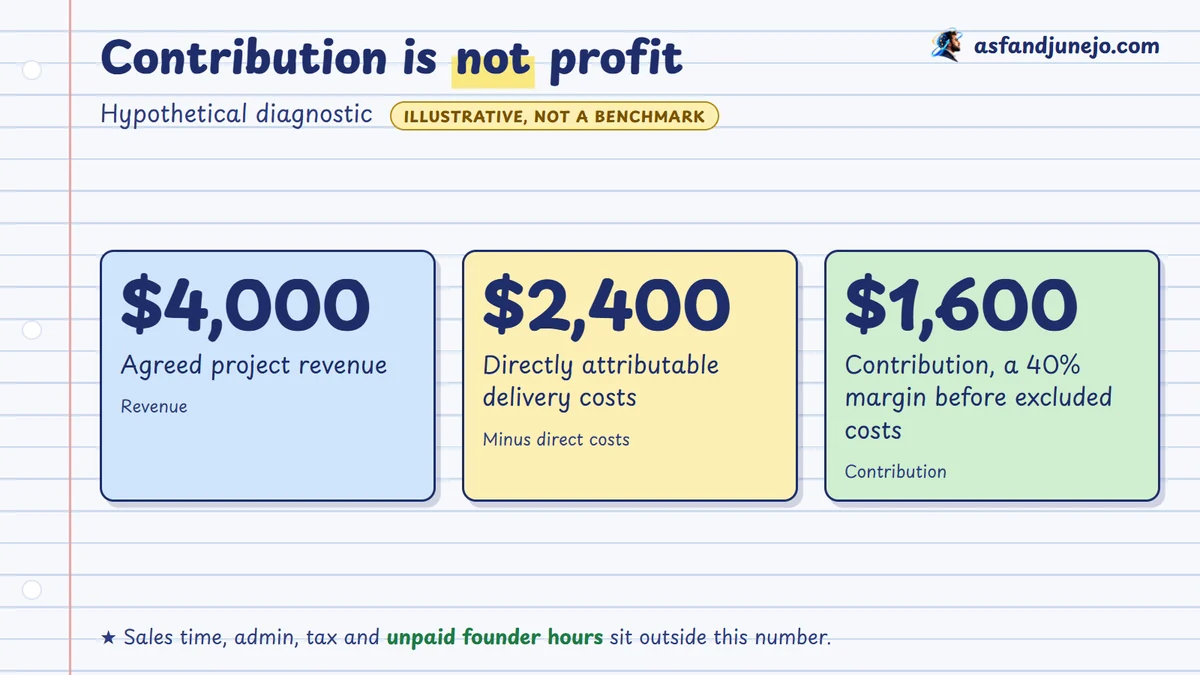
Account for the cost of acquiring clients
An agency may spend substantial time creating customized proposals that never result in accepted engagements. For a small consultancy, this work may compete directly with client delivery. A simple acquisition record can identify the source of the opportunity, the relevant marketing expenditure, the discovery time, the proposal effort, and the eventual outcome. However, acquisition cost should be interpreted carefully.
A referral may involve little immediate advertising expenditure but depend on years of professional relationship development. Organic content may produce inquiries over a long period while requiring research, maintenance, and publication effort. A single expensive engagement may also make an acquisition channel appear unusually productive. Small samples should be presented as operating observations rather than statistically stable benchmarks.
The important question is whether the consultancy can attract suitable work at a cost that remains reasonable relative to the engagements it can deliver.
How should relationship health be evaluated?
A strong client relationship is not defined solely by satisfaction or friendly communication. It should have observable operating characteristics. The client provides relevant information or identifies when it is unavailable. The consultancy communicates material findings and limitations.
Decision-makers participate when approvals are required. Scope changes are documented. Payment conditions remain understood. Problems can be raised without either party concealing information, thereby protecting the relationship.
These conditions can be recorded without assigning an arbitrary relationship score. For example, an account review may state that the client approved the diagnostic findings but deferred implementation because its engineering team is unavailable. That is more useful than labeling the account as at risk merely because the client has not purchased additional services. A different account may be genuinely at risk because repeated approvals remain unresolved, material invoices are disputed, or the original scope can no longer be delivered.
The record should explain the specific condition and the decision required.
Client retention should be defined before it is measured
Retention can describe several different outcomes. A client may renew a recurring agreement. A project client may return for another engagement after several months. A consultancy may complete a one-time diagnostic and end the relationship because no further work is justified.
These situations should not be treated as identical. A conventional retention calculation requires a defined client population, a consistent observation period, and clear rules for new accounts, completed projects, cancellations, pauses, and renewals. For project-based consultancies, repeat engagement and successful project completion may be more informative than indiscriminately applying a subscription-style retention rate.
Promethean Research’s 2026 agency retention research reports associations between account management practices and longer client tenure among its surveyed population. The findings provide useful context, but they do not establish that every agency should maximize relationship duration or that a particular review process will cause a specified increase in retention. A successful project may end exactly when intended. That result should not automatically be treated as a negative commercial outcome.
What about client lifetime value?
Client lifetime value can help an agency assess the economic contribution of a relationship over time. However, the calculation must specify whether it represents revenue, gross contribution, or profit after additional costs. A lifetime revenue total is not interchangeable with lifetime profit. Similarly, an estimate based on expected renewals is not equivalent to revenue already earned.
For a small consultancy, a complicated predictive model may add little value when only a handful of engagements are available. Recording actual fees, costs, scope changes, payment status, and repeat engagements may provide a more reliable starting point. Forecasting can be introduced when the available history supports a defensible model.
Monitor client concentration without treating every large account as a problem
A small agency may depend on a limited number of clients. That concentration can make revenue vulnerable to changes in a single relationship. For example, suppose one client contributes 60% of collected revenue during a defined reporting period. Losing that engagement could create a substantial cash-flow problem even if the project ends professionally.
The consultancy should understand the consequences for available cash, delivery capacity, and future acquisition requirements. However, a large client is not automatically undesirable. The relevant questions concern financial exposure, contractual commitments, the reliability of the relationship, and the agency’s ability to respond if circumstances change. Client concentration should also be measured consistently.
Collected revenue, recognized revenue, contracted value, and recurring revenue represent different financial measures. The agency should identify which measure it is using rather than combine them into a single percentage.
When should the consultancy recommend continuation?
The decision should follow the client’s actual need. Return to the hypothetical software company. The consultancy has delivered the agreed diagnostic and supporting evidence. The client understands which recommendations require engineering resources.
The marketing director may decide to complete the current engagement and revisit implementation during a future development cycle. That outcome can be commercially and professionally appropriate. The consultancy should provide the required handoff rather than manufacture recurring tasks to preserve revenue. If the client later requires implementation support, the new work should be evaluated as a separate opportunity with its own scope, dependencies, and commercial justification.
The agency may also recommend another specialist when the work falls outside its expertise. That decision can preserve professional trust even when it produces no immediate additional revenue. A sustainable SEO consultancy measures whether its relationships create appropriate client value under economically viable conditions, not whether every account remains active indefinitely.
How Can a Small SEO Consultancy Test Relationship-Led Growth in 30 Days?
A small SEO consultancy can improve its commercial process within 30 days by reviewing past opportunities, clarifying its positioning, strengthening evidence and qualification records, testing professional introductions, and making client review decisions more consistent. The purpose is to improve the quality of future engagements, not to guarantee new clients, revenue growth, or retention improvements within a month.
Thirty days is a useful period for testing administrative and decision-making practices. It is generally insufficient to establish long-term effects on client retention or to attribute commercial growth to a newly introduced operating process. The consultancy should therefore measure whether its practices become clearer, more reliable, and easier to repeat.
Week 1: Identify the work the consultancy should pursue
Begin with a review of recent opportunities and completed engagements. An independent consultant might examine the previous five to ten inquiries, or as many as are available. The records should identify the prospect’s problem, acquisition source, proposed service, commercial outcome, and any important delivery constraints. Pay particular attention to opportunities that were accepted despite unclear requirements.
Were the client expectations realistic? Was the necessary evidence available? Did implementation depend on another team? Did the project require unplanned work?
Were the original commercial terms sufficient? These questions may reveal recurring conditions that should influence future qualification. However, a small sample should be treated as a source of operating hypotheses rather than proof of market-wide demand. The week’s deliverable should be a concise description of the consultancy’s intended client situation, the problem it can address, the service it can responsibly deliver, and the circumstances that would justify narrowing or declining an engagement.
Week 2: Improve one proof asset and one qualification record
Select an existing case study, sample deliverable, or research resource. Review the evidence supporting its most important claims. Confirm that the work performed, observation period, source information, and limitations are described accurately. If an outcome cannot be verified, remove or qualify the claim.
If the consultancy lacks permission to publish client information, develop an anonymized example that demonstrates authorization, or use a clearly labeled hypothetical demonstration. The objective is not to create the most impressive marketing story. It is to make the consultancy’s approach easier for a prospective buyer to evaluate. Next, prepare a simple qualification record.
It should identify the prospect’s problem, the availability of evidence, decision-making authority, budget constraints, delivery dependencies, and the proposed disposition. The decision should be recorded as accept, narrow, defer, refer, or decline, with a reason and responsible owner. Avoid constructing an unsupported numerical client-fit score. The week’s outputs should be one credible proof asset and one reusable decision record.
Week 3: Test the clarity of professional introductions
Identify a small number of relevant existing relationships. These may include former clients, developers, analytics professionals, content specialists, or consultants serving complementary business needs. Explain the specific type of problem the consultancy can investigate. For example, an independent SEO consultant specializing in website migrations might describe the circumstances under which a development partner should request a technical search assessment.
The conversation should also clarify when the service is not appropriate. A partner should not feel obligated to introduce clients simply because the consultant has requested referrals. Ask whether the other professional understands the consultancy’s intended role and can recognize a suitable client situation. If introductions occur, preserve the prospect’s consent and context.
Record the acquisition source and qualification outcome without disclosing confidential information unnecessarily. At the end of the week, evaluate whether the conversations improved the offer’s clarity. Do not treat the absence of new clients within seven days as proof that the approach was ineffective.
Week 4: Conduct one decision-oriented client review
Select an active or recently completed engagement. Revisit the original objective, approved scope, completed work, supporting evidence, outstanding limitations, and responsibilities that remain with the client. Prepare a concise review that clearly distinguishes technical findings, implemented changes, and commercial outcomes. If the consultancy made an error during delivery, identify whether it was corrected and whether the client received the information needed to understand its implications.
The review should conclude with a documented decision. The client may authorize further work, defer implementation, complete the engagement, or choose another provider. For the hypothetical B2B software company, the consultancy would explain the completed diagnostic, corrected reporting evidence, unresolved technical questions, and implementation dependencies. The client could then decide whether another phase is justified.
The consultant should not assume that renewal is the preferred outcome.
How should AI support the 30-day process?
AI can help organize authorized records, prepare preliminary summaries, identify missing fields, and draft routine administrative materials. It should not invent reasons a prospect declined a proposal, classify clients based on unsupported predictions, or generate case-study results that were never observed. Commercial decisions and consequential claims require human review. Sensitive client information should be processed only through appropriately approved systems.
A useful operating distinction is between using AI to organize evidence and allowing it to make decisions unsupported by that evidence. The former may improve efficiency. The latter can undermine the reliability of the process. For more detailed guidance on these boundaries, see AI in SEO: What to Automate, What to Verify, and What to Keep Human.
What should be evaluated after 30 days?
The consultancy should compare the new process with its previous operating practices. Useful questions include whether the service description became easier to understand, whether unsuitable opportunities were identified earlier, whether proposals contained fewer unresolved assumptions, and whether client reviews produced clearer decisions. The review should also consider the administrative effort required. A process that generates extensive documentation without improving decisions may not justify its cost.
The goal is a lightweight operating system that preserves essential evidence without becoming a separate administrative burden. At a minimum, the consultancy should have a defined service position, an inspectable proof asset, an opportunity qualification record, a documented scope process, and a consistent client review format. These records can be maintained in a spreadsheet or an existing CRM, depending on the organization’s size and needs.
The success of the 30-day test should be judged by improvements in clarity, decision quality, and operating reliability, not by an unsupported promise of immediate business growth.
Where can you get the SEO agency client-fit toolkit?
Join Search Signals with your email and the toolkit unlocks on this page straight away: an eight-tab workbook for qualification, scope changes, proof, client reviews and account economics, a six-page field guide and five editable communication templates.
The working tabs are blank so you can record real, authorized engagements. A separate Worked Example tab holds the hypothetical B2B software scenario from this guide, kept apart from your own entries.
- SEO Consultancy Client Fit and Relationship WorkbookExcel workbook, 8 tabs including a labeled worked example
- Agency Growth Decision Field GuidePDF, 6 pages
- Client Communication TemplatesPDF, printable, plus an editable text copy
- Full kitZIP: workbook, field guide, templates, read-me and checksums
Directional Planning and record-keeping templates. Nothing here predicts client quality, authorizes publishing a case study, or guarantees revenue, retention, rankings or citations
Frequently Asked Questions About Growing an SEO Agency
How can I grow an SEO agency without relying entirely on referrals?
An SEO agency can develop opportunities through relevant organic search content, professional partnerships, industry participation, educational resources, targeted outreach, and existing-client relationships. Each channel should be evaluated according to the quality of the opportunities it creates and the resources required to maintain it. The agency should apply consistent qualification standards regardless of how a prospect was acquired.
How can a new SEO consultancy demonstrate expertise without client case studies?
A new consultancy can publish technical research, demonstrate a clearly documented diagnostic process, explain how it validates findings, and provide appropriately labeled sample deliverables. These materials can help prospective buyers evaluate professional competence, although they should not be presented as proof of completed client results. Credentials and previous professional experience may also be relevant when described accurately.
Should an SEO agency offer free audits to attract clients?
A limited preliminary review may help a prospective client understand the consultancy’s approach, but it should not become an uncontrolled substitute for paid diagnostic work. The agency should define the information to be examined, the time to be committed, the access required, and the purpose of the review. More extensive investigation may justify a separately scoped paid engagement.
When should an SEO consultant decline a prospective client?
Declining is appropriate when the requested work exceeds the consultancy’s expertise, requires unsupported guarantees, lacks essential authorization, or cannot be delivered responsibly under the proposed commercial and operational conditions. In some cases, a narrower service, deferred engagement, or referral to another specialist is a better decision than immediate rejection.
Can an SEO agency prove commercial value without increasing rankings?
An agency can demonstrate verified technical work, reliable diagnostic findings, improved measurement, or other deliverables relevant to the agreed engagement. However, it should not represent those contributions as increased rankings or revenue when such outcomes have not been observed. Commercial value should be evaluated against the client’s original problem, the accepted scope, and the evidence available.
Should every SEO consultancy offer AI search visibility services?
No. The decision should depend on client demand, professional expertise, access to appropriate evidence, and the consultancy’s ability to explain measurement limitations. AI search visibility may be a relevant specialist service, but introducing it without adequate verification methods can create unsupported expectations.
Is a long-term SEO retainer always better than project-based consulting?
No. Retainers can support ongoing work when continuous analysis, implementation, and maintenance are justified. Project-based engagements may be more appropriate for defined investigations, technical assessments, or completed implementation phases. The preferred model depends on the client’s needs, the consultancy’s economics, and the responsibilities involved.
How can an SEO consultant retain clients without making them dependent?
A consultancy can maintain useful relationships through relevant expertise, transparent reporting, reliable delivery, and clearly justified future work. Clients should retain appropriate access to their accounts and agreed deliverables. Continued engagements should result from legitimate needs rather than restricted access, undocumented systems, or unnecessary contractual dependence.
Sustainable SEO Agency Growth Comes From Better Client Decisions
Growing an SEO agency is not simply a matter of generating more inquiries, signing additional retainers, or maintaining relationships for as long as possible.
A sustainable consultancy must understand which clients it can serve, what problems deserve investigation, how its capabilities can be demonstrated, and whether the agreed work can be delivered under commercially reasonable conditions. Professional relationships can help suitable clients discover the agency. Credible evidence can help those clients evaluate its expertise. Qualification can establish whether the work is appropriate.
Well-defined proposals can convert that understanding into an agreement with realistic responsibilities and expectations. Delivery then determines whether the consultancy fulfills the commitment. This is where technical competence must be supported by accurate reporting, transparent communication, responsible scope management, and a willingness to correct mistakes. Search performance should be explained according to what the available evidence establishes.
Rankings, impressions, clicks, AI search observations, qualified leads, and revenue should not be combined into unsupported conclusions. Commercial reviews should also account for the agency’s own operating conditions. An engagement that produces useful client decisions may be successful even when it does not lead to an indefinite retainer. A completed project can establish professional credibility without creating artificial dependency.
The relationship-led approach described in this guide is a practical operating model, not an empirically validated formula for increasing agency revenue or client lifetime value. Its effectiveness will depend on the consultancy’s market, capabilities, execution, and commercial circumstances. For independent SEO consultants and small specialist agencies, the most useful starting point is a consistent process for identifying suitable problems, documenting evidence, establishing delivery boundaries, and reviewing whether additional work remains justified.
Sustainable growth in SEO consulting comes from winning work the consultancy can responsibly deliver, making its contribution verifiable, and helping both parties make sound decisions about what should happen next. The strongest professional relationship is not one in which the client becomes unable to operate without the agency. It is one in which the client understands the work, retains appropriate control over its business, and can make an informed decision whether to continue, change, or complete the engagement.
Primary sources and references
Opened and read on November 15, 2026: Google's hiring guidance, AI features page, the Search Console generative AI report help page, the Analytics attribution paths help page and Promethean's retention playbook. The FTC page was confirmed to load and its summary read; the Endorsement Guides themselves were not read in full. The B2B software engagement and all of its figures are constructed examples with no outside source.
- Promethean Research: Client Retention Strategies for Agencies (2026 playbook) (opens in a new tab)
- Google Search Central: Do you need an SEO professional? (opens in a new tab)
- FTC: Endorsements, influencers and reviews (Endorsement Guides) (opens in a new tab)
- Search Console Help: Generative AI performance report (Search) (opens in a new tab)
- Google Search Central: AI features and your website (opens in a new tab)
- Google Analytics Help: Key event attribution paths report (opens in a new tab)
